
Cyklokapron T 500 mg/5 ml Film-Coated Tablets
PDF Leaflet Revision Date: 10 September 2025
Clinical Summary
Quick overview from the medicine insert
Indication
Short-term use for haemorrhage or risk of haemorrhage.
Dosage (summary)
0.5-1 g IV or 1-2 tablets 2-3 times daily; adjust for renal impairment.
Special Populations
- Renal impairment
Pregnancy & Breastfeeding
Safety not established; avoid breastfeeding.
Contraindications
- Hypersensitivity to tranexamic acid
- Massive upper urinary tract haemorrhage
- Thrombotic tendency
- Impaired liver function
- Subarachnoid bleeding
- History of thromboembolism
Common side effects
- Nausea
- Vomiting
- Diarrhoea
- Allergic skin reactions
- Thromboembolic events
Counselling Points
- Do not breastfeed while using CYKLOKAPRON.
- Report any visual disturbances.
- Ensure correct administration route.
Serious warnings
- Risk of severe adverse reactions with incorrect administration route
- Convulsions reported with high doses
Important Disclaimer
The Cyklokapron T 500 mg/5 ml Film-Coated Tablets professional information leaflet below is the property of Pfizer Laboratories and is provided on Medinsert exactly as issued, with no.. alterations or editorial changes. We make every effort to keep content current by updating documents as soon as new versions become available. Medinsert serves as a trusted access point for healthcare professionals, but does not replace official sources or clinical judgement. For more details, please read our full disclaimer. read more>>
 Healthcare Professionals Only
This content is for registered healthcare professionals
Sign in or create a free account to read the full package insert.
Free for HPCSA-registered professionals. Powered by Medinsert.
Clinical Particulars
Section 4 of the official insert — extracted exactly as issued, no alterations
4.1 Therapeutic indications
u2022 Short-term use for haemorrhage or risk of haemorrhage in increased fibrinolysis or fibrinogenolysis. Local fibrinolysis occurs in the following conditions:
- Prostatectomy and bladder surgery
- Epistaxis
- Conisation of the cervix
- Traumatic hyphaema
u2022 Management of dental extraction in haemophiliacs
u2022 Hereditary angioedema
u2022 Menorrhagia
4.2 Posology and method of administration
Posology
Haemorrhage or risk of haemorrhage in increased fibrinolysis or fibrinogenolysis
Standard treatment of local fibrinolysis
0,5 g (1 ampoule of 5 mL) to 1 g (2 ampoules of 5 mL) CYKLOKAPRON by slow intravenous injection (IV) or infusion (= 1 mL/minute) two to three times daily; or alternatively 1 u2013 2 (500 mg - 1 g) tablets two to three times daily.
Standard treatment of general fibrinolysis
1 g (2 ampoules of 5 mL) CYKLOKAPRON by slow intravenous injection or infusion (= 1 mL/minute) every 6 to 8 hours, equivalent to 15 mg/kg body weight (BW); or alternatively 2 (1 g) tablets every 6 to hours daily.
Prostatectomy and bladder surgery
0,5 g (1 ampoule of 5 mL) to 1 g (2 ampoules of 5 mL) CYKLOKAPRON by slow intravenous injection or infusion (1 mL/min), 2 - 3 times daily (the first injection being given during the operation)/ for the first three days after surgery, thereafter 2 u2013 3 (1 g u2013 1,5 g) tablets 2 - 3 times daily.
Epistaxis
2 u2013 3 (1 g u2013 1,5 g) tablets every 8 - 12 hours for 10 days.
Conisation of the cervix
2 u2013 3 (1 g u2013 1,5 g) tablets every 8 - 12 hours, 12 days post-operatively.
Traumatic hyphaema
1,0 - 1,5 g (2 u2013 3) tablets every 8 hours for six to seven days.
Dental operations/extraction in haemophiliacs
25 mg/kg orally two hours before the operation. Factor VIII and Factor IX should be given as well as CYKLOKAPRON. After the operation, 25 mg/kg of CYKLOKAPRON is given 3 to 4 times a day for 6 to 8 days.
Hereditary angioedema
Some patients are aware of the onset of illness; a suitable treatment for these patients is 1,0 - 1,5 g (2 u2013 3) tablets two to three times daily for some days. Other patients are treated continually at this dosage.
Menorrhagia
2 u2013 3 tablets (1 g u2013 1,5 g) three to four times daily, given at the onset of heavy bleeding for the duration of the period.
Special populations
Renal impairment
Dosages should be reduced in patients with renal impairment. For patients with moderate to severe impaired renal function, the following dosages are recommended.
Serum creatinine ( uf06d mol/L) Oral dose Intravenous dose
120 - 250 15 mg/kg body weight twice daily 10 mg/kg body weight twice daily
250 - 500 15 mg/kg body weight daily 10 mg/kg body weight daily
> 500 7,5 mg/kg body weight daily 5 mg/kg body weight daily
Method of administration
CYKLOKAPRON is given orally or by slow intravenous infusion/injection. Administration by injection is usually changed to oral administration after a few days.
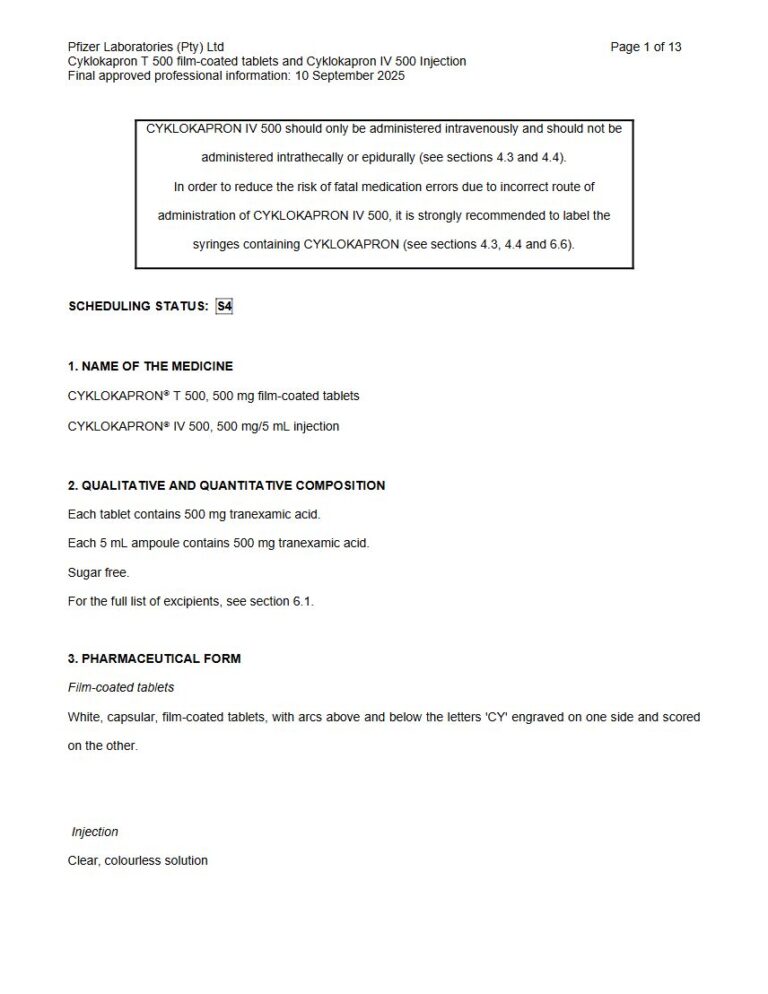
For the injection CYKLOKAPRON IV 500 should only be administered intravenously and should not be administered intrathecally or epidurally (see sections 4.3 and 4.4). In order to reduce the risk of fatal medication errors due to incorrect route of administration of CYKLOKAPRON IV 500, it is strongly recommended to label the syringes containing CYKLOKAPRON (see sections 4.3, 4.4 and 6.6).
CYKLOKAPRON solution for injection is administered intravenously by slow injection over a period of at least five minutes. For intravenous infusion, CYKLOKAPRON solution for injection may be mixed with electrolyte solutions, carbohydrate solutions, Aminosol and dextran solutions. Heparin solutions may be added to CYKLOKAPRON solution for injection.
4.3 Contraindications
u2022 Hypersensitivity to tranexamic acid or any of the excipients of CYKLOKAPRON (listed in section 6.1)
u2022 In cases of massive upper urinary tract haemorrhage, CYKLOKAPRON should be avoided to reduce the risk of ureteric obstruction
u2022 Patients with a pronounced thrombotic tendency or colour vision disorder should not be given CYKLOKAPRON
u2022 Thrombophlebitis
u2022 Impaired liver function
u2022 Subarachnoid bleeding
u2022 History of arterial or venous thromboembolism
u2022 Active intravascular clotting
u2022 Patients with hypercoagulopathies
u2022 Intrathecal, epidural, intraventricular injection and intracerebral application (risk of cerebral oedema, convulsions and death).
4.4 Special warnings and precautions for use
The indications and method of administration indicated above should be followed strictly:
u2022 Intravenous injections or infusions should be given very slowly (maximum 1 mL per minute).
u2022 CYKLOKAPRON IV 500 must not be administered by the intramuscular route.
Risk of medication errors due to incorrect route of administration
CYKLOKAPRON IV 500 is for intravenous use only. Intrathecal, epidural, intraventricular and intracerebral use of CYKLOKAPRON IV 500 is contraindicated (see section 4.3). Serious adverse reactions including fatal events have been reported when CYKLOKAPRON IV 500 was inadvertently administered intrathecally. These events have included severe back, gluteal and lower limb pain, myoclonus and generalised seizures, and cardiac arrhythmias.
Care should be exercised to ensure the correct route of administration of IV 500. Medical practitioners should be aware of the potential for confusion of CYKLOKAPRON IV 500 with other injectables which could result in inadvertent intrathecal administration of CYKLOKAPRON IV 500. This includes in particular intrathecally administered injectables that may be used during the same procedure as CYKLOKAPRON IV 500.
Syringes containing CYKLOKAPRON IV 500 should be clearly labelled with the intravenous route of administration.
Convulsions
Cases of convulsions have been reported in association with CYKLOKAPRON treatment. In coronary artery bypass graft (CABG) surgery, most of these cases were reported following IV injection of CYKLOKAPRON in high doses. With the use of the recommended lower doses of CYKLOKAPRON, the incidence of post-operative seizures was the same as that in untreated patients.
Patients with menorrhagia should not use CYKLOKAPRON until the cause of the menorrhagia has been established.
For patients in renal failure, CYKLOKAPRON should be given with caution because of the risk of accumulation.
Patients with a previous history of thromboembolic disease should not be given CYKLOKAPRON.
For patients who are to receive treatment with CYKLOKAPRON for longer than several days, an ophthalmological examination is advisable (including visual acuity, colour vision, eye-grounds, field of vision), before commencing treatment, and at regular intervals during treatment.
CYKLOKAPRON should be given with caution to patients on antifibrinolytic therapy.
Because of the absence of interaction studies, simultaneous treatment with anticoagulants must take place under the strict supervision of a medical practitioner experienced in this field.
4.5 Interaction with other medicines and other forms of interaction
No studies of interactions between CYKLOKAPRON and other medicines have been conducted.
4.6 Fertility, pregnancy and lactation
The safety of CYKLOKAPRON has not been established in pregnancy and lactation.
Breastfeeding
Women using CYKLOKAPRON should not breastfeed their infants. CYKLOKAPRON passes into breast milk.
4.7 Effects on ability to drive and use machines
CYKLOKAPRON may cause dizziness and may influence the ability to drive or use machines.
4.8 Undesirable effects
The frequency of side effects at a dose of 4 g /day.
Common (u2265 1/100 to < 1/10): Gastrointestinal disorders: Nausea, vomiting, diarrhoea
Uncommon (u2265 1/1 000 to < 1/100): Skin and subcutaneous tissue disorders: Allergic skin reactions
Rare (u2265 1/10 000 to < 1/1 000): Cardiovascular disorders: Thromboembolic events
Eye disorders: Transient disturbance or impairment of colour vision
Patients who experience disturbances of colour vision should be withdrawn from treatment.
Frequency not known (cannot be estimated from the available data): Immune system disorders: Hypersensitivity reactions including anaphylaxis
Nervous system disorders: Convulsions particularly in case of misuse (see section 4.4)
Cases of giddiness have been reported. Rapid intravenous injection may cause dizziness and/or hypotension.
Reporting of suspected adverse reactions
Reporting suspected adverse reactions after authorisation of the medicine is important. It allows continued monitoring of the benefit / risk balance of the medicine. Health care providers are requested to report any suspected adverse drug reactions to SAHPRA via the Med Safety APP (Medsafety X SAHPRA) and eReporting platform (who- umc.org) found on SAHPRA website. Report any suspected adverse drug reactions associated with the use of the medicine directly to Pfizer via [email protected] .
4.9 Overdose
Symptoms of overdosage: dizziness, headache, nausea, vomiting, diarrhoea and convulsions. It has been shown that convulsions tend to occur at higher frequency with increasing dose. Faintness and hypotension may occur. Activated charcoal therapy and symptomatic treatment. Maintain adequate diuresis with fluids.
