
Accord Vildagliptin 50mg Tablets
Clinical Summary
Quick overview from the medicine insert
Indication
Management of type 2 diabetes mellitus as an adjunct to diet and exercise.
Dosage (summary)
The recommended dose is 50 mg once daily, which may be taken with or without food.
Onset of Action / Duration
The onset of action is typically within 1-2 hours, with peak effects occurring around 1-2 hours post-dose.
Special Populations
- Elderly patients
- Patients with renal impairment
- Patients with hepatic impairment
Pregnancy & Breastfeeding
Use during pregnancy only if the potential benefit justifies the potential risk to the fetus. It is not recommended during lactation.
Key Drug Interactions
- May increase the risk of hypoglycemia when used with other antidiabetic agents.
- Caution is advised when used with medications that affect renal function.
Contraindications
- Hypersensitivity to Vildagliptin or any component of the formulation.
- Severe renal impairment (eGFR < 30 mL/min).
- Type 1 diabetes mellitus.
Common side effects
- Headache
- Nausea
- Diarrhea
- Hypoglycemia
- Pancreatitis
Counselling Points
- Advise patients to monitor blood glucose levels regularly.
- Inform patients about the signs and symptoms of hypoglycemia.
- Encourage adherence to diet and exercise recommendations.
Serious warnings
- Risk of pancreatitis; discontinue if pancreatitis is suspected.
- Monitor renal function periodically during treatment.
- Use with caution in patients with a history of heart failure.
Important Disclaimer
The Accord Vildagliptin 50mg Tablets professional information leaflet below is the property of Accord Healthcare and is provided on Medinsert exactly as issued, with no.. alterations or editorial changes. We make every effort to keep content current by updating documents as soon as new versions become available. Medinsert serves as a trusted access point for healthcare professionals, but does not replace official sources or clinical judgement. For more details, please read our full disclaimer. read more>>
 Healthcare Professionals Only
This content is for registered healthcare professionals
Sign in or create a free account to read the full package insert.
Free for HPCSA-registered professionals. Powered by Medinsert.
Clinical Particulars
Section 4 of the official insert — extracted exactly as issued, no alterations
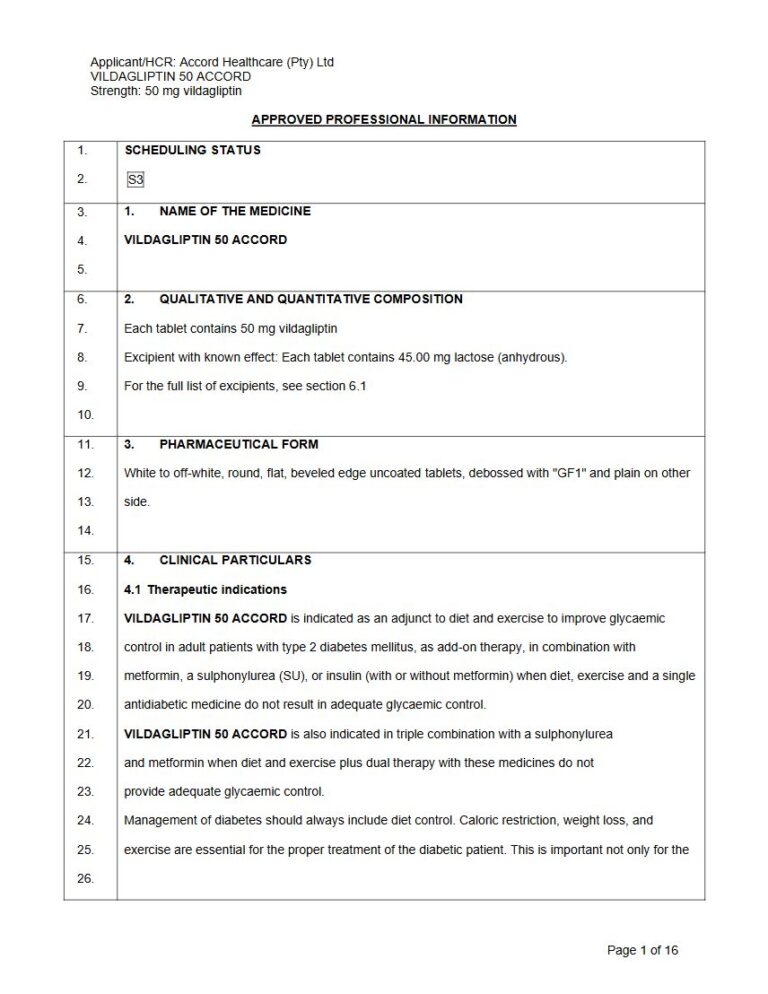
4.1 Therapeutic indications
VILDAGLIPTIN 50 ACCORD is indicated as an adjunct to diet and exercise to improve glycaemic control in adult patients with type 2 diabetes mellitus, as add-on therapy, in combination with metformin, a sulphonylurea (SU), or insulin (with or without metformin) when diet, exercise and a single antidiabetic medicine do not result in adequate glycaemic control. VILDAGLIPTIN 50 ACCORD is also indicated in triple combination with a sulphonylurea and metformin when diet and exercise plus dual therapy with these medicines do not provide adequate glycaemic control. Management of diabetes should always include diet control. Caloric restriction, weight loss, and exercise are essential for the proper treatment of the diabetic patient. This is important not only for the primary treatment of diabetes, but also as an adjunct to medicinal therapy.
4.2 Posology and method of administration
Posology
The management of antidiabetic therapy should be individualised. The recommended dose of VILDAGLIPTIN 50 ACCORD is 50 mg a day or 50 mg twice a day in combination with metformin or insulin (with or without metformin). The recommended dose of VILDAGLIPTIN 50 ACCORD is 50 mg twice a day for triple combination with metformin and a sulphonylurea. When used in combination with a sulphonylurea, the recommended dose of VILDAGLIPTIN 50 ACCORD is 50 mg once daily administered in the morning. In this patient population, vildagliptin 100 mg daily was no more effective than vildagliptin 50 mg once daily.
Special populations
Patients with renal impairment: In patients with moderate or severe renal impairment or with End Stage Renal Disease (ESRD) on haemodialysis, the recommended dose of VILDAGLIPTIN 50 ACCORD is 50 mg once daily (see section 5.2). The maximum dose should be 50 mg in patients with mild renal impairment.
Elderly patients: In patients treated with VILDAGLIPTIN 50 ACCORD u2265 65 years of age and u2265 75 years of age no differences were observed in the overall safety, tolerability, or efficacy between this elderly population and younger patients. No dosage adjustments are therefore necessary in the elderly patients without renal impairment (see section 5.2).
Paediatric population: VILDAGLIPTIN 50 ACCORD has not been studied in patients under 18 years of age; therefore, the use VILDAGLIPTIN 50 ACCORD in paediatric patients is not recommended (see section 5.2).
Method of administration
For oral use.
4.3 Contraindications
- VILDAGLIPTIN 50 ACCORD is contraindicated in patients with known hypersensitivity to vildagliptin or to any of the excipients of VILDAGLIPTIN 50 ACCORD.
- VILDAGLIPTIN 50 ACCORD is contraindicated in patients with hepatic impairment, including patients with a pre-treatment ALT or AST > 2,5 X the upper limit of normal.
4.4 Special warnings and precautions for use
General
VILDAGLIPTIN 50 ACCORD is not a substitute for insulin in insulin-requiring patients. VILDAGLIPTIN 50 ACCORD should not be used in patients with type 1 diabetes or for the treatment of diabetic ketoacidosis.
Renal impairment
There is limited experience in patients with ESRD on haemodialysis. Therefore, VILDAGLIPTIN 50 ACCORD should be used with caution in these patients (see sections 4.2, 5.1 and 5.2).
Hepatic impairment
VILDAGLIPTIN 50 ACCORD should not be used in patients with hepatic impairment, including patients with pre-treatment ALT or AST > 3 x ULN (see sections 4.2 and 5.2).
Liver enzyme monitoring
Cases of hepatic dysfunction (including hepatitis) have been reported. In these cases, the patients were generally asymptomatic without clinical sequelae and liver function test results returned to normal after discontinuation of treatment. Liver function tests should be performed prior to the initiation of treatment with VILDAGLIPTIN 50 ACCORD in order to know the patient's baseline value. Liver function should be monitored during treatment with VILDAGLIPTIN 50 ACCORD at three-month intervals during the first year and periodically thereafter. Patients who develop increased transaminase levels should be monitored with a second liver function evaluation to confirm the finding and be followed thereafter with frequent liver function tests until the abnormality(ies) return(s) to normal. Should an increase in AST or ALT of 3 x ULN or greater persist, withdrawal of VILDAGLIPTIN 50 ACCORD therapy is recommended. Patients who develop jaundice or other signs suggestive of liver dysfunction should discontinue VILDAGLIPTIN 50 ACCORD. Following withdrawal of treatment with VILDAGLIPTIN 50 ACCORD and LFT normalization, treatment with VILDAGLIPTIN 50 ACCORD should not be reinitiated.
Cardiac failure
Vildagliptin is not recommended in patients with New York Heart Association (NYHA) Class III. Rates of reported cardiac adverse events were higher in patients with NYHA functional class III treated with vildagliptin than with placebo. There is no experience of vildagliptin use in clinical trials in patients with NYHA functional class IV and therefore use is not recommended in these patients.
Skin disorders
Skin lesions, including blistering and ulceration have been reported in extremities of monkeys in non-clinical toxicology studies. Although skin lesions were not observed at an increased incidence in clinical trials, there was limited experience in patients with diabetic skin complications. Furthermore, there have been post-marketing reports of bullous and exfoliative skin lesions. Therefore, in keeping with routine care of the diabetic patient, monitoring for skin disorders, such as blistering or ulceration, is recommended.
Acute pancreatitis
Use of vildagliptin has been associated with a risk of developing acute pancreatitis. Patients should be informed of the characteristic symptom of acute pancreatitis. If pancreatitis is suspected, VILDAGLIPTIN 50 ACCORD should be discontinued; if acute pancreatitis is confirmed, VILDAGLIPTIN 50 ACCORD should not be restarted. Caution should be exercised in patients with a history of acute pancreatitis.
Hypoglycaemia
Sulphonylureas are known to cause hypoglycaemia. Patients receiving vildagliptin in combination with a sulphonylurea may be at risk for hypoglycaemia. Therefore, a lower dose of sulphonylurea may be considered to reduce the risk of hypoglycaemia.
Excipients
The tablets contain lactose. Patients with rare hereditary problems of galactose intolerance, total lactase deficiency or glucose-galactose malabsorption should not take VILDAGLIPTIN 50 ACCORD.
4.5 Interaction with other medicinal products and other forms of interaction
Vildagliptin has a low potential for interactions with co-administered medicinal products. Since vildagliptin is not a cytochrome P (CYP) 450 enzyme substrate and does not inhibit or induce CYP 450 enzymes, it is not likely to interact with active substances that are substrates, inhibitors or inducers of these enzymes.
Combination with pioglitazone, metformin and glyburide
Results from studies conducted with these oral antidiabetics have shown no clinically relevant pharmacokinetic interactions.
Digoxin (Pgp substrate), warfarin (CYP2C9 substrate)
Clinical studies performed with healthy subjects have shown no clinically relevant pharmacokinetic interactions. However, this has not been established in the target population.
Combination with amlodipine, ramipril, valsartan or simvastatin
Interaction studies in healthy subjects were conducted with amlodipine, ramipril, valsartan and simvastatin. In these studies, no clinically relevant pharmacokinetic interactions were observed after co-administration with vildagliptin.
Combination with ACE-inhibitors
There may be an increased risk of angioedema in patients concomitantly taking ACE-inhibitors (see section 4.8). The hypoglycaemic effect of vildagliptin may be reduced by certain active substances, including thiazides, corticosteroids, thyroid medicines and sympathomimetics.
4.6 Fertility, pregnancy and lactation
Pregnancy
There are no adequate data from the use of vildagliptin in pregnant women. Studies in animals have shown reproductive toxicity at high doses. The potential risk for humans is unknown. Due to lack of human data, VILDAGLIPTIN 50 ACCORD should not be used during pregnancy.
Breast-feeding
It is unknown whether vildagliptin is excreted in human milk. Animal studies have shown excretion of vildagliptin in milk. VILDAGLIPTIN 50 ACCORD should not be used during breast-feeding.
Fertility
No studies on the effect on human fertility have been conducted for VILDAGLIPTIN 50 ACCORD.
4.7 Effects on ability to drive and use machines
VILDAGLIPTIN 50 ACCORD may cause dizziness. Patients who experience dizziness as an adverse reaction should avoid driving vehicles or using machines.
4.8 Undesirable effects
Cases of angioedema have been reported during treatment with vildagliptin. Cases of hepatic dysfunction (including hepatitis) have been reported. Table 1: Adverse reactions reported in patients who received VILDAGLIPTIN 50 ACCORD as add-on therapy, by system organ class and absolute frequency.
4.9 Overdose
Information regarding overdose with vildagliptin is limited.
Symptoms: Muscle pain, paraesthesia, fever and oedema have been reported. Increases in lipase levels (2 x ULN), creatine phosphokinase (CPK) levels, accompanied by elevations of aspartate aminotransferase (AST), C-reactive protein, and myoglobin may develop.
Management:
In the event of an overdose, supportive management is recommended. Vildagliptin cannot be removed by haemodialysis. However, the major hydrolysis metabolite (LAY 151) can be removed by haemodialysis.
