
Adco-Lamivudine 150 mg Tablets
Clinical Summary
Quick overview from the medicine insert
Indication
Treatment of HIV-1 infection in combination with other antiretroviral agents.
Dosage (summary)
The recommended dose for adults and children over 14 years is 150 mg once daily. For children aged 3 months to 14 years, the dose is based on body weight.
Onset of Action / Duration
Onset of action is typically within 1-2 weeks, with maximum effect observed after several weeks of therapy.
Special Populations
- Renal impairment
- Hepatic impairment
- Elderly patients
Pregnancy & Breastfeeding
Lamivudine is classified as Category C. It should be used during pregnancy only if the potential benefit justifies the potential risk to the fetus. It is excreted in breast milk; caution should be exercised when administered to nursing mothers.
Key Drug Interactions
- Zidovudine may increase the risk of hematologic toxicity when used with Lamivudine.
- Concurrent use with other antiretroviral agents may require dosage adjustments.
Contraindications
- Hypersensitivity to Lamivudine or any component of the formulation.
- Severe hepatic impairment.
Common side effects
- Headache
- Nausea
- Fatigue
- Diarrhea
- Liver enzyme elevation
- Pancreatitis
Counselling Points
- Advise patients to take the medication exactly as prescribed.
- Inform patients about the importance of adherence to therapy to prevent resistance.
- Encourage patients to report any signs of liver problems, such as jaundice or dark urine.
Serious warnings
- Risk of lactic acidosis, especially in patients with liver disease.
- Monitor for signs of pancreatitis.
- Caution in patients with a history of hepatitis B virus infection.
Important Disclaimer
The Adco-Lamivudine 150 mg Tablets professional information leaflet below is the property of Adcock Ingram and is provided on Medinsert exactly as issued, with no.. alterations or editorial changes. We make every effort to keep content current by updating documents as soon as new versions become available. Medinsert serves as a trusted access point for healthcare professionals, but does not replace official sources or clinical judgement. For more details, please read our full disclaimer. read more>>
 Healthcare Professionals Only
This content is for registered healthcare professionals
Sign in or create a free account to read the full package insert.
Free for HPCSA-registered professionals. Powered by Medinsert.
Clinical Particulars
Section 4 of the official insert — extracted exactly as issued, no alterations
4.1 Therapeutic indications
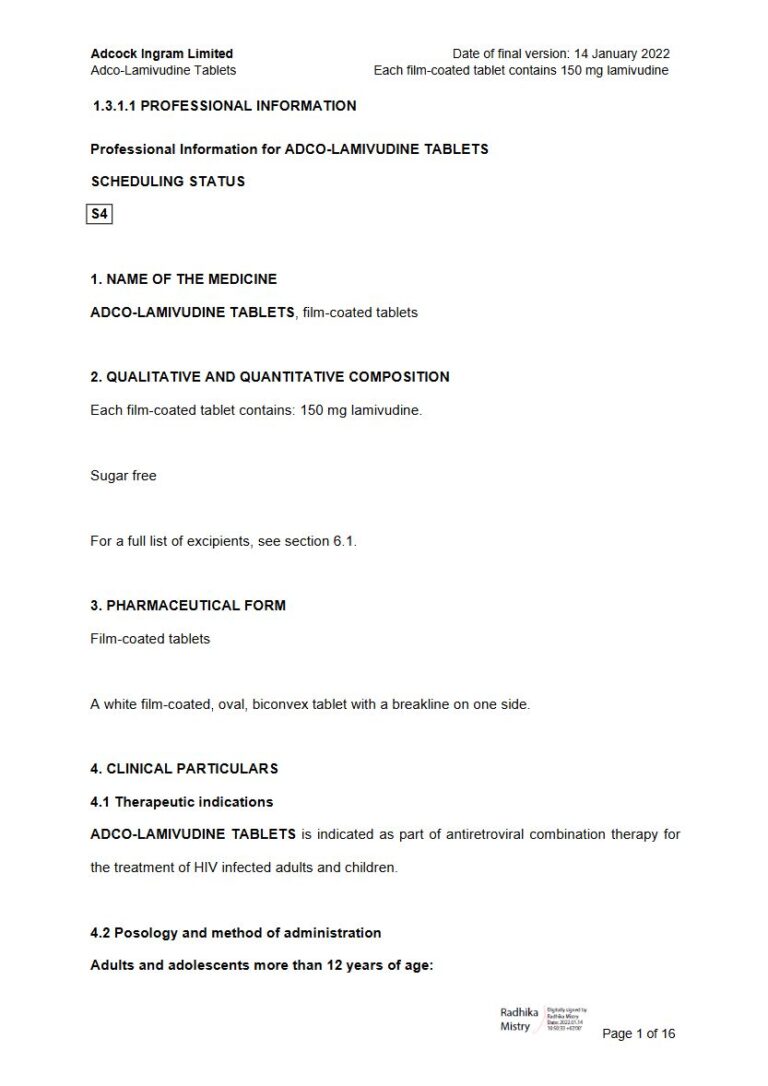
ADCO-LAMIVUDINE TABLETS is indicated as part of antiretroviral combination therapy for the treatment of HIV infected adults and children.
4.2 Posology and method of administration
Adults and adolescents more than 12 years of age:
The recommended dose of ADCO-LAMIVUDINE TABLETS is 300 mg daily. This may be administered as either 300 mg once daily or 150 mg twice daily. The professional information for zidovudine must be consulted for information on its dosage and administration. For patients with low body weights (less than 50 kg), the recommended oral dose of ADCO-LAMIVUDINE TABLETS is 2 mg/kg twice daily.
Children u2265 3 months to 12 years of age: The recommended dose is 4 mg/kg twice daily up to a maximum of 300 mg daily.
Children < 3 months of age: There are limited data to propose specific dosage recommendations (see section 5.2). ADCO-LAMIVUDINE TABLETS can be taken with or without food.
Renal and Hepatic Impairment:
Renal impairment, whether disease- or age-related, affects lamivudine elimination. For recommended dosage regimens in patients with a creatinine clearance below 50 ml/min see table below.
Adults and adolescents > 12 years of age:
Creatinine Clearance (ml/min) Recommended dose of ADCO-LAMIVUDINE TABLETS
u2265 50 150 mg twice daily
30 u2013 49 150 mg once daily
15 u2013 29 150 mg first dose, then 100 mg once daily
5 u2013 14 150 mg first dose, then 50 mg once daily
< 5 50 mg first dose, then 25 mg once daily
Children > 3 months to 12 years:
Creatinine Clearance (ml/min) Recommended dose of ADCO-LAMIVUDINE TABLETS
u2265 50 4 mg/kg first dose, then 4 mg/kg twice daily
30 u2013 49 4 mg/kg first dose, then 4 mg/kg once daily
15 u2013 29 4 mg/kg first dose, then 2.6 mg/kg once daily
5 u2013 14 4 mg/kg first dose, then 1.3 mg/kg once daily
< 5 1.3 mg/kg first dose, then 0.7 mg/kg once daily
4.3 Contraindications
Hypersensitivity to lamivudine or to any of the components listed in section 6.1.
4.4 Special warnings and precautions for use
Lipodystrophy and metabolic abnormalities
Combination antiretroviral therapy has been associated with the redistribution/accumulation of body fat, including central obesity, dorso-cervical fat, enlargement (buffalo hump), peripheral wasting, facial wasting, breast enlargement, and elevated serum lipid and glucose levels in HIV patients. Clinical examination should include evaluation for physical signs of fat redistribution. Patients with evidence of lipodystrophy should have a thorough cardiovascular risk assessment.
Immune Reconstitution Inflammatory Syndrome
Immune reconstitution inflammatory syndrome (IRIS) is an immunopathological response resulting from the rapid restoration of pathogen-specific immune responses to pre-existing antigens combined with immune dysregulation, which occurs shortly after starting combination Anti-Retroviral Therapy (cART). Typically such reaction presents by paradoxical deterioration of opportunistic infections being treated or with unmasking of an asymptomatic opportunistic disease, often with an atypical inflammatory presentation. IRIS usually develops within the first three months of initiation of ART and occurs more commonly in patients with low CD4 counts. Common examples of IRIS reactions to opportunistic diseases are tuberculosis, cytomegalovirus retinitis, and cryptococcal meningitis. Appropriate treatment of the opportunistic disease should be instituted or continued and ART continued. Inflammatory manifestations generally subside after a few weeks. Severe cases may respond to glucocorticoids, but there is only limited evidence for this in patients with tuberculosis IRIS.
Osteonecrosis
Although the aetiology is considered to be multifactorial (including corticosteroid use, alcohol consumption, severe immunosuppression, higher body mass index), cases of osteonecrosis have been reported, particularly in patients with advanced HIV-disease and/or long-term exposure to combination antiretroviral therapy (cART). Patients should be advised to seek medical advice if they experience joint aches and pain, joint stiffness or difficulty in movement.
Opportunistic infections
Patients receiving ADCO-LAMIVUDINE TABLETS and other antiretroviral agents may continue to develop opportunistic infections and other complications of HIV infection. Patients should therefore remain under close observation by healthcare professionals experienced in the treatment of patients with HIV-associated diseases. Regular monitoring of viral load and CD4 counts needs to be done.
The risk of HIV transmission to others
Patients should be advised that current antiretroviral therapy, including ADCO-LAMIVUDINE TABLETS, does not prevent the risk of transmission of HIV to others through sexual contact or blood contamination. Appropriate precautions should continue to be employed.
Lactic acidosis/ hyperlactataemia
Use of ADCO-LAMIVUDINE TABLETS can result in potentially fatal lactic acidosis as a consequence of mitochondrial dysfunction. Clinical features are non-specific, and include nausea, vomiting, abdominal pain, dyspnoea, fatigue and weight loss. In patients with suspicious symptoms or biochemistry, measure the venous lactate level (normal < 2 mmol/L) and the serum bicarbonate, and respond as follows:
u2022 Lactate 2 to 5 mmol/L with minimum symptoms: switch to agents that are less likely to cause lactic acidosis.
u2022 Lactate 5 to 10 mmol/L with symptoms and/or with reduced standard bicarbonate: Stop NRTIs and change treatment option. Once lactate has settled, use medicines that are less likely to cause lactic acidosis. Exclude other causes (e.g. sepsis, uraemia, diabetic ketoacidosis, thyrotoxicosis and hyperthyroidism).
u2022 Lactate > 10 mmol/L: STOP all therapy (80 % mortality).
The above lactate values may not be applicable to paediatric patients. Caution should be exercised when administering ADCO-LAMIVUDINE TABLETS to patients with known risk factors for liver disease. Treatment with ADCO-LAMIVUDINE TABLETS should be suspended in any patient who develops clinical or laboratory findings suggestive of lactic acidosis or hepatotoxicity.
Mitochondrial dysfunction
Nucleoside and nucleotide analogues have been demonstrated in vitro and in vivo to cause a variable degree of mitochondrial damage. There have been reports of mitochondrial dysfunction in HIV negative infants exposed in utero and/or post-natally to nucleoside analogues. Apart from lactic acidosis/hyperlactataemia (see above) other manifestations of mitochondrial dysfunction include haematological disorders (anaemia, neutropenia), and peripheral neuropathy. Some late-onset neurological disorders have been reported (hypertonia, convulsion, abnormal behaviour). It is not known whether the neurological disorders are transient or permanent. Any foetus exposed in utero to nucleoside and nucleotide analogues, even HIV negative infants/children, should have clinical and laboratory follow-up and should be fully investigated for possible mitochondrial dysfunction in case of relevant sign and symptoms.
Pancreatitis
Pancreatitis has been observed in some patients receiving ADCO-LAMIVUDINE TABLETS. Pancreatitis must be considered whenever a patient develops abdominal pain, nausea, vomiting or elevated biochemical markers. Discontinue use of ADCO-LAMIVUDINE TABLETS until diagnosis of pancreatitis is excluded.
Patients with moderate to severe renal impairment
In patients with moderate to severe renal impairment, the terminal half-life of ADCO-LAMIVUDINE TABLETS is increased due to decreased clearance. The dose of ADCO-LAMIVUDINE TABLETS should therefore be adjusted (see section 4.2).
Liver disease
Use of ADCO-LAMIVUDINE TABLETS can result in hepatomegaly due to non-alcoholic fatty liver disease (hepatic steatosis). The safety and efficacy of ADCO-LAMIVUDINE TABLETS has not been established in patients with significant underlying liver disorders/diseases. In case of concomitant antiviral therapy for hepatitis B or C, please also consult the relevant professional information for these medicines. Patients with pre-existing liver dysfunction including chronic active hepatitis have an increased frequency of liver function abnormalities during combination antiretroviral therapy and should be monitored. If there is evidence of worsening liver disease in such patients, temporary or permanent discontinuation of treatment must be considered.
Patients with HIV and hepatitis B or C virus co-infection
Patients with chronic hepatitis B or C and treated with antiretroviral therapy are at an increased risk for severe and potentially fatal hepatic adverse reactions. Medical practitioners should refer to current HIV treatment guidelines for the optimal management of HIV infection in patients co-infected with hepatitis B virus (HBV). In case of concomitant antiviral therapy for hepatitis B or C, please refer also to the relevant professional information for these medicines.
Patients co-infected with HIV and HBV who discontinue ADCO-LAMIVUDINE TABLETS should be closely monitored with both clinical and laboratory follow-up after stopping treatment. In patients with advanced liver disease or cirrhosis, treatment discontinuation is not recommended since post-treatment exacerbation of hepatitis may lead to hepatic decompensation. Discontinuation of ADCO-LAMIVUDINE TABLETS therapy in patients co-infected with HIV and HBV may be associated with severe, acute exacerbations of hepatitis.
4.5 Interaction with other medicines and other forms of interaction
Zidovudine plasma levels are not significantly altered when co-administered with ADCO-LAMIVUDINE TABLETS (see section 5.2). An interaction with trimethoprim, a constituent of co-trimoxazole, causes a 40 % increase in lamivudine plasma concentrations at therapeutic doses. This does not require dose adjustment unless the patient also has renal impairment. Administration of co-trimoxazole with the ADCO-LAMIVUDINE TABLETS/zidovudine combination in patients with renal impairment should be carefully assessed. ADCO-LAMIVUDINE TABLETS may inhibit the intracellular phosphorylation of zalcitabine when the two medicinal products are used concurrently. Use of ADCO-LAMIVUDINE TABLETS in combination with zalcitabine is therefore not recommended. Due to similarities, ADCO-LAMIVUDINE TABLETS should not be administered concomitantly with other cytidine analogues, such as emtricitabine.
In vitro lamivudine inhibits the intracellular phosphorylation of cladribine leading to a potential risk of cladribine loss of efficacy in case of combination in the clinical setting. Some clinical findings also support a possible interaction between lamivudine and cladribine. Therefore, the concomitant use of lamivudine with cladribine is not recommended. Coadministration of sorbitol solution (3.2 g, 10.2 g, 13.4 g) with a single 300 mg dose of lamivudine oral solution resulted in dose-dependent decreases of 14 %, 32 %, and 36 % in lamivudine exposure (AUCu221e) and 28 %, 52 %, and 55 % in the C max of lamivudine in adults. When possible, avoid chronic coadministration of ADCO-LAMIVUDINE TABLETS with medicinal products containing sorbitol or other osmotic acting poly-alcohols or monosaccharide alcohols (e.g. xylitol, mannitol, lactitol, maltitol). Consider more frequent monitoring of HIV-1 viral load when chronic coadministration cannot be avoided.
4.6 Fertility, pregnancy and lactation
Pregnancy
As a general rule, when deciding to use antiretroviral agents for the treatment of HIV infection in pregnant women and consequently for reducing the risk of HIV vertical transmission to the newborn, the animal data as well as the clinical experience in pregnant women should be taken into account. Animal studies with lamivudine showed an increase in early embryonic deaths in rabbits but not in rats. Placental transfer of lamivudine has been shown to occur in humans.
More than 1000 outcomes from first trimester and more than 1000 outcomes from second and third trimester exposure in pregnant women indicate no malformative and foeto/neonatal effect. Lamivudine can be used during pregnancy if clinically needed. The malformative risk is unlikely in humans based on those data. For patients co-infected with hepatitis who are being treated with lamivudine and subsequently become pregnant, consideration should be given to the possibility of a recurrence of hepatitis on discontinuation of lamivudine.
Mitochondrial dysfunction: Nucleoside and nucleotide analogues have been demonstrated in vitro and in vivo to cause a variable degree of mitochondrial damage. There have been reports of mitochondrial dysfunction in infants exposed in utero and/or post-natally to nucleoside analogues (see section 4.4).
Breastfeeding
Following oral administration lamivudine was excreted in breast milk at similar concentrations to those found in serum. Based on more than 200 mother/child pairs treated for HIV, serum concentrations of lamivudine in breastfed infants of mothers treated for HIV are very low (< 4 % of maternal serum concentrations) and progressively decrease to undetectable levels when breastfed infants reach 24 weeks of age. There are no data available on the safety of lamivudine when administered to babies less than three months old. It is recommended that HIV infected women do not breastfeed their infants under any circumstances in order to avoid transmission of HIV.
Fertility
Studies in animals showed that lamivudine had no effect on fertility.
4.7 Effects on ability to drive and use machines
No data available.
4.8 Undesirable effects
The following side effects have been reported during therapy of HIV disease with ADCO-LAMIVUDINE TABLETS alone, and in combination with other anti-retrovirals.
System Organ Class Frequency Side effects
Blood and lymphatic system disorders Less frequent Neutropenia, thrombocytopenia, anaemia, pure red cell aplasia.
Metabolism and nutrition disorders Less frequent Lactic acidosis.
Nervous system disorders Frequent Peripheral neuropathy, paraesthesia, headache, insomnia.
Respiratory, thoracic and mediastinal disorders Frequent Cough, nasal symptoms
Gastrointestinal disorders Frequent Upper abdominal pain or cramps, nausea, vomiting and diarrhoea and pancreatitis.
Frequency unknown Rises in serum amylase
Hepato-biliary disorders Less frequent Hepatitis.
Frequency unknown Transient rises in serum liver enzymes (AST, ALT)
Frequent Skin rash.
Skin and subcutaneous tissue disorders Less frequent Angioedema.
Frequency unknown Alopecia.
Musculoskeletal and connective tissue disorders Frequent Arthralgia and muscle disorders.
Frequency unknown Rhabdomyolysis.
General disorders and administration site conditions Frequent Malaise, fatigue and fever.
Reporting of suspected adverse reactions
Reporting suspected adverse reactions after authorisation of the medicine is important. It allows continued monitoring of the benefit/risk balance of the medicine. Healthcare providers are asked to report any suspected adverse reactions to SAHPRA via the u201c6.04 Adverse Drug Reactions Reporting Formu201d, found online under SAHPRAu2019s publications: https://www.sahpra.org.za/Publications/Index/8
4.9 Overdose
Treatment is symptomatic and supportive.
