
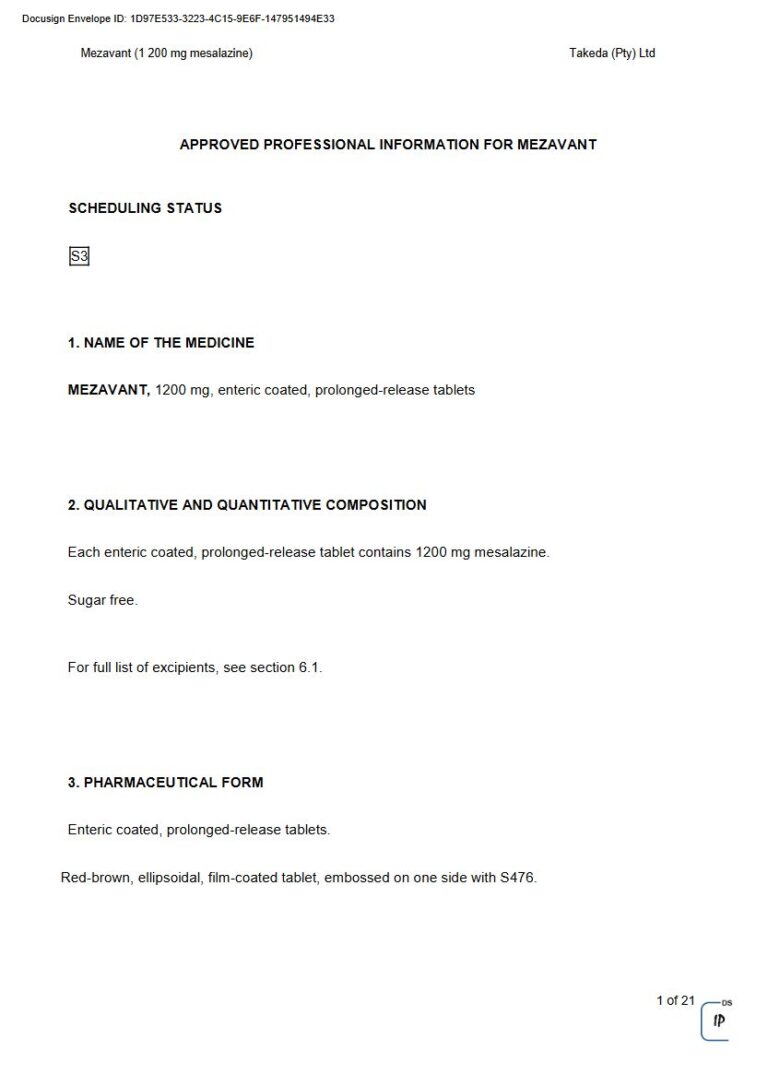
Mezavant 1200 mg FC tablet
PDF Leaflet Revision Date: 16 May 2025
Clinical Summary
Quick overview from the medicine insert
Indication
Treatment and maintenance of remission in ulcerative colitis.
Dosage (summary)
Adults: 2.4 to 4.8 g once daily for induction; 2.4 g once daily for maintenance.
Special Populations
- Elderly
- Hepatic impairment
- Renal impairment
Pregnancy & Breastfeeding
Not recommended during pregnancy or breastfeeding due to potential risks.
Key Drug Interactions
- NSAIDs
- Azathioprine
- Warfarin
Contraindications
- Hypersensitivity to salicylates
- Severe renal impairment
- Severe hepatic impairment
Common side effects
- Colitis
- Abdominal pain
- Headache
- Diarrhoea
- Nausea
Counselling Points
- Swallow tablets whole
- Monitor for renal function
- Report unexplained bleeding or bruising
Serious warnings
- Renal impairment risk
- Severe cutaneous adverse reactions
- Cardiac hypersensitivity reactions
Important Disclaimer
The Mezavant 1200 mg FC tablet professional information leaflet below is the property of Takeda and is provided on Medinsert exactly as issued, with no.. alterations or editorial changes. We make every effort to keep content current by updating documents as soon as new versions become available. Medinsert serves as a trusted access point for healthcare professionals, but does not replace official sources or clinical judgement. For more details, please read our full disclaimer. read more>>
 Healthcare Professionals Only
This content is for registered healthcare professionals
Sign in or create a free account to read the full package insert.
Free for HPCSA-registered professionals. Powered by Medinsert.
Clinical Particulars
Section 4 of the official insert — extracted exactly as issued, no alterations
4.1 Therapeutic indications
MEZAVANT is indicated for the treatment and maintenance of remission in ulcerative colitis.
4.2 Posology and method of administration
Posology
Method of Administration
MEZAVANT is intended for once daily, oral administration. The tablets should be swallowed whole with or without food and should not be crushed or chewed.
Adults, including the elderly (> 65 years)
For induction of remission: 2,4 to 4,8 g (two to four tablets) should be taken once daily. The highest dose of 4,8 g/day is recommended for patients not responding to lower doses of MEZAVANT. When using the highest dose (4,8 g/day), the effect of the treatment should be evaluated at 8 weeks.
For maintenance of remission: 2,4 g (two tablets) should be taken once daily.
Special populations
Hepatic or renal impairment
Specific studies have not been performed to investigate MEZAVANT in patients with hepatic or renal impairment (see section 4.3 and section 4.4).
Paediatric population
MEZAVANT is not recommended for use in children below the age of 18 years due to a lack of data on safety and efficacy.
4.3 Contraindications
- History of hypersensitivity to salicylates (including mesalazine) or any of the excipients of MEZAVANT.
- Severe renal impairment (GFR < 30 mL/min/1,73 m2) and/or severe hepatic impairment.
4.4 Special warnings and precautions for use
- Use in the elderly should be cautious and subject to patients having a normal renal function.
- Reports of renal impairment, including minimal change nephropathy, and acute/chronic interstitial nephritis have been associated with MEZAVANT. MEZAVANT should be used with caution in patients with confirmed mild to moderate renal impairment. It is recommended that all patients have an evaluation of renal function prior to initiation of therapy and at least twice a year, whilst on treatment.
- Patients with chronic lung function impairment, especially asthma, are at risk of hypersensitivity reactions and should be closely monitored.
- Following MEZAVANT treatment, serious blood dyscrasias have been reported. If the patient develops unexplained bleeding, bruising, purpura, anaemia, fever or sore throat, haematological investigations should be performed. If there is suspicion of blood dyscrasia, treatment should be terminated.
- MEZAVANT induced cardiac hypersensitivity reactions (myo- and pericarditis) have been reported. Caution should be used in prescribing MEZAVANT to patients with conditions predisposing to the development of myo- or pericarditis. If such hypersensitivity reaction is suspected, MEZAVANT must not be reintroduced.
- Severe cutaneous adverse reactions (SCARs), including Drug reaction with eosinophilia and systemic symptoms (DRESS), Stevens-Johnson syndrome (SJS) and toxic epidermal necrolysis (TEN), have been reported in association with MEZAVANT treatment. MEZAVANT should be discontinued, at the first appearance of signs and symptoms of severe skin reactions, such as skin rash, mucosal lesions, or any other sign of hypersensitivity.
- MEZAVANT has been associated with an acute intolerance syndrome that may be difficult to distinguish from a flare of inflammatory bowel disease. Although the exact frequency of occurrence has not been determined, it has occurred in 3% of patients in controlled clinical trials of mesalazine or sulphasalazine. Symptoms include cramping, acute abdominal pain and bloody diarrhoea, sometimes fever, headache and rash. If acute intolerance syndrome is suspected, prompt withdrawal is required and MEZAVANT must not be reintroduced.
- There have been reports of increased liver enzyme levels in patients taking preparations containing mesalazine such as MEZAVANT. Caution is recommended if MEZAVANT is administered to patients with hepatic impairment.
- Caution should be exercised when treating patients allergic to sulphasalazine due to the potential risk of cross sensitivity reactions between sulphasalazine and mesalazine.
- Organic or functional obstruction in the upper gastrointestinal tract may delay onset of action of MEZAVANT.
- Cases of nephrolithiasis have been reported with the use of mesalazine, including stones with a 100% mesalazine content. Ensure adequate fluid intake during treatment.
4.5 Interactions with other medicines and other forms of interaction
The following drug interactions have been reported for medicines containing mesalazine:
- Caution is recommended for the concomitant use of mesalazine with known nephrotoxic agents, including non-steroidal anti-inflammatory drugs (NSAIDs) and azathioprine as these may increase the risk of renal adverse reactions.
- Administration with coumarin-type anticoagulants e.g., warfarin, could result in decreased anticoagulant activity. Prothrombin time should be closely monitored if this combination is essential.
- Mesalazine inhibits thiopurine methyltransferase. In patients receiving azathioprine or 6-mercaptopurine, and/or any other medicines known to cause myelotoxicity, concurrent use of mesalazine can increase the potential for blood dyscrasias, bone marrow failure and associated complications.
4.6 Fertility, pregnancy and lactation
Pregnancy
Safety in pregnancy and lactation has not been established. Mesalazine is known to cross the placental barrier. Congenital malformations and other adverse outcomes (including one event of hydrops foetalis and foetal anaemia in one infant) were reported in infants born to mothers who were exposed to mesalazine during pregnancy.
Breast-feeding
Low concentrations of mesalazine and higher concentrations of its N-acetyl metabolite have been detected in human breast milk. Acute diarrhoea has been reported in breast-fed infants of mothers exposed to mesalazine. MEZAVANT is not recommended for mothers breast-feeding their infants.
Fertility
Data on MEZAVANT shows no sustained effect on male fertility.
4.7 Effects on ability to drive and use machines
No currently available data suggest that MEZAVANT affects the ability to drive or operate machinery.
4.8 Undesirable effects
a. Summary of the safety profile
The most frequently reported adverse drug reactions (ADRs) within the pooled safety analysis of clinical studies with Mezavant, including 3,611 patients, were colitis (including ulcerative colitis) 5,8 %, abdominal pain 4,9 %, headache 4,5 %, liver function test abnormal, 2,1 %, diarrhoea 2,0 %, and nausea 1,9 %.
Adverse reactions are listed by System Organ Class (see table below). Within each system organ class, adverse reactions are listed under headings of frequency using the categories: very common (u2265 1/10); common (u22651/100 to <1/10); uncommon (u2265 1/1,000 to <1/100); rare (u2265 1/10,000 to <1/1,000); not known (cannot be estimated from the available data).
b. Tabulated summary of adverse reactions
Adverse Drug Reactions (ADRs) Associated with Mezavant
| System/Organ Class | Incidence Category | Adverse drug reaction |
|---|---|---|
| Blood and lymphatic system disorders | Uncommon | Thrombocytopenia* |
| Rare | Agranulocytosis* | |
| Not known | Aplastic anaemia*, Leukopenia*, Neutropenia*, Pancytopenia* | |
| Immune system disorders | Uncommon | Face oedema |
| Not known | Hypersensitivity*, Anaphylactic shock, Angioedema | |
| Nervous system disorders | Common | Headache* |
| Uncommon | Dizziness, Somnolence, Tremor | |
| Not known | Intracranial pressure increased, neuropathy | |
| Ear and labyrinth disorders | Uncommon | Ear pain |
| Cardiac disorders | Uncommon | Tachycardia |
| Not known | Myocarditis*, Pericarditis* | |
| Vascular disorders | Common | Hypertension |
| Uncommon | Hypotension | |
| Respiratory, thoracic and mediastinal disorders | Uncommon | Pharyngolaryngeal pain* |
| Not known | Hypersensitivity pneumonitis (including interstitial Pneumonitis, allergic alveolitis, eosinophilic pneumonitis), Bronchospasm | |
| Gastrointestinal disorders | Common | Abdominal distension, Abdominal pain*, Colitis, Diarrhoea*, Dyspepsia, Vomiting, Flatulence, Nausea |
| Uncommon | Pancreatitis, Rectal polyp | |
| Hepatobiliary disorders | Common | Liver Function Test abnormal* (e.g., ALT; AST, Bilirubin) |
| Not known | Hepatitis, Hepatotoxicity, Cholelithiasis | |
| Skin and subcutaneous tissue disorders | Common | Pruritus, Rash* |
| Uncommon | Acne, Alopecia, Urticaria | |
| Rare | Photosensitivity | |
| Not known | Stevens-Johnson syndrome (SJS)*, toxic epidermal necrolysis (TEN)*, drug reaction with eosinophilia and systemic symptoms (DRESS) | |
| Musculoskeletal and connective tissue disorders | Common | Arthralgia, Back pain |
| Uncommon | Myalgia | |
| Not known | Systemic-lupus erythematosus-like syndrome, Lupus-like syndrome | |
| Renal and urinary disorders | Rare | Renal failure* |
| Not known | Interstitial nephritis*, Nephrotic syndrome*, Nephrolithiasis* | |
| Reproductive system and breast disorders | Not known | Oligospermia (reversible) |
| General disorders and administration site conditions | Common | Asthenia, Fatigue, Pyrexia* |
*See section 4.4.
c. Description of selected adverse reactions
Intracranial pressure increased Cases of increased intracranial pressure with papilloedema (pseudotumor cerebri or benign intracranial hypertension) have been reported with mesalamine use. If undetected, this condition may result in constriction of the visual field and permanent vision loss. Mesalamine should be discontinued, if clinically possible, if this syndrome occurs.
Photosensitivity More severe reactions are reported in patients with pre-existing skin conditions such as atopic dermatitis and atopic eczema.
Stevens-Johnson syndrome (SJS) and toxic epidermal necrolysis (TEN) Severe cutaneous adverse reactions (SCARs), including Drug reaction with eosinophilia and systemic symptoms (DRESS), such as Stevens-Johnson syndrome (SJS) and toxic epidermal necrolysis (TEN), have been reported in association with mesalazine treatment (see section 4.4).
Reporting of suspected adverse reactions
Reporting suspected adverse reactions after authorization of the medicine is important. It allows continued monitoring of the benefit/risk balance of the medicine. Healthcare professionals are asked to report any suspected adverse reactions to SAHPRA via the Med Safety APP (Medsafety X SAHPRA) and eReporting platform (who-umc.org) found on SAHPRA website. Additionally, suspected adverse reactions can be reported to [email protected] or on the 24 hours contact number: 082 525 3040
4.9 Overdose
MEZAVANT is an aminosalicylate, and signs of salicylate toxicity include tinnitus, vertigo, headache, confusion, drowsiness, pulmonary oedema, dehydration because of sweating, diarrhoea and vomiting, hypoglycaemia, hyperventilation, disruption of electrolyte balance and blood-pH and hyperthermia. Conventional therapy for salicylate toxicity may be beneficial in the event of acute overdosage. Hypoglycaemia, fluid and electrolyte imbalance should be corrected by the administration of appropriate therapy. Adequate renal function should be maintained.
