
Butyronex 20mg Injection
PDF Leaflet Revision Date: 11 March 2025
Clinical Summary
Quick overview from the medicine insert
Indication
Treatment of gastrointestinal spasm.
Dosage (summary)
20 mg IM/IV for adults and children >12 years, repeat after 30 mins if needed.
Special Populations
- Elderly
- Children
Pregnancy & Breastfeeding
Not recommended during pregnancy and breastfeeding due to insufficient safety data.
Key Drug Interactions
- Anticholinergics
- Beta-adrenergic medicines
- Dopamine antagonists
- Alcohol
Contraindications
- Hypersensitivity
- Porphyria
- Prostatic enlargement
- Paralytic ileus
- Pyloric stenosis
- Fever
- Megacolon
- Tachycardia
- Ulcerative colitis
- Glaucoma
- Myasthenia gravis
- Pregnancy
- Breastfeeding
Common side effects
- Tachycardia
- Dry mouth
- Constipation
- Dizziness
- Accommodation disorder
Counselling Points
- Avoid driving if experiencing dizziness
- Report any severe side effects
- Use caution in hot weather due to reduced sweating
Serious warnings
- Anaphylaxis
- Caution in cardiac conditions
- Monitor for severe abdominal pain
Important Disclaimer
The Butyronex 20mg Injection professional information leaflet below is the property of Lebasi Pharmaceuticals and is provided on Medinsert exactly as issued, with no.. alterations or editorial changes. We make every effort to keep content current by updating documents as soon as new versions become available. Medinsert serves as a trusted access point for healthcare professionals, but does not replace official sources or clinical judgement. For more details, please read our full disclaimer. read more>>
 Healthcare Professionals Only
This content is for registered healthcare professionals
Sign in or create a free account to read the full package insert.
Free for HPCSA-registered professionals. Powered by Medinsert.
Clinical Particulars
Section 4 of the official insert — extracted exactly as issued, no alterations
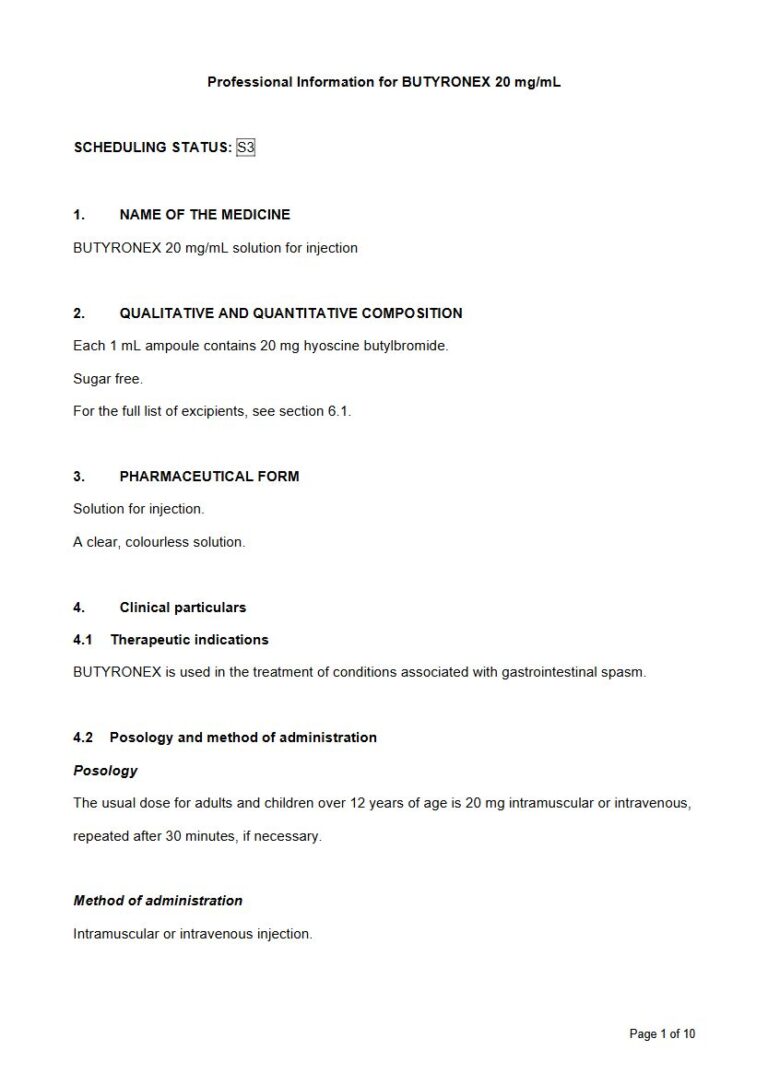
4.1 Therapeutic indications
BUTYRONEX is used in the treatment of conditions associated with gastrointestinal spasm.
4.2 Posology and method of administration
Posology
The usual dose for adults and children over 12 years of age is 20 mg intramuscular or intravenous, repeated after 30 minutes, if necessary.
Method of administration
Intramuscular or intravenous injection.
4.3 Contraindications
BUTYRONEX should not be used in patients with:
u2022 hypersensitivity to hyoscine butylbromide or any of the excipients listed in section 6.1
u2022 porphyria
u2022 prostatic enlargement with urinary retention
u2022 paralytic or obstructive ileus
u2022 pyloric stenosis
u2022 mechanical stenosis in the gastrointestinal tract
u2022 fever (see section 4.4)
u2022 megacolon
u2022 tachycardia
u2022 ulcerative colitis (its use may lead to ileus or megacolon and its effects on the lower oesophageal sphincter may exacerbate reflux)
u2022 closed angle or narrow angle glaucoma between the iris and cornea (see section 4.4)
u2022 myasthenia gravis (unless it is to reduce the adverse muscarinic effects of an anticholinesterase medicine)
u2022 pregnancy and breastfeeding (see section 4.6) as safety has not been established (it has been stated to cross the placenta)
u2022 BUTYRONEX should not be given by intramuscular injection to patients being treated with anticoagulant medicines, since intramuscular haematoma may occur.
4.4 Special warnings and precautions for use
In case severe, unexplained abdominal pain persists or worsens, or occurs together with symptoms like fever, nausea, vomiting, changes in bowel movements, abdominal tenderness, decreased blood pressure, fainting or blood in stool, appropriate diagnostic measures are needed to investigate the aetiology of the symptoms. BUTYRONEX should be given with caution to patients with diarrhoea.
BUTYRONEX ampoules can cause tachycardia, hypotension and anaphylaxis, therefore use with caution in patients with myocardial infarction as ischaemia and infarction may be worsened, hyperthyroidism, cardiac conditions such as cardiac failure, coronary heart disease, cardiac dysrhythmia or hypertension and in cardiac surgery. Monitoring of these patients is advised. Emergency equipment and personnel trained in its use must be readily available.
Because of the possibility that anticholinergics may reduce sweating, BUTYRONEX should be administered with caution to patients with pyrexia.
Elevation of intraocular pressure may be produced by the administration of anticholinergic medicines such as BUTYRONEX in patients with undiagnosed and therefore untreated narrow angle glaucoma. Therefore, patients should seek urgent ophthalmological advice in case they should develop a painful, red eye with loss of vision after the injection of BUTYRONEX.
After parenteral administration of BUTYRONEX, cases of anaphylaxis including episodes of shock have been observed. Patients receiving BUTYRONEX by injection should be kept under observation.
BUTYRONEX should be used with caution in children and the elderly, who may be more susceptible to its adverse effects.
BUTYRONEX ampoules contain sodium chloride: BUTYRONEX ampoules contain sodium chloride. The amount of sodium in a 1 ml ampoule is less than 1 mmol (23 mg). The total amount of sodium if a patient is given five ampoules in 24 hours is less than 1 mmol (23 mg) this means that BUTYRONEX ampoules are essentially sodium free.
4.5 Interaction with other medicines and other forms of interaction
The anticholinergic effect of medicines such as tri- and tetracyclic antidepressants, antihistamines, quinidine, amantadine, antipsychotics (e.g. phenothiazines, butyrophenones), disopyramide and other anticholinergics (e.g. tiotropium, ipratropium, atropine-like compounds) may be intensified by BUTYRONEX.
The tachycardic effects of beta-adrenergic medicines may be enhanced by BUTYRONEX.
Concomitant treatment with dopamine antagonists e.g. metoclopramide may result in diminution of the effects of both medicines on the gastrointestinal tract.
Alcohol should be avoided.
4.6 Fertility, pregnancy and lactation
Pregnancy
There are limited data from the use of hyoscine butylbromide, as in BUTYRONEX, in pregnant women. Animal studies are insufficient with respect to reproductive toxicity. As a precautionary measure, BUTYRONEX is not recommended during pregnancy (see section 4.3).
Breastfeeding
There is insufficient information on the excretion of hyoscine butylbromide, as in BUTYRONEX, and its metabolites in human milk. A risk to the breastfeeding child cannot be excluded. The use of BUTYRONEX during breastfeeding is not recommended (see section 4.3).
Fertility
No studies on the effects on human fertility have been conducted.
4.7 Effects on ability to drive and use machines
Patients should be advised that they may experience undesirable effects, such as accommodation disorder or dizziness during treatment with BUTYRONEX. Therefore, caution should be recommended when driving a vehicle or operating machinery. If patients experience accommodation disorder or dizziness, they should avoid potentially hazardous tasks such as driving or operating machinery.
4.8 Undesirable effects
Many of the side effects can be assigned to the anticholinergic properties of BUTYRONEX.
Nervous system disorders
Frequent: disorientation, delirium, somnolence (especially in elderly patients and in patients with impaired metabolic, liver or kidney function)
Frequency unknown: staggering
Eye disorders
Frequent: dilatation of the pupils with accommodation disorders
Frequency unknown: photophobia
Cardiac disorders
Frequent: tachycardia
Frequency unknown: bradycardia followed by tachycardia, with palpitations and dysrhythmias
Vascular disorders
Frequent: dizziness
Frequency unknown: giddiness
Gastrointestinal disorders
Frequent: dry mouth, constipation
Frequency unknown: difficulty in swallowing, thirst, reduction in the tone and motility of the gastro-intestinal tract, vomiting, retrosternal pain may occur due to increased gastric reflux
Skin and subcutaneous tissue disorders
Frequency unknown: dryness of the skin
Renal and urinary disorders
Frequency unknown: urinary urgency with the inability to do so
General disorders and administration site conditions
Frequency unknown: injection site pain (particularly after intramuscular use)
The following adverse reactions have been observed in post-marketing experience with an unknown frequency:
Immune system disorders
Anaphylactic shock (including cases with fatal outcome), anaphylactic reactions, dyspnoea, other hypersensitivity reactions.
Eye disorders
Mydriasis, increased intraocular pressure.
Vascular disorders
Decreased blood pressure, flushing.
Skin and subcutaneous tissue disorders
Skin reactions (e.g. urticaria, rash, erythema, pruritus), abnormal sweating.
Renal and urinary disorders
Urinary retention.
Hyoscine butylbromide, the active ingredient of BUTYRONEX, due to its chemical structure as a quaternary ammonium derivate, is not expected to enter the central nervous system. Hyoscine butylbromide does not readily pass the blood-brain barrier. However, it cannot totally be ruled out that under certain circumstances psychiatric disorders (e.g. confusion) may also occur after administration of BUTYRONEX.
4.9 Overdose
Symptoms
Serious signs of poisoning following acute overdosage have not been observed in man. In the case of overdosage, anticholinergic symptoms, such as urinary retention, dry mouth, reddening of the skin, tachycardia, inhibition of gastrointestinal motility and transient visual disturbances may occur and Cheynes-Stokes respiration has been reported. Toxic doses cause rapid respiration, hyperpyrexia, restlessness, confusion, excitement, impotence and hallucinations passing into delirium. A rash may appear on face and upper trunk. In severe intoxication, depression of the central nervous system may occur with circulatory failure and respiratory failure. Quaternary ammonium anticholinergic medicine usually has some ganglion blocking action, so that high doses may cause postural hypertension and impotence in toxic doses, nondepolarising neuromuscular block may be produced.
Treatment
Treatment is symptomatic and supportive, as required.
