
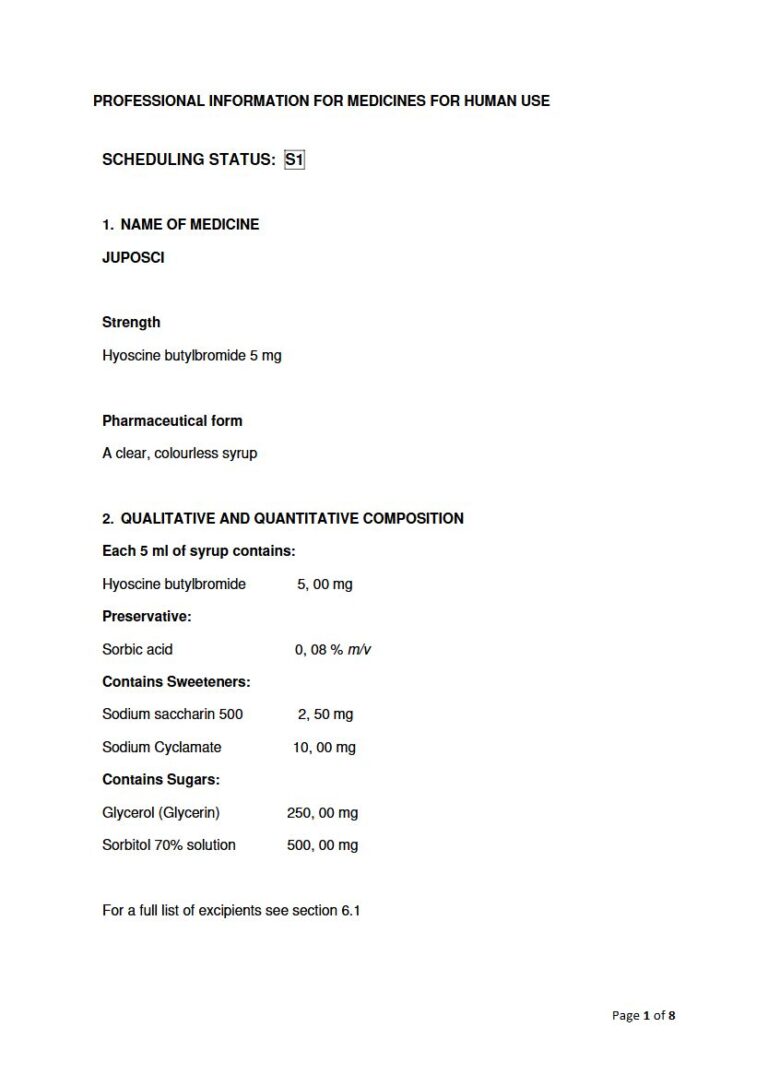
Juposci 5 mg colourless syrup
PDF Leaflet Revision Date: 19 November 2024
Clinical Summary
Quick overview from the medicine insert
Indication
Treatment of gastrointestinal spasm.
Dosage (summary)
Adults: 20 ml four times daily; Children: varies by age.
Special Populations
- Renal impairment
- Hepatic impairment
Pregnancy & Breastfeeding
Contraindicated during pregnancy and lactation.
Key Drug Interactions
- Antimuscarinic drugs
- Antihistamines
- Tricyclic antidepressants
Contraindications
- Myasthenia gravis
- Closed angle glaucoma
- Porphyria
- Intestinal obstruction
- Hypersensitivity to hyoscine butylbromide
Common side effects
- Dry mouth
- Tachycardia
- Constipation
- Flushing
Counselling Points
- Report any adverse reactions
- Avoid in hot environments
- May cause drowsiness
Serious warnings
- Do not exceed prescribed dose
- Use with caution in cardiac disorders
Important Disclaimer
The Juposci 5 mg colourless syrup professional information leaflet below is the property of Adcock Ingram and is provided on Medinsert exactly as issued, with no.. alterations or editorial changes. We make every effort to keep content current by updating documents as soon as new versions become available. Medinsert serves as a trusted access point for healthcare professionals, but does not replace official sources or clinical judgement. For more details, please read our full disclaimer. read more>>
 Healthcare Professionals Only
This content is for registered healthcare professionals
Sign in or create a free account to read the full package insert.
Free for HPCSA-registered professionals. Powered by Medinsert.
Clinical Particulars
Section 4 of the official insert — extracted exactly as issued, no alterations
4.1 Therapeutic Indications
JUPOSCI is used in the treatment of conditions associated with gastrointestinal spasm.
4.2 Posology and method of administration
Posology: The initial oral dose must be the lowest recommended for age. Children older than 1 year up to 3 years: 5 to 10 ml three times daily. Children older than 3 years up to 6 years: 10 ml three times daily. Children older than 6 years up to 12 years: 10 to 20 ml three times daily. Children older than 12 years and adults: 20 ml four times daily. Paediatric population: Babies older than 1 month up to 3 months: 2, 5 ml three times daily. Infants older than 3 months up to 1 year: 2, 5 to 5 ml three times daily.
4.3 Contraindications
JUPOSCI should not be used in patients with:
- Myasthenia gravis
- Closed angle glaucoma
- Narrow angle between the iris and the cornea with a high ambient temperature, especially in children
- Porphyria
- Intestinal obstruction or ileus.
JUPOSCI should not be used in patients who have experienced prior hypersensitivity to hyoscine butylbromide. Hyoscine butylbromide is contraindicated in patients who have tachycardia, hypotension, anaphylaxis and cardiac diseases or history of cardiac disease or hypertension. JUPOSCI should not be used during pregnancy and lactation.
4.4 Special warnings and precautions for use
DO NOT EXCEED THE PRESCRIBED DOSE. JUPOSCI should be used with care in the following;
General disorders:
- Fever
Cardiac disorders:
- tachycardia
- myocardial infarction
Gastrointestinal disorders:
- paralytic ileus
- pyloric stenosis
- ulcerative colitis
- exacerbate reflux
- diarrhoea
Renal and urinary disorders:
- prostatic enlargement
- impaired kidney function
Disorders of metabolism:
- impaired metabolic function
Vascular disorders:
- hypertension
Hepato-biliary disorders:
- impaired liver function
Contains glycerol and sorbitol and may have a laxative effect. Patient with the rare hereditary condition of sorbitol intolerance should not take JUPOSCI.
4.5 Interaction with other medicines and other forms of interaction
The effects of JUPOSCI may be enhanced by the concomitant administration of other medicines with antimuscarinic properties, such as amantadine, some antihistamines, butyrophenones, phenothiazines and tricyclic antidepressants. The absorption of other medicines may also be affected due to the reduction in gastric motility.
4.6 Fertility, pregnancy and lactation
JUPOSCI should not be used during pregnancy and lactation.
4.7 Effects on ability to drive and use machines
The effect on the ability to drive and use machine has not been established.
4.8 Undesirable effects
Frequency System organ class Undesirable effects Less frequent Cardiac disorders u2022 Transient bradycardia u2022 Tachycardia u2022 Palpitations, arrhythmias General disorders u2022 Dryness of the mouth u2022 Difficulty in swallowing and talking u2022 Thirst Skin disorders and subcutaneous tissue disorders u2022 Flushing u2022 Dryness of the skin Renal and urinary disorders u2022 Difficulty micturition Frequency not known Gastrointestinal disorders u2022 Reduction in the tone u2022 Motility of the gastrointestinal tract leading to constipation. Eye disorders u2022 Mydriasis (Dilatation of the pupils) u2022 Cyclopegia (Loss in accommodation) u2022 Photophobia Respiratory disorders u2022 Reduced bronchial secretions
4.9 Overdose
In toxic doses anticholinergic effects predominate. These include tachycardia, hyperpyrexia, restlessness, confusion, excitement, hallucinations and delirium. A flushing of the face and upper trunk may be a prominent feature. Overdose may cause postural hypotension. Toxic doses may cause non-depolarising neuromuscular block. Treatment is symptomatic and supportive.
