
Cabxel 60 mg Injection
PDF Leaflet Revision Date: 27 June 2023
Clinical Summary
Quick overview from the medicine insert
Indication
Treatment of hormone refractory metastatic prostate cancer.
Dosage (summary)
25 mg/mu00b2 IV infusion every 3 weeks with daily prednisone 10 mg.
Special Populations
- Elderly u2265 65 years
- Hepatic impairment
- Renal impairment
Pregnancy & Breastfeeding
Not recommended during pregnancy or breastfeeding.
Key Drug Interactions
- Strong CYP3A inhibitors
- Strong CYP3A inducers
Contraindications
- Hypersensitivity to cabazitaxel
- Neutrophil counts u2264 1,500/mmu00b3
- Hepatic impairment
- Concomitant yellow fever vaccination
Common side effects
- Neutropenia
- Diarrhoea
- Fatigue
- Hypersensitivity
Counselling Points
- Premedicate to reduce hypersensitivity risk
- Avoid live vaccines
- Monitor for signs of neuropathy
Serious warnings
- Neutropenia monitoring required
- Severe hypersensitivity reactions possible
Important Disclaimer
The Cabxel 60 mg Injection professional information leaflet below is the property of Hetero Drugs South Africa and is provided on Medinsert exactly as issued, with no.. alterations or editorial changes. We make every effort to keep content current by updating documents as soon as new versions become available. Medinsert serves as a trusted access point for healthcare professionals, but does not replace official sources or clinical judgement. For more details, please read our full disclaimer. read more>>
 Healthcare Professionals Only
This content is for registered healthcare professionals
Sign in or create a free account to read the full package insert.
Free for HPCSA-registered professionals. Powered by Medinsert.
Clinical Particulars
Section 4 of the official insert — extracted exactly as issued, no alterations
4.1 Therapeutic indications
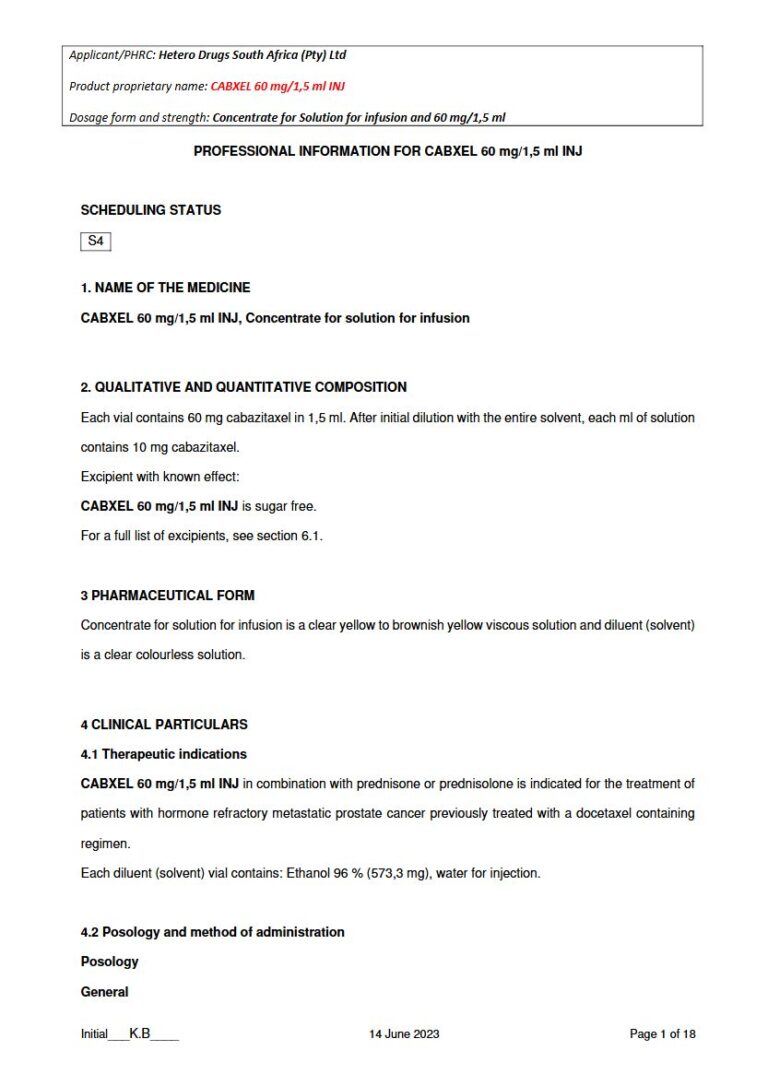
CABXEL 60 mg/1,5 ml INJ in combination with prednisone or prednisolone is indicated for the treatment of patients with hormone refractory metastatic prostate cancer previously treated with a docetaxel containing regimen.
4.2 Posology and method of administration
Posology
General
The use of CABXEL 60 mg/1,5 ml INJ should be confined to units specialised in the administration of cytotoxics and it should be administered under the supervision of a medical practitioner qualified in the use of anticancer chemotherapy.
Premedication:
Premedicate prior to each administration of CABXEL 60 mg/1,5 ml INJ with the following intravenous medications to reduce the incidence and severity of a hypersensitivity reaction:
- antihistamine (dexchlorpheniramine 5 mg or diphenhydramine 25 mg or equivalent),
- corticosteroid (dexamethasone 8 mg or equivalent) and with
- H2 antagonist (ranitidine or equivalent) (see section 4.4).
Dosage:
The recommended dose of CABXEL 60 mg/1,5 ml INJ is 25 mg/m2 administered as a 1-hour intravenous infusion every 3 weeks in combination with oral prednisone (or prednisolone) 10 mg administered daily throughout CABXEL 60 mg/1,5 ml INJ treatment.
Dosage adjustments:
Dosage modifications should be made if patients experience the following adverse reactions.
Recommended Dosage Modifications for adverse reaction in patients treated with CABXEL 60 mg/1,5 ml INJ
- Prolonged grade u2265 3 neutropenia (greater than 1 week) despite appropriately medication including G-CSF: Delay treatment until neutrophil count is > 1 500 cells/mm3, then reduce dosage of CABXEL 60 mg/1,5 ml INJ from 25 mg/m2 to 20 mg/m2.
- Febrile neutropenia: Delay treatment until improvement or resolution, and until neutrophil count is > 1 500 cells/mm3, then reduce dosage of CABXEL 60 mg/1,5 ml INJ from 25 mg/m2 to 20 mg/m2.
- Grade u2265 3 diarrhoea or persisting diarrhoea despite appropriate medication, fluid and electrolytes replacement: Delay treatment until improvement or resolution, then reduce dosage of CABXEL 60 mg/1,5 ml INJ from 25 mg/m2 to 20 mg/m2. Discontinue CABXEL 60 mg/1,5 ml INJ treatment if a patient continues to experience any of these reactions at 20 mg/m2.
The elderly u2265 65 years: No specific dose adjustment for the use of CABXEL 60 mg/1,5 ml INJ in senior adult patients is recommended (see sections 4.4, 4.8 and 5).
Patients with hepatic impairment: CABXEL 60 mg/1,5 ml INJ is extensively metabolised by the liver. No formal studies were conducted in patients with severe hepatic impairment. As a precautionary measure, CABXEL 60 mg/1,5 ml INJ should not be given to patients with hepatic impairment [bilirubin u2265 1 x Upper Limit of Normal (ULN), or AST/SGOT and/or ALT/SGPT u2265 1,5 x ULN] (see sections 4.3, 4.4 and 5).
Patients with renal impairment: CABXEL 60 mg/1,5 ml INJ is minimally excreted through the kidney. No dose adjustment is necessary in patients with mild renal impairment (creatinine clearance (CLCR): 50 to 80 ml/min). Data in patients with moderate (CLCR: 30 to 50 ml/min) and severe renal impairment (CLCR < 30 ml/min) is limited; therefore these patients should be treated with caution and monitored carefully during treatment (see section 5). Dose delay or reduction should be considered in the event of adverse effects.
Paediatric population
The safety and the efficacy of CABXEL 60 mg/1,5 ml INJ in children have not been established.
Method of administration
Intravenous infusion. Use an in-line filter of 0,22 micrometre nominal pore size during administration.
4.3 Contraindications
- Known hypersensitivity to cabazitaxel or other medicines formulated with polysorbate 80 or to any of the excipients of CABXEL 60 mg/1,5 ml INJ (see section 6.1).
- Neutrophil counts u2264 1 500/mm3.
- Hepatic impairment (bilirubin u2265 1 x ULN, or AST/SGOT and/or ALT/SGPT u2265 1,5 x ULN).
- Concomitant vaccination with yellow fever vaccine.
4.4 Special warnings and precautions for use
Neutropenia
Neutropenia is the most common adverse reaction of CABXEL 60 mg/1,5 ml INJ (see section 4.8). The use of G-CSF has been shown to limit the incidence and severity of neutropenia and its complications. Monitoring of complete blood count is essential on a weekly basis during cycle 1 and before each treatment cycle thereafter so that the dose can be adjusted, if needed (see section 4.2). Reduce dose in case of febrile neutropenia, or prolonged neutropenia despite appropriate treatment (see section 4.2). Retreat only when neutrophils recover to a level > 1 500/mm3 (see section 4.3).
Hypersensitivity reactions
All patients should be premedicated prior to the initiation of the infusion of CABXEL 60 mg/1,5 ml INJ (see section 4.2). Patients should be observed closely for hypersensitivity reactions. Hypersensitivity reactions may occur within a few minutes following the initiation of the infusion of CABXEL 60 mg/1,5 ml INJ, thus facilities and equipment for the treatment of hypotension and bronchospasm should be available. Severe reactions can occur and may include generalised rash/erythema, hypotension and bronchospasm. Severe hypersensitivity reactions require immediate discontinuation of CABXEL 60 mg/1,5 ml INJ and appropriate therapy. Patients who have a history of severe hypersensitivity reactions should not be rechallenged with CABXEL 60 mg/1,5 ml INJ (see section 4.3).
Gastrointestinal symptoms
If patients experience diarrhoea following administration of CABXEL 60 mg/1,5 ml INJ they may be treated with commonly used anti-diarrhoeal medications. Appropriate measures should be taken to rehydrate the patients. Treatment delay or dosage reduction may be necessary for grade u2265 3 diarrhoea (see section 4.2). If patients experience nausea or vomiting, they may be treated with commonly used anti-emetics.
Renal disorders
Renal disorders, have been reported in association with sepsis, severe dehydration due to diarrhoea, vomiting and obstructive uropathy. Renal failure including cases with fatal outcome has been observed. Appropriate measures should be taken to identify the cause and intensively treat the patients if this occurs.
Bone marrow suppression
Bone marrow suppression manifested as neutropenia, anaemia, thrombocytopenia or pancytopenia may occur.
Peripheral neuropathy
Cases of peripheral neuropathy, peripheral sensory neuropathy (e.g., paraesthesias, dysaesthesias) and peripheral motor neuropathy have been observed in patients receiving cabazitaxel. Patients under treatment with cabazitaxel should be advised to inform their doctor prior to continuing treatment if symptoms of neuropathy such as pain, burning, tingling, numbness, or weakness develop. Medical practitioners should assess for the presence or worsening of neuropathy before each treatment. Treatment should be delayed until improvement of symptoms. The dose of cabazitaxel should be reduced from 25 mg/m2 to 20 mg/m2 for persistent grade u2265 2 peripheral neuropathy (see section 4.2).
4.5 Interactions with other medicines
No formal clinical studies to assess the potential interaction between CABXEL 60 mg/1,5 ml INJ and other medicines have been performed. In vitro studies have shown that CABXEL 60 mg/1,5 ml INJ is mainly metabolised through CYP3A (80 % to 90 %) and inhibits CYP3A. The metabolism of CABXEL 60 mg/1,5 ml INJ may be modified by the concomitant administration of compounds which are known to be potent inhibitors (e.g., ketoconazole) or inducers (e.g., rifampicin, carbamazepine, phenobarbital or phenytoin) of CYP3A. Coadministration of CABXEL 60 mg/1,5 ml INJ with medicines that are known to be primarily metabolised through CYP3A may increase the exposure of these medicines. Therefore, caution should be exercised in patients concurrently taking medicines known to be either primarily metabolised through CYP3A or to be potent inhibitors or inducers of this enzyme (see section 5.2). Prednisone/prednisolone administered at 10 mg daily did not affect the pharmacokinetics of CABXEL 60 mg/1,5 ml INJ. OATP1B1 In vitro, cabazitaxel has also been shown to inhibit the transport proteins of the Organic Anion Transport Polypeptides OATP1B1. The risk of interaction with OATP1B1 substrates (e.g. statins, valsartan, repaglinide) is possible, notably during the infusion duration (1 hour) and up to 20 minutes after the end of the infusion. A time interval of 12 hours is recommended before the infusion and at least 3 hours after the end of infusion before administering the OATP1B1 substrates.
4.6 Fertility, pregnancy and lactation
Women of childbearing potential and female/male contraception
CABXEL 60 mg/1,5 ml INJ is not recommended for use in women of childbearing potential not using contraception. Due to potential exposure via seminal liquid, men with partners of childbearing potential should use reliable contraception throughout treatment and are recommended to continue this for up to 3 months after the last dose of CABXEL 60 mg/1,5 ml INJ.
Pregnancy
There are no data from the use of CABXEL 60 mg/1,5 ml INJ in pregnant women. Studies in animals have shown reproductive toxicity and that CABXEL 60 mg/1,5 ml INJ crosses the placenta barrier. CABXEL 60 mg/1,5 ml INJ is not recommended for use during pregnancy.
Breastfeeding
Available pharmacokinetics data in animals have shown excretion of CABXEL 60 mg/1,5 ml INJ and its metabolites in milk. CABXEL 60 mg/1,5 ml INJ should not be used during breastfeeding.
Fertility
The effect of CABXEL 60 mg/1,5 ml INJ on human fertility is unknown. Animal studies showed that CABXEL 60 mg/1,5 ml INJ affected the reproductive system in male rats and dogs.
4.7 Effects on ability to drive and use machines
No studies on the effects on the ability to drive and use machines have been performed. However, based on the safety profile, CABXEL 60 mg/1,5 ml INJ may have moderate influence on the ability to drive and use machines as it may cause fatigue and dizziness. Patients should be advised to not drive or use machines if they experience these adverse reactions during treatment.
4.8 Undesirable effects
a) Summary of the safety profile
The safety of CABXEL 60 mg/1,5 ml INJ in combination with prednisone or prednisolone was evaluated in 371 patients with hormone refractory metastatic prostate cancer, in a randomised open label, controlled phase III study. Patients received a median duration of 6 cycles of CABXEL 60 mg/1,5 ml INJ. The most frequent Grade u2265 3 adverse reactions in the cabazitaxel group were clinical neutropenia, febrile neutropenia, diarrhoea, fatigue, and asthenia. Discontinuation of treatment due to adverse drug reactions occurred in 68 patients in the CABXEL 60 mg/1,5 ml INJ group and 31 patients in the mitoxantrone group. The most frequent adverse reaction leading to treatment discontinuation in the CABXEL 60 mg/1,5 ml INJ group was neutropenia.
b) Tabulated list of adverse reactions
CABXEL 60 mg/1,5 ml INJ in combination with prednisone or prednisolone
Infections and infestations
Frequent: Urinary tract infection, Septic shock, Sepsis, Cellulitis, Influenza, Cystitis, Upper respiratory tract infection, Herpes zoster, Candidiasis
Blood and lymphatic system disorders
Frequent: Neutropenia, anaemia, leukopenia, thrombocytopenia, febrile neutropenia
Immune system disorders
Frequent: Hypersensitivity
Metabolism and nutrition disorders
Frequent: Anorexia, dehydration, Hyperglycaemia, Hypokalemia
Psychiatric disorders
Frequent: Anxiety, Confusional state
Nervous system disorders
Frequent: Dysgeusia, neuropathy peripheral, dizziness, headache, peripheral sensory neuropathy, Paraesthesia, Lethargy, Hypoaesthesia, Sciatica.
Eye disorders
Frequent: Conjunctivitis, Lacrimation increased.
Ear and labyrinth disorders
Frequent: Tinnitus, Vertigo.
Cardiac disorders
Frequent: Atrial fibrillation, Tachycardia.
Vascular disorders
Frequent: Hypotension, Deep vein thrombosis, Hypertension, Orthostatic hypotension, Hot flush, Flushing.
Respiratory, thoracic and mediastinal disorders
Frequent: Dyspnoea, cough, Oropharyngeal pain, Pneumonia.
Gastrointestinal disorders
Frequent: Diarrhoea, nausea, vomiting, constipation, abdominal pain, dyspepsia, upper abdominal pain, haemorrhoids, gastro-oesophageal reflux disease, Rectal haemorrhage, Dry mouth, Abdominal distension.
Skin and subcutaneous tissue disorders
Frequent: Alopecia, Dry skin, Erythema.
Musculoskeletal and connective tissue disorders
Frequent: Back pain, arthralgia, muscle spasms, Pain in extremity, Myalgia, Musculoskeletal chest pain, Flank pain.
Renal and urinary disorders
Frequent: Haematuria, dysuria, urinary incontinence, acute renal failure, Renal failure, Renal colic, Pollakiuria, Hydronephrosis, Urinary retention, Urinary incontinence, Ureteric obstruction.
Reproductive system and breast disorders
Frequent: Pelvic pain.
General disorders and administration site conditions
Frequent: Fatigue, asthenia, pyrexia, peripheral oedema, mucosal inflammation, Pain, Chest pain, Oedema, Chills, Malaise.
Investigations
Frequent: Weight decreased, Aspartate aminotransferase increased, Transaminases Increased.
4.9 Overdose
The anticipated complications of overdose would be exacerbation of adverse reactions as bone marrow suppression and gastrointestinal disorders. There is no known antidote to CABXEL 60 mg/1,5 ml INJ. In case of overdose, the patient should be kept in a specialised unit and closely monitored. Patients should receive therapeutic G-CSF as soon as possible after discovery of overdose. Other appropriate symptomatic measures should be taken.
