
Bortiv Injection
PDF Leaflet Revision Date: 22 July 2025
Clinical Summary
Quick overview from the medicine insert
Indication
Treatment of multiple myeloma and mantle cell lymphoma.
Dosage (summary)
1.3 mg/mu00b2 twice weekly for two weeks, followed by a rest period.
Special Populations
- Elderly
- Renal impairment
- Hepatic impairment
Pregnancy & Breastfeeding
Not recommended during pregnancy; safety in lactation not established.
Key Drug Interactions
- CYP3A4 inhibitors
- CYP3A4 inducers
- Concomitant medications causing peripheral neuropathy
Contraindications
- Hypersensitivity
- Acute diffuse infiltrative pulmonary disease
Common side effects
- Nausea
- Diarrhea
- Constipation
- Fatigue
- Thrombocytopenia
- Peripheral neuropathy
Counselling Points
- Monitor for signs of neuropathy
- Avoid pregnancy during treatment
- Hydration for gastrointestinal toxicity
Serious warnings
- Fatal intrathecal administration
- Cardiac failure
- Pulmonary disorders
Important Disclaimer
The Bortiv Injection professional information leaflet below is the property of Hetero Drugs South Africa and is provided on Medinsert exactly as issued, with no.. alterations or editorial changes. We make every effort to keep content current by updating documents as soon as new versions become available. Medinsert serves as a trusted access point for healthcare professionals, but does not replace official sources or clinical judgement. For more details, please read our full disclaimer. read more>>
 Healthcare Professionals Only
This content is for registered healthcare professionals
Sign in or create a free account to read the full package insert.
Free for HPCSA-registered professionals. Powered by Medinsert.
Clinical Particulars
Section 4 of the official insert — extracted exactly as issued, no alterations
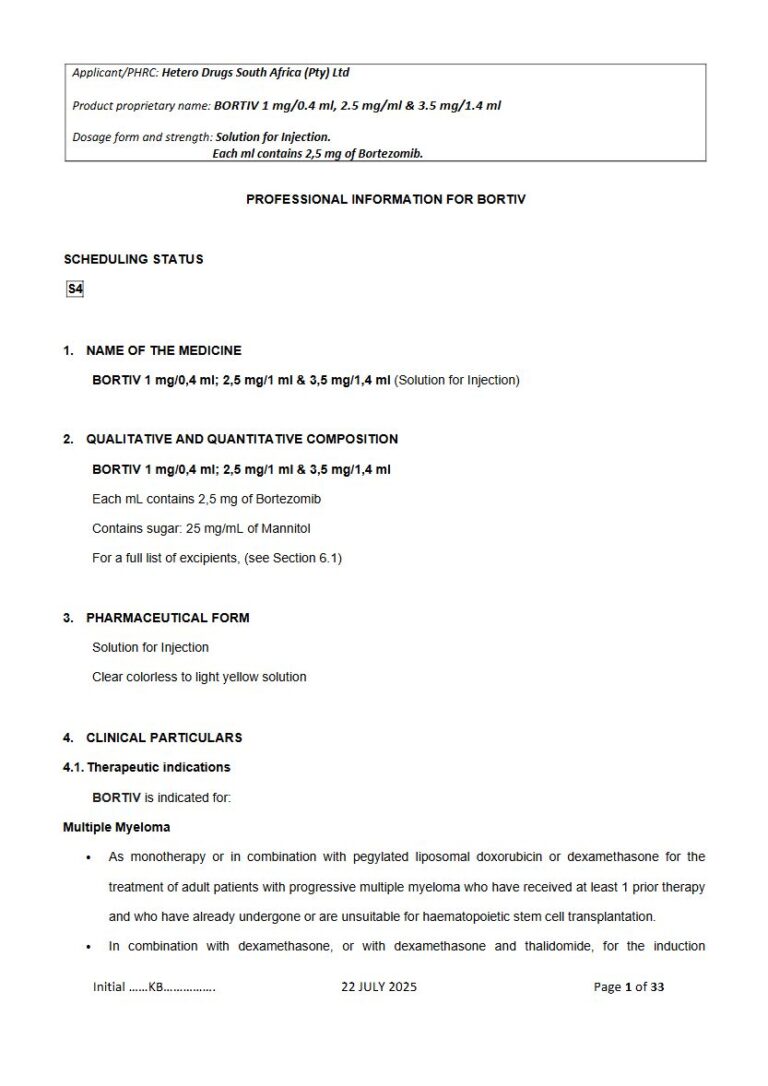
4.1. Therapeutic indications
BORTIV is indicated for:
Multiple Myeloma
- As monotherapy or in combination with pegylated liposomal doxorubicin or dexamethasone for the treatment of adult patients with progressive multiple myeloma who have received at least 1 prior therapy and who have already undergone or are unsuitable for haematopoietic stem cell transplantation.
- In combination with dexamethasone, or with dexamethasone and thalidomide, for the induction treatment of adult patients with previously untreated multiple myeloma who are eligible for high dose chemotherapy with haematopoietic stem cell transplantation.
- In combination with melphalan and prednisone for the treatment of adult patients with previously untreated multiple myeloma who are not eligible for high-dose chemotherapy with haematopoietic stem cell transplantation.
Mantle Cell Lymphoma
- Treatment of relapsed or refractory mantle cell lymphoma for patients who have received at least 1 prior line of therapy, one of which should have included an anthracycline (or mitoxantrone) and/or rituximab as part of their chemotherapy regimen.
- Treatment for newly diagnosed mantle cell lymphoma (MCL) in adults, in combination with rituximab, cyclophosphamide, doxorubicin and prednisone who are unsuitable for haematopoietic stem cell transplantation.
4.2 Posology and method of administration
Posology
BORTIV solution for injection is available for:
- Intravenous administration at a concentration of 1 mg/mL (as a 3-5 second bolus injection) or
- Subcutaneous administration at a concentration 2,5 mg/mL.
Because each route of administration has a different reconstituted concentration, caution should be used when calculating the volume to be administered. BORTIV should not be given by other routes. Intrathecal administration has resulted in death.
Monotherapy
Recommended dosage
The recommended starting dose of BORTIV is 1,3 mg/m2 body surface area twice weekly for two weeks (days 1, 4, 8 and 11) followed by a 10-day rest period (days 12-21). This 3-week period is considered a treatment cycle. At least 72 hours should lapse between consecutive doses of BORTIV. It is recommended that patients with a confirmed complete response receive 2 additional cycles of BORTIV beyond a confirmation. It is also recommended that responding patients who do not achieve a complete remission receive a total of 8 cycles of BORTIV therapy.
Recommended dosage adjustments during treatment and re-initiation of treatment
BORTIV treatment must be withheld at the onset of any grade 3 non-haematological or any grade 4 haematological toxicities, excluding neuropathy as discussed below (see section 4.4). Once the symptoms of the toxicity have resolved, BORTIV treatment may be re-initiated at a 25 % reduced dose (1,3 mg/m2 reduced to 1,0 mg/m2; 1,0 mg/m2 reduced to 0,7mg/m2). If toxicity is not resolved or if it recurs at the lowest dose, discontinuation of BORTIV must be considered.
Patients who experience BORTIV related neuropathic pain and/or peripheral neuropathy are to be managed as presented in table 1. Patients with pre-existing severe neuropathy may be treated with BORTIV only after careful assessment.
Table 1: Recommended* dose modifications for BORTIV related neuropathic pain and /or peripheral sensory neuropathy
| Severity of peripheral neuropathy | Modification of dose and regimen |
|---|---|
| Grade 1 (asymptomatic, paraesthesia, weakness and/or loss of reflex) with no pain or loss of function | No action |
| Grade 1 with pain or grade 2 (moderate symptoms, interfering with function but not activities of daily living) | Reduce to 1,0 mg/m2 or Change BORTIV treatment schedule to 1,3 mg/m2 once per week |
| Grade 2 with pain or grade 3 (severe symptoms, interfering with activities of daily living) | Withhold BORTIV treatment until symptoms of toxicity have resolved. When toxicity resolves re-initiate BORTIV treatment and reduce dose to 0,7 mg/m2 and change treatment schedule to once per week. |
| Grade 4 (life threatening consequences, sensory neuropathy which is disabling or motor neuropathy that is life-threatening or leads to paralysis) | Discontinue BORTIV |
Combination therapy
Previously Untreated Multiple Myeloma - Patients who are Not Eligible for Stem Cell Transplantation
Recommended dosage in Combination with Melphalan and Prednisone
BORTIV (bortezomib) for injection is administered in combination with oral melphalan and oral prednisone for nine 6-week treatment cycles as shown in Table 3. In cycles 1-4 BORTIV is administered twice weekly (days 1, 4, 8, 11, 22, 25, 29 and 32). In cycles 5-9, BORTIV is administered once weekly (days 1, 8, 22 and 29).
Table 2: Recommended dosage regimen for BORTIV when used in combination with melphalan and prednisone for patients with previously untreated multiple myeloma who are not eligible for stem cell transplantation:
Twice weekly BORTIV (cycles 1-4)
| Week | 1 | 2 | 3 | 4 | 5 | 6 |
|---|---|---|---|---|---|---|
| Vc (1,3 mg/m2) | Day 1 | Day 4 | Day 8 | Day 11 | Rest period | Day 22 |
| Day 25 | Day 29 | Day 32 | Rest Period |
Once weekly BORTIV (cycles 5-9)
| Week | 1 | 2 | 3 | 4 | 5 | 6 |
|---|---|---|---|---|---|---|
| Vc (1,3 mg/m2) | Day --- | Day 1 | Day 8 | Rest period | Day 22 | Day 29 |
Vc = BORTIV; m = melphalan; p = prednisone
...
4.3 Contraindications
- Hypersensitivity to any of the ingredients of bortezomib, or any of the ingredients of BORTIV, including the excipients listed in section 6.1.
- Acute diffuse infiltrative pulmonary and pericardial disease.
4.4 Special warnings and precautions for use
Treatment must be initiated and administered under the supervision of a medical practitioner and experienced in the use of chemotherapeutic medicines. There have been fatal cases of inadvertent intrathecal administration of BORTIV. BORTIV is for IV or SC use only. DO NOT ADMINISTER BORTIV INTRATHECALLY.
Herpes Zoster Virus Reactivation
Medical practitioners should reconsider using antiviral prophylaxis in patients being treated with BORTIV. Patients with previously untreated multiple myeloma, the overall incidence of herpes zoster reactivation was very common in patients treated with BORTIV, melphalan and prednisone (VcMP) Patients with mantle cell lymphoma Safety data for patients with mantle cell lymphoma were evaluated in a phase 2 study, which included 155 patients treated with BORTIV at the recommended dose of 1,3 mg/m2. The safety profile of BORTIV in these patients was similar to that observed in patients with multiple myeloma. Notable differences between the two patient populations were that thrombocytopaenia, neutropaenia, anaemia, nausea, vomiting and pyrexia were reported more often in the patients with multiple myeloma than in those with mantle cell lymphoma; whereas peripheral neuropathy, rash and pruritus were higher among patients with mantle cell lymphoma compared to patients with multiple myeloma.
Based on the integrated safety database from 256 patients with relapsed and/or refractory multiple myeloma, the following special precautions are suggested: Overall, the safety profile of patients treated with BORTIV in monotherapy was similar to that observed in patients treated with BORTIV in combination with melphalan and prednisone.
Laboratory Tests
Complete blood counts (CBC) including platelet counts should be frequently monitored throughout treatment with BORTIV.
Gastrointestinal toxicity
Gastrointestinal toxicity, including diarrhoea, constipation, nausea and vomiting are very common with BORTIV treatment (see section 4.8). Reactions usually occur early in treatment (Cycles 1 and 2) and may persist for several cycles. Patients experiencing treatment emergent gastrointestinal toxicity may benefit from administration of anti-emetics and anti-diarrhoeals. Fluid and electrolyte replacement should be administered to prevent or treat dehydration. Cases of ileus have been reported, therefore patients who experience constipation should be closely monitored.
Haematological toxicity
BORTIV treatment is very commonly associated with haematological toxicities (thrombocytopenia and neutropenia). However, febrile neutropenia is an uncommon undesirable effect. The most common haematologic toxicity is transient thrombocytopenia, which generally resolves between treatment cycles. Platelets were lowest at Day 11 of each cycle of BORTIV treatment and typically recovered to baseline by the next cycle. The cyclical pattern of platelet decrease and recovery remained consistent over the 8 cycles of twice weekly dosing and there was no evidence of cumulative thrombocytopenia. The mean platelet count nadir measured was approximately 40 % of baseline. Severe bleeding, including CNS and gastrointestinal bleeding, associated with thrombocytopenia, has been reported. In patients with advanced myeloma, the severity of thrombocytopenia was related to pre-treatment platelet count (see table 6). Platelet counts should be monitored prior to each dose of BORTIV. Therapy should be held when the platelet count is < 25,000/u03bcu2113 and re-initiated at a reduced dose after resolution (see section 4.2 and 4.8). Potential benefit of the treatment should be carefully weighed against the risks. Platelet transfusions, red blood cell (RBC) transfusions and administration of growth factors may be utilised in the management of haematologic toxicities. Prophylactic platelet transfusions should be considered in thrombocytopenic patients at high risk of bleeding.
Table 6: The severity of Thrombocytopenia Related to Pre-treatment Platelet Count in the Phase 3 Study Multiple Myeloma Study
...
4.5 Interaction with other medicines and other forms of interaction
BORTIV is a weak inhibitor of the cytochrome P450 (CYP) isozymes 1A2, 2C9, 2C19, 2D6 and 3A4. Based on the limited contribution (7 %) of CYP2D6 to the metabolism of BORTIV the CYP2D6, poor metaboliser phenotype is not expected to affect the overall disposition of BORTIV. Ketoconazole, a potent CYP3A4 inhibitor, showed 35 % increase in mean bortezomib AUC. Therefore, patients should be monitored closely when given BORTIV in combination with potent CYP3A4-inhibitors (e.g. ketoconazole, ritonavir). Omeprazole, a potent inhibitor of CYP2C19, has no significant effect on the pharmacokinetics of bortezomib. Concomitant use of bortezomib with rifampicin, a potent CYP3A4 inducer, showed a mean bortezomib AUC reduction of 45 %. Therefore the concomitant use of BORTIV with strong CYP3A4 inducers is therefore not recommended, as efficacy may be reduced. Examples of CYP3A4 inducers are rifampicin, carbamazepine, phenytoin, phenobarbital and St. John's Wort. Dexamethasone, a weaker CYP3A4 inducer has no significant effect on bortezomib pharmacokinetics.
Concomitant exposure to narcotics may increase the incidence of constipation, nausea and vomiting. Melphalan-prednisone showed a 17 % increase in mean bortezomib AUC and is not considered clinically relevant. Patients on oral antidiabetic medicines receiving BORTIV treatment may require close monitoring of the blood glucose levels and adjustment of the dose of their antidiabetic medication. Normal liver function should be confirmed and caution should be exercised in patients receiving oral hypoglycaemic medicines. Patients should be cautioned about the use of concomitant medications that may be associated with peripheral neuropathy (such as amiodarone, anti-virals, isoniazid, nitrofurantoin, or statins), or with a decrease in blood pressure.
4.6 Fertility, pregnancy and lactation
Contraception in males and females
Males and females of childbearing capacity should use effective contraceptive measures during treatment and for 3 months following BORTIV therapy.
Pregnancy
Safety in pregnancy has not been established. If BORTIV is used during pregnancy, or if the patient becomes pregnant while receiving BORTIV, the patient needs to be informed of potential for hazards to the foetus. BORTIV should be avoided during pregnancy and women are advised to avoid falling pregnant while on treatment with BORTIV.
Breastfeeding
Safety in lactation has not been established. It is not known whether BORTIV is excreted in human milk. Because of the potential for serious undesirable effects in breastfed infants from mothers on BORTIV, women should not breastfeed their infants while receiving BORTIV.
4.7 Effects on ability to drive and use machines
BORTIV may have a moderate influence on the ability to drive and use machines. BORTIV may be associated with fatigue, dizziness, syncope, orthostatic/postural hypotension or blurred vision. Therefore, patients must be cautious when operating machinery, or when driving and should be advised not to drive or operate machinery if they experience these symptoms (see section 4.8).
4.8 Undesirable effects
a) Summary of safety profile
Serious adverse reactions uncommonly reported during treatment with BORTIV include cardiac failure, tumour lysis syndrome, pulmonary hypertension, posterior reversible encephalopathy syndrome, acute diffuse infiltrative pulmonary disorders and rarely autonomic neuropathy. The most frequently reported adverse reactions during treatment with BORTIV are nausea, diarrhoea, constipation, vomiting, fatigue, pyrexia, thrombocytopenia, anaemia, neutropenia, peripheral neuropathy (including sensory), headache, paraesthesia, decreased appetite, dyspnoea, rash, herpes zoster and myalgia.
b) Tabulated list of adverse reactions
The following undesirable effects included are considered to have at least a possible or probable causal relationship to BORTIV.
Infections and infestations: Frequent: herpes zoster (including disseminated & ophthalmic), pneumonia, bronchitis, sinusitis, nasopharyngitis, herpes simplex. Less frequent: sepsis (inc. septic shock), bacteraemia, pneumonia pneumococcal, bronchopneumonia, upper and lower respiratory tract infection, catheter related infection, pleural infection, haemophilus infection, cytomegalovirus infection, influenza, mononucleosis, varicella, urinary tract infection, gastroenteritis, candida infection, fungal infection, post herpetic neuralgia oral candidiasis, blepharitis.
Neoplasms benign, malignant and unspecified (including cysts and polyps): Less frequent: tumour lysis syndrome, Neoplasm malignant, Leukaemia plasmacytic, Renal cell carcinoma, Mass, Mycosis fungoides, Neoplasm benign.
Blood and the lymphatic system disorders: Frequent: thrombocytopenia, neutropenia, anaemia, leukopenia, lymphopenia. Less frequent: pancytopenia, febrile neutropenia, haemolytic anaemia, thrombocytopenic purpura, lymphadenopathy, disseminated intravascular coagulation.
Immune system disorders: Less frequent: angioedema, hypersensitivity, immune-complex mediated hypersensitivity, potentially immune-complex-mediated reactions, such as serum-sickness-type reaction, polyarthritis with rash and proliferative glomerulonephritis.
Endocrine disorders: Less frequent: inappropriate antidiuretic hormone (ADH) secretion.
Metabolism and nutrition disorders: Frequent: appetite decreased, dehydration, hypokalaemia, hyperglycaemia. Less frequent: hyperkalaemia, cachexia, hypercalcaemia, hypocalcaemia, hypernatremia, hyponatraemia, hypoglycaemia, hyperuricaemia, vitamin B12 deficiency, Vitamin B complex deficiency, appetite increased, hypomagnesaemia, hypophosphataemia, Alcohol intolerance.
4.9 Overdose
Overdosage (more than twice the recommended dose) in the setting of concurrent sepsis has been reported. Overdosage is associated with acute onset of the symptomatic hypotension. It is recommended that in the events of overdosage, patients should undergo careful haemodynamic monitoring and hypotension should be treated aggressively with intravenous hydration and other clinically appropriate measures.
