
Cistrax 5 mg/2.5 ml/10 mg/5 ml/150 mg/30 ml Solution
PDF Leaflet Revision Date: 01 November 2024
Clinical Summary
Quick overview from the medicine insert
Indication
Used during surgical procedures to relax skeletal muscles.
Dosage (summary)
Adults: 0.15 mg/kg for intubation; maintenance 0.03 mg/kg.
Onset of Action / Duration
Onset: 2-8 mins, Duration: approx. 20 mins for maintenance.
Special Populations
- Elderly patients
- Renal impairment
- Hepatic impairment
- ICU patients
Pregnancy & Breastfeeding
Contraindicated in pregnancy and lactation; safety not established.
Key Drug Interactions
- Halogenated anaesthetics
- Aminoglycosides
- Calcium-channel blockers
- Diuretics
- Magnesium salts
Contraindications
- Hypersensitivity to cisatracurium
- Pregnancy
- Lactation
- Neonates
Common side effects
- Bradycardia
- Hypotension
- Anaphylactic reaction
- Muscle weakness
Counselling Points
- Monitor for respiratory function.
- Avoid use with blood transfusion lines.
- Inform about potential allergic reactions.
Serious warnings
- Respiration must be assisted until CISTRAX is inactivated.
- Caution in patients with neuromuscular disorders.
Important Disclaimer
The Cistrax 5 mg/2.5 ml/10 mg/5 ml/150 mg/30 ml Solution professional information leaflet below is the property of Accord Healthcare and is provided on Medinsert exactly as issued, with no.. alterations or editorial changes. We make every effort to keep content current by updating documents as soon as new versions become available. Medinsert serves as a trusted access point for healthcare professionals, but does not replace official sources or clinical judgement. For more details, please read our full disclaimer. read more>>
 Healthcare Professionals Only
This content is for registered healthcare professionals
Sign in or create a free account to read the full package insert.
Free for HPCSA-registered professionals. Powered by Medinsert.
Clinical Particulars
Section 4 of the official insert — extracted exactly as issued, no alterations
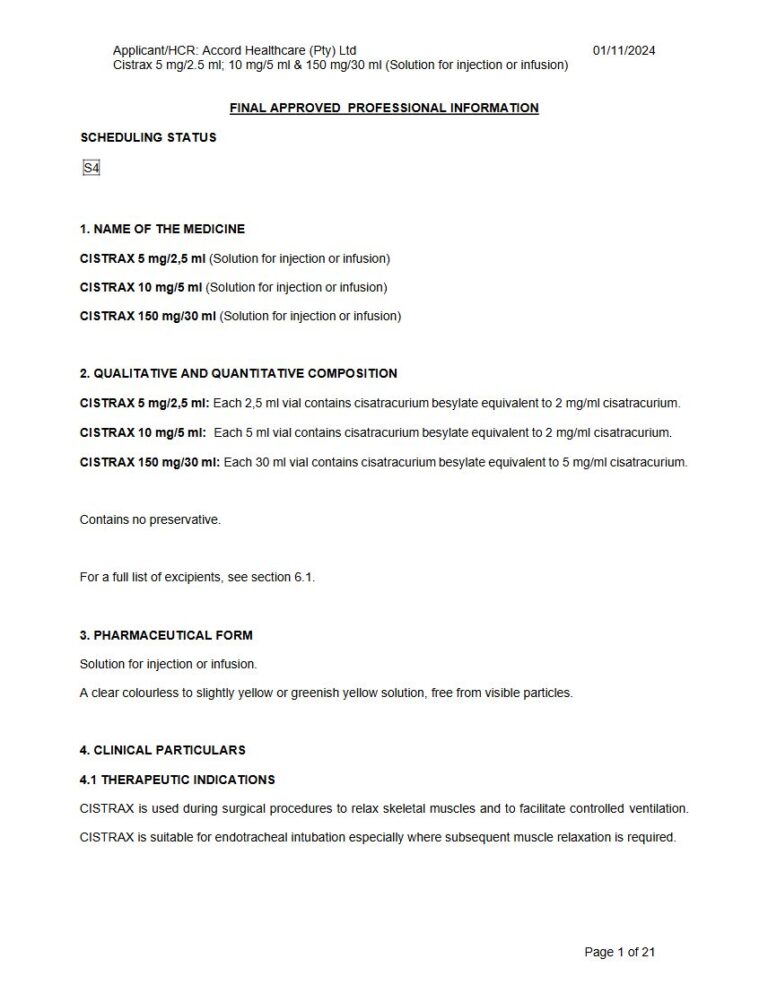
4.1 THERAPEUTIC INDICATIONS
CISTRAX is used during surgical procedures to relax skeletal muscles and to facilitate controlled ventilation. CISTRAX is suitable for endotracheal intubation especially where subsequent muscle relaxation is required.
4.2 POSOLOGY AND METHOD OF ADMINISTRATION
CISTRAX should only be administered by or under the supervision of anaesthetists or other medical practitioners who are familiar with the use and action of neuromuscular blocking medication. Facilities for tracheal intubation, and maintenance of pulmonary ventilation and adequate arterial oxygenation have to be available.
Administration by intravenous bolus injection:
Dosage in adults:
Tracheal intubation: The recommended intubation dose of CISTRAX for adults is 0,15 mg/kg. This dose produces good to excellent conditions for tracheal intubation 120 seconds after the injection. Higher doses will shorten the time to onset of the neuromuscular block.
CISTRAX administered at doses of 0,1 to 0,4 mg/kg to healthy adult patients during opioid (thiopentone/fentanyl/midazolam) or propofol anaesthesia, is summarised in the following table according to its mean pharmacodynamic data:
Initial CISTRAX dose (mg/kg) Anaesthetic background Time to 90 % T1a suppression (min) Time to maximum T1a suppression (min) Time to 25 % spontaneous T1 recovery (min)
- 0,1 Opioid 3,4 4,8 45
- 0,15 Propofol 2,6 3,5 55
- 0,2 Opioid 2,4 2,9 65
- 0,4 Opioid 1,5 1,9 91
Maintenance: The neuromuscular block can be extended with maintenance doses of CISTRAX. A dose of 0,03 mg/kg provides approximately 20 minutes of additional clinically effective neuromuscular block during opioid or propofol anaesthesia. Consecutive maintenance doses do not result in progressive prolongation of effect.
Spontaneous recovery: Once spontaneous recovery from neuromuscular block is underway, the rate is independent of the CISTRAX dose. During opioid or propofol anaesthesia, the mean median times, from 25 % to 75 % and from 5 % to 95 % recovery, are approximately 13 and 30 minutes respectively.
Reversal: The neuromuscular block following CISTRAX administration is reversible with standard doses of anticholinesterase medicines. Following administration of the reversal medicine at an average of 10 % T1 recovery, the mean times from 25 % to 75 % recovery and to full clinical recovery (T4:T1 ratio u22650,7) are approximately 4 and 9 minutes respectively.
Dosage in paediatric patients aged 1 month to 12 years:
Tracheal intubation: The recommended intubation dose of CISTRAX is 0,15 mg/kg administered rapidly over 5 to 10 seconds. This dose produces good to excellent conditions for tracheal intubation 120 seconds following the injection of CISTRAX. If a shorter clinical duration is required, pharmacodynamic data suggest that a dose of 0,1 mg/kg may produce similar intubation conditions at 120 to 150 seconds.
In paediatric patients aged 1 month to 12 years of age, CISTRAX has a shorter clinically effective duration and a faster spontaneous recovery profile than those observed in adults under similar anaesthetic conditions.
Pharmacodynamic data for the recommended CISTRAX dose are presented in the tables below and small differences, which are summarised below, were observed between the age ranges 1 to 11 months and 1 to 12 years.
Paediatric patients aged 1 to 11 months
Initial CISTRAX dose (mg/kg) Anaesthetic background Time to 90 % suppression (min) Time to maximum suppression (min) Time to 25 % spontaneous T1 recovery (min)
- 0,15 Halothane 1,4 2,0 52
- 0,15 Opioid 1,4 2,0 47
Paediatric patients aged 1 to 12 years
Initial CISTRAX dose (mg/kg) Anaesthetic background Time to 90 % suppression (min) Time to maximum suppression (min) Time to 25 % spontaneous T1 recovery (min)
- 0,08 Halothane 1,7 2,5 31
- 0,1 Opioid 1,7 2,8 28
- 0,15 Halothane 2,3 3,0 43
- 0,15 Opioid 2,6 3,6 38
The clinically effective duration of a CISTRAX dose may be expected to extend up to 20 % with halothane. No information is available on the use of CISTRAX in children during isoflurane anaesthesia, but these medicines may also be expected to extend the clinically effective duration of a CISTRAX dose by up to 20 %.
Maintenance: The neuromuscular block can be extended with maintenance doses of CISTRAX. During halothane anaesthesia, a dose of 0,02 mg/kg provides approximately 9 minutes of additional clinically effective neuromuscular block. Consecutive maintenance doses do not result in progressive prolongation of effect.
Spontaneous recovery: Once recovery from neuromuscular block is underway, the rate is independent of the CISTRAX dose administered. During opioid or halothane anaesthesia, the median times from 25 % to 75 % and from 5 % to 95 % recovery are approximately 11 and 28 minutes, respectively.
Reversal: The neuromuscular block following CISTRAX administration is reversible with standard doses of anticholinesterase medicines. Following the administration of the reversal medicine at an average of 13 % T1 recovery, the mean times from 25 % to 75 % recovery and to full clinical recovery (T4:T1 ratio u22650,7), are approximately 2 and 5 minutes respectively.
Administration by intravenous infusion:
Dosage in adults and children aged 2 to 12 years: The maintenance of a neuromuscular block may be achieved by the infusion of CISTRAX. An initial infusion rate of 3 u03bcg/kg/min (0,18 mg/kg/h) is recommended to restore 89 % to 99 % T1 suppression following evidence of spontaneous recovery. A rate of 1 to 2 u03bcg/kg/min (0,06 to 0,12 mg/kg/h) should be adequate to maintain the neuromuscular block in this range in most patients after an initial period of stabilisation of the neuromuscular block in this range in most patients.
During isoflurane or enflurane anaesthesia, a reduction of the infusion rate by up to 40 % may be required when CISTRAX is administered (see section 4.5). The infusion rate will depend upon the concentration of cisatracurium in the infusion solution, the desired degree of the neuromuscular block and the weight of the patient.
The following table provides guidelines for delivery of undiluted CISTRAX:
Infusion delivery rate of CISTRAX 2 mg/ml: Patient weight Dose (u03bcg/kg/min) Infusion rate
1,0 1,5 2,0 3,0
- 20 0,6 0,9 1,2 1,8 ml/h
- 70 2,1 3,2 4,2 6,3 ml/h
- 100 3,0 4,5 6,0 9,0 ml/h
A progressive increase or decrease in the neuromuscular blocking effect is not associated with a steady rate continuous infusion of CISTRAX. Following the discontinuation of the infusion of CISTRAX, spontaneous recovery from the neuromuscular block proceeds at a rate comparable to that following administration of a single bolus.
Dosage in neonates aged less than 1 month: No dosage recommendation for neonates can be made until further information is available (see section 4.3).
Special populations
Dosage in elderly patients: In elderly patients, CISTRAX has a similar pharmacodynamic profile to that observed in young adult patients, but it may have a slightly slower onset. No dose alterations are required in elderly patients.
Dosage in patients with renal impairment: In patients with renal impairment, CISTRAX has a similar pharmacodynamic profile to that observed in patients with normal renal function, but it may have a slightly slower onset. No dose alterations are required in patients with renal impairment.
Dosage in patients with hepatic impairment: In patients with hepatic impairment, CISTRAX has a similar pharmacodynamic profile to that observed in patients with normal hepatic function, but it may have a slightly faster onset. No dosing alterations are required in patients with end-stage liver disease.
Dosage in patients with cardiovascular disease: CISTRAX has been used to provide neuromuscular block in patients undergoing cardiac surgery. CISTRAX has not been associated with clinically significant cardiovascular effects in any dose studied [up to and including 0,4 mg/kg (8x ED95)], when administered by rapid bolus injection (over 5 to 10 seconds) to patients with serious cardiovascular disease.
Dosage in intensive care unit (ICU) patients: CISTRAX may be administered by bolus dose and/or infusion to adult patients in the ICU. An initial infusion rate of 3 u03bcg/kg/min (0,18 mg/kg/h) CISTRAX is recommended for adult ICU patients. Dosage requirements may vary widely between patients and these variations may increase or decrease with time. In clinical studies the average infusion rate was 3 u03bcg/kg/min [range 0,5 to 10,2 u03bcg/kg/min (0,03 to 0,6 mg/kg/h)]. The mean time to full spontaneous recovery following long-term infusion (up to 6 days) of CISTRAX in ICU patients was approximately 50 minutes.
Infusion delivery rate of CISTRAX 5 mg/ml Patient weight Dose (u03bcg/kg/min) Infusion rate
1,0 1,5 2,0 3,0
- 70 0,8 1,2 1,7 2,5 ml/h
- 100 1,2 1,8 2,4 3,6 ml/h
The recovery profile after CISTRAX infusions to ICU patients, is independent of the duration of infusion.
Dosage in patients undergoing hypothermic cardiac surgery: The rate of infusion required to maintain adequate surgical relaxation under these conditions may be expected to be significantly reduced. There have been no studies of CISTRAX in patients undergoing surgery with induced hypothermia (25 u00b0C to 28 u00b0C).
Method of administration: CISTRAX is used by intravenous bolus injection and intravenous infusion. For single use only. For further instructions on dilution, refer to section 6.6.
4.3 CONTRA - INDICATIONS
- CISTRAX is contra-indicated in patients with a known hypersensitivity to cisatracurium, atracurium, benzene sulphonic acid or to any of the ingredients of CISTRAX (see section 6.1).
- Pregnancy and lactation, as the use and safety of CISTRAX has not been established in women who are pregnant and breastfeeding (see section 4.6).
- CISTRAX has not been studied in neonates, and is therefore contraindicated.
4.4 SPECIAL WARNINGS AND PRECAUTIONS FOR USE
- CISTRAX must not be administered into the infusion line of a blood transfusion, as it is hypotonic.
- Patients who have received CISTRAX should have their respiration assisted or controlled until CISTRAX has been inactivated or antagonised.
- Great caution should be exercised when administering CISTRAX to patients with a history of allergic hypersensitivity to any other neuromuscular blocking medicines, since high rates of cross-reactivity (greater than 50 %) between neuromuscular blocking medicines have been reported (see section 4.3).
- CISTRAX does not have significant vagolytic or ganglion-blocking properties at recommended doses and does not induce histamine release. CISTRAX is therefore associated with greater cardiovascular stability. CISTRAX has no clinically significant effect on the heart rate and will not counteract the bradycardia produced by many anaesthetic medicines or by vagal stimulation during surgery.
- The response to CISTRAX is often unpredictable in patients with neuromuscular disorders and great care should be taken in these patients. Patients with myasthenia gravis and other forms of neuromuscular disease have shown increased sensitivity to non-depolarising blocking medicines. CISTRAX is recommended at an initial dose of not more than 0,02 mg/kg in these patients.
- Persistent muscle weakness and/or myopathy have been reported following prolonged use of CISTRAX in ICU patients. Most reports were associated with concomitant corticosteroid administration.
- Severe acid-base and/or serum electrolyte abnormalities may increase or decrease the sensitivity of patients to CISTRAX.
- A reduction in body temperature may necessitate a reduction in the CISTRAX dose since cooling reduces the rate of inactivation of CISTRAX.
- There have been no studies of cisatracurium in patients undergoing surgery with induced hypothermia (25 to 28 u00b0C). The rate of infusion required to maintain adequate surgical relaxation under these conditions may be expected to be significantly reduced.
- CISTRAX has not been studied in patients with a history of malignant hyperthermia. Studies in malignant hyperthermia-susceptible pigs indicated that cisatracurium does not trigger this syndrome.
- CISTRAX has not been studied in patients with burn wounds. Resistance to the effects of CISTRAX may occur in patients with burn wounds, the possibility of increased dosing requirements and shortened duration of action must be considered if CISTRAX is administered to these patients.
- Intensive care unit (ICU) patients: When administered to laboratory animals in high doses, laudanosine, a metabolite of cisatracurium and atracurium, has been associated with transient hypotension and in some species, cerebral excitatory effects. In the most sensitive animal species, these effects occurred at laudanosine plasma concentrations similar to those that have been observed in some ICU patients following prolonged infusion of atracurium. Consistent with the decreased infusion rate requirements of cisatracurium, plasma laudanosine concentrations are approximately one third of those following atracurium infusion.
- There have been reports of seizures in ICU patients who received atracurium and other medicines. These patients usually had one or more medical conditions predisposing to seizures (e.g. cranial trauma, hypoxic encephalopathy, cerebral oedema, viral encephalitis, uraemia). A causal relationship to laudanosine has not been established.
4.5 INTERACTION WITH OTHER MEDICINES AND OTHER FORMS OF INTERACTION
CISTRAX may influence neuromuscular transmission and interfere with the action of both competitive and depolarising neuromuscular blockers, resulting in the potentiation or antagonism of a neuromuscular block. In general adverse interactions are potentially more serious in patients with impaired neuromuscular function.
Increased effect by:
- Anaesthetics: Medicines such as halogenated anaesthetics (enflurane, isoflurane, halothane) and ketamine can increase the potentiation effect of CISTRAX. Neuromuscular blockers are potentiated in a dose-dependent manner by inhalation anaesthetics and the dose of CISTRAX may need to be reduced depending on the anaesthetic used.
- Other non-depolarising neuromuscular blocking medicines.
- Antibiotics: Including the aminoglycosides, polymyxins, spectinomycin, tetracyclines, lincomycin and clindamycin. High concentrations of certain antibiotics may produce a muscle paralysis that may be additive when used concurrently with CISTRAX.
- Antidysrhythmic medicine: Propranolol, lidocaine, procainamide and quinidine have some neuromuscular blocking activity and may enhance the block produced by CISTRAX.
- Calcium-channel blockers: Calcium-channel blockers such as diltiazem, nicardipine, nifedipine and verapamil enhance the effect of CISTRAX. Verapamil may interfere with the release of acetylcholine and prolonged use may lead to a reduction in intracellular calcium concentrations. Potentiation of the neuromuscular block may occur and the block may be resistant to reversal with neostigmine and edrophonium may be required.
- Diuretics: Furosemide and possibly thiazides, mannitol and acetazolamide may enhance the effects of CISTRAX due to the potassium-depleting effects of diuretics.
- Magnesium salts: Magnesium salts reduce the release of and the sensitivity to acetylcholine, thus contributing to the neuromuscular blockade. It may potentiate the effect of CISTRAX, and the neuromuscular block is deepened and prolonged. A reduction in the CISTRAX dose may be required. Magnesium salts must be used with caution in the post-operative period, as the use shortly after recovery from CISTRAX may lead to recurarisation.
- Lithium salts: Lithium may prolong the neuromuscular block produced by CISTRAX.
- Ganglion blocking medicines: Trimetaphan and hexamethonium may prolong the neuromuscular block when used concurrently with CISTRAX and may have direct neuroblocking activity and some activity against plasma cholinesterase.
Decreased effect by:
- Anti-epileptic medication: Patients receiving chronic carbamazepine or phenytoin have been reported to be resistant to CISTRAX and rapid recovery from the neuromuscular block may occur.
- Anticholinesterases: Anticholinesterases, including ecothiopate, edrophonium, galantamine, neostigmine, pyridostigmine, rivastigmine and possibly donepezil may antagonise the effect of CISTRAX, thereby shortening the duration and diminishing the magnitude of neuromuscular blockade.
- Immunosuppressants: Antagonism of the neuromuscular blocking effects of competitive neuromuscular blockers have been reported with azathioprine, although the effects may not be of clinical significance.
Other effects:
- Aprotinin: Caution is advised when aprotinin is used with CISTRAX, as apnoea has been reported.
- Benzodiazepines: Potentiation, antagonism and no interactions have been reported when diazepam and CISTRAX were used concurrently.
- Botulinum A toxin: The neuromuscular block induced by botulinum toxins may be enhanced by CISTRAX.
- Neuromuscular blockers: Prior administration of suxamethonium has no effect on the duration of neuromuscular block following bolus doses of CISTRAX injections or on infusion rate requirements. Administration of suxamethonium to prolong the effects of non-depolarising neuromuscular blocking medicines may result in a prolonged and complex block which can be difficult to reverse with anticholinesterases. The combination of competitive blockers may have additive or synergistic effects and the interaction may differ depending on which blocker was administered first. Caution is needed if a small dose of a short-acting blocker is given near the end of an operation in which a long-acting blocker has been given previously, since the resulting block may be greater and longer than desired. Certain medicines may aggravate or unmask latent myasthenia gravis or actually induce a myasthenic syndrome. Increased sensitivity to CISTRAX may result. Such medicines include various antibiotics, beta-blockers (propranolol, oxprenolol), antidysrhythmic medicines (procainamide, quinidine), anti-rheumatic medicines (chloroquine, D-penicillamine), trimetaphan, chlorpromazine, steroids, phenytoin and lithium (see section 4.4).
4.6 PREGNANCY AND LACTATION
CISTRAX should not be used in pregnancy and lactation (see section 4.3).
Pregnancy: There are no adequate data from the use of cisatracurium in pregnant women. Animal studies are insufficient with respect to effects on pregnancy, embryonal/foetal development, parturition, and postnatal development. The potential risk for humans is unknown. CISTRAX should not be used during pregnancy (see section 4.3).
Breastfeeding: It is not known whether cisatracurium, as in CISTRAX, or its metabolites are excreted in human milk. A risk to the breastfed infant cannot be excluded. As a precaution breastfeeding should be discontinued during treatment with CISTRAX.
Fertility: Fertility studies have not been performed.
4.7 EFFECTS ON ABILITY TO DRIVE AND USE MACHINES
This precaution is not relevant to the use of CISTRAX. CISTRAX will always be used in combination with a general anaesthetic and therefore the usual precautions relating to performance of tasks following general anaesthesia apply. CISTRAX has minor influence on the ability to drive or operate machinery. Patients should not drive, use machinery or perform any tasks that require concentration until they are certain that CISTRAX does not adversely affect their ability to do so safely (see section 4.8).
4.8 UNDESIRABLE EFFECTS
System organ class Frequency Adverse reaction
Immune system disorders Less frequent Anaphylactic reaction, anaphylactic shock
Cardiac disorders Frequent Bradycardia
Vascular disorders Frequent Hypotension
Less frequent Cutaneous flushing
Respiratory, thoracic and mediastinal disorders Less frequent Bronchospasm
Gastro-intestinal disorders Less frequent Reduced gastrointestinal motility
Skin and subcutaneous tissue disorders Less frequent Rash
Musculoskeletal, connective tissue and bone disorders Less frequent Muscle weakness, myopathy
General disorders and administration site conditions Less frequent Hypothermia
Reporting of suspected adverse reactions: Reporting suspected adverse reactions after authorisation of the medicine is important. It allows continued monitoring of the benefit/risk balance of the medicine. Healthcare professionals are asked to report any suspected adverse reactions to SAHPRA via the u201cAdverse drug reaction and quality problem reporting formu201d, found online under SAHPRAu2019s publications: https://www.sahpra.org.za/document/adverse-drug-reactions-and-quality-problem-reporting-form/.
4.9 OVERDOSE
Symptoms: Prolonged muscle paralysis and its consequences, such as prolonged apnoea and cardiovascular collapse, are expected to be the main signs of an overdose with CISTRAX.
Treatment: It is essential to maintain pulmonary ventilation and arterial oxygenation until adequate spontaneous respiration returns. CISTRAX does not impair consciousness and full sedation is required. Recovery may be accelerated by the administration of anticholinesterase medicines once evidence of spontaneous recovery is present.
