
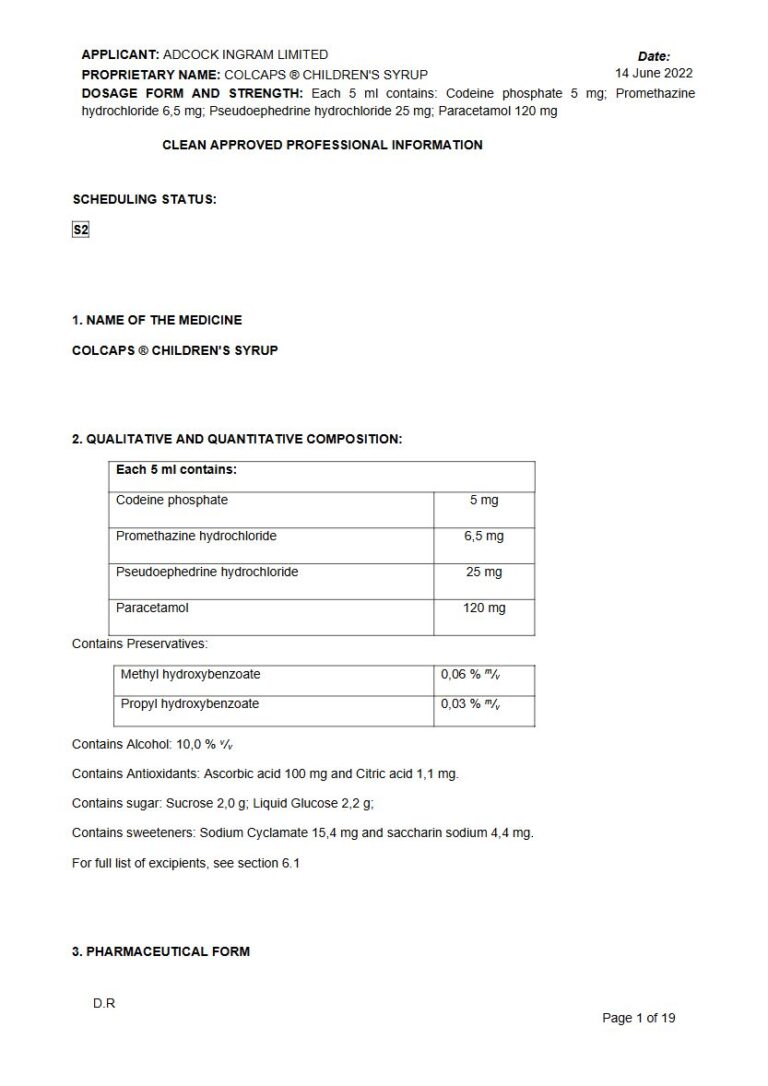
Colcaps Children’S Syrup 5 ml Syrup.
PDF Leaflet Revision Date: 14 June 2022
Clinical Summary
Quick overview from the medicine insert
Indication
Symptomatic relief of colds and flu associated with cough in children 2 years and older.
Dosage (summary)
2-5 years: 5 ml three times daily; 5-12 years: 5-10 ml three times daily.
Special Populations
- Children under 2 years
- Severe liver impairment
- Severe renal impairment
Pregnancy & Breastfeeding
Not recommended in pregnancy; contraindicated in breastfeeding mothers.
Key Drug Interactions
- CNS depressants
- MAO inhibitors
- Antihypertensives
Contraindications
- Hypersensitivity to components
- Severe liver and renal impairment
- Breastfeeding
- Children under 2 years
Common side effects
- Drowsiness
- Constipation
- Nausea
- Vomiting
Counselling Points
- Do not exceed recommended dose
- Consult doctor if symptoms persist
- Avoid alcohol while taking this medication
Serious warnings
- Risk of respiratory depression
- Potential for overdose in ultra-rapid metabolizers
Important Disclaimer
The Colcaps Children’S Syrup 5 ml Syrup. professional information leaflet below is the property of Adcock Ingram and is provided on Medinsert exactly as issued, with no.. alterations or editorial changes. We make every effort to keep content current by updating documents as soon as new versions become available. Medinsert serves as a trusted access point for healthcare professionals, but does not replace official sources or clinical judgement. For more details, please read our full disclaimer. read more>>
 Healthcare Professionals Only
This content is for registered healthcare professionals
Sign in or create a free account to read the full package insert.
Free for HPCSA-registered professionals. Powered by Medinsert.
Clinical Particulars
Section 4 of the official insert — extracted exactly as issued, no alterations
4.1 Therapeutic Indications
The symptomatic relief of colds and flu associated with cough in children 2 years and older.
4.2 Posology and method of administration
DO NOT EXCEED THE RECOMMENDED DOSE.
2 years - 5 years: 5 ml (1 teaspoonful) three times a day.
5 years - 12 years: 5 ml or 10 ml (1 or 2 teaspoonfuls) three times a day.
Not recommended for use in children under 2 years of age (see Section 4.3 Contraindications).
4.3 Contraindications
COLCAPS CHILDRENu2019S SYRUP is contraindicated in:
- Known hypersensitivity to the active substances or to any of the excipients listed under Section 6.1.
- Severe liver and renal function impairment.
- Patients receiving monoamine oxidase inhibitor treatment, or within 14 days of such treatment (see section 4.4 Special Warnings and precautions for use).
- Children under 2 years of age.
- Breastfeeding mothers (See Section 4.6).
- CYP2D6 ultra-rapid metabolisers who convert codeine into its active metabolite more rapidly and completely than other people. These individuals may experience signs of overdose/toxicity including symptoms such as extreme sleepiness, confusion, or shallow breathing, which may be life threatening. (see section 4.4 and section 5.2)
- Acute respiratory depression and obstructive airways disease especially in the presence of cyanosis and excessive bronchial secretion, and after operations on the biliary-tract.
- Patients at risk of paralytic ileus.
- Convulsive disorders, head injuries, and conditions in which intracranial pressure is raised.
- Acute alcoholism.
- COLCAPS CHILDRENu2019S SYRUP should not be given during an attack of bronchial asthma or in heart disease.
- The use of promethazine as contained in COLCAPS CHILDRENu2019S SYRUP may be associated with the sudden infant death syndrome.
4.4 Special warnings and precautions for use
Glucose:
- COLCAPS CHILDRENS SYRUP contains liquid glucose which may have an effect on the glycaemic control of patients with diabetes mellitus.
Sucrose:
- COLCAPS CHILDRENS SYRUP contains sucrose which may have an effect on the glycaemic control of patients with diabetes mellitus.
- Patients with rare hereditary conditions such as fructose intolerance, glucose-galactose mal-absorption or sucrase-isomaltase insufficiency should not take COLCAPS CHILDRENS SYRUP.
Paracetamol:
- Do not use continuously for more than ten days without consulting your doctor.
- Patients suffering from liver or kidney disease should take paracetamol-containing preparations such as COLCAPS CHILDRENu2019S SYRUP under medical supervision. Dosage in excess of those recommended may cause severe liver damage. COLCAPS CHILDRENu2019S SYRUP contains paracetamol which may be fatal in overdose. In the event of overdosage or suspected overdose and notwithstanding the fact that the person may be asymptomatic, the nearest doctor, hospital, poison control centre must be contacted immediately.
- Patients suffering from hepatitis or alcoholism or recovering from any form of liver disease should not take excessive quantities of COLCAPS CHILDRENu2019S SYRUP.
- COLCAPS CHILDRENu2019S SYRUP should be used with caution in patients with hyperthyroidism; cardiovascular disease such as dysrhythmia or tachycardia; occlusive vascular disorders, including arteriosclerosis, hypertension or aneurysms; diabetes mellitus and closed angle glaucoma.
- COLCAPS CHILDRENu2019S SYRUP should not be used by patients being treated with monoamine oxidase inhibitors (MAOIs), anti-depressants or anxiolytics or within two weeks of stopping treatment with these medications (see section 4.3 Contraindications).
Codeine phosphate:
- Codeine should be given with caution to patients with hypothyroidism, adrenocortical insufficiency, impaired liver function, prostatic hypertrophy or shock.
- Codeine should be used with caution in patients with inflammatory or obstructive bowel disorders.
- Codeine should be given with caution to patients with myasthenia gravis.
- Exceeding the prescribed dose, together with prolonged and continuous use of this medicine, may lead to dependency and addiction.
Promethazine hydrochloride:
- Promethazine hydrochloride has anticholinergic properties and should be used with care in conditions such as glaucoma.
- Cases of respiratory depression, including fatalities have been reported in children under two years of age.
- Promethazine hydrochloride may thicken or dry lung secretions and impair expectoration. It should therefore be used with caution in patients with asthma, bronchitis or bronchiectasis.
- Use with care in patients with severe coronary artery disease, narrow angle glaucoma, epilepsy or hepatic and renal insufficiency.
- Caution should be exercised in patients with bladder neck or pyloro-duodenal obstruction.
- The use of promethazine hydrochloride should be avoided in children and adolescents with signs and symptoms suggestive of Reye's Syndrome.
- Promethazine hydrochloride may mask the warning signs of ototoxicity caused by ototoxic medicines e.g. salicylates.
- Promethazine hydrochloride may also delay the early diagnosis of intestinal obstruction or raised intracranial pressure through the suppression of vomiting.
Pseudoephedrine hydrochloride:
- Use with caution in occlusive vascular disease.
- COLCAPS CHILDRENu2019S SYRUP should be discontinued if hallucinations or restlessness occur.
4.5 Interaction with other medicines and other forms of interaction
Interactions with other medicines:
- The depressant effects of codeine are enhanced by depressants of the central nervous system such as alcohol, anaesthetics, hypnotics, sedatives, and phenothiazines.
- The actions of codeine may affect the activities of other medicines e.g. the gastrointestinal effects of codeine may delay absorption as with mexiletine or may be counteractive as with cisapride, metoclopramide or domperidone.
- The effects of atropine and tricyclic antidepressants may be enhanced by promethazine hydrochloride.
- Warning symptoms of damage caused by ototoxic medicines such as aminoglycoside antibiotics may be masked.
- The sedative effect of central nervous system depressants including alcohol, barbiturates, hypnotics, opioid analgesics, anxiolytic sedatives and antipsychotics may be enhanced.
- Pseudoephedrine hydrochloride should be avoided or used with caution in patients undergoing anaesthesia with halogenated anaesthetics as they may induce ventricular fibrillation.
- An increased risk of dysrhythmias may occur if given to patients receiving cardiac glycosides, quinidine or tricyclic antidepressants.
- Reversal of the action of antihypertensive agents may occur and therefore special care is advisable in patients receiving antihypertensive therapy. Interaction with alpha- and beta-blocking medicines may be complex.
- Amphetamine-like psychostimulants: risk of hypertension.
- Oxytocin u2013 risk of hypertension.
- Enhances effects of anticholinergic medicines.
Interactions with laboratory tests:
- Promethazine hydrochloride should be discontinued at least 72 hours before the start of skin tests as it may inhibit the cutaneous histamine response thus producing false-negative results.
4.6 Fertility, pregnancy and lactation
Safety in pregnancy and lactation has not been established. Do not use in pregnancy. COLCAPS CHILDRENu2019S SYRUP is contraindicated in breastfeeding mothers. No fertility data available.
4.7 Effects on ability to drive and use machines
COLCAPS CHILDRENS SYRUP may lead to drowsiness and impaired concentration, which may be aggravated by simultaneous intake of alcohol or other medicines which depress the central nervous system. Patients should be warned against activities requiring mental alertness, judgment and/or sound coordination and vision.
4.8 Undesirable effects
The undesirable effects listed are based on the MedDRA system organ classes (SOC) classification system. The frequency groupings listed conform to the following convention: Very common (u22651/10); common (u22651/100 to <1/10); uncommon (u22651/1 000 to <1/100); rare (u22651/10 000 to <1/1 000); very rare (<1/10 000) and unknown (cannot be estimated from the available data).
Paracetamol
| System Organ Class | Frequency | Undesirable effect |
|---|---|---|
| Blood and lymphatic system disorders | Less frequent | Thrombocytopenia and agranulocytosis. |
| Immune system disorders | Less frequent | Allergic reactions. |
| Gastrointestinal disorders | Unknown | Pancreatitis. |
| Hepato-biliary disorders | Less frequent | Hepatitis. |
| Renal and urinary disorders | Less frequent | Renal colic, renal failure and sterile pyuria. |
| Skin and subcutaneous tissue disorders | Less frequent | Skin rash (usually erythematous or urticarial) but sometimes more serious and accompanied by drug fever and mucosal lesions. Dermatitis. |
Codeine phosphate
| System Organ Class | Frequency | Undesirable effect |
|---|---|---|
| Immune system disorders | Less frequent | Urticaria. |
| Psychiatric disorders | Less frequent | Restlessness and confusion. |
| Nervous system disorders | Frequent | Drowsiness. |
4.9 Overdose
In overdose, side effects can be precipitated and/or be of increased severity.
Paracetamol:
Prompt treatment is essential. In the event of an overdosage, consult a doctor immediately, or take the person to a hospital directly. A delay in starting treatment may mean that antidote is given too late to be effective. Evidence of liver damage is often delayed until after the time for effective treatment has lapsed. Susceptibility to paracetamol toxicity is increased in patients who have taken repeated high doses (greater than 5 - 10 g/day) of paracetamol for several days, in chronic alcoholism, chronic liver disease, AIDS, malnutrition, and with the use of medicines that induce liver microsomal oxidation such as barbiturates, isoniazid, rifampicin, phenytoin and carbamazepine.
Symptoms of paracetamol overdosage in the first 24 hours include pallor, nausea, vomiting, anorexia and possibly abdominal pain. Mild symptoms during the first two days of acute poisoning do not reflect the potential seriousness of the overdosage. Liver damage may become apparent 12 to 48 hours, or later after ingestion, initially by elevation of the serum transaminase and lactic dehydrogenase activity, increased serum bilirubin concentration and prolongation of the prothrombin time. Liver damage may lead to encephalopathy, coma and death. Acute renal failure with acute tubular necrosis may develop even in the absence of severe liver damage. Abnormalities of glucose metabolism and metabolic acidosis may occur. Cardiac arrhythmias have been reported.
Treatment:
Treatment for paracetamol overdosage: Although evidence is limited it is recommended that any adult person who has ingested 5 - 10 grams or more of paracetamol (or a child who has had more than 140 mg/kg) within the preceding four hours, should be given a single dose of 50 g activated charcoal. Ingestion of amounts of paracetamol smaller than this may require treatment in patients susceptible to paracetamol poisoning (see above). In patients who are stuperose or comatose endotracheal intubation should precede gastric lavage in order to avoid aspiration. N-acetylcysteine should be administered to all cases of suspected overdose as soon as possible preferably within eight hours of overdosage, although treatment up to 36 hours after ingestion may still be of benefit, especially if more than 150 mg/kg of paracetamol was taken.
