
Doxorubicin Liposomal 20 Mg/10 Ml/50 Mg/25 Ml Solution
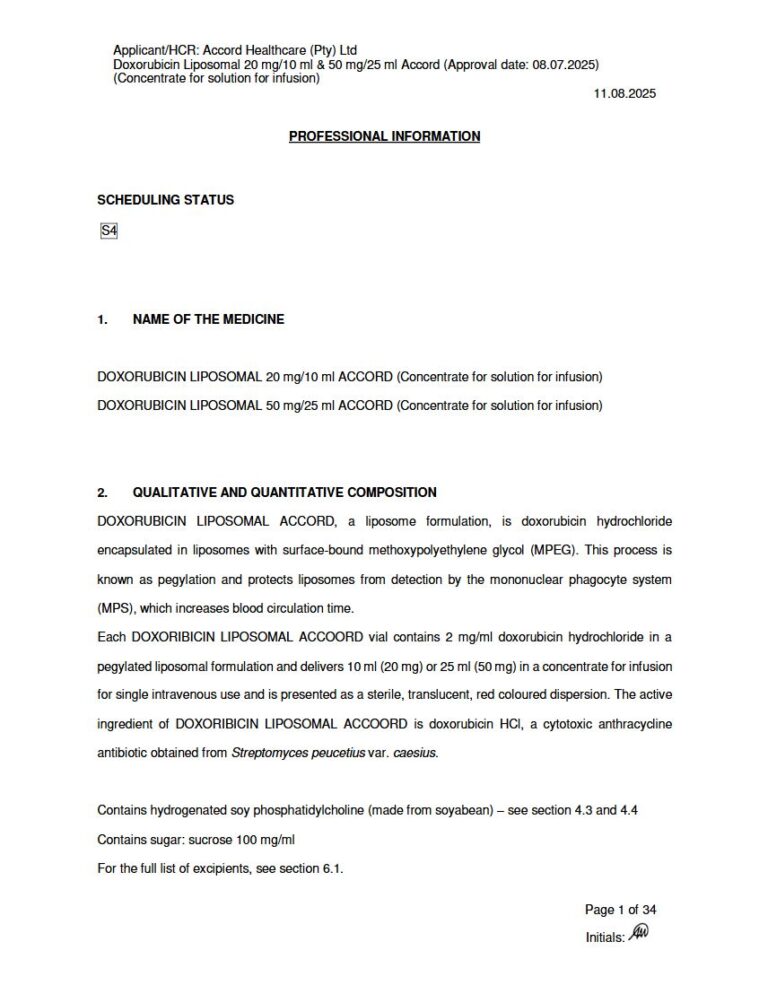
PDF Leaflet Revision Date: 11 August 2025
Clinical Summary
Quick overview from the medicine insert
Indication
Metastatic breast cancer, advanced ovarian cancer, multiple myeloma, AIDS-related Kaposi's sarcoma.
Dosage (summary)
50 mg/mu00b2 every 4 weeks for breast/ovarian cancer; 30 mg/mu00b2 on day 4 of bortezomib regimen; 20 mg/mu00b2 every 2-3 weeks for AIDS-KS.
Special Populations
- Hepatic impairment
- Renal impairment
- Elderly patients
Pregnancy & Breastfeeding
Contraindicated in pregnancy and breastfeeding.
Key Drug Interactions
- Caution with other cytotoxic agents
- May enhance toxicity of other anti-cancer therapies
Contraindications
- Hypersensitivity to doxorubicin
- Pregnancy
- Breastfeeding
- Patients <18 years
Common side effects
- Neutropenia
- Nausea
- Fatigue
- Stomatitis
- Palmar-plantar erythrodysaesthesia
Counselling Points
- Avoid pregnancy during treatment
- Monitor for infusion reactions
- Report any severe side effects immediately
Serious warnings
- Cardiac toxicity
- Myelosuppression
- Infusion reactions
Important Disclaimer
The Doxorubicin Liposomal 20 Mg/10 Ml/50 Mg/25 Ml Solution professional information leaflet below is the property of Accord Healthcare and is provided on Medinsert exactly as issued, with no.. alterations or editorial changes. We make every effort to keep content current by updating documents as soon as new versions become available. Medinsert serves as a trusted access point for healthcare professionals, but does not replace official sources or clinical judgement. For more details, please read our full disclaimer. read more>>
 Healthcare Professionals Only
This content is for registered healthcare professionals
Sign in or create a free account to read the full package insert.
Free for HPCSA-registered professionals. Powered by Medinsert.
Clinical Particulars
Section 4 of the official insert — extracted exactly as issued, no alterations
4.1 Therapeutic indications
DOXORIBICIN LIPOSOMAL ACCOORD is indicated:
- As monotherapy for patients with metastatic breast cancer.
- For the treatment of advanced ovarian cancer in women who have failed a first line platinum-based chemotherapy regimen.
- In combination with bortezomib, for the treatment of progressive multiple myeloma in patients who have received at least one prior therapy and who have already undergone or are unsuitable for bone marrow transplant.
- For AIDS-related Kaposiu2019s sarcoma (KS) in patients with low CD4 counts (< 200 CD4 lymphocytes/mm3) and extensive mucocutaneous or visceral disease.
4.2 Posology and method of administration
DOXORIBICIN LIPOSOMAL ACCOORD should only be administered under the supervision of a qualified medical practitioner specialised in the administration of cytotoxic medicines. DOXORIBICIN LIPOSOMAL ACCOORD exhibits unique pharmacokinetic properties and must not be used interchangeably with other formulations of doxorubicin hydrochloride.
Posology
Breast cancer / Ovarian cancer
DOXORIBICIN LIPOSOMAL ACCOORD is administered intravenously at a dose of 50 mg/m2 once every 4 weeks for as long as the disease does not progress and the patient continues to tolerate treatment.
Multiple myeloma
DOXORIBICIN LIPOSOMAL ACCOORD is administered at 30 mg/m2 on day 4 of the bortezomib 3-week regimen as a 1-hour infusion administered immediately after the bortezomib infusion. The bortezomib regimen consists of 1,3 mg/m2 on days 1, 4, 8, and 11 every 3 weeks. The dose should be repeated as long as patients respond satisfactorily and tolerate treatment. Day 4 dosing of both medicines may be delayed up to 48 hours as medically necessary. Doses of bortezomib should be at least 72 hours apart. The first infusion of DOXORIBICIN LIPOSOMAL ACCOORD should be administered over 90 minutes (see u201cMethod of Administrationu201d).
AIDS-KS patients
DOXORIBICIN LIPOSOMAL ACCOORD should be administered intravenously at 20 mg/m2 every 2 to 3 weeks. Avoid intervals shorter than 10 days as medicine accumulation and increased toxicity cannot be ruled out. Patients should be treated for 2 to 3 months to achieve a therapeutic response. Treatment should be continued as needed to maintain a therapeutic response.
All patients
If the patient experiences early symptoms or signs of infusion reaction (see section 4.4 and 4.8), immediately discontinue the infusion, give appropriate pre-medications (antihistamine and/or short acting corticosteroid) and restart at a slower rate.
4.3 Contraindications
- Hypersensitivity to the active substance, doxorubicin hydrochloride or to any of the excipients listed in section 6.1.
- DOXORIBICIN LIPOSOMAL ACCOORD should not be administered during pregnancy and breastfeeding (see section 4.6).
- DOXORIBICIN LIPOSOMAL ACCOORD must not be used to treat AIDS-related KS that may be treated effectively with local therapy or systemic alpha-interferon.
- The safety and effectiveness in patients less than 18 years of age have not been established.
4.4 Special warnings and precautions for use
Given the difference in pharmacokinetic profiles and dosing schedules, DOXORIBICIN LIPOSOMAL ACCOORD should not be used interchangeably with other formulations of doxorubicin hydrochloride. Combination therapy with pegylated liposomal doxorubicin hydrochloride has been extensively studied in solid tumour populations however the efficacy of pegylated liposomal doxorubicin hydrochloride combination chemotherapy has not been established in the treatment of ovarian cancer.
Cardiac risk
All patients receiving DOXORIBICIN LIPOSOMAL ACCOORD should routinely undergo frequent electrocardiogram (ECG) monitoring. Transient ECG changes such as T-wave flattening, S-T segment depression and benign dysrhythmias are not considered mandatory indications for the suspension of DOXORIBICIN LIPOSOMAL ACCOORD therapy. However, reduction of the QRS complex is considered more indicative of cardiac toxicity. If this change occurs, the most definitive test for DOXORIBICIN LIPOSOMAL ACCOORD myocardial injury i.e. endomyocardial biopsy, should be considered. More specific methods for the evaluation and monitoring of cardiac functions as compared to ECG are a measurement of left ventricular ejection fraction by echocardiography or preferably by Multigated Angiography (MUGA). These methods should be applied routinely before the initiation of DOXORIBICIN LIPOSOMAL ACCOORD therapy and should be repeated periodically during treatment. The evaluation of left ventricular function is considered to be mandatory before each additional administration of DOXORIBICIN LIPOSOMAL ACCOORD that exceeds a lifetime cumulative anthracycline dose of 450 mg/m2. The evaluation tests and methods mentioned above concerning the monitoring of cardiac performance during anthracycline therapy are to be employed in the following order: ECG monitoring, measurement of left ventricular ejection fraction, endomyocardial biopsy. If a test result indicates possible cardiac injury associated with pegylated liposomal therapy, the benefit of continued therapy must be carefully weighed against the risk of myocardial injury. In patients with cardiac disease requiring treatment, administer DOXORIBICIN LIPOSOMAL ACCOORD only when the benefit outweighs the risk to the patient.
Exercise caution in patients with impaired cardiac function who receive DOXORIBICIN LIPOSOMAL ACCORD. Whenever cardiomyopathy is suspected i.e. the left ventricular ejection fraction has decreased relatively as compared to pre-treatment values and/or (at the same time) left ventricular ejection is lower than a prognostically relevant value (e.g. < 45 %), endomyocardial biopsies should be performed and the benefit of continued therapy with DOXORIBICIN LIPOSOMAL ACCORD must be carefully evaluated against the risk of producing irreversible cardiac damage. Congestive heart failure due to cardiomyopathy may occur suddenly, without prior ECG changes and may also be encountered several weeks after discontinuation of therapy. Caution should be observed in patients who have received other anthracyclines. The total dose of doxorubicin hydrochloride should also take into account any previous (or concomitant) therapy with cardiotoxic compounds such as other anthracyclines/anthraquinones or e.g. 5-fluorouracil. Cardiac toxicity also may occur at cumulative anthracycline doses lower than 450 mg/m2 in patients with prior mediastinal irradiation or in those receiving concurrent cyclophosphamide therapy. The cardiac safety profile for the dosing schedule recommended for both breast and ovarian cancer (50 mg/m2) is similar to the 20 mg/m2 profile in patients with AIDS-KS (see section 4.8).
Myelosuppression
Many patients treated with DOXORIBICIN LIPOSOMAL ACCOORD have baseline myelosuppression due to such factors as their pre-existing HIV disease or numerous concomitant medications, or tumours involving bone marrow. In studies of patients with ovarian cancer treated at a dose of 50 mg/m2, myelosuppression was generally mild to moderate, reversible, and was not associated with episodes of neutropenic infection or sepsis. In contrast to the experience in patients with breast or ovarian cancer, myelosuppression appears to be the dose-limiting adverse event in patients with AIDS-KS (see section 4.8). Because of the potential for bone marrow suppression, periodic blood counts should be performed frequently during the course of DOXORIBICIN LIPOSOMAL ACCOORD therapy, and at a minimum, prior to each dose of DOXORUBICIN LIPOSOMAL ACCORD. Persistent severe myelosuppression, although not seen in patients with ovarian cancer, may result in super-infection or haemorrhage. Study data indicate that in patients with AIDS-KS against a bleomycin/vincristine regimen, opportunistic infections were more frequent during treatment with pegylated liposomal doxorubicin hydrochloride. Patients and doctors must be aware of this higher incidence so that appropriate action can be taken.
Secondary haematological malignancies
Secondary acute myeloid leukemias and myelodysplasias have been reported in patients having received combined treatment with doxorubicin. Therefore, any patient treated with doxorubicin should be kept under haematological supervision.
Secondary oral neoplasms
Cases of secondary oral cancer have been reported in patients with long-term (more than one year) exposure to pegylated liposomal doxorubicin hydrochloride or those receiving a cumulative pegylated liposomal doxorubicin hydrochloride dose greater than 720 mg/m2. Cases of secondary oral cancer were diagnosed both, during treatment with pegylated liposomal doxorubicin hydrochloride, and up to 6 years after the last dose. Patients should be examined at regular intervals for the presence of oral ulceration or any oral discomfort that may be indicative of secondary oral cancer.
Infusion-associated reactions
Serious and sometimes life-threatening infusion reactions, which are characterised by allergic-like or anaphylactoid-like reactions, with symptoms including asthma, flushing, urticarial rash, chest pain, fever, hypertension, tachycardia, pruritus, sweating, shortness of breath, facial oedema, chills, back pain, tightness in the chest and throat and/or hypotension may occur within minutes of starting the infusion of DOXORIBICIN LIPOSOMAL ACCORD. Convulsions have been observed in relation to infusion reactions. Temporarily stopping the infusion usually resolves these symptoms without further therapy. However, medications to treat these symptoms (e.g., antihistamines, corticosteroids, adrenaline, and anticonvulsants), as well as emergency equipment should be available for immediate use. In most patients treatment can be resumed after all symptoms have resolved, without recurrence. Infusion reactions rarely recur after the first treatment cycle. To minimise the risk of infusion reactions, the initial dose should be administered at a rate no greater than 1 mg/minute (see section 4.2).
Palmar plantar erythrodysaesthesia syndrome (PPE)
PPE is characterised by painful, macular reddening skin eruptions. In patients experiencing this event, it is generally seen after two or three cycles of treatment. Improvement usually occurs in 1-2 weeks, and in some cases, may take up to 4 weeks or longer for complete resolution. Pyridoxine at a dose of 50-150 mg per day and corticosteroids have been used for the prophylaxis and treatment of PPE, however, these therapies have not been fully evaluated. Other strategies to prevent and treat PPE include keeping hands and feet cool, by exposing them to cool water (soaks, baths, or swimming), avoiding excessive heat/hot water and keeping them unrestricted (no socks, gloves, or shoes that are tight fitting). PPE appears to be primarily related to the dose schedule and can be reduced by extending the dose interval 1-2 weeks (see section 4.2). However, this reaction can be severe and debilitating in some patients and may require discontinuation of treatment (see section 4.8).
Extravasation
Although local necrosis following extravasation has been reported infrequently, pegylated liposomal doxorubicin hydrochloride is considered to be an irritant. Animal studies indicate that administration of doxorubicin hydrochloride as a liposomal formulation reduces the potential for extravasation injury. If any signs or symptoms of extravasation occur (e.g., stinging, erythema) terminate the infusion immediately and restart in another vein. The application of ice over the site of extravasation for approximately 30 minutes may be helpful in alleviating the local reaction. DOXORIBICIN LIPOSOMAL ACCOORD must not be given by the intramuscular or subcutaneous route.
Diabetic patients
It should be noted that DOXORIBICIN LIPOSOMAL ACCOORD contains sucrose (100 mg/ml) and is administered in Dextrose 5 % in Water for intravenous infusion. An adjustment to diabetic treatment may be required.
Excipients
DOXORIBICIN LIPOSOMAL ACCOORD contains hydrogenated soy phosphatidylcholine. If you are allergic to peanut or soya, do not use this medicine.
4.5 Interaction with other medicines and other forms of interaction
No formal medicine interaction studies have been conducted with pegylated liposomal doxorubicin hydrochloride, although combination trials with conventional chemotherapy medicines have been conducted in patients with gynaecological malignancies. Caution should be exercised in the concomitant use of medicines known to interact with doxorubicin hydrochloride. DOXORIBICIN LIPOSOMAL ACCORD may potentiate the toxicity of other anti-cancer therapies. In studies of patients with solid tumours (including ovarian cancer) who have received concomitant cyclophosphamide or taxanes, no new additive toxicities were noted. In patients with AIDS-KS, exacerbation of cyclophosphamide-induced haemorrhagic cystitis and enhancement of the hepatotoxicity of 6-mercaptopurine have been reported with doxorubicin hydrochloride. Caution must be exercised when giving any other cytotoxic medicines, especially myelotoxic medicines, at the same time.
4.6 Fertility, pregnancy and lactation
Women of child-bearing potential
Women of child-bearing potential must be advised to avoid pregnancy while they or their male partner is receiving DOXORIBICIN LIPOSOMAL ACCOORD and in the six months following discontinuation of DOXORIBICIN LIPOSOMAL ACCOORD therapy.
Pregnancy
DOXORIBICIN LIPOSOMAL ACCOORD is teratogenic in animals. There is no experience in pregnant women with DOXORUBICIN LIPOSOMAL ACCORD. Teratogenicity cannot be ruled out. Therefore, DOXORIBICIN LIPOSOMAL ACCOORD should not be administered during pregnancy.
Breastfeeding
It is not known whether doxorubicin is excreted in human milk and because of the potential for serious adverse reactions in breastfeeding infants, DOXORIBICIN LIPOSOMAL ACCOORD should not be administered in women breastfeeding their infants.
Fertility
The effect of doxorubicin hydrochloride on human fertility has not been established.
4.7 Effects on ability to drive and use machines
Patients may experience dizziness and somnolence during DOXORIBICIN LIPOSOMAL ACCOORD treatment. Patients who experience these effects must avoid driving or operating machinery.
4.8 Undesirable effects
Summary of the safety profile
The most frequently reported adverse reactions were neutropenia, nausea, leucopaenia, anaemia and fatigue. Severe adverse reactions (Grade 3/4 adverse reactions) were neutropaenia, PPE, leucopaenia, lymphopaenia, anaemia, thrombocytopaenia, stomatitis, fatigue, diarrhoea, vomiting, nausea, pyrexia, dyspnoea, and pneumonia. Less frequently reported severe adverse reactions included Pneumocystis jirovecii pneumonia, abdominal pain, cytomegalovirus infection including cytomegalovirus chorioretinitis, asthenia, cardiac arrest, cardiac failure, cardiac failure congestive, pulmonary embolism, thrombophlebitis, venous thrombosis, anaphylactic reaction, anaphylactoid reaction, toxic epidermal necrolysis, and Stevens-Johnson syndrome.
Tabulated list of adverse reactions
The table below summarises the adverse reactions experienced in patients receiving treatment for breast cancer, ovarian cancer, multiple myeloma and AIDS-related KS.
SYSTEM ORGAN CLASS FREQUENCY ADVERSE REACTION
Infections and infestations Frequent Sepsis, pneumonia, Pneumocystis jirovecii pneumonia, cytomegalovirus infection including cytomegalovirus chorioretinitis, Mycobacterium avium complex infection, candidiasis, Herpes zoster, urinary tract infection, infection, upper respiratory tract infection, oral candidiasis, folliculitis, pharyngitis, nasopharyngitis
Less frequent Herpes simplex, fungal infection, opportunistic infection (including Aspergillus, Histoplasma, Isospora, Legionella, Microsporidium, Salmonella, Staphylococcus, Toxoplasma, Tuberculosis)
Neoplasms benign, malignant and unspecified (including cysts and polyps) Frequency unknown Acute myeloid leukaemia, myelodysplastic syndrome, oral neoplasm
Blood and lymphatic system disorders Frequent Leucopaenia, neutropaenia, lymphopaenia, anaemia (including hypochromic), thrombocytopaenia, febrile neutropaenia
Less frequent Pancytopaenia, thrombocytosis, bone marrow failure
Immune system disorders Less frequent Hypersensitivity, anaphylactic reaction, anaphylactoid reaction
Metabolism and nutrition disorders Frequent Decreased appetite, anorexia cachexia, dehydration, hypokalaemia, hyponatraemia, hypocalcaemia
Less frequent Hyperkalaemia, hypomagnesemia
Psychiatric disorders Frequent Confusional state, anxiety, depression, insomnia
Nervous system disorders Frequent Neuropathy peripheral, peripheral sensory neuropathy, neuralgia, paraesthesia, hypoaesthesia, dysgeusia, headache, lethargy, dizziness, hypertonia
Less frequent Polyneuropathy, convulsion, syncope, dysaesthesia, somnolence
Eye disorders Frequent Conjunctivitis
Less frequent Vision blurred, lacrimation increased, retinitis
Cardiac disorders Frequent Tachycardia
Less frequent Palpitations, cardiac arrest, cardiac failure, cardiac failure congestive, cardiomyopathy, cardiotoxicity, ventricular dysrhythmia, bundle branch block right, conduction disorder, atrioventricular block, cyanosis
Vascular disorders Frequent Hypertension, hypotension, flushing
Less frequent Pulmonary embolism, infusion site necrosis (including soft tissue necrosis and skin necrosis), phlebitis, orthostatic hypotension, thrombophlebitis, venous thrombosis, vasodilation
Respiratory, thoracic and mediastinal disorders Frequent Dyspnoea, dyspnoea exertional, epistaxis, cough
Less frequent Asthma, chest discomfort, throat tightness
Gastrointestinal disorders Frequent Stomatitis, nausea, vomiting, diarrhoea, constipation, gastritis, aphthous stomatitis, mouth ulceration, dyspepsia, dysphagia, oesophagitis, abdominal pain, abdominal pain upper, oral pain, dry mouth
Less frequent Flatulence, gingivitis, glossitis, lip ulceration
Skin and subcutaneous tissue disorders Frequent Palmar plantar erythrodysaesthesia syndrome, rash (including erythematous, maculo-papular, and papular), alopecia, skin exfoliation, blister, dry skin, erythema, pruritus, hyperhidrosis, skin hyperpigmentation
Less frequent Dermatitis, dermatitis exfoliative, acne, skin ulcer, dermatitis allergic, urticaria, skin discolouration, petechiae, pigmentation disorder, nail disorder, toxic epidermal necrolysis, erythema multiforme, dermatitis bullous, lichenoid keratosis
Frequency unknown Stevens-Johnson syndrome
Musculoskeletal and connective tissue disorders Frequent Musculoskeletal pain (including musculoskeletal chest pain, back pain, pain in extremity), muscle spasms, myalgia, arthralgia, bone pain
Less frequent Muscular weakness
Renal and urinary disorders Frequent Dysuria
Reproductive system and breast disorders Less frequent Breast pain, vaginal infection, scrotal erythema
General disorders and administration site conditions Frequent Pyrexia, fatigue, infusion-related reaction, pain, chest pain, influenza-like illness, chills, mucosal inflammation, asthenia, malaise, oedema, oedema peripheral
Less frequent Administration site extravasation, injection site reaction, face oedema, hyperthermia, mucous membrane disorder
Investigations Frequent Weight decreased
Less frequent Ejection fraction decreased, liver function test abnormal (including Blood bilirubin increased, Alanine aminotransferase increased and Aspartate aminotransferase increased), blood creatinine increased
Injury, poisoning and procedural complications Less frequent Radiation recall phenomenon
Reporting of suspected adverse reactions
Reporting suspected adverse reactions after authorisation of the medicine is important. It allows continued monitoring of the benefit/risk balance of the medicine. Healthcare professionals are asked to report any suspected adverse reactions to SAHPRA via the Med Safety App (Medsafety X SAHPRA) and eReporting platform (who-umc.org) found on SAHPRA website.
4.9 Overdose
Acute overdosage with doxorubicin hydrochloride worsens the toxic effects of mucositis, leukopenia and thrombocytopenia. Treatment of acute overdosage of the severely myelosuppressed patient consists of hospitalisation, antibiotics, platelet and granulocyte transfusions and symptomatic treatment of mucositis.
