
Eccladex Solution
PDF Leaflet Revision Date: 11 April 2025
Clinical Summary
Quick overview from the medicine insert
Indication
ICU sedation and monitored anaesthesia care.
Dosage (summary)
Loading: 1 mcg/kg over 10 mins; Maintenance: 0.2-0.7 mcg/kg/hr.
Special Populations
- Elderly
- Renal impairment
- Hepatic impairment
Pregnancy & Breastfeeding
Not recommended in pregnancy or lactation.
Key Drug Interactions
- Anaesthetics
- Sedatives
- Opioids
Contraindications
- Hypersensitivity
- Sepsis
- Unstable trauma
- Hypovolaemia
- Heart block
- Uncontrolled cardiac failure
- Imminent hepatic failure
- Uncontrolled hypotension
Common side effects
- Hypotension
- Bradycardia
- Respiratory depression
Counselling Points
- Avoid driving for 24 hours post-surgery
- Monitor for signs of hypotension or bradycardia
- Not suitable for deep sedation
Serious warnings
- Continuous monitoring required
- Risk of bradycardia and sinus arrest
Important Disclaimer
The Eccladex Solution professional information leaflet below is the property of Equity Pharmaceuticals and is provided on Medinsert exactly as issued, with no.. alterations or editorial changes. We make every effort to keep content current by updating documents as soon as new versions become available. Medinsert serves as a trusted access point for healthcare professionals, but does not replace official sources or clinical judgement. For more details, please read our full disclaimer. read more>>
 Healthcare Professionals Only
This content is for registered healthcare professionals
Sign in or create a free account to read the full package insert.
Free for HPCSA-registered professionals. Powered by Medinsert.
Clinical Particulars
Section 4 of the official insert — extracted exactly as issued, no alterations
4.1 Therapeutic indications
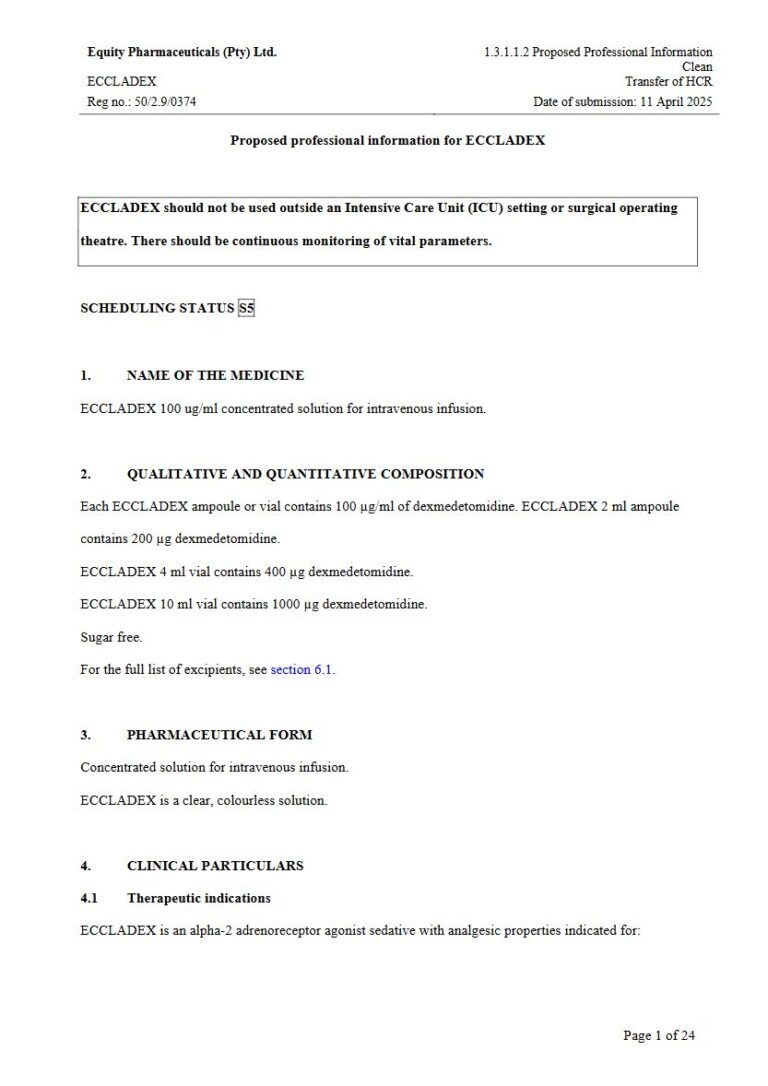
ECCLADEX is an alpha-2 adrenoreceptor agonist sedative with analgesic properties indicated for:
Intensive Care Unit (ICU) Sedation
Sedation of intubated and mechanically ventilated adult post-surgical patients during treatment in an intensive care setting.
Monitored Anaesthesia Care (MAC)/Conscious sedation in a theatre or intensive care setting for:
- Minor surgical procedures under local anaesthesia.
- Fibreoptic intubation.
Efficacy and safety have not been studied in children under 18 years of age.
4.2 Posology and method of administration
Posology
NOTE: ECCLADEX should be administered only by healthcare providers skilled in the management of patients in the intensive care setting.
Continuous monitoring of vital signs, in particular blood pressure, heart rate and oxygen saturation is mandatory during infusion of ECCLADEX.
In order to minimise undesirable pharmacologic side effects, bolus injections of ECCLADEX should not be used. Clinically significant events of bradycardia and sinus arrest have been associated with dexmedetomidine hydrochloride administration in young healthy volunteers with high vagal tone, or with different routes of administration including rapid intravenous or bolus administration of dexmedetomidine hydrochloride.
Fluid supplementation should be administered prior to and during administration of ECCLADEX to ensure normovolaemia. ECCLADEX has been administered to patients requiring mechanical ventilation as well as to patients breathing spontaneously after extubation. There is no respiratory depression associated with the administration of ECCLADEX.
Patients receiving ECCLADEX have been observed to be arousable and alert when stimulated. This is an expected component of dexmedetomidine sedation and should not be considered as evidence of lack of efficacy in the absence of other clinical signs and symptoms. ECCLADEX has been continuously infused in mechanically ventilated patients prior to extubation, during extubation, and post extubation. It is not necessary to discontinue dexmedetomidine prior to extubation.
Adults
ICU Sedation
ECCLADEX dosage should be individualised and titrated to the desired clinical effect.
Initiation
For adult patients, it is recommended to initiate ECCLADEX with a loading dose of 1,0 (one) microgram/kg over ten minutes.
Maintenance of ICU sedation
Adult patients will generally require a maintenance infusion in the range of 0,2 to 0,7 microgram/kg/hr. The rate of the maintenance infusion can be adjusted in order to achieve the desired clinical effect. Dosages as low as 0,05 micrograms/kg/hr have been used in clinical studies.
A dose reduction for both the loading and maintenance infusions should be considered in patients with impaired hepatic or renal function and in patients over 65 years of age (see sections 4.3, 4.4 and 5.2).
Conscious Sedation
Monitored anaesthesia care (MAC) with an adequate nerve block and awake fibreoptic intubation (AFI) ECCLADEX dosing should be individualised and titrated to the desired clinical effect.
Initiation
For adult patients, ECCLADEX is generally initiated with a loading infusion of 1 (one) mcg/kg over 10 minutes.
For patients over 65 years of age or those undergoing less invasive procedures such as ophthalmic surgery, a loading infusion of 0,5 mcg/kg over 10 minutes may be suitable.
Maintenance of Conscious Sedation
MAC: Following the load, maintenance dosing of ECCLADEX should generally be initiated at 0,6 mcg/kg/hr and titrated to achieve desired clinical effect with doses ranging from 0,2 to 1 mcg/kg/hr for all procedures. The rate of the maintenance infusion should be adjusted to achieve the targeted level of sedation.
AFI: Following the load in awake fibreoptic intubation, a fixed maintenance dose of 0,7 mcg/kg/hr should be used.
Dosage Adjustment
Due to possible pharmacodynamic interactions a reduction in dosage of ECCLADEX or other concomitant anaesthetics, sedatives, hypnotics or opioids may be required when co-administered (see section 4.5).
Special populations
Elderly population
Since the elderly are more sensitive to the effects of ECCLADEX dosage reductions may need to be considered (see section 4.4).
Renal impairment
Since the majority of metabolites are excreted in the urine, dosage reductions may need to be considered for patients with renal impairment.
Hepatic impairment
Dosage reductions may need to be considered for patients with hepatic impairment, as ECCLADEX is metabolized primarily in the liver.
Paediatric population
Safety and efficacy of ECCLADEX has not been studied in children and adolescents and is therefore not recommended for patients under 18 years of age.
Method of administration
A controlled infusion device should be used to administer ECCLADEX. ECCLADEX should be administered by continuous intravenous infusion not to exceed 24 hours. For instructions on preparation of the solution refer to section 6.6. Parenteral products should be inspected visually for particulate matter and discolouration prior to administration. Vials are intended for single patient use only.
4.3 Contraindications
ECCLADEX is contraindicated in patients with:
- Patients with hypersensitivity to dexmedetomidine or to any excipients in ECCLADEX (see section 6.1).
- Patients with sepsis.
- Unstable trauma patients.
- Hypovolaemic patients.
- Patients with heart block.
- Patients with uncontrolled cardiac failure.
- Patients with imminent hepatic failure.
- Patients with uncontrolled hypotension.
- Patients with acute cerebrovascular conditions.
4.4 Special warnings and precautions for use
Monitoring
ECCLADEX should be administered only by healthcare providers skilled in the management of patients in the intensive care setting and who have received complete training in the use of ECCLADEX in the ICU setting. The use in other environments is not recommended. All patients should have continuous cardiac monitoring during ECCLADEX infusion. Respiration should be monitored in non-intubated patients due to the risk of respiratory depression and in some cases apnoea (see section 4.8).
Clinical events of bradycardia and sinus arrest have been associated with ECCLADEX administration in some young, healthy volunteers with high vagal tone, or with different routes of administration including rapid intravenous or bolus administration of ECCLADEX. Bolus injections of ECCLADEX should not be used, in order to minimise undesirable pharmacological side effects.
Continuous electrocardiogram (ECG), blood pressure and oxygen saturation monitoring are mandatory during infusion of ECCLADEX.
General precautions
Some patients receiving ECCLADEX have been observed to be arousable and alert when stimulated. This alone should not be considered as evidence of lack of efficacy in the absence of other clinical signs and symptoms. ECCLADEX normally does not cause deep sedation and patients may be easily roused. ECCLADEX is therefore not suitable in patients who will not tolerate this profile of effects, for example those requiring continuous deep sedation.
ECCLADEX should not be used as a general anaesthetic induction medicine for intubation or to provide sedation during muscle relaxant use. ECCLADEX lacks the anticonvulsant action of some other sedatives and so will not suppress underlying seizure activity. Care should be taken if combining ECCLADEX with other medicines with sedative or cardiovascular actions as additive effects may occur. ECCLADEX is not recommended for patient controlled sedation. Adequate data is not available.
Cardiovascular effects and precautions
ECCLADEX reduces heart rate and blood pressure through central sympatholysis but at higher concentrations causes peripheral vasoconstriction leading to hypertension (see section 5.1). ECCLADEX is therefore not suitable in patients with severe cardiovascular instability (see section 4.3). Caution should be exercised in patients with pre-existing severe bradycardia disorders (i.e. advanced heart block), or patients with pre-existing severe ventricular dysfunction (e.g. ejection fraction < 30 %) including congestive heart failure and cardiac failure in whom sympathetic tone is critical for maintaining haemodynamic balance (see section 4.3). Data on the effects of ECCLADEX in patients with heart rate < 60 are very limited and particular care should be taken with such patients. Bradycardia does not normally require treatment, but has commonly responded to anti-cholinergic medicine or dose reduction where needed. Patients with high physical fitness and slow resting heart rate may be particularly sensitive to bradycardic effects of alpha-2 receptor agonists and cases of transient sinus arrest have been reported. Also cases of cardiac arrest, often preceded by bradycardia or atrioventricular block, have been reported (see section 4.8).
The hypotensive effects of ECCLADEX may be of greater significance in those patients with pre-existing hypotension (especially if not responsive to vasopressors), hypovolaemia, chronic hypotension or reduced functional reserve such as patients with severe ventricular dysfunction and the elderly and special care is warranted in these cases. Hypotension does not normally require specific treatment but, where needed, users should be ready to intervene with dose reduction, fluids and/or vasoconstrictors.
Patients with impaired peripheral autonomic activity (e.g. due to spinal cord injury) may have more pronounced haemodynamic changes after starting ECCLADEX and so should be treated with care.
Hypotension, bradycardia and sinus arrest
Clinical events of bradycardia and sinus arrest have been associated with ECCLADEX administration in young, healthy volunteers with high vagal tone, or with different routes of administration including rapid intravenous or bolus administration of ECCLADEX. Decreased blood pressure and/or heart rate may occur with the administration of ECCLADEX. Based on clinical experience with ECCLADEX, if medical intervention is required, treatment may include decreasing or stopping the infusion of ECCLADEX, increasing the rate of intravenous fluid administration, elevation of the lower extremities and use of pressor medicines. Because ECCLADEX has the potential to augment bradycardia induced by vagal stimuli, healthcare providers should be prepared to intervene. The intravenous administration of anticholinergic medicines should be considered to modify vagal tone. In clinical trials, atropine and glycopyrrolate were effective in the treatment of most episodes of ECCLADEX-induced bradycardia. However, in some patients with significant cardiovascular dysfunction, more advanced resuscitative measures were required. ECCLADEX decreases sympathetic nervous activity and therefore, these effects may be expected to be most pronounced in patients with desensitised autonomic nervous system control (i.e. elderly, diabetes, chronic hypertension, severe cardiac disease). Prevention of hypotension and bradycardia should take into consideration the haemodynamic stability of the patient and normovolaemia must be ensured prior to the administration of ECCLADEX. Patients who are hypovolaemic may become hypotensive under ECCLADEX therapy. Therefore, fluid supplementation should be administered prior to and during the administration of ECCLADEX. Additionally, in situations where other vasodilators or negative chronotropic medicines are administered, coadministration of ECCLADEX could have an additive pharmacodynamic effect and should be administered with caution and careful titration (see section 4.5).
Clinical events of bradycardia or hypotension may be potentiated when ECCLADEX is used concurrently with propofol or midazolam. Therefore, consider a dose reduction of propofol or midazolam (see section 4.5).
Non-surgical ICU patients
Safety and efficacy of ECCLADEX in non-surgical intensive care patients have not been established.
Transient hypertension
Transient hypertension has been observed primarily during the loading infusion, associated with initial peripheral vasoconstrictive effects of ECCLADEX and relatively higher plasma concentrations achieved during the loading infusion. If intervention is necessary, reduction of the loading infusion rate may be considered. Following the loading infusion, the central effects of ECCLADEX dominate and the blood pressure usually decreases.
Local vasoconstriction at higher concentration may be of greater significance in patients with ischaemic heart disease or severe cerebrovascular disease who should be monitored closely. Dose reduction or discontinuation should be considered in a patient developing signs of myocardial or cerebral ischaemia. Caution is advised when administering ECCLADEX together with spinal or epidural anaesthesia due to possible increased risk of hypotension or bradycardia.
Reduced lacrimation
ECCLADEX may cause reduced lacrimation. Lubrication of the patientu2019s eyes may be considered when administering dexmedetomidine to avoid corneal dryness.
Patients with neurological disorders
Experience of ECCLADEX in severe neurological disorders such as head injury and after neurosurgery is limited and it should be used with caution here, especially if deep sedation is required. ECCLADEX may reduce cerebral blood flow and intracranial pressure and this should be considered when selecting therapy (see section 4.3).
Other
Alpha-2 agonists, such as ECCLADEX have been associated with withdrawal reactions when stopped abruptly after prolonged use. This possibility should be considered if the patient develops agitation and hypertension shortly after stopping ECCLADEX. ECCLADEX may induce hyperthermia that may be resistant to traditional cooling methods. Dexmedetomidine, as contained in ECCLADEX treatment should be discontinued in the event of a sustained unexplained fever and is not recommended for use in malignant hyperthermia-sensitive patients. Diabetes insipidus has been reported in association with dexmedetomidine treatment. If polyuria occurs, it is recommended to stop dexmedetomidine and check serum sodium level and urine osmolality.
Hepatic impairment
Care should be taken in severe hepatic impairment as excessive dosing may increase the risk of adverse reactions, over-sedation or prolonged effect as a result of reduced ECCLADEX clearance (see section 4.2).
Elderly
The elderly are more prone to cardiovascular adverse events e.g. hypotension and bradycardia and the dose must be carefully titrated to obtain the desired effect. Close CVS monitoring is required. Elderly patients (over 65 years) often require lower doses of ECCLADEX (see section 4.2).
Sodium content: ECCLADEX contains less than 1 mmol sodium (23 mg) per ml.
4.5 Interaction with other medicines and other forms of interaction
Interaction studies have only been performed in adults.
Cytochrome P-450
Inhibition of CYP enzymes including CYP2B6 by dexmedetomidine, as contained in ECCLADEX has been studied in human liver microsome incubations. In vitro study suggests that interaction potential in vivo exists between dexmedetomidine and substrates with dominant CYP2B6 metabolism.
Induction of dexmedetomidine in vitro was observed on CYP1A2, CYP2B6, CYP2C8, CYP2C9 and CYP3A4, and induction in vivo cannot be excluded. The clinical significance is unknown.
Anaesthetics/Sedatives/Hypnotics/Opioids
Co-administration of ECCLADEX is likely to lead to an enhancement of effects with anaesthetics, sedatives, hypnotics and opioids such as sedative, anaesthetic and cardiorespiratory effects. Specific studies have confirmed these effects with sevoflurane, isoflurane, propofol, alfentanil, and midazolam. No pharmacokinetic interactions between dexmedetomidine and isoflurane, propofol, alfentanil, and midazolam were demonstrated. However, due to pharmacodynamic effects, when co-administered with ECCLADEX a reduction in dosage of these medicines may be required.
Neuromuscular blockers
No clinically meaningful increases in the magnitude of neuromuscular blockade and no pharmacokinetic interactions were observed with ECCLADEX and rocuronium administration.
Medicines causing hypotension and bradycardia
The possibility of enhanced hypotensive and bradycardic effects should be considered in patients receiving other medicines causing these effects, for example beta blockers, although additional effects in an interaction study with esmolol were modest.
4.6 Fertility, pregnancy and lactation
Safety in pregnancy and lactation has not been established.
Pregnancy
There are no adequate and well-controlled studies in pregnant women. The use of ECCLADEX is not recommended in pregnancy.
Labour and delivery
The safety of ECCLADEX in labour and delivery has not been studied and it is therefore not recommended for obstetrics, including caesarean section deliveries.
Breastfeeding
Dexmedetomidine, as contained in ECCLADEX is excreted in breast milk. The use of ECCLADEX is not recommended in lactating women.
Fertility
No data is available in humans.
4.7 Effects on ability to drive and use machines
ECCLADEX has major influence on the ability to drive and use machines and patients should not drive or operate machinery or make legal decisions until 24 hours after recovery from surgical procedure in which ECCLADEX was used.
4.8 Undesirable effects
a) Summary of the safety profile
Sedation of adult ICU (Intensive Care Unit) patients
The most frequently reported adverse reactions with ECCLADEX in ICU setting are hypotension, hypertension and bradycardia. Hypotension and bradycardia were also the most frequent dexmedetomidine-related serious adverse reactions.
Procedural/awake sedation
The most frequently reported adverse reactions with dexmedetomidine in procedural sedation were:
- Hypotension
- Respiratory depression
- Bradycardia
b) Tabulated list of adverse reactions
System organ class Frequent Less frequent Frequency unknown (cannot be estimated from the available data)
Infections and infestations Infection*, fungal infection*, sepsis*
Blood and the lymphatic system disorders Anaemia Leucocytosis*, coagulation disorders disseminated intravascular coagulation, haematoma, abnormal platelets, decreased prothrombin, thrombocytopenia,
Immune system disorders Allergic reaction*
Endocrine disorders Diabetes insipidus
Metabolism and nutrition disorders Hyperglycaemia, hypoglycaemia Metabolic acidosis, hypoalbuminaemia, hyopcalcemia, hypovolaemia Acidosis*, lactic acidosis*, respiratory acidosis*, diabetes mellitus*, hypokalaemia*, hyperkalaemia*, hypoproteinaemia*, increased alkaline phosphatase*, increased Non-protein nitrogen (NPN)*
Psychiatric disorders Agitation Hallucination Anxiety*, confusion*, delirium*, depression*, illusion*, nervousness*
Nervous system disorders Convulsion*, dizziness*, headache*, neuralgia*, neuritis*, neuropathy*, paraesthesia*, paralysis*, paresis*, speech disorder*
Eye disorders Diplopia*, photopsia*, abnormal vision*
Cardiac disorders Bradycardia 1,2 , myocardial ischaemia or infarction, tachycardia Atrioventricular block 1 , cardiac output decreased, cardiac arrest 1 Blood pressure fluctuation*, circulatory failure*, cyanosis, abnormal ECG*, heart disorder*, postural hypotension*, pulmonary hypertension* dysrhythmia*, atrial dysrhythmia*, atrial fibrillation, AV block*, bundle branch block*, extrasystoles*, heart block*, hypoxia*, supraventricular tachycardia*,T wave inversion, tachycardia*, ventricular dysrhythmia*, ventricular tachycardia* angina pectoris, myocardial infarction, myocardial ischaemia
Vascular disorders Hypotension 1,2 , hypertension 1,2 Haemorrhage*, cerebral haemorrhage*, peripheral ischaemia*, vascular disorder*, vasodilation*, circulatory failure, cyanosis
Respiratory, thoracic and mediastinal disorders Respiratory depression 2,3 atelectasis, pleural effusion, hypoxia Pulmonary oedema, wheezing Dyspnoea, apnoea adult respiratory distress syndrome*, apnoea*, bronchial obstruction*, bronchospasm*, coughing*, dyspnoea*, emphysema*, haemoptysis*, hypercapnia*, hypoventilation*, hypoxia*, pharyngitis*, pleurisy*, pneumonia*, pneumothorax*, pulmonary congestion*, pulmonary oedema*, respiratory disorder*, respiratory insufficiency*, increased sputum*, stridor*
Gastrointestinal disorders Nausea 2 , vomiting, dry mouth 2 Abdominal distension Abdominal pain*, diarrhoea*, eructation*, mucosal ulceration*
Hepatobiliary disorders Increased AG ratio*, increased GGT*, abnormal hepatic function*, hyperbilirubinaemia*, increased alanine transaminase*, increased aspartate aminotransferase*, increased Alanine transaminase (ALT)*, jaundice*
Skin and subcutaneous tissue disorders Oedema, rash erythematous*, increased sweating*
Musculoskeletal and connective tissue disorders Muscle weakness*
Renal and urinary disorders Decreased urine output Haematuria*, acute renal failure*, abnormal renal function*, urinary retention*, increased blood urea*, oliguria*
General disorders and administrative site conditions Withdrawal, hyperthermia Medicine ineffective, thirst, ascites*, fever*, hyperpyrexia*, hypovolaemia*, light anaesthesia, oedema*, peripheral oedema*, pain, syncope*, rigors*
Investigations Coagulation disorders*, disseminated intravascular coagulation*, haematoma*, abnormal platelets*, decreased prothrombin*, thrombocytopenia*
Injury, poisoning and procedural complications Post-procedural haemorrhage 1 See section on Description of selected adverse reactions 2 Adverse reaction observed also in procedural sedation studies 3 Incidence 'common' in ICU sedation studies * Post-marketing data
c) Description of selected adverse reactions
Clinically significant hypotension or bradycardia should be treated as described in section 4.4. In relatively healthy non-ICU patients treated with dexmedetomidine, bradycardia has occasionally led to sinus arrest or pause. The symptoms responded to leg raising and anticholinergics such as atropine or glycopyrrolate. In isolated cases bradycardia has progressed to periods of asystole in patients with pre-existing bradycardia. Also cases of cardiac arrest, often preceded by bradycardia or atrioventricular block, have been reported. Hypertension has been associated with the use of a loading dose and this reaction can be reduced by avoiding such a loading dose or reducing the infusion rate or size of the loading dose.
Reporting of suspected adverse reactions
Reporting suspected adverse reactions after authorisation of the medicine is important. It allows continued monitoring of the benefit/risk balance of the medicine. Health care providers are requested to report any suspected adverse drug reactions to: SAHPRA: https://www.sahpra.org.za/health-products-vigilance/
4.9 Overdose
Symptoms
Several cases of dexmedetomidine overdose have been reported both in the clinical trial and the post-marketing data. The reported highest infusion rates of dexmedetomidine in these cases have reached up to 60 u03bcg/kg/h for 36 minutes and 30 u03bcg/kg/h for 15 minutes in a 20-month-old child and in an adult, respectively. The most common adverse reactions reported in conjunction with overdose include bradycardia, hypotension, hypertension, over sedation, respiratory depression and cardiac arrest. First-degree AV block and second-degree heart block may occur.
Treatment
In cases of overdose with clinical symptoms, dexmedetomidine infusion should be reduced or stopped. Expected effects are primarily cardiovascular and should be treated as clinically indicated (see section 4.4). At high concentration hypertension may be more prominent than hypotension. In clinical studies, cases of sinus arrest reversed spontaneously or responded to treatment with atropine and glycopyrrolate. Resuscitation was required in isolated cases of severe overdose resulting in cardiac arrest.
