
Herclon Range 440 mg. 20 m_ Water for Injection. Infusion
PDF Leaflet Revision Date: 12 August 2022
Clinical Summary
Quick overview from the medicine insert
Indication
Treatment of HER2 positive metastatic breast cancer and gastric adenocarcinoma.
Dosage (summary)
Loading dose: 4 mg/kg IV over 90 mins; Maintenance: 2 mg/kg weekly.
Special Populations
- Elderly
- Renal impairment
- Hepatic impairment
Pregnancy & Breastfeeding
Contraindicated in pregnancy and breastfeeding; effective contraception required during treatment.
Key Drug Interactions
- Paclitaxel
- Docetaxel
- Cisplatin
Contraindications
- Hypersensitivity to trastuzumab
- Severe dyspnoea at rest
- Pregnancy and lactation
Common side effects
- Cardiotoxicity
- Infusion reactions
- Neutropenia
- Diarrhoea
Counselling Points
- Monitor for infusion reactions
- Report any breathing difficulties
- Avoid pregnancy during treatment
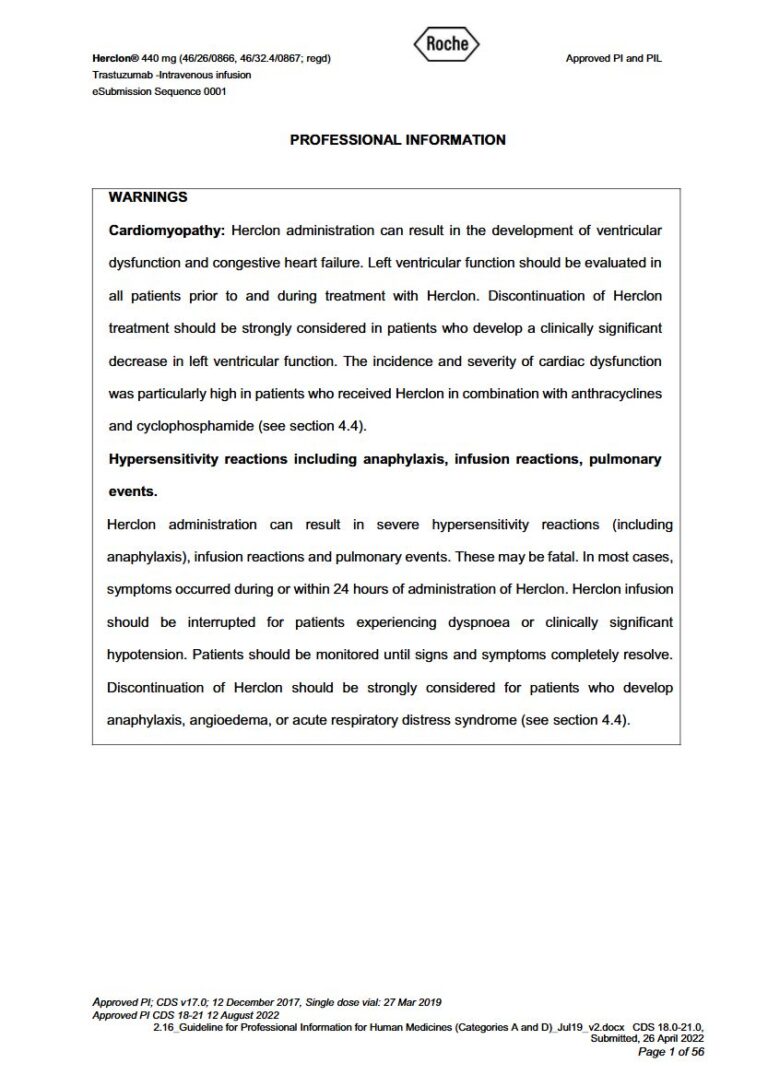
Serious warnings
- Risk of cardiomyopathy
- Severe hypersensitivity reactions
- Monitor left ventricular function
Important Disclaimer
The Herclon Range 440 mg. 20 m_ Water for Injection. Infusion professional information leaflet below is the property of Roche Products and is provided on Medinsert exactly as issued, with no.. alterations or editorial changes. We make every effort to keep content current by updating documents as soon as new versions become available. Medinsert serves as a trusted access point for healthcare professionals, but does not replace official sources or clinical judgement. For more details, please read our full disclaimer. read more>>
 Healthcare Professionals Only
This content is for registered healthcare professionals
Sign in or create a free account to read the full package insert.
Free for HPCSA-registered professionals. Powered by Medinsert.
Clinical Particulars
Section 4 of the official insert — extracted exactly as issued, no alterations
4.1 Therapeutic Indications
Herclon is indicated for the treatment of patients with metastatic breast cancer whose tumours over-express HER2:
- As monotherapy for the treatment of those patients who have received at least two chemotherapy regimens for their metastatic disease.
- In combination with paclitaxel or docetaxel for the treatment of those patients who have not received chemotherapy for their metastatic disease.
- In combination with an aromatase inhibitor for the treatment of patients with hormone-receptor positive metastatic breast cancer.
Early breast cancer (EBC)
Herclon is indicated for the treatment of patients with HER2 positive early breast cancer:
- Following surgery, chemotherapy (neoadjuvant or adjuvant) and radiotherapy (if applicable).
- In combination with adjuvant chemotherapy consisting of docetaxel and carboplatin.
- In combination with neoadjuvant chemotherapy followed by adjuvant Herclon, for locally advanced (including inflammatory) breast cancer or tumours > 2 cm in diameter.
Herclon should only be used in patients whose tumours have either HER2 overexpression or HER2 gene amplification as determined by an accurate and validated assay. Herclon should only be used in patients whose tumours have HER2 overexpression at a 3+ level as determined by immunohistochemistry.
Metastatic gastric-adenocarcinoma (MGC)
Herclon in combination with capecitabine or 5-fluorouracil and cisplatin is indicated for the treatment of patients with HER2 positive metastatic adenocarcinoma of the stomach or gastro-oesophageal junction who have not received prior anti-cancer treatment for their metastatic disease.
Herclon should only be used in patients with metastatic gastric-adenocarcinoma whose tumours have HER2 overexpression as defined by IHC 2+ and a confirmatory silver in situ hybridisation (SISH) or fluorescence in situ hybridisation (FISH) result, or by an IHC 3+ result. Accurate and validated assay methods should be used (see section 4.4).
In a method comparison study a high degree of concordance (> 95 %) was observed for SISH and FISH techniques for the detection of HER2 gene amplification in gastric-adenocarcinoma patients.
4.2 Posology and method of administration
HER2 testing is mandatory prior to initiation of Herclon therapy. Herclon should be administered by a qualified healthcare professional. It is important to check the product labels to ensure that the correct formulation (Herclon or Herclon 600 mg SC) is being administered to the patient as prescribed. Herclon IV formulation is not intended for subcutaneous administration and should be administered via intravenous infusion only. Herclon should be administered as an intravenous infusion. Do not administer as an intravenous push or bolus.
Early breast cancer (EBC), Metastatic breast cancer (MBC) and Metastatic gastric-adenocarcinoma (MGC):
Weekly schedule
The following loading and subsequent doses are recommended for monotherapy and in combination with paclitaxel or docetaxel.
Loading dose: The recommended initial loading dose is 4 mg/kg body weight Herclon administered as a 90-minute intravenous infusion. Patients should be observed for fever and chills or other infusion-associated symptoms (see sections 4.4 and 4.8). Interruption of the infusion may help control such symptoms. The infusion may be resumed when symptoms abate.
Subsequent doses: The recommended weekly dose of Herclon is 2 mg/kg body weight, beginning one week after the loading dose. If the loading dose was well tolerated, the subsequent dose can be administered as a 30-minute infusion. Patients should be observed for fever and chills or other infusion-associated symptoms (see sections 4.4 and 4.8).
Administration in combination with paclitaxel or docetaxel
Paclitaxel or docetaxel in metastatic disease may be administered the day following the first dose of Herclon or immediately after the subsequent doses of Herclon if the preceding dose of Herclon was well tolerated.
Administration in combination with an aromatase inhibitor
In the pivotal trial Herclon and anastrozole were administered on day 1. There were no restrictions on the relative timing of Herclon and anastrozole at administration. For the anastrozole dose, refer to the anastrozole professional information.
Three weekly schedule
Initial loading dose of 8 mg/kg body weight, followed by 6 mg/kg body weight 3 weeks later and then 6 mg/kg repeated at 3-weekly intervals administered as infusions over approximately 90 minutes. If the prior dosage was well tolerated, the dose can be administered as a 30-minute infusion.
Duration of treatment
Patients with MBC or MGC should be treated with Herclon until progression of disease. Patients with EBC should be treated with Herclon for 1 year or until disease recurrence, whichever occurs first. Extending treatment in EBC beyond 1 year has been shown to be not more effective than treatment for one year.
Missed doses
If the patient misses a dose of Herclon by one week or less, then the usual maintenance dose of Herclon (weekly regimen: 2 mg/kg; three-weekly regimen: 6 mg/kg) should be given as soon as possible. Do not wait until the next planned cycle. Subsequent Herclon maintenance doses should be administered 7 days or 21 days later according to the weekly or three-weekly schedules, respectively. If the patient misses a dose of Herclon by more than one week, a re-loading dose of Herclon should be given over approximately 90 minutes (weekly regimen: 4 mg/kg; three weekly regimen: 8 mg/kg) as soon as possible. Subsequent Herclon maintenance doses (weekly regimen: 2 mg/kg; three-weekly regimen 6 mg/kg respectively) should be administered 7 days or 21 days later according to the weekly or three-weekly schedules respectively.
Dose reduction
No reductions in the dose of Herclon were made during clinical trials. Patients may continue Herclon therapy during periods of reversible, chemotherapy-induced, myelosuppression but they should be monitored carefully for complications of neutropenia during this time. The specific instructions to reduce or withhold the dose of chemotherapy should be followed.
Special populations
Elderly: Data suggests that the disposition of Herclon is not altered based on age (see section 5.2). In clinical trials, elderly patients did not receive reduced doses of Herclon.
Children: Herclon is not recommended for use in children below 18 years of age because the safety and efficacy in paediatric patients have not been established.
4.3 Contraindications
- Patients with known hypersensitivity to trastuzumab, murine proteins, or to any of the excipients in Herclon.
- Patients with severe dyspnoea at rest due to complications of advanced malignancy or the requirement for supplementary oxygen therapy.
- Pregnancy and lactation (see section 4.6).
4.4 Special warnings and precautions for use
General
HER2 testing must be performed in a specialised laboratory which can ensure adequate validation of the testing procedures (see section 4.1). Herclon therapy should only be initiated under supervision of a medical practitioner experienced in the treatment of cancer patients. Refer to boxed warning. No data are available on re-treatment of patients with previous exposure to Herclon in the adjuvant or neoadjuvant setting.
Cardiotoxicity
Patients treated with Herclon are at increased risk of developing congestive heart failure (CHF) (New York Heart Association [NYHA] Class II-IV) or asymptomatic cardiac dysfunction. These events have been observed in patients receiving Herclon therapy alone or in combination with taxane following anthracycline (doxorubicin or epirubicin)u2013containing chemotherapy. This may be moderate to severe and has been associated with death (see section 4.8). In addition, extreme caution should be exercised in treating patients with increased cardiac risk, e.g. hypertension, documented coronary artery disease, CHF, LVEF of < 55 %, older age. Population pharmacokinetic model simulations indicate that trastuzumab may persist in the circulation for up to 7 months after stopping Herclon treatment (see section 5.2). Patients who receive anthracycline after stopping Herclon are also at increased risk of cardiac dysfunction. If possible, medical practitioners should avoid anthracycline-based therapy for up to 7 months after stopping Herclon. If anthracyclines are used, the patientu2019s cardiac function should be monitored carefully. Candidates for treatment with Herclon, especially those with prior exposure to an anthracycline, should undergo baseline cardiac assessment including history and physical examination, electrocardiogram (ECG) and echocardiogram or multigated acquisition scanning (MUGA) scan. Monitoring may help to identify patients who develop cardiac dysfunction, including signs and symptoms of CHF. Cardiac assessments, as performed at baseline, should be repeated every 3 months during treatment and every 6 months following discontinuation of treatment until 24 months from the last administration of Herclon. If LVEF percentage drops 10 points from baseline and to below 50 %, Herclon should be withheld and a repeat LVEF assessment performed within approximately 3 weeks. If LVEF has not improved, or has declined further, or if clinically significant CHF has developed, discontinuation of Herclon should be strongly considered.
Patients who develop asymptomatic cardiac dysfunction may benefit from more frequent monitoring (e.g. every 6 - 8 weeks). If patients have a continued decrease in left ventricular function, but remain asymptomatic, the medical practitioner should consider discontinuing therapy if no clinical benefit of Herclon therapy has been seen. The safety of continuation or resumption of Herclon in patients who experience cardiac dysfunction has not been prospectively studied. If symptomatic cardiac failure develops during Herclon therapy, Herclon should be stopped and patients treated with standard medicines for heart failure (HF). In the pivotal trials, most patients who developed HF or asymptomatic cardiac dysfunction improved with standard HF treatment consisting of an angiotensin-converting enzyme (ACE) inhibitor or angiotensin receptor blocker (ARB) and a u03b2-blocker. The majority of patients with cardiac symptoms and evidence of a clinical benefit of Herclon treatment continued with Herclon without additional clinical cardiac events.
Metastatic breast cancer (MBC)
Herclon and anthracyclines should not be given concurrently in the metastatic breast cancer setting.
Early breast cancer (EBC)
For patients with EBC, cardiac assessments, as performed at baseline, should be repeated every 3 months during treatment and every 6 months following discontinuation of treatment until 24 months from the last administration of Herclon. In patients who receive anthracycline-containing chemotherapy, further monitoring is recommended and should occur yearly up to 5 years from the last administration of Herclon, or longer if a continuous decrease of LVEF is observed. Patients with history of myocardial infarction (MI), angina pectoris requiring medication, history of or present CHF (NYHA Class II - IV), other cardiomyopathy, cardiac dysrhythmia requiring medication, clinically significant cardiac valvular disease, uncontrolled hypertension, and haemodynamic significant pericardial effusion were excluded from adjuvant breast cancer clinical trials with Herclon.
4.5 Interactions with other medicines
There have been no formal medicine interaction studies performed with Herclon in humans. The results of an interaction substudy evaluating the pharmacokinetics of capecitabine and cisplatin when used with or without Herclon suggested that the exposure to the bioactive metabolites (e.g. 5-FU) of capecitabine was not affected by concurrent use of cisplatin or by concurrent use of cisplatin plus Herclon. However, capecitabine itself showed higher concentrations and a longer half-life when combined with Herclon. The data also suggested that the pharmacokinetics of cisplatin were not affected by concurrent use of capecitabine or by concurrent use of capecitabine plus Herclon.
4.6 Fertility, pregnancy and lactation
Pregnancy
Treatment with Herclon is contraindicated during pregnancy.
Breastfeeding
Herclon crosses the placenta and appears in the breast milk (see section 4.2). Mothers breastfeeding their infants should not use Herclon (see section 4.2).
Contraception
In the post-marketing setting, cases of foetal renal growth, a single kidney and/or renal function impairment often in association with oligohydramnios, some of which also had fatal pulmonary hypoplasia of the foetus, have been reported in pregnant women receiving Herclon. Women of childbearing potential should be advised to use effective contraception during treatment with Herclon and for at least 7 months after treatment has concluded. Women who become pregnant should be advised of the possibility of harm to the foetus.
Males: Based on currently available knowledge including the elimination half-life of Herclon in humans, male and female patients treated with Herclon, are recommended to use highly effective contraception, including a barrier method for at least 7 months following the last dose of Herclon.
4.7 Effects on ability to drive and use machines
No studies on the effects on the ability to drive and use machines have been performed. Patients experiencing infusion-related symptoms should be advised not to drive or use machines until symptoms resolved completely.
4.8 Undesirable effects
a. Summary of the safety profile
Amongst the most serious and/or common adverse reactions reported with Herclon usage are cardiotoxicity, infusion-related reactions, haematotoxicity (in particular neutropenia) and pulmonary adverse events. In this section, the following categories of frequency have been used: very common ( u00b3 1/10), common ( u00b3 1/100 to <1/10), uncommon (u22651/1 000 to <1/100), rare (u22651/10 000 to <1/1 000), very rare (<1/10 000), not known (cannot be estimated from the available data). Within each frequency grouping, adverse reactions are presented in order of decreasing seriousness.
b. Tabulated list of adverse reactions
Clinical trials Presented in the following table are adverse reactions that have been reported in association with the use of Herclon alone or in combination with chemotherapy in pivotal clinical trials for EBC, MBC and MGC. All the frequency terms included are based on the highest percentage seen in pivotal clinical trials.
Table 1: Clinical trial adverse drug reactions (ADRs)
System organ class Frequency Adverse reaction Infections and infestations Very common Nasopharyngitis, infection Common Neutropenic sepsis, cystitis, herpes zoster, influenza, sinusitis, skin infection, rhinitis, upper respiratory tract infection, urinary tract infection, erysipelas, cellulitis, bronchitis Uncommon Sepsis Blood and lymphatic system disorders Very common Anaemia, thrombocytopenia, febrile neutropenia, decreased white blood cell count/leukopenia Common Neutropenia Immune system disorders Common Hypersensitivity, e.g. allergic-like reactions, (itching, lacrimation, skin rash, urticaria), anaphylaxis Metabolism and nutrition disorders Very common Increased weight, decreased weight, decreased appetite Psychiatric disorders Very common Insomnia Common Anxiety, depression, abnormal thinking Nervous system disorders Very common Tremor, dizziness, headache, hypoaesthesia, paraesthesia, dysgeusia Common Peripheral neuropathy, hypertonia, somnolence, ataxia, lethargy Rare Paresis Eye disorders Very common Conjunctivitis, increased lacrimation Common Dry eye Ear and Labyrinth Disorders Common Vertigo Uncommon Deafness Cardiac disorders Very common Decreased blood pressure, increased blood pressure, irregular heart beat, palpitation, atrial flutter, decreased left ventricular ejection fraction Common Cardiac failure (congestive), supraventricular tachydysrhythmia, cardiomyopathy, chest discomfort Uncommon Pericardial effusion Vascular disorders Very common Hot flush, lymphoedema Common Hypotension, vasodilation, hypertension Respiratory, thoracic and mediastinal disorders Very common Wheezing, dyspnoea, oropharyngeal pain, epistaxis, cough, rhinorrhoea Common Asthma, lung disorder, pharyngitis, hiccups, exertional dyspnoea, pneumonia, pleural effusion Uncommon Interstitial pneumonitis Gastrointestinal disorders Very common Diarrhoea, vomiting, nausea, lip swelling, abdominal pain, stomatitis, dyspepsia, constipation Common Pancreatitis, haemorrhoids, dry mouth, gastritis Hepatobiliary disorders Common Hepatitis, liver tenderness, abnormal liver function Rare Jaundice Skin and subcutaneous disorders Very common Erythema, rash, swelling face, palmar-plantar erythrodysaethesia syndrome (hand-foot syndrome), alopecia, nail disorder Common Acne, dry skin, ecchymosis, hyperhydrosis, maculopapular rash, pruritus, onychorrhexis, dermatitis, onychoclasis Uncommon Urticaria Musculoskeletal and connective tissue disorders Very common Arthralgia, rigor, myalgia Common Arthritis, back pain, bone pain, muscle spasms, neck pain, pain in extremity, musculoskeletal pain Renal and urinary conditions Common Renal disorder, dysuria Reproductive system and breast disorders Common Breast inflammation/mastitis, breast pain General disorders and administration site conditions Very common Asthenia, chest pain, chills, fatigue, influenza-like symptoms, infusion related reaction, pain, pyrexia, peripheral oedema, mucosal inflammation Common Oedema, malaise
Post Marketing Table 2: Adverse reactions reported in the post-marketing setting: System organ class Adverse Event Infections and infestations Meningitis Neoplasms benign and malignant (including cysts and polyps) Progression of malignant neoplasm, progression of neoplasia Blood and lymphatic system disorders Anaemia, hypoprothrombinaemia, leukaemia, neutropenia, immune thrombocytopenia Immune system disorders Anaphylactoid reaction, angioedema Psychiatric disorders Abnormal thinking Nervous system disorders Cerebral oedema Eye disorders Papilloedema, abnormal lacrimation, retinal haemorrhage, madarosis Ear and labyrinth disorders Deafness Cardiac disorders Cardiomyopathy, deterioration in congestive heart failure, hypotension, cerebrovascular disorder, cardiac failure, cardiogenic shock, pericarditis, hypertension, gallop rhythm, tachycardia Respiratory, thoracic and mediastinal disorders Interstitial lung disease, lung infiltration, bronchospasm, respiratory distress, respiratory failure, acute pulmonary oedema, respiratory insufficiency, acute respiratory distress syndrome, Cheyne-Stokes breathing, pneumonia, pneumonitis, pulmonary fibrosis, dyspnoea, hypoxia, laryngeal oedema, pleural effusion, decreased oxygen saturation, orthopnoea Gastrointestinal system disorders Diarrhoea, nausea, vomiting Hepatobiliary disorders Hepatocellular damage, liver tenderness, pancreatitis, hepatic failure, jaundice Skin and subcutaneous tissue disorders Rash, dermatitis, urticaria, Stevens-Johnson syndrome Musculoskeletal and connective tissue disorders Myalgia, bone pain Renal and urinary conditions Membranous glomerulonephritis, glomerulonephropathy, renal failure Pregnancy, puerperium and perinatal disorders Oligohydramnios, pulmonary hypoplasia, renal hypoplasia General disorders and administration site conditions Infusion-related symptoms, peripheral oedema, coma, paraneoplastic cerebellar degeneration
+ Denotes adverse reactions that have been reported in association with a fatal outcome.
c. Description of selected adverse reactions from clinical trials
Reporting of suspected adverse reactions
Reporting suspected adverse reactions after authorisation of the medicine is important. It allows continued monitoring of the benefit/risk balance of the medicine. Healthcare professionals are asked to report any suspected adverse reactions to SAHPRA via the u201c6.04 Adverse Drug Reaction Report Formu201d, found online under SAHPRAu2019s publications: https://www.sahpra.org.za/Publications/Index/8
4.9 Overdose
Symptoms of overdose may be exacerbated and/or exaggerated to those reported in side effects. There is no experience with overdosage in human clinical trials. Single doses higher than 10 mg/kg have not been tested.
