
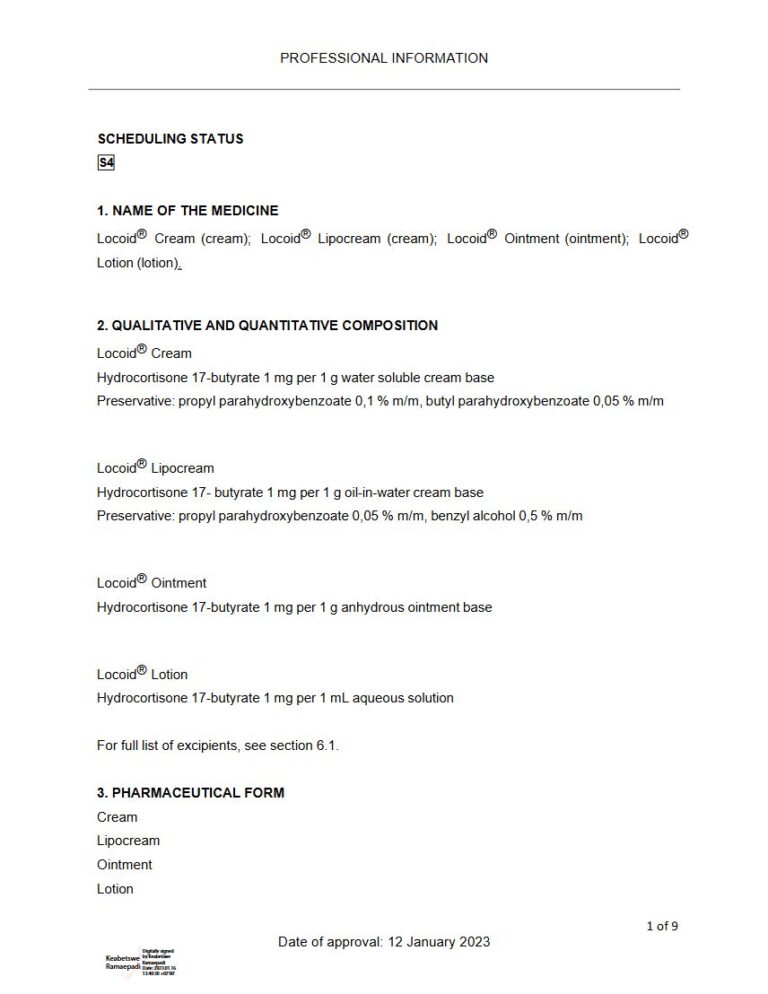
Locoid 1 mg/1 g Cream
PDF Leaflet Revision Date: 12 January 2023
Clinical Summary
Quick overview from the medicine insert
Indication
Inflammatory skin conditions such as allergy and eczema.
Dosage (summary)
Apply thinly 2 to 4 times daily; reduce to once daily or 2-3 times weekly after initial response.
Special Populations
- Children
- Elderly
Pregnancy & Breastfeeding
Use with caution in pregnancy; avoid applying directly on the breast during breastfeeding.
Contraindications
- Hypersensitivity to active substance or excipients
- Broken skin
- Skin infections
- Peri-oral dermatitis
Common side effects
- Skin atrophy
- Blurred vision
- Hypersensitivity
- Dermatitis
Counselling Points
- Avoid contact with eyes
- Wash hands after application
- Do not use on infected skin
- Avoid long-term use
Serious warnings
- Risk of glaucoma and cataract
- Systemic effects with prolonged use
- Increased susceptibility to infections
Important Disclaimer
The Locoid 1 mg/1 g Cream professional information leaflet below is the property of Adcock Ingram and is provided on Medinsert exactly as issued, with no.. alterations or editorial changes. We make every effort to keep content current by updating documents as soon as new versions become available. Medinsert serves as a trusted access point for healthcare professionals, but does not replace official sources or clinical judgement. For more details, please read our full disclaimer. read more>>
 Healthcare Professionals Only
This content is for registered healthcare professionals
Sign in or create a free account to read the full package insert.
Free for HPCSA-registered professionals. Powered by Medinsert.
Clinical Particulars
Section 4 of the official insert — extracted exactly as issued, no alterations
4.1 Therapeutic indications
Inflammatory skin conditions e.g., allergy and eczema. Also suitable for treatment of psoriasis, lichen ruber planus, and intertrigo caused by chemical and/or mechanical irritation.
4.2 Posology and method of administration
Posology
Long term topical use with Locoid u00ae should be avoided, especially in children. Apply the appropriate Locoid u00ae formulation thinly 2 to 4 times daily. After the initial therapeutic response, application should be reduced to once daily or to 2 to 3 times weekly. The optimal therapeutic effect can only be obtained if the formulation is adapted to the nature of the skin disorder e.g.:
- Locoid u00ae Cream has an oil-in-water base with a low fat content
- Locoid u00ae Lipocream has an oil-in-water base with a high fat content
- Locoid u00ae Ointment has an anhydrous ointment base
- Locoid u00ae Lotion has an alcohol-in-water solution base and contains no fat.
For cutaneous use. Gentle massage may facilitate penetration into the skin. In some cases a better result is achieved with an occlusive dressing.
4.3 Contraindications
- Hypersensitivity to the active substance or to any of the excipients listed in section 6.1.
- Do not apply to broken skin.
- Skin infections caused by bacteria, fungi or viruses (for example herpes simplex). Wound treatment especially ulcerous lesions.
- Peri-oral dermatitis.
- History of allergy to the ingredients.
4.4 Special warnings and precautions for use
Application in or near the eye may lead to glaucoma simplex or subcapsular cataract. Keep away from the eyes. Application under occlusion should be restricted to dermatoses involving limited areas. Application to the face, genitals, flexures and other areas of thin skin may cause skin atrophy and increased absorption and should be avoided. Hands must be washed after each application unless Locoid u00ae is used to treat the hands. Systemic effects may develop after use for a longer period, under occlusive dressing, intertriginous areas, in a large area of skin and especially in children, leading to suppression of the adrenal cortex function, and can lead to suppression of the growth hormone secretion. Due to the immunosuppressant and anti-inflammatory effect of corticosteroids, Locoid u00ae may be associated with increased susceptibility to skin infections, aggravation of existing infection, and activation of latent infection. As such, Locoid u00ae is contraindicated against use on infected skin (see section 4.3) and should be used with particular caution at the site of previous or suspected infections (see section 4.3). In some patients with psoriasis, topical corticosteroids may cause rebound relapses following development of tolerance, risk of generalised pustular psoriasis and local and systemic toxicity due to impaired barrier function of the skin. Steroids may have a place in psoriasis of the scalp and chronic plaque psoriasis of the hands and feet. Careful patient supervision is important. Long term continuous or inappropriate use of topical steroids can result in the development of rebound flares after stopping treatment (topical steroid withdrawal syndrome). A severe form of rebound flare can develop which takes the form of a dermatitis with intense redness, stinging and burning that can spread beyond the initial treatment area. It is more likely to occur when delicate skin sites such as the face and flexures are treated. Should there be a reoccurrence of the condition within days to weeks after successful treatment a withdrawal reaction should be suspected. Reapplication should be with caution and specialist advise is recommended in these cases or other treatment options should be considered (see section 4.8). Visual disturbance may be reported with systemic and topical corticosteroid use. If a patient presents with symptoms such as blurred vision or other visual disturbances, the patient should be considered for referral to an ophthalmologist for evaluation of possible causes which may include cataract, glaucoma or rare diseases such as central serous chorioretinopathy (CSCR) which have been reported after use of systemic and topical corticosteroids. Locoid u00ae lipocream contains benzyl alcohol which may cause mild local irritation. Locoidu00ae cream contains cetostearyl alcohol which may cause local skin reactions (e.g contact dermatitis). Locoidu00ae cream and lipocream contains parahydroxybenzoate and may cause allergic reactions which can be delayed. Instruct patients not to smoke or go near naked flames - risk of severe burns. Fabric (clothing, bedding, dressings etc.) that has been in contact with this product burns more easily and is a serious fire hazard. Washing clothing and bedding may reduce product build-up but not totally remove it. Paediatric population
Care should be taken in prescribing Locoid u00ae to children. Locoid u00ae preparations should not be used in nappy areas in infants for flexural eruptions and ideally, should not be used in infants and young children at all.
4.5 Interaction with other medicines and other forms of interaction
No data available.
4.6 Fertility, pregnancy and lactation
Pregnancy
Corticosteroids such as hydrocortisone pass the placenta and may therefore influence the foetus. This is only of significance when large areas are treated intensively with Locoid u00ae. Corticosteroids have been shown to be teratogenic in animal studies.
Breastfeeding
Care should be taken when treating breastfeeding mothers with large quantities of Locoid u00ae, as it is not known whether Locoid u00ae absorbed through the skin is present in breast milk. Locoid u00ae can be used during breastfeeding, but it is recommended to avoid applying Locoid u00ae directly on the breast.
Fertility
No animal or human data on Locoid u00ae and fertility is available.
4.7 Effects on ability to drive and use machines
None known.
4.8 Undesirable effects
The following side effects are reported less frequently with topical corticosteroids such as Locoid u00ae but may occur more frequently with the use of occlusive dressings.
Tabulated summary of adverse reactions
MedDRA System Organ Less frequent Unknown frequency Class
Immune system disorders Hypersensitivity
Endocrine disorders Adrenal suppression
Eye disorders Vision, blurred*
Skin and subcutaneous tissue disorders Skin atrophy** Dermatitis*** Telangiectasia Skin striae Purpura Pustular acne Peri-oral dermatitis Skin depigmentation Rosacea-like skin, masking and spreading of infections, steroid acne. Pruritus Erythema Rash Withdrawal reactions
General disorders and administration site conditions Rebound effect Application site pain
*See also section 4.4 **often irreversible, with thinning of the epidermis ***Dermatitis and eczema, including contact dermatitis Skin and Subcutaneous Tissue Disorders u2013 Frequency not known: Withdrawal reactions - redness of the skin which may extend to areas beyond the initial affected area, burning or stinging sensation, itch, skin peeling, oozing pustules (see section 4.4).
Reporting of suspected adverse reactions
Reporting suspected adverse reactions after authorisation of the medicine is important. It allows continued monitoring of the benefit/risk balance of the medicine. Healthcare providers are asked to report any suspected adverse reactions to SAHPRA via the u201c6.04 Adverse Drug Reactions Reporting Formu201d, found online under SAHPRAu2019s publications: https://www.sahpra.org.za/Publications/Index/8. Reporting can also be done directly to Adcock Ingram Limited at:
Adcock Ingram Limited: E-mail : [email protected] Tel : 011 635 0134
4.9 Overdose
Excessive use under occlusive dressings may produce adrenal suppression. No special procedures or antidote. See sections 4.4 and 4.8. Treatment is symptomatic and supportive.
