
Nolvadex -D 20 mg Film- coated tablet
PDF Leaflet Revision Date: 15 February 2022
Clinical Summary
Quick overview from the medicine insert
Indication
Treatment of breast cancer.
Dosage (summary)
20-40 mg daily, in divided doses or as a single dose.
Special Populations
- Elderly
- Women of childbearing potential
Pregnancy & Breastfeeding
Contraindicated in pregnancy; not recommended during lactation.
Key Drug Interactions
- Coumarin-type anticoagulants
- CYP2D6 inhibitors
- CYP3A4 inducers
Contraindications
- Pregnancy
- Hypersensitivity to ingredients
Common side effects
- Hot flushes
- Nausea
- Fatigue
- Vaginal bleeding
Counselling Points
- Avoid pregnancy during treatment and for 9 months after
- Monitor for abnormal gynaecological symptoms
Serious warnings
- Increased risk of endometrial cancer
- Risk of thromboembolic events
Important Disclaimer
The Nolvadex -D 20 mg Film- coated tablet professional information leaflet below is the property of Astrazeneca Pharmaceuticals and is provided on Medinsert exactly as issued, with no.. alterations or editorial changes. We make every effort to keep content current by updating documents as soon as new versions become available. Medinsert serves as a trusted access point for healthcare professionals, but does not replace official sources or clinical judgement. For more details, please read our full disclaimer. read more>>
 Healthcare Professionals Only
This content is for registered healthcare professionals
Sign in or create a free account to read the full package insert.
Free for HPCSA-registered professionals. Powered by Medinsert.
Clinical Particulars
Section 4 of the official insert — extracted exactly as issued, no alterations
4.1 Therapeutic indications
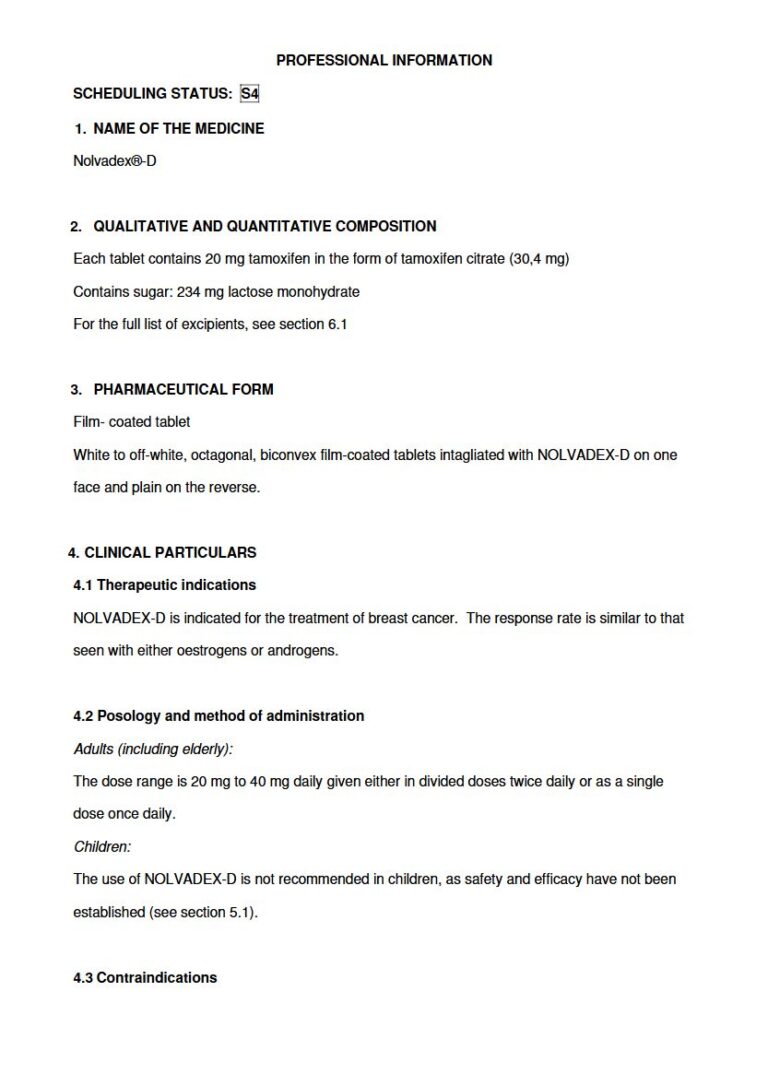
NOLVADEX-D is indicated for the treatment of breast cancer. The response rate is similar to that seen with either oestrogens or androgens.
4.2 Posology and method of administration
Adults (including elderly): The dose range is 20 mg to 40 mg daily given either in divided doses twice daily or as a single dose once daily.
Children: The use of NOLVADEX-D is not recommended in children, as safety and efficacy have not been established (see section 5.1).
4.3 Contraindications
NOLVADEX-D must not be administered during pregnancy (see section 4.6). Pre-menopausal patients must be carefully examined before commencing treatment to exclude the possibility of pregnancy.
NOLVADEX-D should not be given to patients who have experienced hypersensitivity to the product or any of its ingredients.
4.4 Special warnings and precautions for use
When NOLVADEX-D is used in combination with coumarin-type anticoagulants, a significant increase in anticoagulant effect, with risk of bleeding may occur. Where such co-administration is initiated, reduction of anticoagulant dosage and careful monitoring of the patient is recommended.
Concomitant medications that inhibit CYP2D6 may lead to reduced concentrations of the active metabolite endoxifen. Therefore, potent inhibitors of CYP2D6 (e.g. paroxetine, fluoxetine, quinidine, cinacalcet or bupropion) should whenever possible be avoided during tamoxifen treatment (see sections 4.5).
Menstruation is suppressed in a proportion of premenopausal women receiving NOLVADEX-D. Rare cases of pancreatitis have been observed in association with NOLVADEX-D therapy, mostly in patients with pre-treatment elevated triglycerides. Very rarely cases of interstitial pneumonitis have been reported.
Endometrial changes: An increased incidence of endometrial cancer and uterine sarcoma (mostly malignant mixed Mullerian tumours) has been reported in association with NOLVADEX-D treatment. The underlying mechanism is unknown, but may be related to the oestrogen-like effect of NOLVADEX-D. Any women receiving or having previously received NOLVADEX-D, who report abnormal gynaecological symptoms, especially vaginal bleeding, should be promptly investigated.
Exacerbation of hereditary angioedema: In patients with hereditary angioedema NOLVADEX-D may induce or exacerbate symptoms of angioedema.
Secondary tumours: A number of second primary tumours, occurring at sites other than the endometrium and the opposite breast, have been reported in clinical trials. In animal studies high doses of NOLVADEX-D increases ALA synthase activity, although in man no reports of porphyric attacks have been associated with NOLVADEX-D.
In delayed microsurgical breast reconstruction NOLVADEX-D may increase the risk of microvascular flap complications.
In an uncontrolled trial in 28 girls aged 2-10 years with McCune Albright Syndrome (MAS), who received 20 mg once a day for up to 12 months duration, mean uterine volume increased after 6 months of treatment and doubled at the end of the one-year study. While this finding is in line with the Pharmacodynamic properties of tamoxifen, a causal relationship has not been established (see section 5.1).
Contains lactose: Patients with the rare hereditary conditions of galactose intolerance e.g. galactosaemia, Lapp lactase deficiency, glucose-galactose malabsorption or fructose intolerance should not take NOLVADEX-D.
4.5 Interaction with other medicines and other forms of interaction
When NOLVADEX-D is used in combination with coumarin-type anticoagulants, a significant increase in anticoagulant effect may occur. Where such coadministration is initiated for the treatment of breast cancer, careful monitoring of the patient is recommended.
When NOLVADEX-D is used in combination with cytotoxic agents, there is increased risk of thromboembolic events occurring (see section 4.8).
The use of tamoxifen in combination with an aromatase inhibitor as adjuvant therapy has not shown improved efficacy compared with tamoxifen alone.
The known principal pathway for tamoxifen metabolism in humans is demethylation, catalysed by CYP3A4 enzymes. Pharmacokinetic interaction with the CYP3A4 inducing agent rifampicin, showing a reduction in tamoxifen plasma levels have been reported in the literature. The relevance of this to Clinical practice is not known.
Pharmacokinetic interaction with CYP2D6 Inhibitors, showing a reduction in plasma level of an active tamoxifen metabolite, 4-hydroxy-N-desmethyltamoxifen (endoxifen), has been reported in the literature. Reduced efficacy of NOLVADEX-D has been reported with concomitant use of some selective serotonin reuptake inhibitor (SSRI) antidepressants such as paroxetine. As a reduced effect of tamoxifen cannot be excluded, co-administration with potent CYP2D6 inhibitors (e.g. paroxetine, fluoxetine, quinidine, cinacalcet or bupropion) should whenever possible be avoided (see sections 4.4).
4.6 Fertility, pregnancy and lactation
Women of childbearing potential: Women should be advised not to become pregnant whilst taking NOLVADEX-D and for 9 months following cessation of therapy and should use barrier or other non-hormonal contraceptive methods if sexually active. Pre-menopausal women must be carefully examined before treatment to exclude pregnancy.
Women should be informed of the potential risks to the foetus, should they become pregnant whilst taking NOLVADEX-D or within nine months of cessation of therapy.
Pregnancy: NOLVADEX-D must not be administered during pregnancy. There have been reports of spontaneous abortions, birth defects and foetus death after women have taken NOLVADEX-D. In rodent models of foetal reproductive tract development, NOLVADEX-D was associated with changes similar to those caused by oestradiol, ethynyloestradiol, clomiphene and diethylstilboestrol (DES). Although the clinical relevance of these changes is unknown, some of them, especially vaginal adenosis, are similar to those seen in young women who were exposed to DES in utero and who have a 1 in 1 000 risk of developing clear-cell carcinoma of the vagina or cervix.
Lactation: It is not known if NOLVADEX-D is excreted in human milk and therefore the medicine is not recommended during lactation.
4.7 Effects on ability to drive and use machines
There is no evidence that NOLVADEX-D results in impairment of these activities. However, fatigue has been reported with the use of NOLVADEX-D and caution should be observed when driving or operating machinery while such symptoms persist.
4.8 Undesirable effects
When side-effects are severe, it may be possible to control them by a simple reduction of dosage (within the recommended dosage range) without loss of control of the disease. If side-effects do not respond to this measure, it may be necessary to stop the treatment.
The following definitions apply to the incidence of undesirable effects: Frequencies are defined as: very common (u2265 1/10); common (u2265 1/100 to < 1/10); uncommon (u2265 1/1,000 to < 1/100); rare (u2265 1/10,000 to < 1/1,000); very rare (< 1/10,000), not known (cannot be estimated from the available data).
System Organ Class Frequency Adverse Event Neoplasms benign, malignant and unspecified (incl cysts and polyps) Common Uterine fibroids Uncommon Endometrial cancer Rare Uterine Sarcoma (mostly malignant mixed Mullerian tumours), Tumour Flare Blood and lymphatic system disorders Common Anaemia Uncommon Thrombocytopenia, leukopenia Rare Neutropenia, agranulocytosis Immune system disorders Common Hypersensitivity reactions Metabolism and nutrition disorders Very common Fluid retention Uncommon Weight gain, hypercalcaemia (in patients with bony metastases), Psychiatric disorders Very common Depression Nervous system disorders Common Ischaemic cerebrovascular events, headache, light headedness, sensory disturbances (including paraesthesia and dysgeusia) Rare Optic neuritis Eye disorders Common Cataracts, retinopathy Uncommon Visual disturbances Rare Corneal changes, optic neuropathy Vascular disorders Very Common Hot flushes Common Thromboembolic events (including deep vein thrombosis, microvascular thrombosis and pulmonary embolism) Respiratory, thoracic and mediastinal disorders Uncommon Interstitial pneumonitis Gastrointestinal disorders Very common Nausea Common Gastrointestinal intolerance: vomiting, diarrhoea, constipation Uncommon Pancreatitis Hepatobiliary disorders Common Changes in liver enzymes, fatty liver Uncommon Cirrhosis of the liver Rare Hepatitis, cholestasis, hepatic failure, hepatocellular injury, hepatic necrosis Skin and subcutaneous tissue disorders Very common Skin rash Common Alopecia Rare Angioedema, Steven-Johnsons syndrome, toxic epidermal necrolysis, cutaneous vasculitis, bullous pemphigoid, erythema multiforme Very rare Cutaneous lupus erythematosus Musculoskeletal and connective tissue disorders Common Leg cramp, myalgia Reproductive system and breast disorders Very common Vaginal bleeding, vaginal discharge, menstrual suppression Common Pruritus valvae, endometrial changes (including hyperplasia and polyps) Rare Endometriosis, cystic ovarian swelling, vaginal polyps Congenital, familial and genetic disorders Very rare Porphyria cutanea tarda General disorders and administration site conditions Very common Fatigue Investigations Common Elevated triglycerides Injury, poisoning and procedural complications Very rare Radiation recall Cases of exacerbation of angioedema have been reported in patients with hereditary angioedema receiving NOLVADEX-D.
4.9 Overdose
On theoretical grounds, overdosage would be expected to cause enhancement of the pharmacological side effects. Animal studies showed that extreme overdosage (100-200 times the recommended daily dose) may produce oestrogenic effects. There have been reports in the literature that NOLVADEX-D given at several times the standard dose may be associated with prolongation of the QT interval of the ECG. There is no specific antidote and treatment must be symptomatic.
