
Nurofen Cold And Flu 200 mg, 30 mg Tablet
PDF Leaflet Revision Date: 01 September 2023
Clinical Summary
Quick overview from the medicine insert
Indication
Relief of symptoms of colds and flu.
Dosage (summary)
Adults: 2 tablets initially, then 1-2 tablets every 4-6 hours, max 6 tablets/24h.
Special Populations
- Elderly
- Renal impairment
- Hepatic impairment
Pregnancy & Breastfeeding
Avoid in pregnancy after 30 weeks; contraindicated in breastfeeding.
Key Drug Interactions
- MAOIs
- Anticoagulants
- Antihypertensives
- Corticosteroids
Contraindications
- Hypersensitivity to ibuprofen or pseudoephedrine
- Children under 12
- Gastrointestinal bleeding
- Severe coronary heart disease
Common side effects
- Gastrointestinal bleeding
- Dyspepsia
- Headache
- Drowsiness
Counselling Points
- Do not exceed recommended dose
- Consult doctor if symptoms persist
- Avoid use with other NSAIDs
Serious warnings
- Risk of gastrointestinal bleeding
- Serious skin reactions
- Caution in cardiovascular disease
Important Disclaimer
The Nurofen Cold And Flu 200 mg, 30 mg Tablet professional information leaflet below is the property of Reckitt Benckiser Pharmaceuticals and is provided on Medinsert exactly as issued, with no.. alterations or editorial changes. We make every effort to keep content current by updating documents as soon as new versions become available. Medinsert serves as a trusted access point for healthcare professionals, but does not replace official sources or clinical judgement. For more details, please read our full disclaimer. read more>>
 Healthcare Professionals Only
This content is for registered healthcare professionals
Sign in or create a free account to read the full package insert.
Free for HPCSA-registered professionals. Powered by Medinsert.
Clinical Particulars
Section 4 of the official insert — extracted exactly as issued, no alterations
4.1 Therapeutic indications
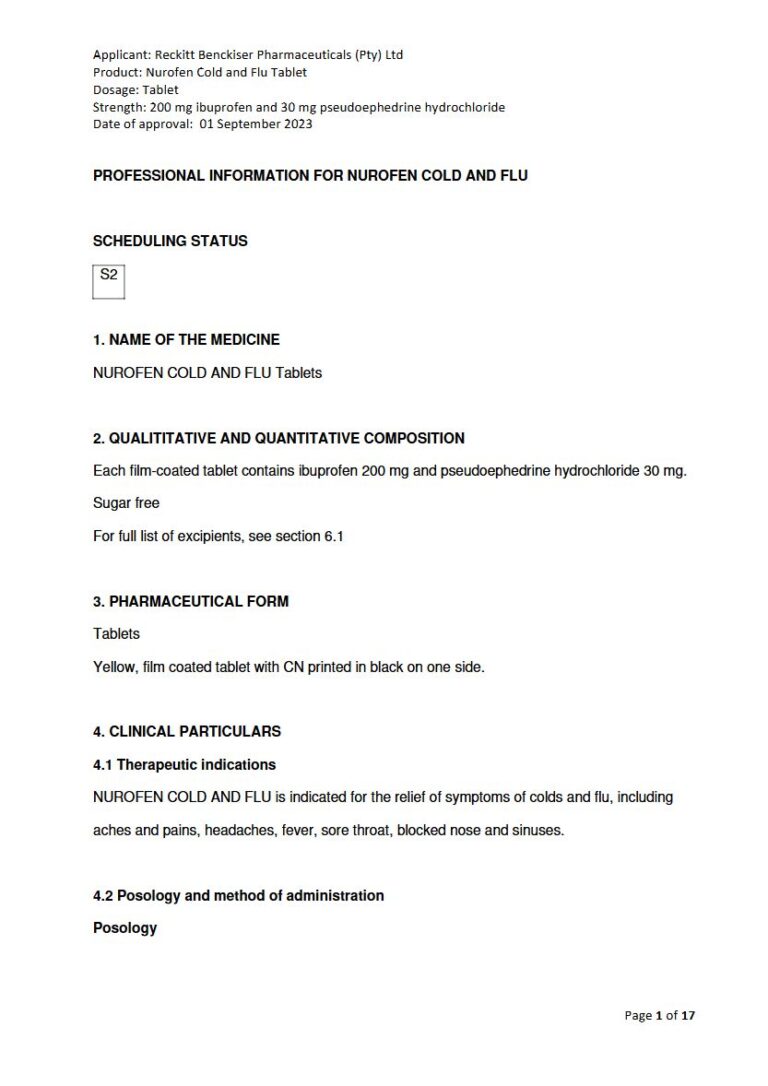
NUROFEN COLD AND FLU is indicated for the relief of symptoms of colds and flu, including aches and pains, headaches, fever, sore throat, blocked nose and sinuses.
4.2 Posology and method of administration
Posology
Adults and children over 12 years: Initial dose: 2 tablets taken with water, then if necessary, 1 or 2 tablets every 4 to 6 hours. Do not exceed 6 tablets in any 24 hours. If symptoms persist for more than 3 days, consult your doctor. Use the lowest possible dose for the shortest possible duration of treatment.
Paediatric population: Not to be given to children under 12 years (see section 4.3).
Method of administration
For oral administration with water
4.3 Contra-indications:
- Hypersensitivity to ibuprofen, pseudoephedrine or any of the excipients in the product.
- Patients who have previously shown hypersensitivity reactions (e.g. asthma, rhinitis, angioedema, or urticaria) in response to acetylsalicylic acid (aspirin) or other non-steroidal anti-inflammatory drugs.
- NUROFEN COLD AND FLU is not recommended for use in children under the age of 12 years.
- NUROFEN COLD AND FLU should not be given to patients receiving monoamine oxidase inhibitors (MAOI) therapy or within 14 days of ceasing such therapy (see section 4.5)
- NSAIDs should not be given to patients with history of gastrointestinal bleeding or perforation (PUBs) related to previous NSAID use.
- Active or history of recurrent ulcer, haemorrhage or perforations.
- Severe coronary heart disease and cardiovascular disorders. Severe hypertension.
- Use of NSAIDu2019s is contraindicated in patients with heart failure, renal failure or hepatic failure (see section 4.4)
- Pregnancy and lactation (see section 4.6). Avoid use of NSAIDs in women around 30 weeks gestation and later in pregnancy due to the risks of oligohydramnios/foetal renal dysfunction and premature closure of the foetal ductus arteriosus.
4.4 Special warnings and precautions for use
- NUROFEN COLD AND FLU should not be used without consulting a doctor or pharmacist if you are presently taking monoamine oxidase inhibitors or other medicines for depression, psychiatric or emotional conditions or hypertension.
- NUROFEN COLD AND FLU should not be given to patients with cardiovascular disease, hypertension, diabetes, hyperthyroidism, phaeochromocytoma, closed angle glaucoma, prostatic enlargement, occlusive vascular disorders or aneurysms.
- Anginal pain may be precipitated in patients with angina pectoris.
- Caution is required in patients with a history of hypertension and/or heart failure as fluid retention and oedema have been reported in association with NSAID therapy.
- Asthma sufferers should only take NUROFEN COLD AND FLU after consulting their doctor.
- Caution is advised in those patients who are receiving coumarin anticoagulants or undergoing anaesthesia with haloginated anaesthetics.
- Patients who are sensitive to aspirin should not be given NUROFEN COLD AND FLU.
- Elderly: The elderly have an increased frequency of adverse reactions to NSAIDu2019s, especially gastrointestinal bleeding and perforation (PUBs) which may be fatal.
- The risk of gastrointestinal bleeding or perforation (PUBs) is higher with increasing doses of NSAIDu2019s, in patients with a history of ulcers, and the elderly.
- When gastrointestinal bleeding or ulceration occurs in patients receiving an NSAID treatment, treatment with NSAIDu2019s should be stopped.
- NSAIDu2019s should be given with caution to patients with a history of gastrointestinal disease (e.g. ulcerative colitis, Crohnu2019s disease, hiatus hernia, gastro-oesophageal reflux disease, angiodysplasia) as the condition may be exacerbated.
- Serious skin reactions, some of them fatal, including exfoliative dermatitis, Stevens Johnson syndrome, and toxic epidermal necrolysis have been reported. NSAID use should be discontinued at the first appearance of skin rash, mucosal lesions, or any other sign of hypersensitivity.
- Severe skin reactions such as acute generalized exanthematous pustulosis (AGEP) may occur with ibuprofen and pseudoephedrine-containing products. This acute pustular eruption may occur within the first 2 days of treatment, with fever, and numerous, small, mostly non-follicular pustules arising on a widespread oedematous erythema and mainly localized on the skin folds, trunk, and upper extremities. Patients should be carefully monitored. If signs and symptoms such as pyrexia, erythema, or many small pustules are observed, administration of Nurofen Cold & Flu should be discontinued and appropriate measures taken if needed.
- Systemic lupus erythematosus and mixed connective tissue disease u2013 increased risk of aseptic meningitis (see section 4.8).
- Some cases of ischaemic colitis have been reported with pseudoephedrine. Pseudoephedrine should be discontinued and medical advice sought if sudden abdominal pain, rectal bleeding or other symptoms of ischaemic colitis develop.
- NUROFEN COLD AND FLU should be used with care in patients with impaired renal function (see section 4.3 and 4.8).
- Hepatic dysfunction (see sections 4.3 and 4.8).
- NUROFEN COLD AND FLU can mask symptoms of infection, which may lead to delayed initiation of appropriate treatment and thereby worsening the outcome of the infection. This has been observed in bacterial community acquired pneumonia and bacterial complications to varicella. When this medicine is administered for fever or pain relief in relation to infection, monitoring of infection is advised. In non-hospital settings, the patient should consult a doctor if symptoms persist or worsen.
- To be used with caution in combination with antihypertensives including adrenergic neurone blockers & Beta blockers (see section 4.5). The effects of a single dose on the blood pressure of these patients should be observed before recommending repeated or unsupervised treatment.
- To be used with caution with other sympathomimetic agents such as decongestants, appetite suppressants and amphetamine-like psycho-stimulants (see section 4.5).
- If hallucinations, restlessness, or sleep disturbances are experienced whilst taking NUROFEN COLD AND FLU, use of the product should be discontinued.
- Cases of ischaemic optic neuropathy have been reported with pseudoephedrine. Pseudoephedrine should be discontinued if sudden loss of vision or decreased visual acuity such as scotoma occurs.
- Drug Reaction with Eosinophilia and Systemic Symptoms (DRESS): Drug Reaction with Eosinophilia and Systemic Symptoms (DRESS) has been reported in patients taking NSAIDs such as NUROFEN COLD AND FLU. Some of these events have been fatal or life-threatening. DRESS typically, although not exclusively, presents with fever, rash, lymphadenopathy, and/or facial swelling. The clinical manifestations may include hepatitis, nephritis, haematological abnormalities, myocarditis, or myositis. Sometimes symptoms of DRESS may resemble an acute viral infection. Eosinophilia is often present. Because this disorder is variable in its presentation, other organ systems not noted here may be involved. It is important to note that early manifestations of hypersensitivity, such as fever or lymphadenopathy, may be present even though rash is not evident. If such signs or symptoms are present, discontinue NUROFEN COLD AND FLU and evaluate the patient immediately.
- Avoid use of NSAIDs in women around 30 weeks gestation and later in pregnancy due to the risks of oligohydramnios/foetal renal dysfunction and premature closure of the foetal ductus arteriosus (see sections 4.3 and 4.6).
4.5 Interactions with other medicines and other forms of interaction
NSAIDs: Use of two or more NSAIDu2019s concomitantly could result in an increase in side effects.
Corticosteroids: Interaction between NSAIDu2019s and corticosteroids can cause an increased risk of gastrointestinal ulceration or bleeding (PUBs).
Anti-coagulants: The interaction between NSAIDu2019s and anti-coagulants may enhance the effect of anti-coagulants such as warfarin.
Anti-platelet agents and selective serotonin re-uptake inhibitors SSRIs: The interaction between NSAIDu2019s and anti-platelet agents and selective serotonin re-uptake inhibitors (SSRIs) can increase the risk of gastrointestinal bleeding.
Acetylsalicylic Acid (Aspirin): Unless low-dose Acetylsalicylic Acid (aspirin) (not above 75mg daily) has been advised by a doctor, as this may increase the risk of adverse reactions (see section 4.4).
Antihypertensives and diuretics: NSAIDs and pseudoephedrine may diminish the effects of these medicines. Diuretics can increase the risk of nephrotoxicity of NSAIDs.
Cardiac glycosides: NSAIDs may exacerbate cardiac failure, reduce GFR and increase plasma glycoside levels.
Sympathomimetics such as pseudoephedrine may increase risk of dysrhythmias.
Lithium: There is evidence for potential increases in plasma levels of lithium.
Methotrexate: There is a potential for an increase in plasma methotrexate.
Ciclosporin: Increased risk of nephrotoxicity.
Mifepristone: NSAIDs should not be used for 8-12 days after mifepristone administration as NSAIDs can reduce the effects of mifepristone.
Tacrolimus: Possible increased risk of nephrotoxicity when NSAIDs are given with tacrolimus.
Zidovudine: Increased risk of haematological toxicity when NSAIDs are given with zidovudine. There is evidence of an increased risk of haemarthroses and haematoma in HIV(+) haemophiliacs receiving concurrent treatment with zidovudine and ibuprofen.
Quinolone antibiotics: Animal data indicate that NSAIDs can increase the risk of convulsions associated with quinolone antibiotics. Patients taking NSAIDs and quinolones may have an increased risk of developing convulsions.
Monoamine oxidase inhibitors (MAOIs) and/or Reversible inhibitors of monoamine oxidase A (RIMAs): should not be given to patients receiving MAOI therapy or within 14 days of stopping treatment: increased risk of hypertensive crisis.
Ergot alkaloids (ergotamine & methysergide): increased risk of ergotism.
Other sympathomimetic agents such as decongestants, amphetamine-like psychostimulants and appetite suppressants: pseudoephedrine may potentiate their effects. Risk of hypertension (see section 4.3)
Oxytocin: risk of hypertension.
Anticholinergics: the effect of pseudoephedrine may be diminished/enhanced by tricyclic antidepressants.
Guanethidine, reserpine and methyldopa: the effect of pseudoephedrine may be diminished.
Moclobemide: risk of hypertensive crisis
4.6 Fertility, pregnancy and lactation
NUROFEN COLD AND FLU is contraindicated in pregnancy and breastfeeding.
Pregnancy
Avoid use of NSAIDs in women around 30 weeks gestation and later in pregnancy due to the risks of oligohydramnios/foetal renal dysfunction and premature closure of the foetal ductus arteriosus.
Breast feeding
Although ibuprofen appears in breast milk in very low concentrations, significant amounts of pseudoephedrine are secreted into breast milk and the use of NUROFEN COLD AND FLU during lactation should be avoided.
4.7 Effects on ability to drive and use machines
Since adverse reaction such as drowsiness has been reported in patients taking NUROFEN COLD AND FLU, patients should not drive, use machinery or perform any tasks that require concentration.
4.8 Undesirable effects
a) Summary of the safety profile
Most commonly observed adverse events are gastrointestinal in nature. Dyspepsia, gastrointestinal intolerance, peptic ulceration and gastrointestinal bleeding/perforation may occur and is sometimes fatal.
b) Tabulated list of adverse reactions
Adverse events which have been associated with Ibuprofen and sympathomimetics including pseudoephedrine are given below, listed by system organ class and frequency.
System Organ Class Frequency Adverse Event
Blood and Lymphatic System Disorders Less frequent Haematopoietic disorders, agranulocytosis, thrombocytopenia
Immune System Disorders Less frequent Hypersensitivity with urticaria and pruritus, Severe hypersensitivity reactions including facial, tongue and throat swelling, dyspnoea, tachycardia, hypotension (anaphylaxis, angioedema or severe shock)
Psychiatric Disorders Not known Insomnia, anxiety, restlessness, agitation, hallucination, nervousness, depression, drowsiness, giddiness
Nervous System Disorders Less frequent Headache, tremors, Aseptic meningitis, muscular weakness
Cardiac Disorders Not known Cardiac failure and oedema, sweating, tachycardia, arrhythmia, palpitations.
Vascular Disorders Not known Hypertension
Respiratory, Thoracic and Mediastinal Disorders Not known Respiratory tract reactivity including exacerbation of asthma, bronchospasm or dyspnoea.
Gastrointestinal Disorders Less frequent Abdominal pain, nausea and dyspepsia, Diarrhoea, flatulence, constipation and vomiting, Peptic ulcers, gastrointestinal perforation or gastrointestinal haemorrhage, melaena, haematemesis. Mouth ulceration and gastritis. Not known Dry mouth, exacerbation of colitis and Crohn's disease, ischaemic colitis.
Hepatobiliary Disorders Less frequent Liver disorders, abnormalities of liver function tests
4.9 Overdose
Symptoms
Symptoms include headache, nausea, vomiting, thirst, anxiety, restlessness, irritability, fever, sinus tachycardia, sweating, dilated pupils, blurred vision, hallucinations, muscular weakness, tremors, hypertension, supraventricular and ventricular arrhythmia, convulsions, coma and respiratory depression.
Treatment
Treatment consists of correction of serum electrolytes. Symptomatic and supportive measures should be undertaken, particularly for control of cardiovascular and respiratory symptoms.
