
Pentasa 1 1 g Suppositories.
PDF Leaflet Revision Date: 11 October 2024
Clinical Summary
Quick overview from the medicine insert
Indication
Treatment of mild to moderate ulcerative proctitis.
Dosage (summary)
1 suppository (1 g) daily for acute treatment; 1 suppository three times weekly for maintenance.
Special Populations
- Elderly
- Renal impairment
- Hepatic impairment
Pregnancy & Breastfeeding
Use with caution; crosses placenta and excreted in breast milk.
Key Drug Interactions
- NSAIDs
- Azathioprine
- 6-mercaptopurine
- Thioguanine
- Warfarin
Contraindications
- Hypersensitivity to mesalazine
- Severe liver impairment
- Severe renal impairment
Common side effects
- Diarrhoea
- Nausea
- Abdominal pain
- Headache
- Rash
Counselling Points
- Monitor renal function regularly
- Ensure adequate fluid intake
- Report any severe skin reactions
Serious warnings
- Severe cutaneous adverse reactions
- Mesalazine-induced nephrotoxicity
- Blood dyscrasias
Important Disclaimer
The Pentasa 1 1 g Suppositories. professional information leaflet below is the property of Ferring and is provided on Medinsert exactly as issued, with no.. alterations or editorial changes. We make every effort to keep content current by updating documents as soon as new versions become available. Medinsert serves as a trusted access point for healthcare professionals, but does not replace official sources or clinical judgement. For more details, please read our full disclaimer. read more>>
 Healthcare Professionals Only
This content is for registered healthcare professionals
Sign in or create a free account to read the full package insert.
Free for HPCSA-registered professionals. Powered by Medinsert.
Clinical Particulars
Section 4 of the official insert — extracted exactly as issued, no alterations
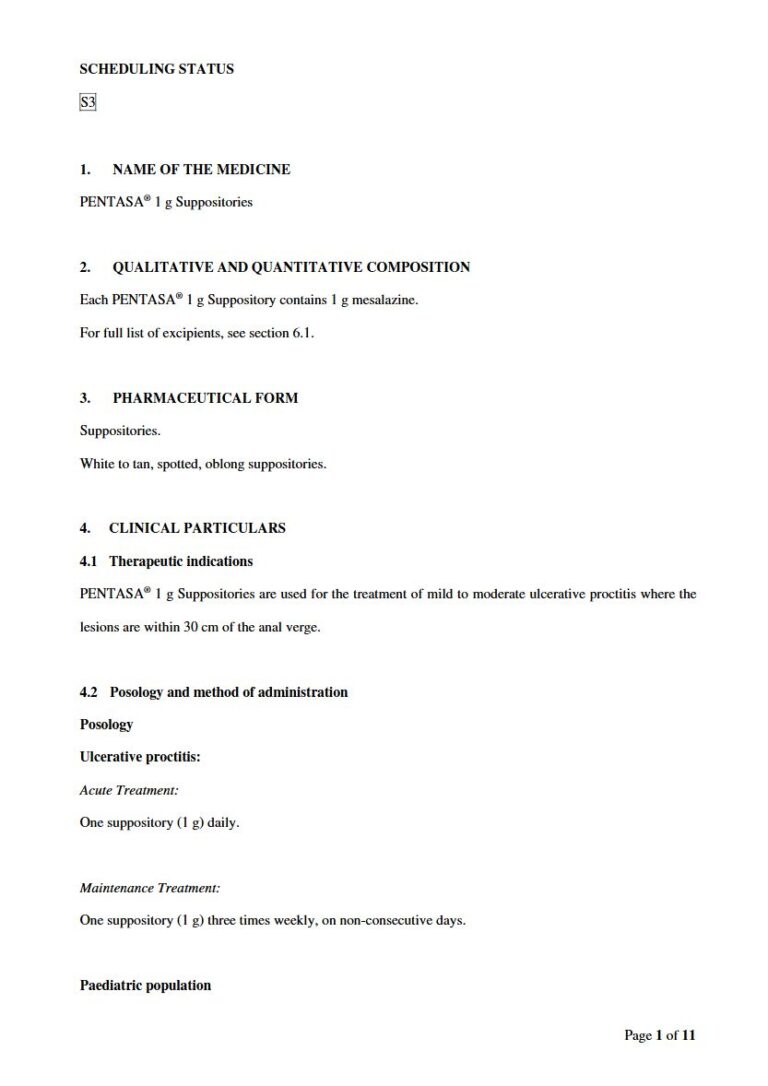
4.1 Therapeutic indications
PENTASA u00ae 1 g Suppositories are used for the treatment of mild to moderate ulcerative proctitis where the lesions are within 30 cm of the anal verge.
4.2 Posology and method of administration
Posology
Ulcerative proctitis:
Acute Treatment: One suppository (1 g) daily.
Maintenance Treatment: One suppository (1 g) three times weekly, on non-consecutive days.
Paediatric population
Not recommended in children and adolescents. There is little experience and only limited documentation for an effect in children.
4.3 Contraindications
- Hypersensitivity to mesalazine, any of the excipients, or salicylates.
- Severe liver and/or renal impairment.
4.4 Special warnings and precautions for use
Caution is recommended in patients with impaired hepatic function. Liver function parameters like ALT or AST should be assessed prior to and during treatment, at the discretion of the treating physician. PENTASA u00ae 1 g Suppositories should not be used in patients with impaired renal function and in patients with haemorrhagic diathesis. The renal function should be monitored regularly (e.g. serum creatinine), especially during the initial phase of treatment based on clinical judgment taking baseline renal function into account. Urinary status (dip sticks) should be determined prior to and during treatment at the discretion of the treating physician. Mesalazine-induced nephrotoxicity should be suspected in patients developing renal dysfunction during treatment. The concurrent use of other known nephrotoxic medicine, such as NSAIDs and azathioprine, may increase the risk of renal reactions and increased monitoring frequency of renal function is required. Treatment should be discontinued if renal function deteriorates. As a guideline, follow-up tests are recommended 14 days after commencement of treatment, then a further two to three tests at intervals of 4 weeks. If the findings are normal, follow-up tests should be carried out every three months. If additional symptoms occur, these tests should be performed immediately. Patients with inflammatory bowel disease are at risk of developing nephrolithiasis. Cases of nephrolithiasis have been reported during treatment with mesalazine (as contained in PENTASA u00ae 1 g Suppositories) including stones with a 100 % mesalazine content. Adequate fluid intake must be ensured during treatment. Patients with pulmonary disease, in particular asthma, should be very carefully monitored during a course of treatment with PENTASA u00ae 1 g Suppositories (see section 4.8). Caution is recommended when treating patients allergic to sulphasalazine (risk of allergy to salicylates). Patients with a history of adverse drug reactions to preparations containing sulphasalazine (risk of allergy to salicylates), should be kept under close medical surveillance on commencement of a course of treatment with PENTASA u00ae 1 g Suppositories. Severe cutaneous adverse reactions (SCARs), including Drug reaction with eosinophilia and systemic symptoms (DRESS), Stevens-Johnson syndrome (SJS) and toxic epidermal necrolysis (TEN), have been reported in association with mesalazine treatment such as Pentasa u00ae 1 g Suppositories. In case of acute intolerance reactions (such as abdominal cramps, acute abdominal pain, fever, and severe headache) and/or the first appearance of signs and symptoms of severe skin reactions, such as skin rash, mucosal lesions, or any other sign of hypersensitivity, therapy should be discontinued immediately. If a patient develops dehydration while on treatment with PENTASA u00ae 1 g Suppositories, normal electrolyte levels and fluid balance should be restored as soon as possible. Mesalazine-induced cardiac hypersensitivity reactions (myo- and pericarditis) have been reported. Serious blood dyscrasias have been reported very rarely with mesalazine. Blood tests for differential blood count is recommended prior to and during treatment, at the discretion of the treating physician. As stated in the interaction section 4.5, concomitant treatment with mesalazine can increase the risk of blood dyscrasia in patients receiving azathioprine, or 6-mercaptopurine or thioguanine. Treatment should be discontinued on suspicion or evidence of these adverse reactions. PENTASA u00ae 1 g Suppositories should be used with caution in the elderly. Age related factors (such as altered renal and hepatic function as described above and polypharmacy should be taken into consideration) (see section 4.4). Mesalazine (as contained in PENTASA u00ae 1 g Suppositories) may produce red-brown urine discoloration after contact with sodium hypochlorite bleach (e.g. in toilets cleaned with sodium hypochlorite contained in certain bleaches).
4.5 Interactions with other medicines and other forms of interaction
No interaction studies have been performed. PENTASA u00ae 1 g Suppositories should not be given with preparations which lower stool pH, e.g. lactulose, and thereby prevent release of the active ingredient. The concurrent use of other known nephrotoxic agents such as NSAIDs and azathioprine may increase the risk of renal reactions (see 4.4 Special warnings and precautions for use). In patients who are concomitantly treated with azathioprine, 6-mercaptopurine, or thioguanine, a possible increase in the myelosuppressive effects of azathioprine, 6-mercaptopurine, or thioguanine should be taken into account. Concomitant treatment with PENTASA u00ae 1 g Suppositories can increase the risk of blood dyscrasia. Regular monitoring of white blood cells is recommended and the dosage regimen of thiopurine should be adjusted accordingly. There is weak evidence that PENTASA u00ae 1 g Suppositories might decrease the anticoagulant effect of warfarin. There are no data on interactions between PENTASA u00ae 1 g Suppositories and other agents.
4.6 Fertility, pregnancy and lactation
Pregnancy
PENTASA u00ae 1 g Suppositories should be used with caution during pregnancy. There are no adequate and well-controlled studies of PENTASA u00ae use in pregnant women. Mesalazine is known to cross the placental barrier. Blood disorders (leucopoenia, thrombocytopenia, anaemia) have been reported in new-borns of mothers being treated with PENTASA u00ae 1 g Suppositories.
Breastfeeding
PENTASA u00ae 1 g Suppositories should be used with caution during breastfeeding. Mesalazine is excreted in breast milk. There is limited experience of the use of PENTASA u00ae 1 g Suppositories in lactating women.
4.7 Effects on ability to drive and use machines
No effects on the ability to drive and use machines have been observed.
4.8 Undesirable effects
The most frequent adverse reactions seen in clinical trials are diarrhoea (3 %), nausea (3 %), abdominal pain (3 %), headache (3 %), vomiting (1 %), and rash (1 %). Hypersensitivity reactions and medicine fever may occasionally occur, and severe cutaneous adverse reactions (SCARs), including Drug reaction with eosinophilia and systemic symptoms (DRESS), Stevens-Johnson syndrome (SJS) and Toxic epidermal necrolysis (TEN), have been reported in association with mesalazine treatment such as PENTASA u00ae 1 g Suppositories (see section 4.4). Following rectal administration local reactions such as pruritus, rectal discomfort and urge may occur. Frequency of adverse effects, based on clinical trials and reports from post-marketing surveillance:
Common : u2265 1 % and < 10 %
Rare : u2265 0,01 % and < 0,1 %
Very rare : < 0,01 %
Nervous system disorders:
Common : Headache
Rare : Dizziness
Very rare : Peripheral neuropathy (including Guillain-Barru00e9 syndrome).
Gastrointestinal disorders:
Common : Diarrhoea, abdominal pain, nausea, vomiting, flatulence
Rare : Increased amylase (blood and/or urine), acute pancreatitis*.
Very rare : Aggravation of ulcerative colitis, cheilitis and melaena, pancolitis
Skin and subcutaneous tissue disorders:
Common : Rash (including urticaria, erythematous rash).
Rare: Photosensitivity **
Very rare : Reversible alopecia, allergic dermatitis, erythema multiforme
Unknown: Stevens-Johnson Syndrome (SJS) / Toxic epidermal necrolysis (TEN), Drug Reaction with Eosinophilia and Systemic Symptoms (DRESS)
Cardiac disorders:
Rare : Myocarditis* and pericarditis*.
Blood and the lymphatic system disorders:
Very rare : Altered blood counts (anaemia, aplastic anaemia, neutropenia, leukopenia (including granulocytopenia), thrombocytopenia, agranulocytosis and pancytopenia, and eosinophilia (as part of an allergic reaction)).
Respiratory, thoracic and mediastinal disorders:
Very rare : Allergic alveolitis, allergic and fibrotic lung reactions (including dyspnoea, coughing, bronchospasm), pulmonary eosinophilia, interstitial lung disease, pulmonary infiltration, pneumonitis.
Hepato-biliary disorders:
Very rare : Changes in liver function parameters (increase in transaminases and cholestasis parameters (e.g., alkaline phosphatase, gammaglutamyl-transferase and bilirubin)); hepatotoxicity (including hepatitis*, cholestatic hepatitis, cirrhosis, hepatic failure).
Musculoskeletal, connective tissue and bone disorders:
Very rare : Myalgia, arthralgia, lupus erythematosus-like syndrome (systemic lupus erythematosus).
Renal and urinary disorders *** :
Very rare : Impairment of renal function**** including acute and chronic interstitial nephritis*, nephrotic syndrome, acute or chronic renal insufficiency.
Unknown: Nephrolithiasis***, Urine discolouration ***
Immune system disorders
Very rare: Hypersensitivity reaction including anaphylactic reaction.
Reproductive system and breast disorders
Very rare: Oligospermia (reversible)
General disorders and administration site conditions
Common : Anal discomfort and irritation at the application site, pruritus (anal), rectal tenesmus
Very rare: Medicine fever
(*) The mechanism of mesalazine-induced myo- and pericarditis, pancreatitis, nephritis and hepatitis is unknown, but it might be of allergic origin.
(**) Photosensitivity: More severe reactions are reported in patients with pre-existing skin conditions such as atopic dermatitis and atopic eczema.
(***) See section 4.4 for further information
(****) Renal failure has been reported. Mesalazine-induced nephrotoxicity should be suspected in patients developing renal dysfunction during treatment. It is important to note that several of these disorders can also be attributed to the inflammatory bowel disease itself.
4.9 Overdose
There is no experience in the overdosage of PENTASA u00ae 1 g Suppositories. Treatment is symptomatic and supportive.
