
Revatio 20 mg FC tablets
PDF Leaflet Revision Date: 23 February 2023
Clinical Summary
Quick overview from the medicine insert
Indication
Treatment of pulmonary arterial hypertension (PAH).
Dosage (summary)
20 mg three times a day, 6-8 hours apart.
Special Populations
- Elderly
- Renal impairment
- Hepatic impairment
Pregnancy & Breastfeeding
Not recommended in pregnancy; low levels in breast milk.
Key Drug Interactions
- Erythromycin
- Saquinavir
- CYP3A4 inhibitors
- Bosentan
Contraindications
- Hypersensitivity
- Concurrent use with nitrates
- Severe hepatic impairment
- Severe renal impairment
- Blood pressure < 90/50 mmHg
Common side effects
- Headache
- Flushing
- Dyspepsia
- Back pain
- Diarrhoea
Counselling Points
- Take with or without food
- Avoid nitrates
- Seek help for prolonged erection
- Caution with driving due to dizziness
Serious warnings
- Risk of priapism
- Caution in cardiovascular disease
- Risk of NAION
Important Disclaimer
The Revatio 20 mg FC tablets professional information leaflet below is the property of Upjohn South Africa and is provided on Medinsert exactly as issued, with no.. alterations or editorial changes. We make every effort to keep content current by updating documents as soon as new versions become available. Medinsert serves as a trusted access point for healthcare professionals, but does not replace official sources or clinical judgement. For more details, please read our full disclaimer. read more>>
 Healthcare Professionals Only
This content is for registered healthcare professionals
Sign in or create a free account to read the full package insert.
Free for HPCSA-registered professionals. Powered by Medinsert.
Clinical Particulars
Section 4 of the official insert — extracted exactly as issued, no alterations
4.1 Therapeutic indications
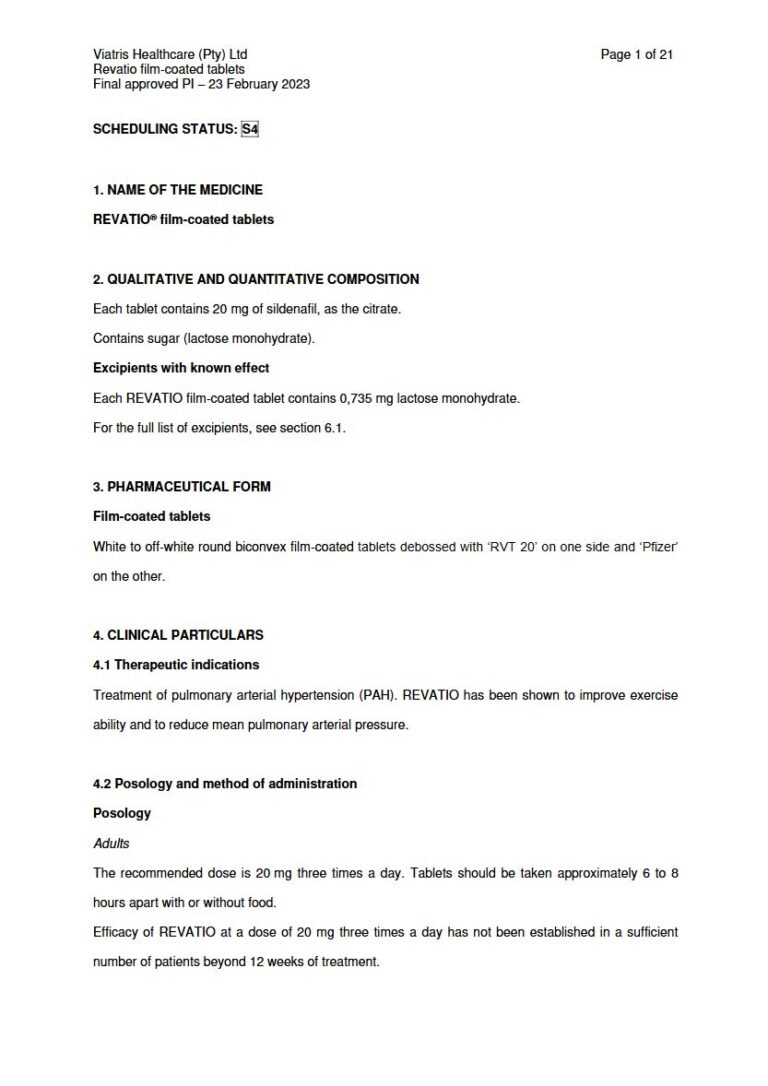
Treatment of pulmonary arterial hypertension (PAH). REVATIO has been shown to improve exercise ability and to reduce mean pulmonary arterial pressure.
4.2 Posology and method of administration
Posology
Adults
The recommended dose is 20 mg three times a day. Tablets should be taken approximately 6 to 8 hours apart with or without food. Efficacy of REVATIO at a dose of 20 mg three times a day has not been established in a sufficient number of patients beyond 12 weeks of treatment.
Special populations
Elderly population
Dosage adjustments are not required in elderly patients.
Renal impairment
Dose adjustments are not required in patients with mild to moderate renal impairment (see section 4.3).
Hepatic impairment
Dose adjustments are not required in patients with mild to moderate hepatic impairment (Child-Pugh class A and B). Patients with severe hepatic impairment (Child-Pugh class C) have not been studied (see section 4.3).
Patients using other medicines
Co-administration of erythromycin or saquinavir and most potent CYP3A4 inhibitors (e.g. ketoconazole, itraconazole, ritonavir) with REVATIO is contraindicated (see section 4.5). Dose adjustments of REVATIO may be required when co-administered with bosentan or other CYP3A4 inducers (see section 4.5).
Paediatric population
REVATIO is not recommended for use in children below 18 years due to insufficient data on safety and efficacy.
Method of administration
For oral use.
4.3 Contraindications
- Use of REVATIO is contraindicated in patients with hypersensitivity to the active substance or to any of the excipients of the tablet (listed in section 6.1).
- Consistent with its known effects on the nitric oxide/cGMP pathway, see section 5.1, REVATIO was shown to potentiate the hypotensive effects of acute and chronic nitrates, and its administration to patients who are concurrently using nitric oxide donors, organic nitrates or organic nitrites in any form either regularly or intermittently is therefore contraindicated. Medical practitioners should discuss with patients the contraindication of REVATIO with concurrent organic nitrates.
- The co-administration of PDE5 inhibitors, including REVATIO, with guanylate cyclase stimulators, such as riociguat, is contraindicated as it may potentially lead to symptomatic hypotension.
- Concomitant use of REVATIO with potent cytochrome P450 3A4 inhibitors e.g. ritonavir, erythromycin, saquinavir, ketoconazole and itraconazole is contraindicated.
- The use of REVATIO is contraindicated in patients with severe hepatic impairment and patients with severe impairment of renal function (creatinine clearance < 30 mL/min).
- Patients with a systemic blood pressure of under 90/50 mmHg.
4.4 Special warnings and precautions for use
There is no controlled clinical data on the safety or efficacy of REVATIO in the following groups; if prescribed, this should be done with caution.
- Patients who have suffered a myocardial infarction, stroke or life-threatening dysrhythmia within the last 6 months.
- Patients with resting hypertension (BP > 170/110 mmHg).
- Patients with cardiac failure or coronary artery disease causing unstable angina.
- Patients with retinitis pigmentosa (a minority of these patients have genetic disorders of retinal phosphodiesterases).
- Patients with severe hepatic impairment (see section 4.3).
Vasodilatory action
REVATIO has systemic vasodilatory properties that resulted in mild and transient decreases in supine blood pressure in healthy volunteers. Medical practitioners should carefully consider whether their patients with certain underlying conditions could be affected adversely by such vasodilatory effects, for example, patients with a low blood pressure, patients with fluid depletion, severe left ventricular outflow obstruction or autonomic dysfunction (see section 4.3).
Cardiovascular risk factors
In post-marketing experience with sildenafil (the active ingredient of REVATIO) for male erectile dysfunction, serious cardiovascular events, including myocardial infarction, sudden cardiac death, ventricular dysrhythmia, cerebrovascular haemorrhage, transient ischaemic attack and hypertension, have been reported in temporal association with the use of sildenafil. Most, but not all, of these patients had pre-existing cardiovascular risk factors. Many of these events were reported to occur during or shortly after sexual activity, and a few were reported to occur shortly after the use of sildenafil without sexual activity. Others were reported to have occurred hours to days after the use of sildenafil and sexual activity. It is not possible to determine whether these events are related directly to these factors or to other factors.
Priapism
REVATIO should be used with caution in patients with anatomical deformation of the penis (such as angulation, cavernosal fibrosis or Peyronieu2019s disease), or in patients who have conditions which may predispose them to priapism (such as sickle cell anaemia, multiple myeloma or leukaemia). Prolonged erections and priapism have been reported with REVATIO in post-marketing experience. In the event of an erection that persists longer than 4 hours, the patient should seek immediate medical assistance. If priapism is not treated immediately, penile tissue damage and permanent loss of potency could result (see section 4.8).
Alpha-blockers
Concomitant administration of REVATIO to patients taking alpha-blocker therapy may lead to symptomatic hypotension in susceptible individuals (see section 4.5). In order to minimize the potential for developing postural hypotension, patients should be haemodynamically stable on alpha-blocker therapy prior to initiating REVATIO treatment. Medical practitioners should advise patients what to do in the event of postural hypotensive symptoms.
Bleeding disorders
REVATIO has no effect on bleeding time, including during co-administration with aspirin. In vitro studies with human platelets indicate that REVATIO potentiates the anti-aggregatory effect of sodium nitroprusside (a nitric oxide donor). There is no safety information on the administration of REVATIO to patients with bleeding disorders or active peptic ulceration. Therefore, REVATIO should be administered with caution to these patients.
Vitamin K antagonists
The incidence of epistaxis was higher in patients with pulmonary arterial hypertension secondary to connective tissue disease (REVATIO 12,9 %, placebo 0 %) than in primary pulmonary hypertension patients (REVATIO 3,0 %, placebo 2,4 %) and was higher in REVATIO-treated patients treated with concomitant oral vitamin K antagonist (8,8 % versus 1,7 % not treated with concomitant Vitamin K antagonist).
Veno-occlusive disease
Pulmonary vasodilators may significantly worsen the cardiovascular status of patients with pulmonary veno-occlusive disease. Since there are no clinical data on administration of REVATIO to patients with pulmonary veno-occlusive disease, administration of REVATIO to such patients is not recommended.
Visual events
Non-arteritic anterior ischaemic optic neuropathy (NAION), a rare condition and a cause of decreased vision or loss of vision, has been reported post-marketing with the use of PDE5 inhibitors, including REVATIO (see section 4.8). Most of these patients had risk factors such as low cup to disc ratio (u201ccrowded disku201d), age over 50, diabetes, hypertension, coronary artery disease, hyperlipidaemia and smoking. In the event of any sudden visual defect, REVATIO should be stopped immediately, and alternative treatment should be considered. Medical practitioners should discuss with patients the increased risk of NAION in individuals who have already experienced NAION. The patients should be advised to seek immediate medical attention in case of sudden vision loss.
Excipient information
Lactose REVATIO contains lactose. Patients with rare hereditary problems of galactose intolerance, total lactase deficiency or glucose-galactose malabsorption should not take this medicine.
Use of REVATIO with bosentan
The efficacy of REVATIO in patients already on bosentan therapy has not been conclusively demonstrated (see sections 4.5 and 5.1).
Concomitant use with other PDE5 inhibitors
The safety and efficacy of REVATIO when co-administered with other PDE5 inhibitor products has not been studied in PAH patients and such concomitant use is not recommended.
4.5 Interaction with other medicines and other forms of interaction
Effects of other medicines on sildenafil (the active ingredient of REVATIO)
In vitro studies
Sildenafil metabolism is principally mediated by the cytochrome P450 (CYP) isoforms 3A4 (major route) and 2C9 (minor route). Therefore, inhibitors of these isoenzymes may reduce sildenafil clearance and inducers of these isoenzymes may increase sildenafil clearance.
In vivo studies
Population pharmacokinetic analysis of clinical trial data indicated a reduction in sildenafil clearance and/or an increase of oral bioavailability when co-administered with CYP3A4 substrates and the combination of CYP3A4 substrates and beta-blockers. These were the only factors with a statistically significant impact on sildenafil pharmacokinetics in patients with pulmonary arterial hypertension. The exposure to sildenafil in patients on CYP3A4 substrates and CYP3A4 substrates plus beta-blockers was 43 % and 66 % higher, respectively, compared to patients not receiving these medicine classes. Sildenafil exposure was 5-fold higher at a dose of 80 mg three times a day compared to the exposure at a dose of 20 mg three times a day. This concentration range covers the increase in sildenafil exposure observed in specifically designed medicine interaction studies with CYP3A4 inhibitors (except with the most potent of the CYP3A4 inhibitors e.g. ketoconazole, itraconazole, ritonavir).
In a study of healthy male volunteers, co-administration of the endothelin antagonist bosentan, which is a moderate inducer of CYP3A4, CYP2C9 and possibly of CYP2C19, at steady state (125 mg twice a day) with sildenafil at steady state (80 mg three times a day) resulted in a 62,6 % decrease of sildenafil AUC and a 55,4 % decrease in sildenafil C max. The combination of both medicines did not lead to clinically significant changes of blood pressure (supine and standing) and was well tolerated in healthy volunteers. A population pharmacokinetic analysis of sildenafil data from adult PAH patients in clinical trials including a 12-week study to assess the efficacy and safety of oral sildenafil 20 mg three times a day when added to a stable dose of bosentan (62,5 mg u2013 125 mg twice a day) indicated a decrease in sildenafil exposure with bosentan co-administration, similar to that observed in healthy volunteers (see sections 4.2, 4.4 and 5.1).
Cimetidine (800 mg), a non-specific CYP3A4 inhibitor, caused a 56 % increase in plasma sildenafil concentrations when co-administered with sildenafil (50 mg) to healthy volunteers. When a single 100 mg dose of sildenafil was administered with erythromycin, a moderate CYP3A4 inhibitor, at steady state (500 mg two times daily for 5 days), there was a 182 % increase in sildenafil systemic exposure (AUC) (see section 4.3). CYP3A4 inhibitors like clarithromycin and telithromycin are expected to have an effect in between that of ritonavir and CYP3A4 inhibitors like saquinavir or erythromycin, a seven-fold increase in exposure is assumed. In addition, co-administration of the HIV protease inhibitor saquinavir, also a CYP3A4 inhibitor, at steady state (1 200 mg three times daily) with sildenafil (100 mg single dose) resulted in a 140 % increase in sildenafil C max and a 210 % increase in sildenafil AUC. Sildenafil had no effect on saquinavir pharmacokinetics (see section 4.2). The most potent CYP3A4 inhibitors such as ketoconazole and itraconazole would be expected to have effects similar to those of ritonavir (see section 4.3). Co-administration with the HIV protease inhibitor ritonavir, which is a highly potent P450 inhibitor, at steady state (500 mg twice daily) with sildenafil (100 mg single dose) resulted in a 300 % (4-fold) increase in sildenafil C max and a 1 000 % (11-fold) increase in sildenafil plasma AUC. At 24 hours, the plasma levels of sildenafil were still approximately 200 ng/mL, compared to approximately 5 ng/mL when sildenafil was dosed alone. This is consistent with ritonaviru2019s marked effects on a broad range of P450 substrates. Sildenafil had no effect on ritonavir pharmacokinetics (see section 4.2). Based on these pharmacokinetic results co-administration of sildenafil with ritonavir is contraindicated.
Single doses of antacid (magnesium hydroxide/aluminium hydroxide) did not affect the bioavailability of sildenafil. Co-administration of oral contraceptives (ethinylestradiol 30 u03bcg and levonorgestrel 150 u03bcg) did not affect the pharmacokinetics of sildenafil. In normal healthy male volunteers, there was no evidence of an effect of azithromycin (500 mg daily for 3 days) on the AUC, C max, T max elimination rate constant, or subsequent half-life of sildenafil or its major circulating metabolite.
Effects of sildenafil on other medicines
In vitro studies
Sildenafil is a weak inhibitor of the cytochrome P450 isoforms 1A2, 2C9, 2C19, 2D6, 2E1 and 3A4 (IC50 > 150 u03bcM).
In vivo studies
No significant interactions were shown with tolbutamide (250 mg) or warfarin (40 mg), both of which are metabolised by CYP2C9. No interactions were observed between sildenafil (100 mg single dose) and acenocoumarol. Sildenafil (50 mg) did not potentiate the increase in bleeding time caused by aspirin (150 mg). Sildenafil (50 mg) did not potentiate the hypotensive effects of alcohol in healthy volunteers with mean maximum blood alcohol levels of 80 mg/dL. In a study of healthy volunteers, sildenafil at steady state (80 mg three times a day) resulted in a 49,8 % increase in bosentan AUC and a 42 % increase in bosentan C max (125 mg twice daily). A population pharmacokinetic analysis of data from a study of adult PAH patients on background bosentan therapy (62,5 mg u2013 125 mg twice a day) indicated an increase (20 % (95 % CI: 9,8 u2013 30,8)) of bosentan AUC with co-administration of steady state sildenafil (20 mg three times a day) of a smaller magnitude than seen in healthy volunteers when co administered with 80 mg sildenafil three times a day (see sections 4.2, 4.4 and 5.1). No interaction was seen when sildenafil (100 mg) was co-administered with amlodipine in hypertensive patients. The mean additive reduction on supine blood pressure (systolic, 8 mmHg; diastolic, 7 mmHg) was of a similar magnitude to that seen when sildenafil was administered alone to healthy volunteers (see section 5.1). In three specific drug-drug interaction studies, the alpha-blocker doxazosin (4 mg and 8 mg) and sildenafil (25 mg, 50 mg, or 100 mg) were administered simultaneously to patients with benign prostatic hyperplasia (BPH) stabilised on doxazosin therapy. In these study populations, mean additional reductions of supine systolic and diastolic blood pressure of 7/7 mmHg, 9/5 mmHg, and 8/4 mmHg, respectively, and mean additional reductions of standing blood pressure of 6/6 mmHg, 11/4 mmHg, and 4/5 mmHg, respectively were observed. When sildenafil and doxazosin were administered simultaneously to patients stabilised on doxazosin therapy, there were infrequent reports of patients who experienced symptomatic postural hypotension. These reports included dizziness and light-headedness, but not syncope. Concomitant administration of REVATIO to patients taking alpha-blocker therapy may lead to symptomatic hypotension in susceptible individuals (see section 4.4). Sildenafil was shown to potentiate the hypotensive effect of acute and chronic nitrates. Therefore, use of nitric oxide donors, organic nitrates or organic nitrites in any form, either regularly or intermittently with REVATIO is contraindicated (see section 4.3). Sildenafil had no clinically significant impact on the plasma levels of oral contraceptives (ethinylestradiol 30 u03bcg and levonorgestrel 150 u03bcg).
4.6 Fertility, pregnancy and lactation
Pregnancy
There are no data from the use of REVATIO in pregnant women. Animal studies do not indicate direct or indirect harmful effects with respect to pregnancy and embryonal/foetal development. Due to lack of data, REVATIO should not be used in pregnant women.
Breastfeeding
There are no adequate and well controlled studies in lactating women. Data from one lactating woman indicate that sildenafil and its active metabolite N-desmethylsildenafil are excreted into breast milk at very low levels. No clinical data are available regarding adverse events in breastfed infants, but amounts ingested would not be expected to cause any adverse effects. Medical practitioners should carefully assess the motheru2019s clinical need for REVATIO and any potential adverse effects on the breastfed child.
4.7 Effects on ability to drive and use machines
As dizziness and altered vision were reported in clinical trials with REVATIO, patients should be aware how they react to REVATIO and exercise caution before driving, operating hazardous machinery or performing hazardous tasks.
4.8 Undesirable effects
Summary of the safety profile
In the pivotal placebo-controlled study of REVATIO in pulmonary arterial hypertension, a total of 207 patients were treated with REVATIO at daily doses ranging from 20 mg to 80 mg three times a day and 70 patients were treated with placebo. The duration of treatment was 12 weeks.
Tabulated summary of adverse reactions
The most commonly reported adverse drug reactions that occurred (u2265 10 %) on REVATIO than on placebo were headache, flushing, dyspepsia, back pain, diarrhoea and pain in extremity. The adverse drug reactions that occurred in > 1 % of REVATIO-treated patients and were more common on REVATIO in the pivotal placebo-controlled trial in pulmonary arterial hypertension at doses of 20, 40 or 80 mg three times a day are shown in Table 1.
Table 1: Adverse drug reactions occurring in > 1 % of patients when compared to placebo, in patients on REVATIO (20, 40 or 80 mg three times a day), in the pivotal placebo-controlled trials in pulmonary arterial hypertension.
Reporting frequency: Very common ( u2265 1/10); common ( u2265 1/100 to < 1/10).
MedDRA System organ class
Frequency
Adverse drug reaction
Infections and infestations
Common
Cellulitis, influenza, sinusitis not otherwise specified (NOS)
Blood and lymphatic system disorders
Common
Anaemia NOS
Metabolism and nutrition disorders
Common
Fluid retention
Psychiatric disorders
Common
Insomnia, anxiety
Nervous system disorders
Very common
Headache
Common
Migraine NOS, tremor, paraesthesia, burning sensation NOS, hypoaesthesia
Eye disorders
Common
Reduced visual acuity, retinal haemorrhage, visual disturbance NOS, photophobia, diplopia, chromatopsia, cyanopsia, abnormal sensation in eye, eye irritation
Ear and labyrinth disorders
Common
Vertigo
Vascular disorders
Very common
Flushing
Respiratory, thoracic and mediastinal disorders
Common
Bronchitis NOS, epistaxis, rhinitis NOS, cough
Gastrointestinal disorders
Very common
Diarrhoea, dyspepsia
Common
Gastritis NOS, gastroenteritis NOS, gastroesophageal reflux disease, haemorrhoids, abdominal distension
Skin and subcutaneous tissue disorders
Common
Alopecia, erythema
Musculoskeletal and connective tissue disorders
Very common
Pain in extremity, back pain
Common
Myalgia
Reproductive system and breast disorders
Common
Gynaecomastia
General disorders and administration site conditions
Common
Pyrexia
Investigations
Common
Weight increase
The overall frequency of discontinuation in REVATIO treated patients at the recommended daily dose of 20 mg three times a day (2,9 %) was low and the same as placebo (2,9 %).
Post-marketing experience
A sudden unilateral or bilateral decrease or loss of hearing (sensorinearal deafness) with or without associated vestibular symptoms has been reported with the use of PDE5 inhibitors, including REVATIO. There is insufficient information regarding the reversibility of the hearing loss and the role of underlying risk factors for hearing loss in individual subjects. Non-arteritic anterior ischaemic optic neuropathy (NAION), a cause of decreased vision or loss of vision, has been reported (see section 4.4). Other side effects reported with sildenafil use not associated with PAH may include the following: Headache, flushing, dizziness, hypotension, angina pectoris, AV block, migraine, syncope, tachycardia, palpitation, postural hypotension, cardiac arrest, heart failure, abnormal electrocardiogram, cardiomyopathy have also been reported.
MedDRA System organ class
Adverse reactions
Blood and lymphatic system disorders
Anaemia and leukopenia.
Metabolism and nutrition disorders
Thirst, oedema, gout, unstable diabetes, hyperglycaemia, peripheral oedema, hyperuricaemia, hypoglycaemic reaction and hypernatraemia.
Nervous system disorders
Ataxia, hypertonia, neuralgia, neuropathy, paraesthesia, tremor, vertigo, depression, insomnia, somnolence, abnormal dreams, reflexes decreased and hypoesthesia.
Eye disorders
Abnormal vision (Mild and transient. Predominantly colour tinge to vision, but also increased perception of light or blurred vision). Diplopia, temporary vision loss/decreased vision, ocular redness or bloodshot appearance, ocular burning, ocular swelling/pressure, increased intraocular pressure, retinal vascular disease or bleeding, vitreous detachment/traction and paramacular oedema. Conjunctivitis, photophobia, eye haemorrhage, cataract, dry eyes and eye pain.
Ear and labyrinth disorders
Tinnitus, deafness, ear pain.
Respiratory, thoracic and mediastinal disorders
Nasal congestion, asthma, dyspnoea, laryngitis, pharyngitis, sinusitis, bronchitis, sputum increased, cough increased.
Gastrointestinal disorders
Dyspepsia, vomiting, glossitis, colitis, dysphagia, gastritis, gastroenteritis, oesophagitis, stomatitis, dry mouth, liver function tests abnormal, rectal haemorrhage, gingivitis.
Skin and subcutaneous tissue disorders
Urticaria, herpes simplex, pruritus, sweating, skin ulcer, contact dermatitis, exfoliative dermatitis.
Musculoskeletal and connective tissue disorders
Arthritis, arthrosis, myalgia, tendon rupture and tenosynovitis, bone pain, myasthenia, synovitis.
Renal and urinary disorders
Cystitis, nocturia, urinary frequency, breast enlargement, urinary incontinence, abnormal ejaculation, genital oedema, anorgasmia and haematuria have also been reported.
Reproductive system and breast disorders
Cases of priapism and erection increased have been reported.
General disorders and administration site conditions
Face oedema, photosensitivity reaction, shock, asthenia, pain, chills, accidental fall, abdominal pain, allergic reaction, chest pain, accidental injury.
Reporting of suspected adverse reactions
Reporting suspected adverse reactions after authorisation of the medicine is important. It allows continued monitoring of the benefit/risk balance of the medicine. Health care providers are asked to report any suspected adverse reactions to SAHPRA via the u201c6.04 Adverse Drug Reactions Reporting Formu201d, found online under SAHPRAu2019s publications: https://www.sahpra.org.za/Publications/Index/8.
4.9 Overdose
In studies with healthy volunteers, of single doses up to 800 mg, adverse events were similar to those seen at lower doses, but incidence rates were increased. In cases of overdose, supportive measures should be adopted as required. Renal dialysis is not expected to accelerate clearance as sildenafil is highly bound to plasma proteins and not eliminated in the urine.
