
Rituximab Equity 100 mg and 500 mg Solution for infusion
PDF Leaflet Revision Date: 03 June 2025
Clinical Summary
Quick overview from the medicine insert
Indication
Treatment of various B-cell malignancies and autoimmune diseases.
Dosage (summary)
375 mg/mu00b2 IV weekly for 4 doses for NHL; 1000 mg IV for RA; adjust for CLL and GPA/MPA.
Onset of Action / Duration
Onset: 30 mins, Duration: variable based on indication.
Special Populations
- Elderly
- Paediatric population
Pregnancy & Breastfeeding
Not recommended in pregnancy; avoid breastfeeding during and 12 months after treatment.
Key Drug Interactions
- Fludarabine
- Cyclophosphamide
- Methotrexate
Contraindications
- Hypersensitivity to rituximab
- Active severe infections
- Severe heart failure
Common side effects
- Infusion-related reactions
- Infections
- Neutropenia
Counselling Points
- Monitor for infusion reactions
- Screen for HBV before treatment
- Avoid live vaccines
Serious warnings
- Progressive multifocal leukoencephalopathy
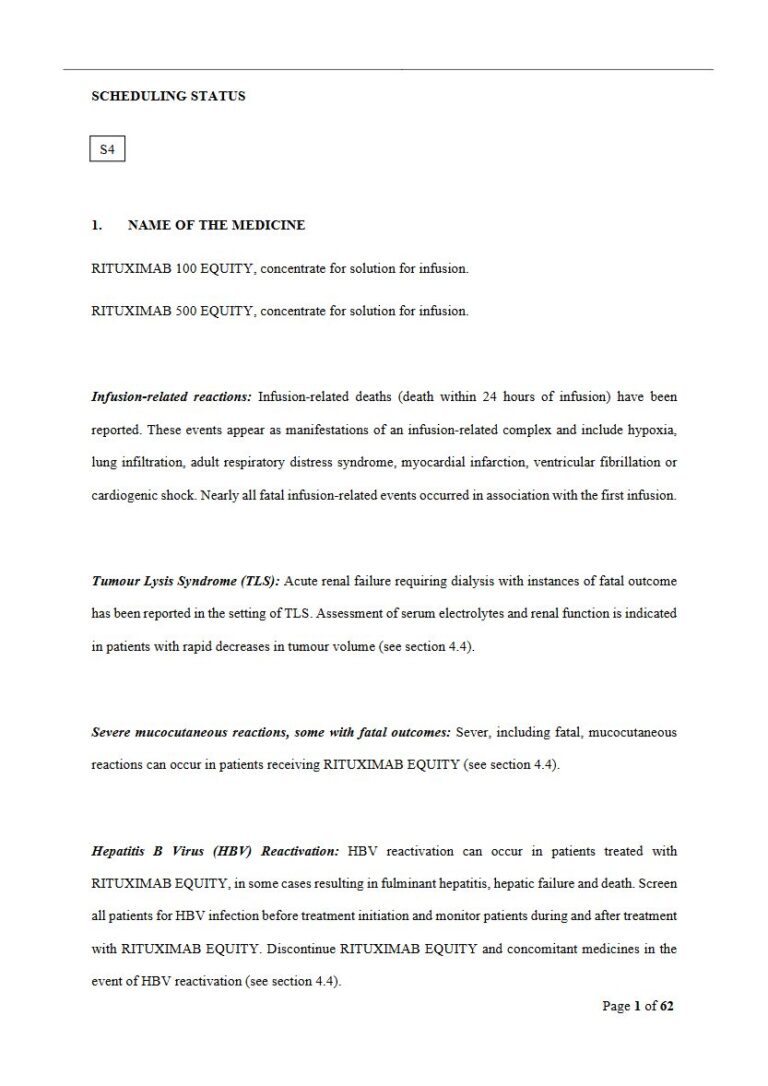
- Hepatitis B reactivation
- Tumour lysis syndrome
Important Disclaimer
The Rituximab Equity 100 mg and 500 mg Solution for infusion professional information leaflet below is the property of Equity Pharmaceuticals and is provided on Medinsert exactly as issued, with no.. alterations or editorial changes. We make every effort to keep content current by updating documents as soon as new versions become available. Medinsert serves as a trusted access point for healthcare professionals, but does not replace official sources or clinical judgement. For more details, please read our full disclaimer. read more>>
 Healthcare Professionals Only
This content is for registered healthcare professionals
Sign in or create a free account to read the full package insert.
Free for HPCSA-registered professionals. Powered by Medinsert.
Clinical Particulars
Section 4 of the official insert — extracted exactly as issued, no alterations
4.1 Therapeutic indications
Non-Hodgkin's lymphoma (NHL) Rituximab Equity is indicated for the treatment of:
- patients with relapsed or chemo-resistant low-grade or follicular, CD20-positive, B-cell non-Hodgkinu2019s lymphoma
- previously untreated patients with stage III-IV follicular lymphoma in combination with chemotherapy
- patients with follicular lymphoma as maintenance treatment, after response to induction therapy
- patients with high grade CD20-positive diffuse large B-cell non-Hodgkinu2019s lymphoma in combination with CHOP (Cyclophosphamide - C, Doxorubicin - H, Vincristine - O, Prednisone - P) chemotherapy
Chronic Lymphocytic Leukaemia
Rituximab Equity in combination with fludarabine and cyclophosphamide is indicated for the treatment of patients with previously untreated and relapsed/refractory chronic lymphocytic leukaemia (CLL).
Rheumatoid arthritis
Rituximab Equity in combination with methotrexate is indicated for the treatment of adult patients with severe active rheumatoid arthritis who have had an inadequate response or intolerance to other disease-modifying anti-rheumatic drugs (DMARD) including one or more tumour necrosis factor (TNF) inhibitor therapies.
Granulomatosis with polyangiitis (Wegeneru2019s) (GPA) and Microscopic polyangiitis (MPA)
Rituximab Equity in combination with glucocorticoids is indicated for the treatment of patients with severely active Granulomatosis with polyangiitis (GPA, also known as Wegener's granulomatosis) and Microscopic polyangiitis (MPA).
4.2 Posology and method of administration
Rituximab Equity infusions should be administered in an environment where full resuscitation facilities are immediately available, and under the close supervision of an experienced healthcare professional.
Pre-medication consisting of an anti-pyretic and an antihistaminic, e.g. paracetamol and diphenhydramine, should always be administered 30 to 60 minutes prior to each infusion of Rituximab Equity. Pre-medication with glucocorticoids should also be considered, particularly if Rituximab Equity is not given in combination with steroid-containing chemotherapy.
Low-grade/CD20 positive or follicular B-cell non-Hodgkin's lymphoma:
a) Initial treatment, weekly for 4 doses: The recommended dosage of Rituximab Equity used as a single agent/monotherapy for adult patients is 375 mg/m2 body surface area (BSA), administered as an intravenous infusion once weekly for four doses.
b) Initial treatment, bulky disease, weekly for 4 doses: The recommended dosage of Rituximab Equity used as a single agent/monotherapy for adult patients is 375 mg/m2 BSA, administered as an intravenous infusion once weekly for four doses.
c) Re-treatment following relapse, weekly for 4 doses: Patients who have responded to Rituximab Equity initially have been treated again with Rituximab Equity at a dose of 375 mg/m2 BSA, administered as an IV infusion once weekly for 4 weeks.
d) Combination therapy: The recommended dosage of Rituximab Equity in combination with chemotherapy for induction treatment of previously untreated or relapsed/refractory patients with follicular NHL is 375 mg/m2 BSA per cycle for 8 cycles (21 days/cycle). Rituximab Equity should be administered on day 1 of each chemotherapy cycle, after IV administration of the glucocorticoid component of the chemotherapy, if applicable.
e) Maintenance therapy: Previously untreated patients after response to induction treatment with R-CHOP may receive maintenance therapy with Rituximab Equity given at 375 mg/m2 BSA once every 2 months until disease progression or for a maximum period of two years (12 infusions). Efficacy has not been demonstrated in patients who previously received Rituximab Equity plus CVP or with FCM.
Relapsed/refractory patients after response to induction treatment may receive maintenance therapy with Rituximab Equity given at 375 mg/m2 BSA once every 3 months until disease progression or for a maximum period of two years.
High grade/CD20 positive or diffuse large B-cell non-Hodgkin's lymphoma: Rituximab Equity should be used in combination with CHOP chemotherapy (R-CHOP). The recommended dosage is 375 mg/m2 BSA, administered on day 1 of each chemotherapy cycle for 8 cycles after IV administration of the glucocorticoid component of CHOP. The other components of CHOP should be given after the administration of Rituximab Equity.
First infusion: The recommended initial rate for infusion is 50 mg/hr; which can subsequently be escalated in 50 mg/hr increments every 30 minutes, to a maximum of 400 mg/hr.
Subsequent infusions: Subsequent doses of Rituximab Equity can be infused at an initial rate of 100 mg/hr, and increased by 100 mg/hr increments at 30-minute intervals, to a maximum of 400 mg/hr.
Alternative 90-minute subsequent infusions: Patients who do not experience a Grade 3 or 4 infusion-related adverse event with Cycle 1 are eligible for an alternative 90-minute subsequent infusion in Cycle 2. The alternative infusion rate can be started at a rate of 20 % of the total dose given in the first 30 minutes and the remaining 80 % of the total dose given over the next 60 minutes for a total infusion time of 90 minutes. Patients who tolerate the first 90-minute Rituximab Equity infusion (Cycle 2) can continue to receive subsequent Rituximab Equity infusions at the 90-minute rate for the remainder of the treatment regimen (through Cycle 6 or Cycle 8). Patients who have clinically significant cardiovascular disease or who have a circulating lymphocyte count > 5 000/mm3 before Cycle 2 should not receive the 90-minute infusion.
Dosage adjustments during treatment: No dose reductions of Rituximab Equity are recommended. When Rituximab Equity is given in combination with CHOP or CVP chemotherapy, standard dose reductions for the chemotherapeutic medicines should be applied.
Chronic Lymphocytic Leukaemia (CLL): Pre-medication consisting of an analgesic/anti-pyretic (e.g. paracetamol) and an antihistaminic (e.g. diphenhydramine) should always be administered before each infusion of Rituximab Equity. Pre-medication with glucocorticoids should also be considered, particularly if Rituximab Equity is not given in combination with steroid-containing chemotherapy. Prophylaxis with adequate hydration and administration of uricostatics starting 48 hours prior to start of therapy is recommended for CLL patients to reduce the risk of tumour lysis syndrome. For CLL patients whose lymphocyte counts are > 25 x 109/u2113 it is recommended to administer prednisone/prednisolone 100 mg IV shortly before infusion with Rituximab Equity to decrease the rate and severity of acute infusion reactions and/or cytokine release syndrome. The recommended dosage of Rituximab Equity in combination with chemotherapy for previously untreated and relapsed/refractory patients is 375 mg/m2 BSA administered on day 0 of the first treatment cycle (the day before chemotherapy) followed by 500 mg/m2 BSA administered on day 1 of each subsequent cycle for 6 cycles in total. The chemotherapy should be given after Rituximab Equity infusion.
Rheumatoid arthritis (RA): Patients treated with Rituximab Equity must be given the patient alert card with each infusion. Pre-medication consisting of an analgesic/anti-pyretic (e.g. paracetamol) and an antihistaminic (e.g. diphenhydramine) should always be administered before each infusion of Rituximab Equity. Pre-medication with glucocorticoids should also be administered in order to reduce the frequency and severity of infusion-related reactions. Patients should receive 100 mg IV methylprednisolone to be completed 30 minutes prior to each Rituximab Equity infusion. See section 4.4. A course of Rituximab Equity consists of two 1 000 mg IV infusions. The recommended dosage of Rituximab Equity is 1 000 mg by IV infusion followed two weeks later by the second 1 000 mg IV infusion. The need for further courses should be evaluated 24 weeks following the previous course with retreatment given based on residual or disease activity returning to a level above a DAS28-ESR of 2,6 (treatment to remission). Patients may receive further courses no sooner than 16 weeks following the previous course.
First infusion of each course: The recommended initial rate for infusion is 50 mg/hr; after the first 30 minutes, it can be escalated in 50 mg/hr increments every 30 minutes, to a maximum of 400 mg/hr.
Second infusion of each course: Subsequent doses of Rituximab Equity can be infused at an initial rate of 100 mg/hr, and increased by 100 mg/hr increments at 30 minutes intervals, to a maximum of 400 mg/hr.
Granulomatosis with polyangiitis (Wegeneru2019s) (GPA) and Microscopic polyangiitis (MPA): Patients treated with Rituximab Equity must be given the patient alert card with each infusion. Pre-medication consisting of an analgesic/anti-pyretic (e.g. paracetamol) and an antihistaminic (e.g. diphenhydramine) should always be administered before each infusion of Rituximab Equity.
Adult induction of remission: The recommended dosage of Rituximab Equity for induction of remission therapy in adult patients with GPA and MPA is 375 mg/m2 BSA, administered as an IV infusion once weekly for 4 weeks (four infusions in total). Methylprednisolone 1 000 mg IV per day for 1 to 3 days is recommended in combination with Rituximab Equity to treat severe vasculitis symptoms, followed by oral prednisone 1 mg/kg/day (not to exceed 80 mg/day, and tapered as rapidly as possible per clinical need) during and after Rituximab Equity treatment.
First infusion: The recommended initial infusion rate for Rituximab Equity is 50 mg/hr; subsequently, the rate can be escalated in 50 mg/hr increments every 30 minutes to a maximum of 400 mg/hr.
Subsequent infusions: Subsequent infusions of Rituximab Equity can be started at a rate of 100 mg/hr and increased by 100 mg/hr increments every 30 minutes to a maximum of 400 mg/hr.
Adult maintenance treatment: Following induction of remission with Rituximab Equity, maintenance treatment in adult patients with GPA and MPA should be initiated no sooner than 16 weeks after the last Rituximab Equity infusion. Following induction of remission with other standard of care immunosuppressants, Rituximab Equity maintenance treatment should be initiated during the 4 week period that follows disease remission. Rituximab Equity should be administered as two 500 mg IV infusions separated by two weeks, followed by a 500 mg IV infusion every 6 months thereafter. Patients should receive Rituximab Equity for at least 24 months after achievement of remission (absence of clinical signs and symptoms). For patients who may be at higher risk for relapse, physicians should consider a longer duration of Rituximab Equity maintenance therapy, up to 5 years.
Pneumocystis jiroveci pneumonia (PCP) prophylaxis is recommended for patients with GPA and MPA during and following Rituximab Equity treatment, as appropriate.
Special populations
Elderly: No dose adjustment is required in elderly patients (aged > 65 years).
Paediatric population: The safety and efficacy of Rituximab Equity in children and adolescents have not been established.
Method of administration: The prepared Rituximab Equity solution should be administered as an intravenous infusion through a dedicated line. It should not be administered as an intravenous push or bolus. Patients should be closely monitored for the onset of cytokine release syndrome (see section 4.4). Patients who develop evidence of severe reactions, especially severe dyspnoea, bronchospasm or hypoxia should have the infusion interrupted immediately. Patients should then be evaluated for evidence of tumour lysis syndrome including appropriate laboratory tests and, for pulmonary infiltration, with a chest X-ray. In all patients, the infusion should not be restarted until complete resolution of all symptoms, and normalisation of laboratory values and chest X-ray findings. At this time, the infusion can be initially resumed at not more than one-half the previous rate. If the same severe adverse reactions occur for a second time, the decision to stop the treatment should be seriously considered on a case by case basis. Mild or moderate infusion-related reactions (IRR) (section 4.8) usually respond to a reduction in the rate of infusion. The infusion rate may be increased upon improvement of symptoms. Patients who have clinically significant cardiovascular disease, including dysrhythmias, or previous serious infusion reactions to any prior biologic therapy or to Rituximab Equity, should not be administered the more rapid infusion.
4.3 Contraindications
- Hypersensitivity to the active substance or to murine proteins, or to any of the other excipients listed in section 6.1.
- Active, severe infections (see section 4.4).
- Patients in a severely immunocompromised state.
- Severe heart failure (New York Heart Association Class IV) or severe, uncontrolled cardiac disease (see section 4.4 and 4.8 regarding other cardiovascular diseases).
4.4 Special warnings and precautions for use
Traceability: In order to improve traceability of biological medicines, the trade name and batch number of the administered product should be clearly recorded (or stated) in the patient file.
Screening for tuberculosis should be undertaken prior to commencement of treatment with Rituximab Equity. A diagnosis of any form of active tuberculosis should be explicitly excluded in patients considered for treatment with Rituximab Equity. Furthermore, a history of previous tuberculosis, HIV-infection, or a diagnosis of latent tuberculosis infection pose a risk for reactivation of tuberculosis disease and appropriate preventive therapy is indicated, regardless of HIV-status. Diagnosis and treatment of latent infection, following national guidelines, should be initiated prior to use of Rituximab Equity.
People starting Rituximab Equity treatment, who initially tested negative for active or latent tuberculosis, should be systematically tested for latent tuberculosis infection during treatment with Rituximab Equity, and preventive treatment instituted if indicated.
Progressive multifocal leukoencephalopathy (PML): All patients treated with Rituximab Equity for rheumatoid arthritis, GPA or MPA must be given the patient alert card with each infusion. The alert card contains important safety information for patients regarding potential increased risk of infections, including progressive multifocal leukoencephalopathy (PML). Fatal PML have been reported following the use of Rituximab Equity. Patients must be monitored at regular intervals for any new or worsening neurological symptoms or signs that may be suggestive of PML. If PML is suspected, further dosing must be suspended until PML has been excluded. The medical practitioner should evaluate the patient to determine if the symptoms are indicative of neurological dysfunction, and if so, whether these symptoms are possibly suggestive of PML. Consultation with a neurologist should be considered as clinically indicated. If any doubt exists, further evaluation, including MRI scan preferably with contrast, cerebrospinal fluid (CSF) testing for JC Viral DNA and repeat neurological assessments, should be considered. The medical practitioner should be particularly alert to symptoms suggestive of PML that the patient may not notice (e.g. cognitive, neurological or psychiatric symptoms). Patients should also be advised to inform their partner or caregivers about their treatment, since they may notice symptoms that the patient is not aware of. If a patient develops PML the dosing of Rituximab Equity must be permanently discontinued. Following reconstitution of the immune system in immunocompromised patients with PML, stabilisation or improved outcome has been seen. It remains unknown if early detection of PML and suspension of Rituximab Equity therapy may lead to similar stabilisation or improved outcome.
Non-Hodgkinu2019s lymphoma and chronic lymphocytic leukaemia: Infusion-related reactions: Rituximab Equity is associated with infusion-related reactions, which may be related to release of cytokines and/or other chemical mediators. Cytokine release syndrome may be clinically indistinguishable from acute hypersensitivity reactions. This set of reactions which includes syndrome of cytokine release, tumour lysis syndrome and anaphylactic and hypersensitivity reactions are described below. Severe infusion-related reactions with fatal outcome have been reported during post-marketing use of the Rituximab Equity intravenous formulation, with an onset ranging within 30 minutes to 2 hours after starting the first intravenous infusion. They were characterised by pulmonary events and in some cases included rapid tumour lysis and features of tumour lysis syndrome in addition to fever, chills, rigors, hypotension, urticaria, angioedema and other symptoms (see section 4.8). Severe cytokine release syndrome is characterised by severe dyspnoea, often accompanied by bronchospasm and hypoxia, in addition to fever, chills, rigors, urticaria, and angioedema. This syndrome may be associated with some features of tumour lysis syndrome such as hyperuricaemia, hyperkalaemia, hypocalcaemia, hyperphosphataemia, acute renal failure, elevated lactate dehydrogenase (LDH) and may be associated with acute respiratory failure and death. The acute respiratory failure may be accompanied by events such as pulmonary interstitial infiltration or oedema, visible on a chest X-ray. The syndrome frequently manifests itself within one or two hours of initiating the first infusion. Patients with a history of pulmonary insufficiency or those with pulmonary tumour infiltration may be at greater risk of poor outcome and should be treated with increased caution. Patients who develop severe cytokine release syndrome should have their infusion interrupted immediately (see section 4.2) and should receive aggressive symptomatic treatment. Since initial improvement of clinical symptoms may be followed by deterioration, these patients should be closely monitored until tumour lysis syndrome and pulmonary infiltration have been resolved or ruled out. Further treatment of patients after complete resolution of signs and symptoms has less frequently resulted in repeated severe cytokine release syndrome. Patients with a high tumour burden or with a high number (u2265 25 x 109/L) of circulating malignant cells such as patients with CLL and mantle cell lymphoma, who may be at higher risk of especially severe cytokine release syndrome, should be treated with extreme caution and only when other therapeutic alternatives have been exhausted. These patients should be very closely monitored throughout the first infusion. Consideration should be given to the use of a reduced infusion rate for the first infusion in these patients or a split dosing over two days during the first cycle and any subsequent cycles if the lymphocyte count is still > 25 x 109/L.
Infusion-related adverse reactions of all kinds have been observed in 77 % of patients treated with Rituximab Equity (including cytokine release syndrome accompanied by hypotension and bronchospasm in 10 % of patients) (see section 4.8). These symptoms are usually reversible with interruption of Rituximab Equity infusion and administration of an anti-pyretic, an antihistaminic, and occasionally oxygen, intravenous saline or bronchodilators, and glucocorticoids if required. Please see cytokine release syndrome above for severe reactions. Anaphylactic and other hypersensitivity reactions have been reported following the intravenous administration of proteins to patients. In contrast to cytokine release syndrome, true hypersensitivity reactions typically occur within minutes after starting infusion. Medicines for the treatment of hypersensitivity reactions, e.g., epinephrine (adrenaline), antihistamines and glucocorticoids, should be available for immediate use in the event of an allergic reaction during administration of Rituximab Equity. Clinical manifestations of anaphylaxis may appear similar to clinical manifestations of the cytokine release syndrome (described above). Reactions attributed to hypersensitivity have been reported less frequently than those attributed to cytokine release. Additional reactions reported in some cases were myocardial infarction, atrial fibrillation, pulmonary oedema and acute reversible thrombocytopenia. Since hypotension may occur during Rituximab Equity administration, consideration should be given to withholding anti-hypertensive medicines 12 hours prior to the Rituximab Equity infusion.
Cardiac disorders: Angina pectoris, cardiac dysrhythmias such as atrial flutter and fibrillation, heart failure and/or myocardial infarction have occurred in patients treated with Rituximab Equity. Therefore, patients with a history of cardiac disease and/or cardiotoxic chemotherapy should be monitored closely.
Haematological toxicities: Although Rituximab Equity is not myelosuppressive in monotherapy, caution should be exercised when considering treatment of patients with neutrophils < 1,5 x 10⁹/L and/or platelet counts < 75 x 109/L as clinical experience in this population is limited. Rituximab, as contained in Rituximab Equity, has been used in patients who underwent autologous bone marrow transplantation and other risk groups with a presumable reduced bone marrow function without inducing myelotoxicity. Regular full blood counts, including neutrophil and platelet counts, should be performed during Rituximab Equity therapy.
Infections: Serious infections, including fatalities, can occur during therapy with Rituximab Equity (see section 4.8). Rituximab Equity should not be administered to patients with an active, severe infection (e.g. tuberculosis, sepsis and opportunistic infections, see section 4.3). Medical practitioners should exercise caution when considering the use of Rituximab Equity in patients with a history of recurring or chronic infections or with underlying conditions which may further predispose patients to serious infection (see section 4.8). Patients treated with Rituximab Equity should avoid exposure to patients with tuberculosis. Cases of hepatitis B reactivation have been reported in subjects receiving Rituximab Equity including fulminant hepatitis with fatal outcome. The majority of these subjects were also exposed to cytotoxic chemotherapy. Limited information in relapsed/refractory CLL patients suggests that Rituximab Equity treatment may also worsen the outcome of primary hepatitis B infections. Hepatitis B virus (HBV) screening should be performed in all patients before initiation of treatment with Rituximab Equity. At minimum this should include HBsAg-status and HBcAb-status. These can be complemented with other appropriate markers as per local guidelines. Patients with active hepatitis B disease should not be treated with Rituximab Equity. Patients with positive hepatitis B serology (either HBsAg or HBcAb) should consult liver disease experts before start of treatment. Patients with evidence of current or prior HBV infection should be monitored for clinical and laboratory signs of hepatitis or HBV reactivation during and for several months following Rituximab Equity therapy. HBV reactivation has been reported up to 24 months following completion of Rituximab Equity therapy. Local medical standards should be followed to prevent hepatitis B reactivation. Cases of progressive multifocal leukoencephalopathy (PML) have been reported during post-marketing use of rituximab, as contained in Rituximab Equity, in NHL and CLL (see section 4.8). The majority of patients had received rituximab in combination with chemotherapy or as part of a haematopoietic stem cell transplant. Cases of enteroviral meningoencephalitis including fatalities have been reported following use of Rituximab Equity. False negative serologic testing of infections: Due to the risk of false negative serologic testing of infections, alternative diagnostic tools should be considered in case of patients presenting with symptoms indicative of rare infectious disease e.g. West Nile virus and neuroborreliosis.
Immunisations: The safety of immunisation with live viral vaccines, following Rituximab Equity therapy has not been studied for NHL and CLL patients and vaccination with live virus vaccines is not recommended. Patients treated with Rituximab Equity may receive non-live vaccinations. However, with non-live vaccines response rates may be reduced. Patients with relapsed low-grade NHL who received rituximab monotherapy, as contained in Rituximab Equity, when compared to healthy untreated controls had a lower rate of response to vaccination with tetanus recall antigen (16 % vs. 81 %) and Keyhole Limpet Haemocyanin (KLH) neoantigen (4 % vs. 76 % when assessed for > 2-fold increase in antibody titer).
For CLL patients similar results are assumable considering similarities between both diseases but that has not been investigated in clinical trials. Mean pre-therapeutic antibody titres against a panel of antigens (Streptococcus pneumoniae, influenza A, mumps, rubella, varicella) were maintained for at least 6 months after treatment with Rituximab Equity. Patients treated with Rituximab Equity should avoid contact with children and adults recently vaccinated with attenuated live vaccines.
Skin reactions: Severe skin reactions such as Toxic Epidermal Necrolysis (Lyellu2019s Syndrome) and Stevens-Johnson Syndrome, some with fatal outcome, have been reported (see section 4.8). In case of such an event, with a suspected relationship to Rituximab Equity, treatment should be permanently discontinued.
Rheumatoid arthritis, granulomatosis with polyangiitis (GPA) and microscopic polyangiitis (MPA): Methotrexate (MTX) nau00efve populations with rheumatoid arthritis: The use of Rituximab Equity is not recommended in MTX-nau00efve patients since a favourable benefit risk relationship has not been established.
Infusion-related reactions: Rituximab Equity is associated with infusion-related reactions (IRRs), which may be related to release of cytokines and/or other chemical mediators. Severe IRRs with fatal outcome have been reported in rheumatoid arthritis patients in the post-marketing setting. In rheumatoid arthritis most infusion-related events reported in clinical trials were mild to moderate in severity. The most frequent symptoms were allergic reactions like headache, pruritus, throat irritation, flushing, rash, urticaria, hypertension, and pyrexia. In general, the proportion of patients experiencing any infusion reaction was higher following the first infusion than following the second infusion of any treatment course. The incidence of IRR decreased with subsequent courses (see section 4.8). The reactions reported were usually reversible with a reduction in rate, or interruption, of Rituximab Equity infusion and administration of an anti-pyretic, an antihistamine, and, occasionally, oxygen, intravenous saline or bronchodilators, and glucocorticoids if required. Closely monitor patients with pre-existing cardiac conditions and those who experienced prior cardiopulmonary adverse reactions. Depending on the severity of the IRR and the required interventions, temporarily or permanently discontinue Rituximab Equity. In most cases, the infusion can be resumed at a 50 % reduction in rate (e.g. from 100 mg/hr to 50 mg/hr) when symptoms have completely resolved.
Medicines for the treatment of hypersensitivity reactions, e.g. epinephrine (adrenaline), antihistamines and glucocorticoids, should be available for immediate use in the event of an allergic reaction during administration of Rituximab Equity. There are no data on the safety of Rituximab Equity in patients with moderate heart failure (NYHA class III) or severe, uncontrolled cardiovascular disease. In patients treated with Rituximab Equity, the occurrence of pre-existing ischemic cardiac conditions becoming symptomatic, such as angina pectoris, has been observed, as well as atrial fibrillation and flutter. Therefore, in patients with a known cardiac history, and those who experienced prior cardiopulmonary adverse reactions the risk of cardiovascular complications resulting from infusion reactions should be considered before treatment with Rituximab Equity and patients closely monitored during administration. Since hypotension may occur during Rituximab Equity infusion, consideration should be given to withholding anti-hypertensive medicine 12 hours prior to the Rituximab Equity infusion.
4.5 Interactions with other medicines
Currently, there are limited data on possible medicine interactions with Rituximab Equity. In CLL patients, co-administration with Rituximab Equity did not appear to have an effect on the pharmacokinetics of fludarabine or cyclophosphamide. In addition, there was no apparent effect of fludarabine and cyclophosphamide on the pharmacokinetics of Rituximab Equity. Co-administration with methotrexate had no effect on the pharmacokinetics of Rituximab Equity in rheumatoid arthritis patients. Patients with human anti-mouse antibody (HAMA) or anti-drug antibody (ADA) titres may have allergic or hypersensitivity reactions when treated with other diagnostic or therapeutic monoclonal antibodies. In patients with rheumatoid arthritis receiving subsequent therapy with a biologic DMARD following Rituximab Equity, the rate of clinically relevant infection while on Rituximab Equity was 6,01 per 100 patient years compared to 4,97 per 100 patient years following treatment with the biologic DMARD.
4.6 Fertility, pregnancy and lactation
Safety in pregnancy and lactation has not been established.
Women of childbearing potential / Contraception in males and females: Due to the long retention time of rituximab in B-cell depleted patients, women of childbearing potential should use effective contraceptive methods during and for 12 months following treatment with Rituximab Equity.
Pregnancy: IgG immunoglobulins are known to cross the placental barrier. B-cell levels in human neonates following maternal exposure to Rituximab Equity have not been studied in clinical trials. There are no adequate and well-controlled data from studies in pregnant women, however transient B-cell depletion and lymphocytopenia have been reported in some infants born to mothers exposed to rituximab, as contained in Rituximab Equity, during pregnancy. Similar effects have been observed in animal studies (see section 5.3). For these reasons Rituximab Equity should not be administered to pregnant women.
Breastfeeding: Whether rituximab is excreted in human milk is not known. However, because maternal IgG is excreted in human milk, women should not breastfeed while treated with Rituximab Equity and for 12 months following Rituximab Equity treatment.
Fertility: Animal studies did not reveal deleterious effects of rituximab on reproductive organs.
4.7 Effects on ability to drive and use machines
No studies on the effects of Rituximab Equity on the ability to drive and use machines have been performed, although the pharmacological activity and adverse reactions reported to date suggest that Rituximab Equity would have no or negligible influence on the ability to drive and use machines.
4.8 Undesirable effects
Experience from non-Hodgkinu2019s lymphoma and chronic lymphocytic leukaemia
Summary of the safety profile: The overall safety profile of Rituximab Equity in non-Hodgkinu2019s lymphoma and CLL is based on data from patients from clinical trials and from post-marketing surveillance. These patients were treated either with rituximab (as contained in Rituximab Equity) monotherapy (as induction treatment or maintenance treatment following induction treatment) or in combination with chemotherapy. The most frequently observed adverse drug reactions (ADRs) in patients receiving rituximab (as contained in Rituximab Equity) were infusion-related reactions (IRRs) which occurred in the majority of patients during the first infusion. The incidence of infusion-related symptoms decreases substantially with subsequent infusions and is less than 1 % after eight doses of Rituximab Equity. Infectious events (predominantly bacterial and viral) occurred in approximately 30 u2013 55 % of patients during clinical trials in patients with NHL and in 30 u2013 50 % of patients during clinical trials in patients with CLL. The most frequent reported or observed serious adverse drug reactions were:
- IRRs (including cytokine-release syndrome, tumour-lysis syndrome), see section 4.4.
- Infections, see section 4.4.
- Cardiovascular events, see section 4.4.
Other serious ADRs reported include hepatitis B reactivation and PML (see section 4.4.)
Tabulated list of adverse reactions: The frequencies of ADRs reported with Rituximab Equity, alone or in combination with chemotherapy are summarised in Table 1. The ADRs identified only during post-marketing surveillance, and for which a frequency could not be estimated, are listed under u201cnot knownu201d.
Table 1 ADRs reported in clinical trials or during post-marketing surveillance in patients with NHL and CLL disease treated with Rituximab Equity monotherapy/maintenance or in combination with chemotherapy
System organ class Frequent Less frequent Not known
Infections and Infestations Bacterial infection, viral infections, + bronchitis, sepsis, + pneumonia, + febrile infection, + herpes zoster, + respiratory tract infection, fungal infections, infections of unknown aetiology, + acute bronchitis, + sinusitis, hepatitis B 1 Serious viral infection 2 , pneumocystis jirovecii , PML Enteroviral meningoencephalitis 2, 3
4.9 Overdose
Limited experience with doses higher than the approved dose of intravenous Rituximab Equity is available. The highest intravenous dose of rituximab, as contained in Rituximab Equity, tested in humans to date is 5 000 mg (2 250 mg/m2), tested in a dose escalation study in patients with CLL. No additional safety signals were identified. Patients who experience overdose should have immediate interruption of their infusion and be closely monitored. Consideration should be given to the need for regular monitoring of blood cell count and for increased risk of infections while patients are B-cell depleted. In the post-marketing setting five cases of rituximab (as contained in Rituximab Equity) overdose have been reported. Three cases had no reported adverse event. The two adverse events that were reported were flu-like symptoms, with a dose of 1,8 g of rituximab and fatal respiratory failure, with a dose of 2 g of rituximab.
