
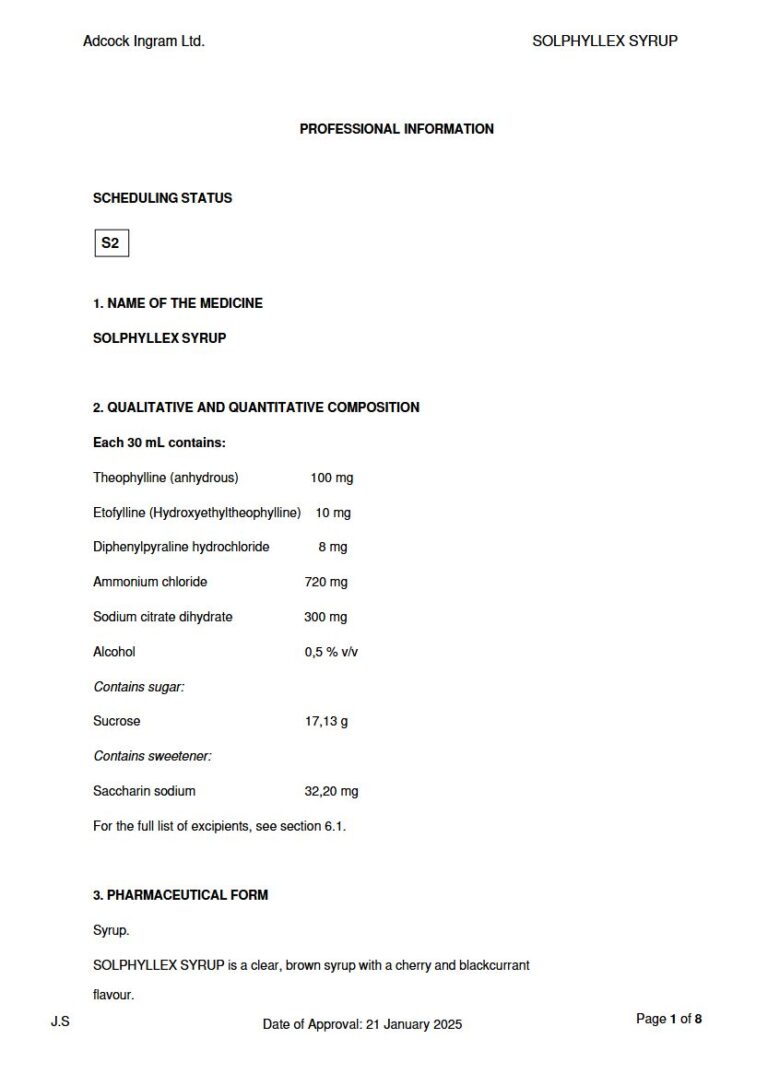
Solphyllex Syrup 30 mL Syrup.
PDF Leaflet Revision Date: 21 January 2025
Clinical Summary
Quick overview from the medicine insert
Indication
Relief of coughs associated with respiratory infection, asthma, and allergy.
Dosage (summary)
Adults: 15 mL three times daily; Children (2-12 years): 10 mL three times daily.
Special Populations
- Renal impairment
- Hepatic impairment
Pregnancy & Breastfeeding
Safety in pregnancy and lactation not established.
Key Drug Interactions
- Sympathomimetics
- Other xanthines
- Alcohol
- Tricyclic antidepressants
Contraindications
- Hypersensitivity to components
- Diabetes
- Renal disease
- Hepatic disease
- Severe hypotension
- Peptic ulcer
- Gout
- Alcoholism
Common side effects
- Gastrointestinal disturbances
Counselling Points
- Shake well before use
- Avoid alcohol
- Monitor for drowsiness
- Keep out of reach of children
Serious warnings
- May cause drowsiness
- Caution in diabetes due to sucrose content
Important Disclaimer
The Solphyllex Syrup 30 mL Syrup. professional information leaflet below is the property of Adcock Ingram and is provided on Medinsert exactly as issued, with no.. alterations or editorial changes. We make every effort to keep content current by updating documents as soon as new versions become available. Medinsert serves as a trusted access point for healthcare professionals, but does not replace official sources or clinical judgement. For more details, please read our full disclaimer. read more>>
 Healthcare Professionals Only
This content is for registered healthcare professionals
Sign in or create a free account to read the full package insert.
Free for HPCSA-registered professionals. Powered by Medinsert.
Clinical Particulars
Section 4 of the official insert — extracted exactly as issued, no alterations
4.1 Therapeutic Indications
SOLPHYLLEX SYRUP is indicated for the prompt relief of coughs associated with respiratory infection, asthma and allergy. Being non-narcotic and non-addictive, SOLPHYLLEX SYRUP can be used for prolonged therapy.
4.2 Posology and method of administration
Adults: Three medicine measuresful (15 mL) three times daily after meals and at bedtime.
Children (2 to 12 years): Two medicine measuresful (10 mL) three times daily after meals and at bedtime.
Do not exceed the recommended dose (see section 4.9).
Renal impairment: Patients undergoing routine haemodialysis may require increased doses.
Method of administration: Oral administration only. Shake well before use.
4.3 Contraindications
Hypersensitivity to theophylline, hydroxyethyltheophylline, diphenylpyraline, ammonium chloride, sodium citrate or any of the excipients listed in section 6.1. SOLPHYLLEX SYRUP is contraindicated in patients suffering from:
- diabetes
- hypersensitivity to antihistamines
- renal or hepatic disease
- severe hypotension
- peptic ulcer
- gout
- alcoholism (rehabilitated alcoholics).
4.4 Special warnings and precautions for use
- When given orally in excessive dosage all the constituents may cause gastrointestinal disturbances. However, when the recommended dosage is used, these symptoms are usually infrequent and mild.
- SOLPHYLLEX SYRUP contains 17,13 g of sucrose per 30 mL of syrup which may have an effect on the effects of the glycaemic control of patients with diabetes mellitus.
- SOLPHYLLEX SYRUP contains 0,15 mL of alcohol (ethanol) in each 30 mL of syrup, expressed as 0.5% (v/v). The alcohol in this medicine may alter the effects of other medicines.
- This medicinal product contains 73,6 mg sodium per 30 mL or 2,45 mg/mL of syrup, equivalent to 5,5 % of the WHO recommended maximum daily intake of 2 g sodium for an adult.
4.5 Interactions with other medicinal products and other forms of interaction
- The bronchodilator and toxic effects of theophylline may be enhanced by sympathomimetics and by administration with other xanthines.
- Smokers may require increased doses.
- Diphenylpyraline hydrochloride has anticholinergic properties and should be used with care in conditions such as glaucoma and prostatic hypertrophy. The effects of atropine and tricyclic antidepressants may be enhanced.
- This medicine may lead to drowsiness and impaired concentration that may be aggravated by simultaneous intake of alcohol or other central nervous system depressants (see section 4.3 and 4.7).
4.6 Fertility, pregnancy, and lactation
Safety and/or efficacy in fertility, pregnancy and lactation has not been established.
4.7 Effects on ability to drive and use machines
SOLPHYLLEX SYRUP may lead to drowsiness and impaired concentration, which may be aggravated by the simultaneous intake of alcohol or other central nervous system depressant agents. Patients should not drive, use machinery, or perform any tasks that require concentration, until they are certain that SOLPHYLLEX SYRUP does not adversely affect their ability to do so (see section 4.8).
4.8 Undesirable effects
Gastrointestinal disturbances.
Reporting of suspected adverse reactions
Reporting suspected adverse reactions after authorisation of the medicine is important. It allows continued monitoring of the benefit /risk balance of the medicine. Health care providers are requested to report any suspected adverse drug reactions to SAHPRA via the Med Safety APP (Medsafety X SAHPRA) and eReporting platform (who-umc.org) found on SAHPRA website.
Adverse Drug Reactions may also report to Adcock Ingram Limited using the following email: [email protected].
4.9 Overdose
Large doses of theophylline will cause gastric irritation. Large doses of ammonium chloride will cause similar symptoms including nausea, vomiting, thirst, also headache, hyperventilation, progressive drowsiness, mental confusion and hyperchloraemic acidosis. Acidosis and electrolyte loss may be corrected by intravenous administration of sodium bicarbonate and potassium gluconate. Large doses of antihistamines will cause sedation varying from slight drowsiness to deep sleep, also dizziness, muscular weakness and in co-ordination. Paediatric Population: In infants and children the antihistamines often act as cerebral stimulants and may cause hyperpyrexia and convulsions. No fatal effects have ever been reported with the usual therapeutic doses, but rare fatalities have occurred in young children who had ingested large overdoses. Since there is no specific antidote for acute antihistamine poisoning (histamine must not be used) it is important to keep SOLPHYLLEX SYRUP out of the reach of young children. If a large overdose has just been taken, contact the nearest doctor, hospital or poison control center.
