
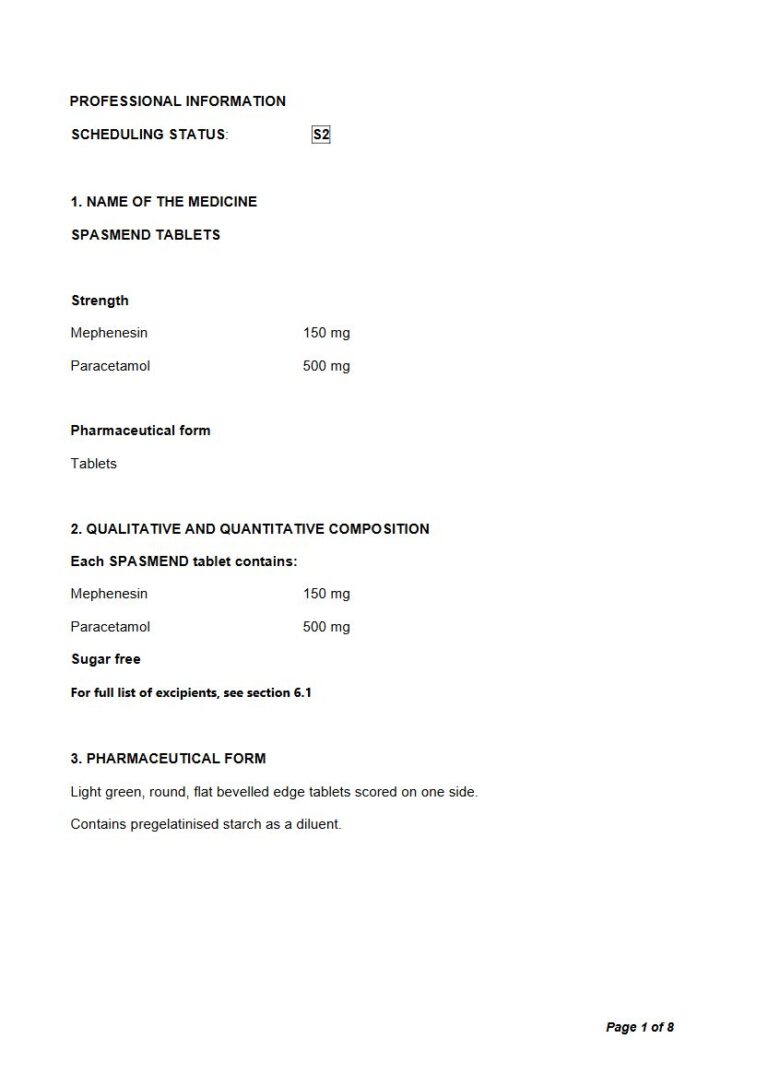
Spasmend 150 mg, 500 mg Tablets
PDF Leaflet Revision Date: 14 October 2022
Clinical Summary
Quick overview from the medicine insert
Indication
For generalised and symptomatic pain associated with tension.
Dosage (summary)
Adults: 1-2 tablets every 4 hours, max 8 tablets/day for 10 days.
Special Populations
- Renal impairment
- Hepatic impairment
Pregnancy & Breastfeeding
Safety in pregnancy and lactation not established.
Key Drug Interactions
- Enhances effects of barbiturates
- Enhances effects of opioids
Contraindications
- Impaired kidney function
- Impaired liver function
- Hypersensitivity to ingredients
Common side effects
- Drowsiness
- Nausea
- Vomiting
- Abdominal pain
- Skin rash
Counselling Points
- Do not use for more than 10 days without consulting a doctor
- May cause drowsiness, avoid driving or operating machinery
Serious warnings
- Risk of overdose leading to liver damage
- Do not exceed recommended dose
Important Disclaimer
The Spasmend 150 mg, 500 mg Tablets professional information leaflet below is the property of Adcock Ingram and is provided on Medinsert exactly as issued, with no.. alterations or editorial changes. We make every effort to keep content current by updating documents as soon as new versions become available. Medinsert serves as a trusted access point for healthcare professionals, but does not replace official sources or clinical judgement. For more details, please read our full disclaimer. read more>>
 Healthcare Professionals Only
This content is for registered healthcare professionals
Sign in or create a free account to read the full package insert.
Free for HPCSA-registered professionals. Powered by Medinsert.
Clinical Particulars
Section 4 of the official insert — extracted exactly as issued, no alterations
4.1 Therapeutic indications
For generalised and symptomatic pain associated with tension.
4.2 Posology and method of administration
Posology
Adults (18 years and older): Take one or two tablets orally every four hours. The maximum dosage is eight tablets per day, for 10 days. Consult a doctor if no relief is obtained with the recommended dosage. Do not use continuously for more than 10 days without consulting a doctor. DO NOT EXCEED THE RECOMMENDED DOSE The safety and efficacy of SPASMEND in children aged below 18 years old has not yet been established.
4.3. Contraindications:
- Impaired kidney and liver function.
- Hypersensitivity to paracetamol or mephenesin or to any of the other excipients in SPASMEND TABLETS.
4.4 Special warnings and precautions for use:
This product contains paracetamol which may be fatal in overdose. In the event of overdosage or suspected overdose and notwithstanding the fact that the person may be asymptomatic, the nearest doctor, hospital or Poison Centre must be contacted immediately. Do not use continuously for more than 10 days without consulting a doctor.
Dosage in excess of those recommended may cause severe liver damage. Paracetamol should be given with care to patients with impaired renal or hepatic function. Mephenesin may enhance the effects of barbiturates and opioids (see Interaction with other medicines and other forms of interactions). Mephenesin may cause drowsiness; patients that are affected should not drive or operate machinery (see Effects on ability to drive and use machines).
4.5 Interaction with other medicines and other forms of interactions
Mephenesin may enhance the effects of barbiturates and opioids (see Special warnings and precautions for use).
4.6. Fertility, pregnancy and lactation
Safety affecting fertility, pregnancy and lactation has not been established.
4.7 Effects on ability to drive and use machines
Mephenesin may cause drowsiness; patients that are affected should not drive or operate machinery.
4.8 Undesirable effects
Frequency System Organ Class Undesirable effects Frequency Unknown Blood and the lymphatic system disorders Anaemia. Cardiac disorders Tachycardia, low blood pressure. Gastrointestinal disorders Anorexia, nausea and vomiting, abdominal pain. General disorders and administration site conditions Lassitude, drowsiness, fever.
Immune system disorders Sensitive allergic reactions, skin rash, blood disorders such as neutropenia, pancytopenia, leucopenia. Skin and subcutaneous tissue disorders Erythematous or urticarial skin rash, sometimes accompanied by fever and mucosal lesions, facial edema, pruritus, dyspnea, general edema without skin eruption, cutaneous eruptions like contact dermatitis and erythema multiform like eruptions.
Reporting of suspected adverse reactions Reporting suspected adverse reactions after authorisation of the medicine is important. It allows continued monitoring of the benefit/risk balance of the medicine. Health care providers are asked to report any suspected adverse reactions to SAHPRA via the u201c6.04 Adverse Drug Reactions Reporting Formu201d, found online under SAHPRAu2019s publications: https://www.sahpra.org.za/Publications/Index/8. One may also report to Adcock Ingram Limited using the following email: [email protected]
4.9 Overdose
Paracetamol: Prompt treatment is essential. In the event of an overdosage, consult a doctor immediately, or take the person directly to a hospital. A delay in starting treatment may mean that the antidote is given too late to be effective. Evidence of liver damage is often delayed until after the time for effective treatment has lapsed.
Susceptibility to paracetamol toxicity is increased in patients who have taken repeated high doses (greater than 5 -10 g/day) of paracetamol for several days, in chronic alcoholism, chronic liver disease, AIDS, malnutrition, and with the use of drugs that induce liver microsomal oxidation such as barbiturates, isoniazid, rifampicin, phenytoin and carbamazepine.
Symptoms of paracetamol overdosage in the first 24 hours include pallor, nausea, vomiting, anorexia and possibly abdominal pain. Mild symptoms during the first two days of acute poisoning, do not reflect the potential seriousness of the overdosage. Liver damage may become apparent 12 to 48 hours, or later after ingestion, initially by elevation of the serum transaminase and lactic dehydrogenase activity, increased serum bilirubin concentration and prolongation of the prothrombin time. Liver damage may lead to encephalopathy, coma and death. Acute renal failure with acute tubular necrosis may develop even in the absence of severe liver damage. Abnormalities of glucose metabolism and metabolic acidosis may occur. Cardiac arrhythmias have been reported.
Treatment for paracetamol overdosage: Although evidence is limited it is recommended that any adult person who has ingested 5 - 10 grams or more of paracetamol (or a child who has had more than 140 mg/kg) within the preceding four hours, should have the stomach emptied by lavage (emesis may be adequate for children) and a single dose of 50 g activated charcoal given via the lavage tube. Ingestion of amounts of paracetamol smaller than this may require treatment in patients susceptible to paracetamol poisoning (see above). In patients who are stuperose or comatose, endotracheal intubation should precede gastric lavage in order to avoid aspiration.
N-acetylcysteine should be administered to all cases of suspected overdose as soon as possible preferably within eight hours of overdosage, although treatment up to 36 hours after ingestion may still be of benefit, especially if more than 150 mg/kg of paracetamol was taken. An initial dose of 150 mg/kg N-acetylcysteine in 200 ml dextrose injection given intravenously over 15 minutes, followed by an infusion of 50 mg/kg in 500 ml dextrose injection over the next four hours, and then 100 mg/kg in 1 000 ml dextrose injection over the next sixteen hours. The volume of intravenous fluid should be modified for children. Although the oral formulation is not the treatment of choice, 140 mg/kg dissolved in water may be administered initially, followed by 70 mg/kg every four hours for seventeen doses. A plasma paracetamol level should be determined four hours after ingestion in all cases of suspected overdosage. Levels done before four hours may be misleading. Patients at risk of liver damage, and hence requiring continued treatment with N-acetylcysteine, can be identified according to their 4-hour plasma paracetamol level. The plasma paracetamol level can be plotted against time since ingestion in the nomogram below. The nomogram should be used only in relation to a single acute ingestion. Those whose plasma paracetamol levels are above the u201cnormal treatment lineu201d, should continue N-acetylcysteine treatment with 100 mg/kg IV over sixteen hours repeatedly until recovery. Patients with increased susceptibility to liver damage as identified above, should continue treatment if concentrations are above the u201chigh risk treatment lineu201d. Prothrombin index correlates best with survival.
Mephenesin: Overdosage may produce nystagmus, blurred vision and motor in-coordination; in gross overdosage there may be hypotonia, a fall in blood pressure and respiratory paralysis. Treatment is symptomatic and supportive.
