
Pharma-Q Betamethasone Injection 4mg /1 ml Solution for injection
PDF Leaflet Revision Date: 08 September 2023
Clinical Summary
Quick overview from the medicine insert
Indication
Treatment of adrenal insufficiency and inflammatory conditions responsive to corticosteroids.
Dosage (summary)
4 mg to 20 mg betamethasone, adjusted based on patient needs.
Special Populations
- Elderly
- Pediatric population
Pregnancy & Breastfeeding
Contraindicated in pregnancy and lactation; safety not established.
Key Drug Interactions
- Anti-epileptics may reduce corticosteroid effects.
- Oestrogen may enhance corticosteroid effects.
- Potassium-depleting diuretics may cause excessive potassium loss.
- Cardiac glycosides may enhance dysrhythmias risk.
- NSAIDs may increase gastrointestinal bleeding risk.
Contraindications
- Hypersensitivity to betamethasone or corticosteroids.
- Systemic fungal infections.
- Certain conditions like osteoporosis and peptic ulcer.
Common side effects
- Increased infection risk.
- Hypertension.
- Psychiatric disturbances.
- Osteoporosis.
- Gastrointestinal issues.
Counselling Points
- Avoid hazardous tasks until effects are known.
- Monitor for signs of infection.
- Gradual dosage reduction is necessary to avoid withdrawal symptoms.
Serious warnings
- Serious neurologic events with epidural use.
- Risk of adrenal suppression with prolonged use.
- Caution in patients with psychiatric disorders.
Important Disclaimer
The Pharma-Q Betamethasone Injection 4mg /1 ml Solution for injection professional information leaflet below is the property of Pharma-Q Holdings and is provided on Medinsert exactly as issued, with no.. alterations or editorial changes. We make every effort to keep content current by updating documents as soon as new versions become available. Medinsert serves as a trusted access point for healthcare professionals, but does not replace official sources or clinical judgement. For more details, please read our full disclaimer. read more>>
 Healthcare Professionals Only
This content is for registered healthcare professionals
Sign in or create a free account to read the full package insert.
Free for HPCSA-registered professionals. Powered by Medinsert.
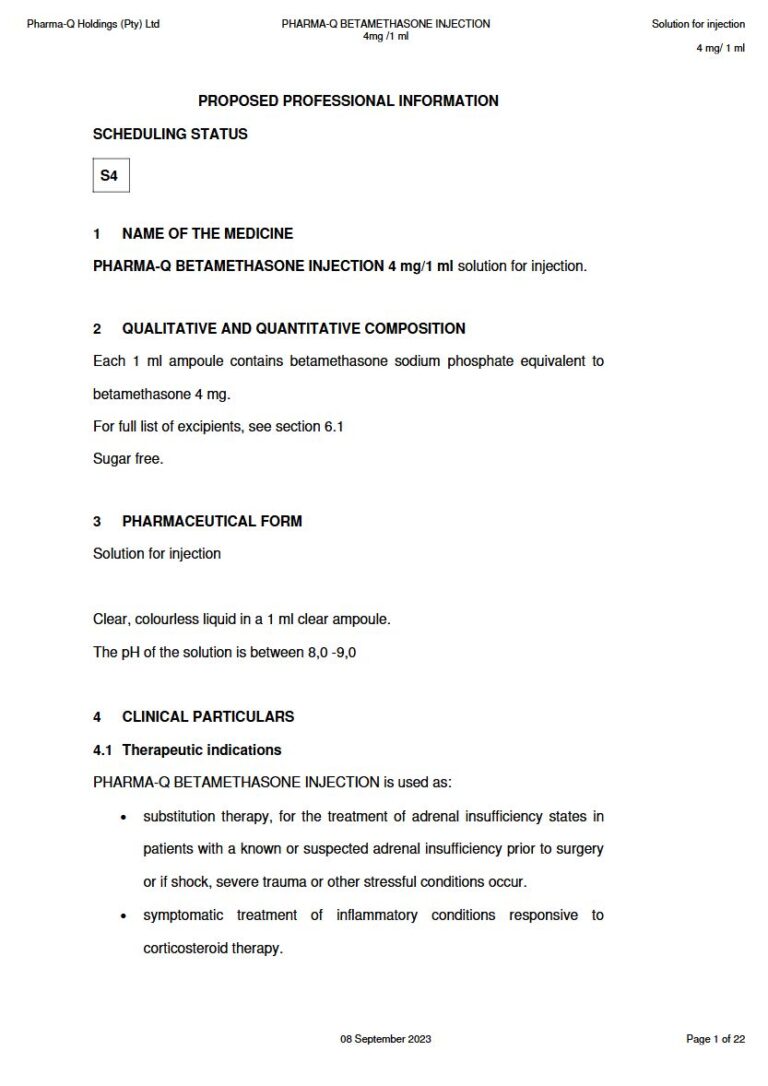
Clinical Particulars
Section 4 of the official insert — extracted exactly as issued, no alterations
4.1 Therapeutic indications
PHARMA-Q BETAMETHASONE INJECTION is used as:
- substitution therapy, for the treatment of adrenal insufficiency states in patients with a known or suspected adrenal insufficiency prior to surgery or if shock, severe trauma or other stressful conditions occur.
- symptomatic treatment of inflammatory conditions responsive to corticosteroid therapy.
4.2 Posology and method of administration
Posology
PHARMA-Q BETAMETHASONE INJECTION may be given, intravenously, intramuscularly, intra-articularly, intralesionally or by infusion in doses equivalent to 4 mg to 20 mg of betamethasone. It may also be given by local injection into soft tissue, in doses equivalent to 4 mg to 8 mg of betamethasone. Dosage frequency and route of administration must be adjusted to the specific requirements of the patient, according to the disease, the severity of the condition, the response obtained and the patientu2019s tolerance to the product. Rapid intravenous injection of massive doses of corticosteroids may sometimes cause cardiovascular collapse and injections should therefore be given slowly or by infusion.
Method of administration
PHARMA-Q BETAMETHASONE INJECTION may be given, intravenously, intramuscularly, intra-articularly, intralesionally or by infusion. It may also be given by local injection into soft tissue. PHARMA-Q BETAMETHASONE INJECTION should not be administered intrathecally or subconjunctivally.
4.3 Contraindications
- Hypersensitivity to betamethasone sodium phosphate, other corticosteroids or to any of the excipients (see section 6.1).
- Patients with systemic fungal infections.
- In certain conditions ordinarily considered contraindicated to corticosteroid therapy (osteoporosis, marked emotional instability, peptic ulcer, tuberculosis, acute viral infections, including acute ocular herpes simplex, thromboembolic tendencies, diverticulitis, recent intestinal anastomosis and acute and chronic infections), the anticipated clinical improvement must be weighed against the possibility of undesirable corticosteroid effects.
- Patients who are pregnant or lactating since the safety in pregnancy and lactation has not been established (see section 4.6).
4.4 Special warnings and precautions for use
PHARMA-Q BETAMETHASONE INJECTION should not be administered intrathecally or subconjunctivally. Serious neurologic events, some resulting in death, have been reported with epidural injection of corticosteroids. Specific events reported include but are not limited to spinal cord infarction, paraplegia, quadriplegia, cortical blindness and stroke. These serious neurologic events have been reported with and without use of fluoroscopy. The safety and effectiveness of epidural administration of corticosteroids have not been established and corticosteroids are not approved for this use.
Corticosteroids should not be used for management of head injury or stroke because it is unlikely to be of benefit and may even be harmful. In the treatment of cerebral oedema due to tumour, gastrointestinal bleeding may occur, and stool examination may be helpful in diagnosis. Toxic effects may result from withdrawal or from continued use or large doses. Less frequent instances of anaphylactoid/anaphylactic reactions with a possibility of shock have occurred in patients receiving parenteral corticosteroid therapy. Appropriate precautionary measures should be taken with patients who have a history of allergic reactions to corticosteroids.
PHARMA-Q BETAMETHASONE INJECTION should be administered intramuscularly with caution to patients with idiopathic thrombocytopenic purpura. Intramuscular injection of corticosteroids should be given deep into large muscle masses to avoid local tissue atrophy. Soft tissue, intralesional and intra-articular administration of a corticosteroid may produce systemic as well as local effects. Examination of any joint fluid present is necessary to exclude a septic process. Local injection into a previously infected joint is to be avoided. A marked increase in pain and local swelling, further restriction of joint motion, fever and malaise are suggestive of septic arthritis. If the diagnosis of sepsis is confirmed appropriate antimicrobial therapy should be instituted.
Corticosteroids should not be injected into unstable joints, infected areas or intervertebral spaces. Repeated injections into joints of osteoarthritis may increase joint destruction. Avoid injecting corticosteroids directly into the substance of tendons because delayed appearance of tendon rupture has resulted. Following intra-articular corticosteroid therapy, care should be taken by the patient to avoid overuse of the joint in which symptomatic benefit has been obtained. With long-term corticosteroid therapy, transfer from parenteral to oral administration should be considered after weighing the potential benefits and risks.
Dosage adjustments may be required with remission or exacerbation of the disease process, the patient's individual response to therapy and exposure of the patient to emotional or physical stress such as serious infection, surgery or injury. Monitoring may be necessary for up to 1 year following cessation of long-term or high-dose corticosteroid therapy. Corticosteroids may mask some signs of infection, and new infections may appear during use. When corticosteroids are used, decreased resistance and inability to localise infection may occur. Prolonged corticosteroid use may produce posterior subcapsular cataracts (especially in children), glaucoma with possible damage to the optic nerves, and may enhance secondary ocular infections due to fungi or viruses. Average and large doses of corticosteroids can cause elevation of blood pressure, salt and water retention and increased excretion of potassium. These effects are less likely to occur with the synthetic derivatives except when used in large doses. Dietary salt restriction and potassium supplementation may be considered. All corticosteroids increase calcium excretion.
Patients should not be vaccinated with live vaccines while being treated with PHARMA-Q BETAMETHASONE INJECTION. While on corticosteroid therapy patients should not be vaccinated against smallpox. Other immunisation procedures should not be undertaken in patients receiving corticosteroids, especially high doses, because of possible hazards of neurological complications and lack of antibody response. However, immunisation procedures may be undertaken in patients who are receiving corticosteroids as replacement therapy e.g. for Addison's disease. Patients who are on immunosuppressant doses of corticosteroids should be warned to avoid exposure to chickenpox or measles, and if exposed, to obtain medical advice. This is of particular importance in children. Prophylaxis with intramuscular normal immunoglobulin may be needed.
PHARMA-Q BETAMETHASONE INJECTION therapy in active tuberculosis should be restricted to those cases of fulminating or disseminated tuberculosis in which the corticosteroid is used for management in conjunction with an appropriate anti-tuberculosis regimen. If PHARMA-Q BETAMETHASONE INJECTION is indicated in patients with latent tuberculosis or tuberculin reactivity, close observation is necessary since reactivation of the disease may occur. During prolonged PHARMA-Q BETAMETHASONE INJECTION therapy patients should receive chemoprophylaxis. If rifampicin is used in a chemoprophylactic program, its enhancing effect on metabolic hepatic clearance of corticosteroids should be considered; adjustment in corticosteroid dosage may be required.
The lowest possible dose of corticosteroid should be used to control the condition under treatment when dosage reduction is possible. It should be gradual. Medicine-induced secondary adrenocortical insufficiency may result from too rapid corticosteroid withdrawal and may be minimised by gradual dosage reduction. Such relative insufficiency may persist for months after discontinuation of therapy: therefore, if stress occurs during that period, corticotherapy should be reinstituted. If the patient is receiving corticosteroids already, dosage may have to be increased. Since mineralocorticosteroid secretion may be impaired, salt and/or a mineralocorticosteroid should be administered concurrently.
Adrenal suppression: Adrenal cortical atrophy develops during prolonged therapy and may persist for years after stopping treatment. In patients who have received more than physiological doses of systemic corticosteroids (approximately 1 mg betamethasone or equivalent) for longer than 3 weeks, withdrawal should not be abrupt. How dose reduction should be carried out depends largely on whether the disease is likely to relapse as a dose of systemic corticosteroids is reduced. Clinical assessment of disease activity may be needed during withdrawal. If the disease is unlikely to relapse on withdrawal of systemic corticosteroids but there is uncertainty about HPA suppression, the dose of systemic corticosteroid may be reduced rapidly to physiological doses. Once a daily dose equivalent to 1 mg betamethasone is reached, dose reduction should be slower to allow the HPA-axis to recover. Abrupt withdrawal of systemic corticosteroid treatment, which has continued up to 3 weeks is appropriate if it is considered that the disease is unlikely to relapse. Abrupt withdrawal of doses of up to 6 mg daily of betamethasone, or equivalent for 3 weeks is unlikely to lead to clinically relevant HPA-axis suppression, in the majority of patients. In the following patient groups, gradual withdrawal of systemic corticosteroid therapy should be considered even after courses lasting 3 weeks or less:
- Patients who have had repeated courses of systemic corticosteroids, particularly if taken for longer than 3 weeks,
- When a short course has been prescribed within one year of cessation of long-term therapy (months or years),
- Patients who have reasons for adrenocortical insufficiency other than exogenous corticosteroids therapy,
- Patients receiving doses of systemic corticosteroid greater than 6 mg daily of betamethasone (or equivalent),
- Patients repeatedly taking doses in the evening.
During prolonged therapy any intercurrent illness, trauma or surgical procedure will require a temporary increase in dosage; if corticosteroids have been stopped following prolonged therapy they may need to be temporarily re-introduced. The effects of PHARMA-Q BETAMETHASONE INJECTION are enhanced in patients with hypothyroidism, myasthenia gravis or in those with cirrhosis. Cautious use of corticosteroids is advised in patients with ocular herpes simplex because of possible corneal perforation. Psychic derangements may appear with corticosteroid therapy. PHARMA-Q BETAMETHASONE INJECTION may aggravate existing emotional instability or psychotic tendencies. Patients/and or carers should be warned that potentially severe psychiatric adverse reactions may occur with systemic steroids. Symptoms typically emerge within a few days or weeks of starting treatment. Risks may be higher with high doses/systemic exposure, although dose levels do not allow prediction of the onset, type, severity, or duration of reactions. Most reactions recover after either dose reduction or withdrawal, although specific treatment may be necessary. Patients/carers should be encouraged to seek medical advice if worrying psychological symptoms develop, especially if depressed mood or suicidal ideation is suspected. Patients/carers should also be alert to possible psychiatric disturbances that may occur either during or immediately after dose tapering/withdrawal of systemic steroids, although such reactions have been reported infrequently. Particular care is required when considering the use of systemic corticosteroids in patients with existing or previous history of severe affective disorders in themselves or in their first-degree relatives. These would include depressive or manic-depressive illness and previous steroid psychosis. PHARMA-Q BETAMETHASONE INJECTION should be used with caution in non-specific ulcerative colitis, if there is a possibility of impending perforation, abscess or other pyogenic infection, diverticulitis, fresh intestinal anastomoses, active or latent peptic ulcer, renal insufficiency, hypertension, osteoporosis and myasthenia gravis. Pheochromocytoma crisis, which can be fatal, has been reported after administration of systemic corticosteroids. Corticosteroids should only be administered to patients with suspected or identified pheochromocytoma after an appropriate risk/benefit evaluation. Since complications of glucocorticosteroid treatment are dependent on dose size and duration of treatment. A risk/benefit decision must be made with each patient. Visual disturbance may be reported with systemic and topical (including, intranasal, inhaled and intraocular) corticosteroid use. If a patient presents with symptoms such as blurred vision or other visual disturbances, the patient should be considered for referral to an ophthalmologist for evaluation of possible causes of visual disturbances which may include cataract, glaucoma or rare diseases such as central nervous chorioretinopathy (CSCR) which have been reported after use of systemic and topical corticosteroids. Corticosteroids are not indicated in the management of hyaline membrane disease after birth and should not be administered to pregnant women with pre-eclampsia, eclampsia, or evidence of placental damage.
PHARMA-Q BETAMETHASONE INJECTION may alter the motility and number of spermatozoa in some patients. Caution is advised with the use of corticosteroids in patients who have suffered a recent myocardial infarction because of the risk of myocardial rupture. Elderly The common adverse effects of systemic corticosteroids may be associated with more serious consequences in old age, especially osteoporosis, hypertension, hypokalaemia, diabetes, susceptibility to infection and thinning of the skin. Close clinical supervision is required to avoid life-threatening reactions. Paediatric population Caution is advised in children as they are more susceptible to systemic toxicity from betamethasone. Corticosteroids cause dose-related growth retardation in infancy, childhood, and adolescence, which may be irreversible. Treatment should be limited to the minimum dosage for the shortest possible time. In order to minimise suppression of the HPA axis and growth retardation, consideration should be given to administration of a single dose on alternate days.
4.5 Interaction with other medicines and other forms of interaction
PHARMA-Q BETAMETHASONE INJECTION may interact with other medicines.
- Anti-epileptic medicines: Simultaneous administration of barbiturates, carbamazepine, phenytoin, primidone, or rifampicin may reduce the effects of corticosteroids.
- Oestrogen therapy: Concomitant use with oestrogen may cause excessive corticosteroid effects.
- Potassium depleting diuretics: Excessive potassium loss may be due to concurrent administration of corticosteroids with potassium-depleting diuretics e.g., furosemide.
- Cardiac glycosides or Amphotericin B: Concurrent use of corticosteroids with cardiac glycosides may enhance the possibility of dysrhythmias or digitalis toxicity associated with hypokalaemia. Corticosteroids may enhance the potassium depletion caused by amphotericin B. In patients taking any of these medicines concurrently, serum electrolyte levels, particularly potassium levels should be closely monitored.
- Coumarin-type anticoagulants: The efficacy of coumarin anticoagulants may be enhanced by concurrent corticosteroid therapy and close monitoring of the INR or prothrombin time is required to avoid spontaneous bleeding.
- Non-steroidal anti-inflammatories: When corticosteroids are given with non-steroidal anti-inflammatory medicines, an increase in the incidence of gastrointestinal bleeding and ulceration may occur.
- Anti-diabetic and antihypertensive medicines: The desired effects of hypoglycaemic medicines (including insulin), anti-hypertensives and diuretics are antagonised by corticosteroids, therefore dosages of anti-diabetic and anti-hypertensive medicines may need to be adjusted or increased.
- Anti-muscarinic medicines: Antimuscarinic effects may be decreased in myasthenia gravis.
- Somatotropin: The growth promoting effect of somatropin may be inhibited by corticosteroids.
- Salicylates: The renal clearance of salicylates is increased by corticosteroids and steroid withdrawal may result in salicylate intoxication.
- Fluoroquinolones: Concurrent use of corticosteroids and fluoroquinolones may result in increased risk of tendon rupture.
- Quetiapine: Concomitant use of betamethasone with quetiapine may result in the increased metabolism of quetiapine and, depending on the clinical response, a higher dose of quetiapine may need to be considered.
- Tretinoin: Corticosteroids may enhance the metabolism of tretinoin resulting in decreased levels of tretinoin.
- CYP3A4 inhibitors: Ketoconazole has been reported to decrease the metabolism of certain corticosteroids by up to 60 %, leading to an increased risk of corticosteroid side effects. Co-administration with other strong CYP3A4 inhibitors, (e.g. itraconazole, clarithromycin, ritonavir, cobicistat-containing products) may lead to increased exposures of corticosteroids and therefore the potential for increased risk of systemic corticosteroid side effects. Consider the benefit of co-administration versus the potential risk of systemic corticosteroid effects, in which case patients should be monitored for systemic corticosteroid side effects.
- Laboratory tests: Corticosteroids may interfere with assay procedures for endogenous substances. Corticosteroids may affect the nitro-blue tetrazolium test for bacterial infection and produce false negative results.
4.6 Fertility, pregnancy, and lactation
Pregnancy
PHARMA-Q BETAMETHASONE INJECTION is contraindicated for use in pregnancy since the safety in pregnancy has not been established (see section 4.3).
Lactation
PHARMA-Q BETAMETHASONE INJECTION is contraindicated for use in lactation since the safety in lactation has not been established (see section 4.3).
Fertility
PHARMA-Q BETAMETHASONE INJECTION may alter the motility and number of spermatozoa in some patients (see section 4.4).
4.7 Effects on ability to drive and use machines
Patients should be instructed that they should avoid potentially hazardous tasks such as driving and operating machinery until they know how PHARMA-Q BETAMETHASONE INJECTION affects them.
4.8 Undesirable effects
a. Summary of the safety profile
PHARMA-Q BETAMETHASONE INJECTION may have side effects, but the frequencies are unknown:
b. Tabulated summary of adverse reactions
The frequency of adverse reactions listed below is defined using the following convention: frequent and frequency unknown (cannot be estimated from the available data).
MedDRA system organ class Frequency Adverse reactions
Infections and infestations Frequency unknown Increased susceptibility to and severity of infections with suppression of clinical symptoms and signs, opportunistic infections, recurrence of dormant tuberculosis (see section 4.4)
Blood and lymphatic system disorders Frequency unknown Increased coagulability of the blood may lead to thromboembolic complications.
Immune system disorders Frequency unknown Increased susceptibility to all kinds of infection, sepsis, tuberculosis, fungal infections, viral infections and delayed wound healing.
Endocrine disorders Frequency unknown Acute adrenal insufficiency, development of Cushingoid state, suppression of foetal intrauterine or childhood growth, secondary adrenocortical and pituitary unresponsiveness (particularly in times of stress as in trauma, surgery or illness), decreased carbohydrate tolerance, manifestations of latent diabetes mellitus, increased requirements of insulin or oral hypoglycaemic medicines in diabetes, menstrual irregularity, and amenorrhoea.
Metabolism and nutrition disorders Frequency unknown Electrolyte disturbances, hypokalaemic alkalosis, osteoporosis, spontaneous fractures, nitrogen depletion, hyperglycaemia, *
Psychiatric disorders Frequent A wide range of psychiatric reactions**
Nervous system disorders Frequency unknown Mental and neurological disturbances, convulsions, increased intracranial pressure with papilloedema (pseudotumor cerebri) usually after treatment, vertigo, headache.
Eye disorders Frequency unknown Ocular changes including increased intra-ocular pressure, glaucoma, posterior subcapsular cataracts, exophthalmos, blurred vision, papilloedema, corneal or scleral thinning, exacerbation of ophthalmic viral or fungal diseases.
Cardiac disorders Frequency unknown Congestive heart failure, myocardial rupture following recent myocardial infarction.
Vascular disorders Frequency unknown Hypertension, intracranial hypertension.
Gastrointestinal disorders Frequency unknown Hiccups, abdominal distension, oesophageal ulceration, nausea, dyspepsia, peptic ulceration with perforation and haemorrhage, acute pancreatitis, candidiasis.
Hepato-biliary disorders Frequency unknown Acute pancreatitis.
Skin and subcutaneous tissue disorders Frequency unknown Hyperhidrosis, skin thinning, thin fragile skin, petechiae and ecchymoses, facial erythema, suppressed reactions to skin tests, reactions such as allergic dermatitis, urticaria, angioneurotic oedema, impaired wound healing, bruising, telangiectasia, striae, acne, Stevens-Johnsonu2019s syndrome.
Musculoskeletal and connective tissue disorders Frequency unknown Muscle weakness and aseptic necrosis of bone, loss of muscle mass, aggravation of myasthenic symptoms in myasthenia gravis, osteoporosis, vertebral compression fractures, aseptic necrosis of femoral and humeral heads, pathologic fracture of long bones, tendon rupture, joint instability (from repeated intra-articular injections), osteoporosis, vertebral and long bone fractures, avascular osteonecrosis, proximal myopathy.
General disorders and administration site conditions Frequency unknown Anaphylactoid or hypersensitivity and hypotensive or shock-like reactions, leucocytosis, thromboembolism, malaise.
*Negative protein, nitrogen, and calcium balance. Increased appetite. Hyperhidrosis. Increased high-density lipoprotein and low-density lipoprotein concentrations in the blood. Fluid and electrolyte disturbance (Sodium and water retention, hypertension, potassium loss, hypokalaemic alkalosis).
** Including affective disorder (such as irritable, euphoric, depressed, and labile mood and suicidal thoughts), psychotic reactions (including mania, delusions, hallucinations, and aggravation of schizophrenia), behavioural disturbances, irritability, anxiety, sleep disturbances and cognitive dysfunction including confusion and amnesia have been reported. Reactions are frequent and may occur in both adults and children. Psychological effects have been reported on withdrawal of corticosteroids; the frequency is unknown.
Psychological dependence. Increased intra-cranial pressure with papilledema in children (pseudotumour cerebri), usually after treatment withdrawal. Aggravation of epilepsy.
c. Description of selected adverse reactions
Acute adrenal insufficiency may occur during prolonged therapy or on cessation and may be precipitated by stressful situations. Growth retardation in children and amenorrhoea (in females). Reversible Cushingoid symptoms may be produced with large doses. Electrolyte disturbances are characterized by hypertension and oedema, because of the retention of sodium and water and the increase in potassium, excretion may cause hypokalaemic alkalosis. Due to the mobilization of calcium and phosphorus, osteoporosis and spontaneous fractures, nitrogen depletion and hyperglycaemia may occur. Additional adverse reactions related to parenteral corticosteroid therapy include less frequent instances of blindness associated with intralesional therapy around the face and head, hyperpigmentation or hypopigmentation, subcutaneous and cutaneous atrophy, sterile abscess, post-injection flare (following intra-articular use) and charcot-like arthropathy.
Withdrawal symptoms and signs
Too rapid reduction of corticosteroid dosage following prolonged treatment can lead to acute adrenal insufficiency, hypotension and death (see section 4.4).
A u201cwithdrawal syndromeu201d may also occur including fever, myalgia, arthralgia, rhinitis, conjunctivitis, painful itchy skin nodules and loss of weight.
Reporting of suspected adverse reactions
Reporting suspected adverse reactions after authorisation of the medicine is important. It allows continued monitoring of the benefit/risk balance of the medicine. Health care providers are asked to report any suspected adverse reactions to SAHPRA via the u201c6.04 Adverse Drug Reactions Reporting Formu201d, found online under SAHPRAu2019s publications: https://www.sahpra.org.za/Publications/Index/8
4.9 Overdose
Treatment is symptomatic and supportive, and doses must be reduced, and the treatment slowly withdrawn.
