
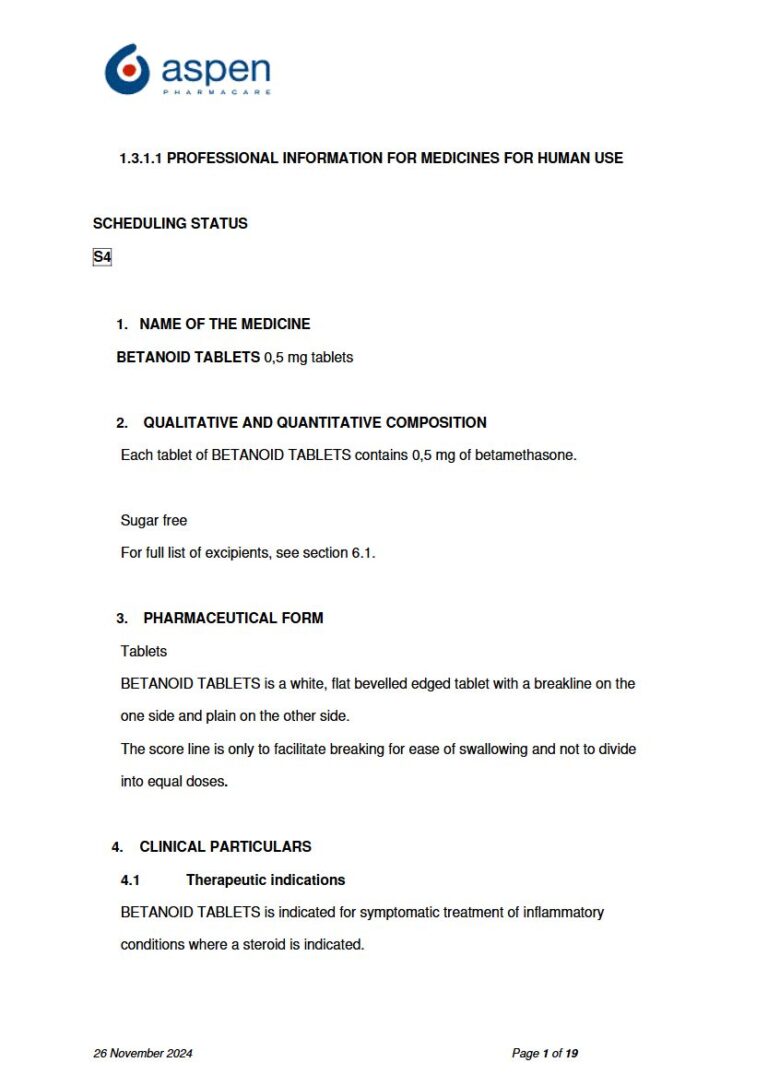
Betanoid Tablets
PDF Leaflet Revision Date: 26 November 2024
Clinical Summary
Quick overview from the medicine insert
Indication
Symptomatic treatment of inflammatory conditions where a steroid is indicated.
Dosage (summary)
0.5 mg to 5 mg daily in divided doses; can be given once daily in the morning.
Special Populations
- Elderly
- Renal impairment
- Hepatic impairment
- Diabetes mellitus
- Post-menopausal females
Pregnancy & Breastfeeding
Safety during pregnancy and lactation not established; may affect fetal development.
Key Drug Interactions
- Anticholinesterases in myasthenia gravis
- NSAIDs may increase gastrointestinal bleeding
- CYP3A inhibitors may increase systemic side effects
Contraindications
- Hypersensitivity to betamethasone
- Systemic fungal infections
- Peptic ulceration
- Active tuberculosis
- Live vaccines
Common side effects
- Increased susceptibility to infections
- Cushing's syndrome
- Hyperglycemia
- Osteoporosis
- Psychiatric disturbances
Counselling Points
- Take in the morning to minimize side effects
- Avoid exposure to infections like chickenpox
- Monitor for psychological symptoms
Serious warnings
- Risk of myocardial rupture post-MI
- Adrenal suppression with prolonged use
- Potential for severe psychiatric reactions
Important Disclaimer
The Betanoid Tablets professional information leaflet below is the property of Pharmacare Limited and is provided on Medinsert exactly as issued, with no.. alterations or editorial changes. We make every effort to keep content current by updating documents as soon as new versions become available. Medinsert serves as a trusted access point for healthcare professionals, but does not replace official sources or clinical judgement. For more details, please read our full disclaimer. read more>>
 Healthcare Professionals Only
This content is for registered healthcare professionals
Sign in or create a free account to read the full package insert.
Free for HPCSA-registered professionals. Powered by Medinsert.
Clinical Particulars
Section 4 of the official insert — extracted exactly as issued, no alterations
4.1 Therapeutic indications
BETANOID TABLETS is indicated for symptomatic treatment of inflammatory conditions where a steroid is indicated.
4.2 Posology and method of administration
Posology
Dosing requirements are variable and must be individualised on the basis of the specific disease, its severity and the response of the patient. Betamethasone has a usual dose range of 0,5 mg to 5 mg daily in divided doses (1 to 10 BETANOID TABLETS) depending on the specific disease being treated. In situations of less severity, low doses generally will suffice while in selected patients higher initial doses may be required. The initial dose should be maintained or adjusted until a satisfactory response is observed. If a period of spontaneous remission occurs in a chronic condition, treatment should be discontinued.
Once a day dosage: The total daily maintenance dose can be administered once early in the morning.
Paediatric population
Dosages for infants and children should be governed by the same considerations as adults rather than strict adherence to ratios indicated by age or body weight.
Method of administration
For oral administration.
4.3 Contraindications
BETANOID TABLETS is contraindicated in:
- Patients with hypersensitivity to betamethasone or to any excipients in BETANOID TABLETS (see section 6.1).
- Patients with hypersensitivity to corticosteroids.
- Patients with systemic fungal infections.
- Patients with peptic ulceration, osteoporosis, psychosis or severe psychoneurosis.
- Patients with active or doubtfully quiescent tuberculosis should not be given corticosteroids except, very rarely, as adjuncts to treatment with anti-tubercular medicine.
- In the presence of acute viral infections including herpes zoster or herpes simplex ulceration of the eye.
- Vaccination with live vaccines.
The safety and use of BETANOID TABLETS during pregnancy and in lactation has not been established.
4.4 Special warnings and precautions for use
Undesirable effects may be minimised by using the lowest effective dose for the minimum period and by administering the daily requirement as a single morning dose, or whenever possible as a single morning dose on alternate days. Frequent patient review is required to appropriately titrate the dose against disease activity.
Myocardial infarction
Caution is advised with the use of corticosteroids, as in BETANOID TABLETS in patients who have suffered a recent myocardial infarction because of the risk of myocardial rupture.
Hypothyroidism and myasthenia gravis
Caution is advised on the use of corticosteroids, as in BETANOID TABLETS in patients with hypothyroidism or myasthenia gravis.
Suppression of the inflammatory response and immune function
BETANOID TABLETS may mask some signs of infection. Suppression of the inflammatory response and immune function increases the susceptibility to all kinds of infection, including sepsis and fungal infections and their severity. The clinical presentation may often be atypical and serious infections such as septicaemia and tuberculosis may be masked and may reach an advanced stage before being recognised.
Infectious diseases
Chickenpox is of particular concern since this normally minor illness may be fatal in immunosuppressed patients. Patients (or parents of children) without a definite history of chickenpox should be advised to avoid close personal contact with chickenpox or herpes zoster and if exposed they should seek urgent medical attention. Passive immunisation with varicella zoster immunoglobulin (VZIG) is needed by exposed non-immune patients who are receiving systemic corticosteroids or who have used them within the previous months; this should be given within 10 days of exposure to chickenpox. If a diagnosis of chickenpox is confirmed, the illness warrants specialist care and urgent treatment.
Corticosteroids should, such as BETANOID TABLETS not be stopped and the dose may need to be increased. Patients should be advised to take particular care to avoid exposure to measles and to seek immediate medical advice if exposure occurs. Prophylaxis with intramuscular normal immunoglobulin may be needed.
Vaccines
Live vaccines should not be given to individuals with impaired immune responsiveness. The antibody response to other vaccines may be diminished.
Adrenal suppression
Adrenal cortical atrophy develops during prolonged therapy and may persist for years after stopping treatment. In patients who have received more than physiological doses of systemic corticosteroids (approximately 1 mg betamethasone or equivalent) for greater than 3 weeks, withdrawal should not be abrupt. How dose reduction should be carried out depends largely on whether the disease is likely to relapse as a dose of systemic corticosteroids is reduced. Clinical assessment of disease activity may be needed during withdrawal. If the disease is unlikely to relapse on withdrawal of systemic corticosteroids but there is uncertainty about hypothalamic-pituitary-adrenal (HPA) suppression, the dose of systemic corticosteroid may be reduced rapidly to physiological doses. Once a daily dose equivalent to 1 mg betamethasone is reached, dose reduction should be slower to allow the HPA-axis to recover.
Abrupt withdrawal of systemic corticosteroid treatment, which has continued up to 3 weeks is appropriate if it is considered that the disease is unlikely to relapse. Abrupt withdrawal of doses of up to 6 mg daily of betamethasone, or equivalent for 3 weeks is unlikely to lead to clinically relevant HPA-axis suppression, in the majority of patients.
In the following patient groups, gradual withdrawal of systemic corticosteroid therapy should be considered even after courses lasting 3 weeks or less:
- Patients who have had repeated courses of systemic corticosteroids, particularly if taken for greater than 3 weeks,
- When a short course has been prescribed within one year of cessation of long-term therapy (months or years),
- Patients who have reasons for adrenocortical insufficiency other than exogenous corticosteroids therapy,
- Patients receiving doses of systemic corticosteroid greater than 6 mg daily of betamethasone (or equivalent),
- Patients repeatedly taking doses in the evening.
During prolonged therapy any intercurrent illness, trauma or surgical procedure will require a temporary increase in dosage; if corticosteroids have been stopped following prolonged therapy, they may need to be temporarily reintroduced.
Special precautions
Particular care is required when considering the use of systemic corticosteroids in patients with the following conditions and frequent patient monitoring is necessary.
- Post-menopausal females as they are at particular risk of osteoporosis.
- Hypertension or congestive heart failure.
- Diabetes mellitus (or a family history of diabetes).
- History of tuberculosis.
- Glaucoma (or a family history of glaucoma).
- Previous corticosteroid-induced myopathy.
- Liver failure - blood levels of corticosteroid may be increased, (as with other medicines which are metabolised in the liver).
- Elderly persons.
- Renal insufficiency, chronic renal failure and uraemia.
- Epilepsy.
- Diverticulitis.
- Thromboembolic tendencies.
Psychiatric disturbances
Patients and /or carers should be warned that potentially severe psychiatric adverse reactions may occur with systemic steroids (see section 4.8). Symptoms typically emerge within a few days or weeks of starting treatment. Risks may be higher with high doses/systemic exposure, although dose levels do not allow prediction of the onset, type, severity or duration of reactions. Most reactions recover after either dose reduction or withdrawal, although specific treatment may be necessary. Patients/carers should be encouraged to seek medical advice if worrying psychological symptoms develop, especially if depressed mood or suicidal ideation is suspected. Patients/carers should also be alert to possible psychiatric disturbances that may occur either during or immediately after dose tapering/withdrawal of systemic steroids, although such reactions have been reported infrequently. Particular care is required when considering the use of systemic corticosteroids in patients with existing or previous history of severe affective disorders in themselves or in their first degree relatives. These would include depressive or manic-depressive illness and previous steroid psychosis.
Pheochromocytoma Crisis
Pheochromocytoma crisis, which can be fatal, has been reported after administration of systemic corticosteroids, as in BETANOID TABLETS. Corticosteroids should only be administered to patients with suspected or identified pheochromocytoma after an appropriate risk/benefit evaluation.
Visual disturbance
Visual disturbance may be reported with systemic and topical corticosteroid use. If a patient presents with symptoms such as blurred vision or other visual disturbances, the patient should be considered for referral to an ophthalmologist for evaluation of possible causes which may include cataract, glaucoma or rare diseases such as central serous chorioretinopathy (CSCR) which have been reported after use of systemic and topical corticosteroids.
Elderly
The common adverse effects of systemic corticosteroids may be associated with more serious consequences in old age, especially osteoporosis, hypertension, hypokalaemia, diabetes, susceptibility to infection and thinning of the skin. Close clinical supervision is required to avoid life-threatening reactions.
Diabetic patients
The insulin requirements of diabetic patients are increased.
Sodium intake and potassium supplements
Sodium intake may need to be reduced and potassium supplements may be necessary.
Tumour lysis syndrome (TLS)
In post marketing experience tumour lysis syndrome (TLS) has been reported in patients with malignancies, including haematological malignancies and solid tumours, following the use of systemic corticosteroids alone, including BETANOID INJECTION 4mg/ml, or in combination with other chemotherapeutic medicines. Patients at high risk of TLS, such as patients with tumours that have a high proliferative rate, high tumour burden and high sensitivity to cytotoxic medicines, should be monitored closely and appropriate precautions should be taken.
Paediatric population
Caution is advised in children as they are more susceptible to systemic toxicity from betamethasone, as in BETANOID TABLETS. Corticosteroids, as in BETANOID TABLETS, cause dose-related growth retardation in infancy, childhood and adolescence, which may be irreversible. Treatment should be limited to the minimum dosage for the shortest possible time. In order to minimize suppression of the HPA axis and growth retardation, consideration should be given to administration of a single dose on alternate days.
4.5 Interaction with other medicinal products and other forms of interaction
Steroids may reduce the effects of anticholinesterases in myasthenia gravis, cholecystographic X-ray media and non-steroidal anti-inflammatory medicines.
Hepatic enzyme inducers (e.g., aminoglutethemide, barbiturates, phenytoin, carbamazepine, primidone, rifabutin, rifampicin)
Concurrent administration of barbiturates (phenobarbitone), phenytoin, primidone, aminoglutethimide, ephedrine or rifampicin may enhance the metabolism and reduce the therapeutic effects of corticosteroids.
Hypoglycaemic medicines, antihypertensives and diuretics
The desired effects of hypoglycaemic medicines (including insulin), antihypertensives and diuretics are antagonised by corticosteroids, the hypokalaemic effects of acetazolamide, loop diuretics, thiazides or furosemide are enhanced.
Coumarin anticoagulants
The efficacy of coumarin anticoagulants may be enhanced by concurrent corticosteroid therapy and close monitoring of the INR or prothrombin time is required to avoid spontaneous bleeding.
Salicylates
The renal clearance of salicylates is increased by corticosteroids, as in BETANOID TABLETS, and steroid withdrawal may result in salicylate intoxication.
Theophylline, carbenoxolone, amphotericin B
The risk of hypokalaemia is increased with theophylline, ulcer healing medicines such as carbenoxolone and antifungals such as amphotericin B.
Cardiac glycosides
Increased toxicity may result if hypokalaemia occurs in patients on cardiac glycosides.
Ritonavir and oral contraceptives
Ritonavir and oral contraceptives may result in increased plasma concentrations of corticosteroids, as in BETANOID TABLETS.
Mifepristone
The effect of corticosteroids, as in BETANOID TABLETS, may be reduced for 3-4 days after mifepristone.
Somatropin
The growth promoting effect of somatropin may be inhibited by corticosteroids as in BETANOID TABLETS.
Non-steroidal anti-inflammatory drugs (NSAIDs)
An increase in the incidence of gastrointestinal bleeding may occur if NSAIDS are taken concomitantly with corticosteroids, as in BETANOID TABLETS.
Vecuronium
Corticosteroids, as in BETANOID TABLETS, may antagonise the effects of neuromuscular blocking medicines such as vecuronium.
Fluoroquinolones
Concurrent use of corticosteroids, as in BETANOID TABLETS, and fluoroquinolones may result in increased risk of tendon rupture.
4.6 Fertility, pregnancy and lactation
The safety and use of BETANOID TABLETS during pregnancy and in lactation has not been established.
Pregnancy
The ability of corticosteroids to cross the placenta varies between individual medicines, however, betamethasone, as in BETANOID TABLETS, readily crosses the placenta. Administration of corticosteroids to pregnant animals can cause abnormalities of foetal development including cleft palate, intra-uterine growth retardation and effects on brain growth and development.
There is no evidence that corticosteroids result in an increased incidence of congenital abnormalities, such as cleft palate/lip in man. However, when administered for prolonged periods or repeatedly during pregnancy, corticosteroids may increase the risk of intrauterine growth retardation. Hypoadrenalism may, in theory, occur in the neonate following prenatal exposure to corticosteroids but usually resolves spontaneously following birth and is rarely clinically important. Myocardial hypertrophy and gastroesophageal reflux have been reported in association with in-utero exposure to betamethasone.
Betamethasone, as in BETANOID TABLETS, systemically administered to a woman during pregnancy may result in a transient suppression of the foetal heart rate parameters and biophysical activities that are widely used for the assessment of foetal well-being. These characteristics can include a reduction in foetal breathing movements, body movements and heart rate.
Breastfeeding
Corticosteroids may pass into breast milk, although no data are available for betamethasone, as in BETANOID TABLETS. Infants of mothers taking high doses of systemic corticosteroids for prolonged periods may have a degree of adrenal suppression.
Fertility
There are no data in humans to evaluate the effect of corticosteroids on fertility.
4.7 Effects on ability to drive and use machines
BETANOID TABLETS has minor influence the ability to drive or operate machinery. Since adverse reactions such as blurred vision have been reported patients receiving, betamethasone, as in, BETANOID TABLETS, patients should not drive, use machinery or perform any tasks that require concentration, until they are certain that BETANOID TABLETS does not adversely affect their ability to do so.
4.8 Undesirable effects
a) Tabulated list of adverse reactions
System organ class
Frequent
Less frequent
Frequency unknown
Infections and infestations
Increased susceptibility and severity of infections with suppression of clinical symptoms and signs (masking of infections), opportunistic infections, recurrence of dormant tuberculosis.
Blood and the lymphatic system disorders
Leucocytosis.
Immune system disorders
Hypersensitivity including anaphylaxis has been reported.
Endocrine disorders
Cushings syndrome (moon face, buffalo hump, hirsutism, weight gain, flushing), suppression of the HPA axis, suppression of growth in infancy, childhood and adolescence, menstrual irregularity and amenorrhoea.
Metabolism and nutrition disorders
Hyperglycaemia with precipitation of the diabetic state, impaired carbohydrate tolerance with increased requirement for antidiabetic therapy*, retention of sodium and water with oedema excretion of potassium with the possibility of hypokalaemic alkalosis.
Psychiatric disorders
A wide range of psychiatric reactions**
Nervous system disorders
Intracranial hypertension, neurological disturbances.
Eye disorders
Increased intra-ocular pressure, glaucoma, papilloedema, posterior subcapsular cataracts, corneal or scleral thinning, exacerbation of ophthalmic viral or fungal diseases, vision blurred (see also section 4.4).
Cardiac disorders
Myocardial rupture following recent myocardial infarction cardiac failure in extreme cases.
Vascular disorders
Thromboembolism hypertension, thrombo-embolic complications.
Gastrointestinal disorders
Abdominal distension, oesophageal ulceration, nausea, dyspepsia, peptic ulceration with perforation and haemorrhage acute pancreatitis, candidiasis gastric discomfort, hiccups, increased appetite.
Skin and subcutaneous tissue disorders
Impaired healing, skin atrophy, increased bruising, acne, telangiectasia, striae, Stevens-Johnson syndrome.
Musculoskeletal, connective tissue and bone disorders
Aseptic necrosis of bone, proximal myopathy, osteoporosis, vertebral and long bone fractures, avascular osteonecrosis, tendon rupture, spontaneous fractures.
General disorders and administrative site conditions
Hyperhidrosis, malaise.
Investigations
Nitrogen depletion.
* Negative protein, nitrogen and calcium balance. Increased appetite. Hyperhidrosis. Increased high-density lipoprotein and low-density lipoprotein concentrations in the blood. Fluid and electrolyte disturbance (Sodium and water retention, hypertension, potassium loss, hypokalaemic alkalosis).
** Including affective disorder (such as irritable, euphoric, depressed and labile mood and suicidal thoughts), psychotic reactions (including mania, delusions, hallucinations and aggravation of schizophrenia), behavioural disturbances, irritability, anxiety, sleep disturbances and cognitive dysfunction including confusion and amnesia have been reported. Reactions are common and may occur in both adults and children. In adults, the frequency of severe reactions has been estimated to the 5-6 %. Psychological effects have been reported on withdrawal of corticosteroids; the frequency is unknown. Psychological dependence.
b) Description of selected adverse reactions
Acute adrenal insufficiency during prolonged treatment, or on cessation of treatment. During long courses of corticosteroid therapy, patients should be seen regularly and checked for hypertension, glycosuria, hypokalaemia, gastric discomfort and mental changes.
Withdrawal symptoms and signs
Too rapid reduction of corticosteroid dosage following prolonged treatment can lead to acute adrenal insufficiency, hypotension and death (see section 4.4). A 'withdrawal syndrome' may also occur including fever, myalgia, arthralgia, rhinitis, conjunctivitis, painful itchy skin nodules and loss of weight.
Reporting of suspected adverse reactions
Reporting suspected adverse reactions after authorisation of the medicine is important. It allows continued monitoring of the benefit/risk balance of the medicine. Health care providers are requested to report any suspected adverse drug reactions to SAHPRA via the Med Safety APP (Medsafety X SAHPRA) and eReporting platform (who-umc.org) found on SAHPRA website. Aspen Pharmacare: E-mail: [email protected] Tel: 0800 118 088 /+27 (0)11 239-6200
4.9 Overdose
Symptoms
Side effects can be precipitated and/or be of increased severity (see section 4.8).
Treatment
Treatment is symptomatic and supportive. Treatment is unlikely to be needed in cases of acute overdosage.
