
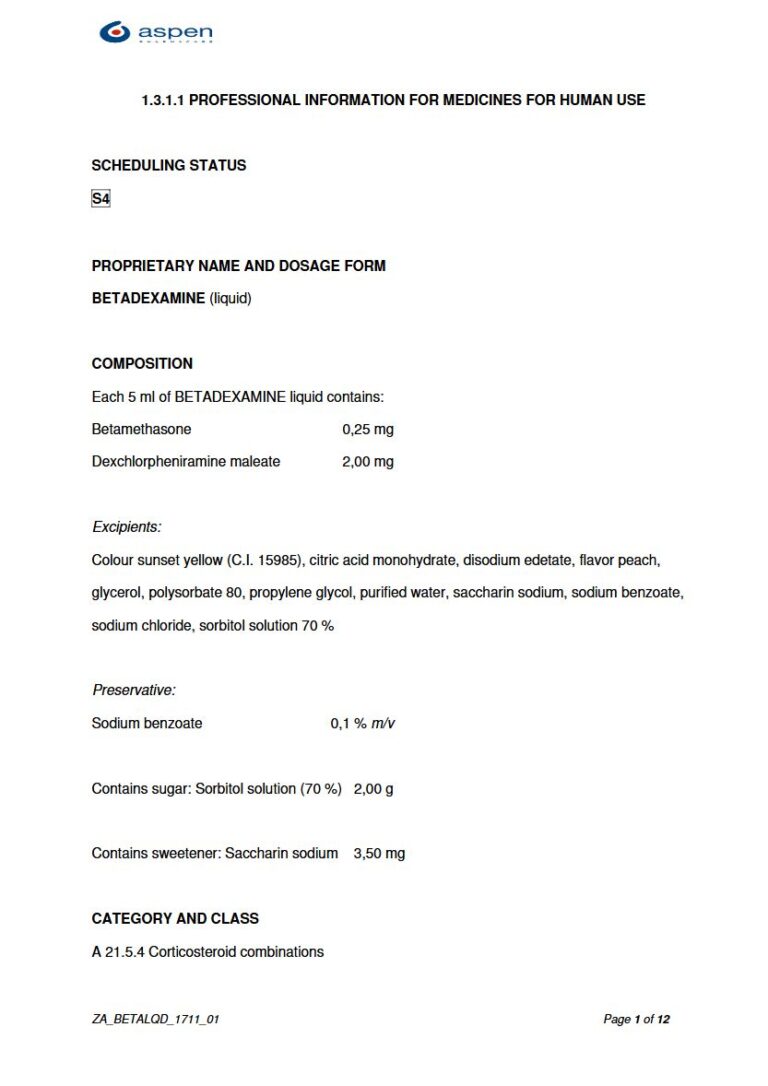
Betadexamine Liquid
PDF Leaflet Revision Date: 23 November 2017
Clinical Summary
Quick overview from the medicine insert
Indication
Second-line therapy for allergic rhinitis and steroid-responsive dermatological allergies.
Dosage (summary)
Adults: 5-10 ml four times daily, max 40 ml/day, for less than 5 days.
Special Populations
- Children under 12 years
- Elderly patients
Pregnancy & Breastfeeding
Safety not established; monitor infants for hypoadrenalism if exposed in utero.
Key Drug Interactions
- MAOIs
- Oestrogen
- Anticoagulants
- CNS depressants
Contraindications
- Hypersensitivity
- Newborns
- Systemic fungal infections
- Glaucoma
Common side effects
- Increased risk of infection
- Depression
- Hypertension
- Gastric irritation
Counselling Points
- Do not exceed recommended duration
- Avoid alcohol
- Caution with driving or machinery
Serious warnings
- Long-term use may suppress HPA axis
- Caution in stress situations
- May mask signs of infection
Important Disclaimer
The Betadexamine Liquid professional information leaflet below is the property of Pharmacare Limited and is provided on Medinsert exactly as issued, with no.. alterations or editorial changes. We make every effort to keep content current by updating documents as soon as new versions become available. Medinsert serves as a trusted access point for healthcare professionals, but does not replace official sources or clinical judgement. For more details, please read our full disclaimer. read more>>
 Healthcare Professionals Only
This content is for registered healthcare professionals
Sign in or create a free account to read the full package insert.
Free for HPCSA-registered professionals. Powered by Medinsert.
Clinical Particulars
Section 4 of the official insert — extracted exactly as issued, no alterations
4.1 Therapeutic indications
BETADEXAMINE is indicated as a second-line therapy when antihistamines are not effective for the treatment of:
- Short-term treatment of allergic rhinitis
- Steroid-responsive dermatological allergies and steroid-responsive dermatoses.
4.2 Posology and method of administration
Dosage should be individualised and adjusted according to the condition under treatment and the response obtained. BETADEXAMINE is only to be used for short-term treatment (less than 5 days). BETADEXAMINE should only be used for well-defined indications. BETADEXAMINE should not be mixed with other mixtures.
Adults and children over 12 years of age:
Recommended initial dose: Take 5 ml to 10 ml four times daily, after meals and at bedtime. The dose should not exceed 40 ml daily. The dose should be tapered off and discontinued as improvement occurs. Treatment should not exceed 5 days. The course should not be repeated within 28 days unless specifically indicated by a medical practitioner. Not for use in children under 12 years of age. Shake bottle before use.
4.3 Contraindications
BETADEXAMINE is contraindicated in patients with:
- Hypersensitivity to dexchlorpheniramine or racemic chlorphenamine, betamethasone or any of the excipients for BETADEXAMINE (see COMPOSITION).
- Newborn and premature infants. This age group has an increased susceptibility to anticholinergic side effects including central nervous system (CNS) excitation, and an increased tendency towards convulsions.
- Patients receiving monoamine oxidase inhibitors (MAOI) or within two weeks after use of a MAOI. Concurrent use with BETADEXAMINE may prolong and intensify the anticholinergic and CNS depressant effects (see INTERACTIONS).
- Systemic fungal infections.
- Children below the age of 12 years as safety has not been established.
- Glaucoma.
4.4 Special warnings and precautions for use
BETADEXAMINE contains a potent, long-acting corticosteroid. The recommended maximum treatment period should not be exceeded. Long term use of corticosteroids such a BETADEXAMINE, particularly in high doses and in young children can lead to suppression of the HPA axis. This may lead to Cushingoid signs, growth and development retardation in children and increased susceptibility to stress and adrenal crisis in all patients (see CONTRAINDICATIONS).
Patients undergoing stress, such as major surgery, septicaemia or trauma, who have signs of HPA axis suppression, should receive replacement therapy to prevent a possible adrenal crisis.
Corticosteroids, such as BETADEXAMINE, should be used with caution in ulcerative colitis, increased intraocular pressure, active or latent peptic ulcer, abscess or other pyogenic infections, active tuberculosis, systemic fungal infections, renal failure, hypertension, osteoporosis, hyperthyroidism, cirrhosis, ocular herpes simplex infection and glaucoma, diverticulitis, fresh intestinal anastomoses, myasthenia gravis, congestive heart failure, patients with diabetes mellitus and elderly patients.
BETADEXAMINE may aggravate existing emotional instability or psychotic tendencies.
With corticosteroid therapy such as BETADEXAMINE, dietary salt restriction and potassium supplementation may be considered. BETADEXAMINE increases calcium excretion. Prolonged BETADEXAMINE use may produce posterior subcapsular cataracts and glaucoma, and may enhance secondary ocular infections due to fungi or viruses. BETADEXAMINE therapy may mask some signs of infection. BETADEXAMINE may decrease blood salicylate concentrations. Aspirin should be used cautiously in conjunction with corticosteroids in hypoprothrombinaemia. Whilst on BETADEXAMINE therapy patients should not be vaccinated against smallpox. Other immunisation procedures should not be undertaken in patients receiving BETADEXAMINE, especially those receiving high doses. Thromboembolic complications and muscular weakness have been reported. BETADEXAMINE should be used with caution in patients with active or latent peptic ulcer, pyloroduodenal obstruction, prostatic hypertrophy or bladder neck obstruction, cardiovascular disease including hypertension, and in patients with hyperthyroidism. BETADEXAMINE should be avoided in patients with narrow angle glaucoma (see CONTRAINDICATIONS). Antihistamines, as contained in BETADEXAMINE, may cause dizziness, sedation and hypotension, especially in patients over 60 years of age.
Incoordination can occur with antihistamines such as BETADEXAMINE, although paradoxical stimulation may occasionally occur, especially at high doses and in children or the elderly. Reports of convulsions in patients taking BETADEXAMINE suggest a need for caution in patients with epilepsy.
4.5 Interactions with other medicines
Dosage and therapeutic effects should be monitored closely when BETADEXAMINE is used concurrently with:
- Monoamine oxidase inhibitors may exacerbate the CNS depressant and anticholinergic effects of the dexchlorpheniramine in BETADEXAMINE.
- Phenobarbitone, phenytoin, rifampicin or ephedrine, as these can cause a reduced steroid effect.
- Oestrogen as this can cause an increased steroid effect.
- Potassium-depleting diuretic, digoxin and amphotericin B can cause increased hypokalaemia.
- Anticoagulants such as warfarin can cause an increase in PTT (increased INR).
- Nonsteroidal anti-inflammatory medicines can aggravate the ulcerogenic effect of betamethasone.
- Antidiabetic medicines, oral and insulin, may require a dosage adjustment of both medicines as betamethasone may increase blood glucose concentration.
- Other oral anticoagulants as these can result in either a decrease in anticoagulant effect due to dexchlorpheniramine, or in an increased anticoagulant effect due to the betamethasone. Close monitoring of the international normalized ratio (INR) or prothrombin time (PT) is required.
- Alcohol, tricyclic antidepressants, barbiturates or other central nervous system depressants may potentiate the sedative effect of BETADEXAMINE.
- Medicines with anticholinergic effects will potentiate the sedative effects of BETADEXAMINE.
- Corticosteroids, such as BETADEXAMINE, may decrease blood salicylate concentrations. Aspirin should be used cautiously in conjunction with BETADEXAMINE in hypoprothrombinaemia.
- Whilst on BETADEXAMINE therapy patients should not be vaccinated against smallpox or with live attenuated virus vaccines. Other immunisation procedures should not be undertaken in patients receiving corticosteroids, especially those receiving high doses.
- Concomitant glucocorticoid therapy may inhibit the response to somatotropin.
4.6 Fertility, pregnancy and lactation
Safety and efficacy in pregnancy and lactation have not been established (see CONTRAINDICATIONS). Infants born to mothers who had high doses of BETADEXAMINE during pregnancy should be carefully monitored for signs of hypoadrenalism.
Corticosteroid therapy, such as BETADEXAMINE, may alter the motility and number of spermatozoa.
4.7 Effects on ability to drive and use machines
BETADEXAMINE may lead to drowsiness and impaired concentration that may be aggravated by the simultaneous intake of alcohol or other central nervous system depressants. Patients should be warned against taking charge of vehicles or machinery or performing potentially hazardous tasks where loss of concentration could lead to accidents.
4.8 Undesirable effects
Betamethasone
Immune system disorders
- Frequent: Increased risk of infection
- Less frequent: Generalised allergic reactions
Endocrine disorders
- Frequent: Decreased body growth
- Less frequent: Cushingu2019s syndrome, hyperglycaemia, adrenocortical insufficiency
Metabolism and nutrition disorders
- Less frequent: Sodium and fluid retention, negative protein, nitrogen and calcium balance, hypokalaemia
Psychiatric disorders
- Frequent: Depression, euphoria
Nervous system disorders
- Less frequent: Nervousness, restlessness
Eye disorders
- Less frequent: Cataracts, glaucoma
Cardiac disorders
- Frequent: Hypertension
Respiratory, thoracic and mediastinal disorders
- Less frequent: Pulmonary tuberculosis
Gastrointestinal disorders
- Frequent: Gastric irritation, nausea, vomiting, dyspepsia, increased appetite, indigestion, pancreatitis
- Less frequent: Peptic ulcer
Skin and subcutaneous tissue disorders
- Frequent: Atrophic condition of the skin, impaired skin healing
Musculoskeletal, connective tissue and bone disorders
- Less frequent: Osteoporosis
Renal and urinary disorders
- Less frequent: Fluid and electrolyte disturbances
Dexchlorpheniramine
Blood and lymphatic system disorders
- Less frequent: Agranulocytosis, thrombocytopenia, pancytopenia, aplastic anaemia, leucopenia, haemolytic anaemia
Immune system disorders
- Less frequent: Hypersensitivity reactions (including bronchospasm, angioedema, and anaphylaxis)
Psychiatric disorders
- Less frequent: Depression
Nervous system disorders
- Frequent: Somnolence, slight drowsiness to sleep, lassitude, dizziness, incoordination, headache, psychomotor impairment
- Less frequent: Convulsions, tremor, sleep disturbances, confusion, paraesthesia, neuritis, extrapyramidal effects
Eye disorders
- Frequent: Blurred vision
Ear and labyrinth disorders
- Less frequent: Tinnitus
Cardiac disorders
- Less frequent: Cardiac dysrhythmias, palpitations, hypotension
Respiratory, thoracic and mediastinal disorders
- Frequent: Thickening of the mucus, dry nasal mucosa
Gastrointestinal disorders
- Frequent: Constipation and increased gastric reflux, xerostomia
- Less Frequent: Nausea, vomiting, diarrhoea, epigastric pain
Hepato-biliary disorders
- Less frequent: Jaundice
Skin and subcutaneous tissue disorders
- Less frequent: Rash, hair loss, sweating, urticaria
Musculoskeletal, connective tissue and bone disorders
- Less frequent: Myalgia
Renal and urinary disorders
- Frequent: Urinary difficulty or retention
4.9 Overdose
Symptoms
Betamethasone (see SIDE EFFECTS).
Dexchlorpheniramine
Overdosage with sedating antihistamines is associated with antimuscarinic, extrapyramidal, and CNS effects. When CNS stimulation predominates over CNS depression, which is more likely in children or the elderly, it causes ataxia, excitement, tremors, psychoses, hallucinations, and convulsions; hyperpyrexia may also occur. Deepening coma and cardiorespiratory collapse may follow. In adults, CNS depression is more common with drowsiness, coma, and convulsions, progressing to respiratory failure and cardiovascular collapse.
Treatment
Treatment is symptomatic and supportive.
