
Cafcit 5 mg Solution
PDF Leaflet Revision Date: 31 October 2023
Clinical Summary
Quick overview from the medicine insert
Indication
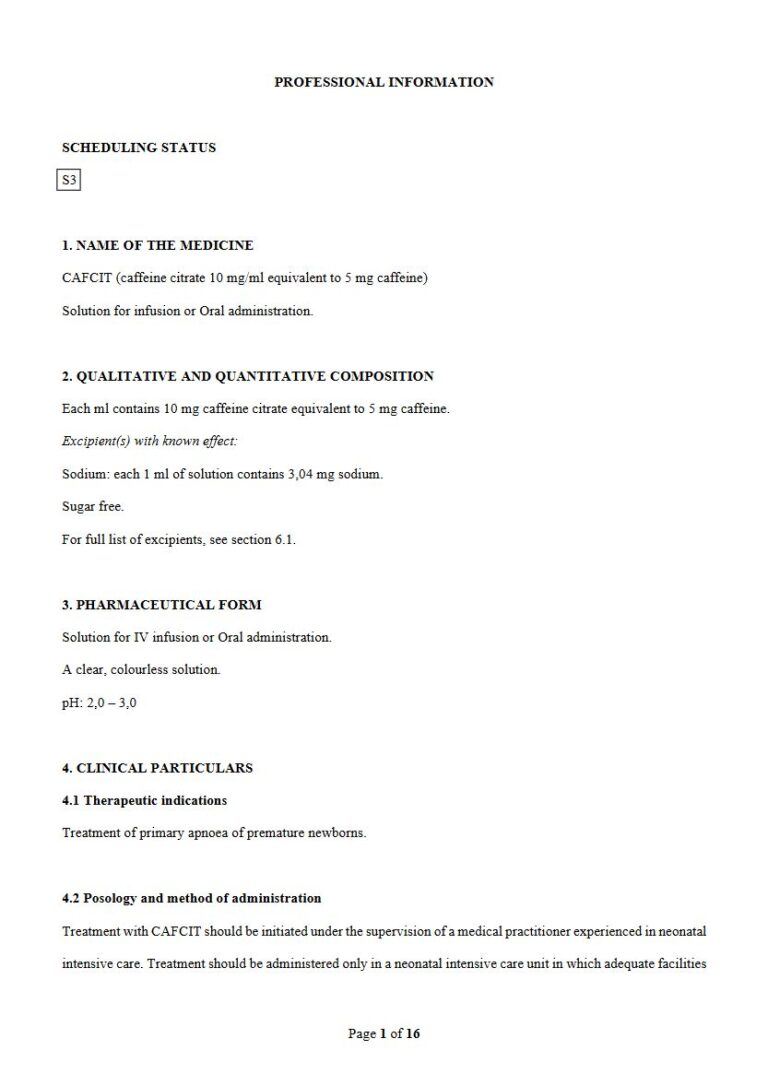
Treatment of primary apnoea of premature newborns.
Dosage (summary)
Loading dose: 20 mg/kg IV over 30 mins; Maintenance: 5 mg/kg IV or orally every 24 hours.
Onset of Action / Duration
Onset: minutes, Duration: prolonged half-life in neonates.
Special Populations
- Hepatic impairment
- Renal impairment
Pregnancy & Breastfeeding
Caffeine crosses placenta and is excreted in breast milk; breastfeeding mothers should avoid caffeine.
Key Drug Interactions
- Theophylline
- Cimetidine
- Ketoconazole
- Phenobarbital
- Phenytoin
Contraindications
- Hypersensitivity to caffeine citrate
Common side effects
- Irritability
- Jitteriness
- Tachycardia
- Hypoglycaemia
- Necrotising enterocolitis
Counselling Points
- Monitor for apnoea recurrence
- Avoid caffeine in breastfeeding
- Report any unusual symptoms
Serious warnings
- Monitor plasma caffeine levels
- Risk of seizures
- Caution in cardiac disease
Important Disclaimer
The Cafcit 5 mg Solution professional information leaflet below is the property of Equity Pharmaceuticals and is provided on Medinsert exactly as issued, with no.. alterations or editorial changes. We make every effort to keep content current by updating documents as soon as new versions become available. Medinsert serves as a trusted access point for healthcare professionals, but does not replace official sources or clinical judgement. For more details, please read our full disclaimer. read more>>
 Healthcare Professionals Only
This content is for registered healthcare professionals
Sign in or create a free account to read the full package insert.
Free for HPCSA-registered professionals. Powered by Medinsert.
Clinical Particulars
Section 4 of the official insert — extracted exactly as issued, no alterations
4.1 Therapeutic indications
Treatment of primary apnoea of premature newborns.
4.2 Posology and method of administration
Treatment with CAFCIT should be initiated under the supervision of a medical practitioner experienced in neonatal intensive care. Treatment should be administered only in a neonatal intensive care unit in which adequate facilities are available for patient surveillance and monitoring.
Posology
Intravenous infusion
The recommended dose regimen in previously untreated infants is a loading dose of 20 mg CAFCIT per kg body weight administered by slow intravenous infusion over 30 minutes, using a syringe infusion pump or other metered infusion device. After an interval of 24 hours, maintenance doses of 5 mg per kg body weight may be administered by slow intravenous infusion over 10 minutes every 24 hours. Alternatively, maintenance doses of 5 mg per kg body weight may be administered by oral administration, such as through a nasogastric tube every 24 hours.
Oral administration
The recommended loading dose and maintenance doses of CAFCIT are provided in the following table which clarifies the relationship between injection volumes and administered doses expressed as caffeine citrate. The dose expressed as caffeine base is half the dose when expressed as caffeine citrate (10 mg CAFCIT is equivalent to 5 mg caffeine base).
Duration of treatment
The optimal duration of treatment has not been established. In a study on premature newborn infants a median treatment period of 37 days was reported. In clinical practice, treatment is usually continued until the infant has reached a post-menstrual age of 37 weeks, by which time apnoea of prematurity usually resolves spontaneously. This limit may however be revised according to the response to treatment, the continuing presence of apnoeic episodes despite treatment, or other clinical considerations. It is recommended that CAFCIT administration should be stopped when the patient has 5-7 days without a significant apnoeic attack. If the patient has recurrent apnoea, CAFCIT administration can be restarted with either a maintenance dose or half a loading dose, depending upon the time interval from stopping CAFCIT to recurrence of apnoea. Because of the slow elimination of caffeine in this patient population, there is no requirement for dose tapering on cessation of treatment. As there is a risk for recurrence of apnoeas after cessation of CAFCIT treatment monitoring of the patient should be continued for approximately one week.
4.3 Contraindications
Hypersensitivity to caffeine citrate or to any of the excipients listed under section 6.1.
4.4 Special warnings and precautions for use
Treatment with CAFCIT should be initiated under the supervision of a medical practitioner experienced in neonatal intensive care. Treatment should be administered only in a neonatal intensive care unit in which adequate facilities are available for patient surveillance and monitoring.
In neonates born to mothers who consumed large quantities of caffeine prior to delivery, baseline plasma caffeine concentrations should be measured prior to initiation of treatment with CAFCIT, since caffeine readily crosses the placenta into the foetal circulation.
Apnoea
Apnoea of prematurity is a diagnosis of exclusion. Other causes of apnoea (e.g., central nervous system disorders, primary lung disease, anaemia, sepsis, metabolic disturbances, cardiovascular abnormalities, or obstructive apnoea) should be ruled out or properly treated prior to initiation of treatment with CAFCIT.
It is advisable to monitor plasma levels of caffeine periodically. However, at the recommended doses, frequent (more than weekly) monitoring of plasma levels is not normally necessary unless there are concerns regarding lack of efficacy or possible toxicity. In premature neonates, caffeine has a prolonged half-life. If higher maintenance dosages are used, the medical practitioner should recognise this potential for accumulation and monitor plasma caffeine levels (see also Section 5.2).
If there is inadequate clinical response to the first loading dose, a second dose may be given, but if there is continued inadequate response, the plasma levels should be confirmed before further doses are given, as the failure to respond could be an indication of another cause of apnoea. Plasma levels should not normally exceed 50 micrograms/ml (optimally 10-30 micrograms/ml).
Caffeine consumption
In newborn infants born to mothers who consumed large quantities of caffeine prior to delivery, baseline plasma caffeine concentrations should be measured prior to initiation of treatment with CAFCIT, since caffeine readily crosses the placenta into the foetal circulation (see sections 4.2 and 5.2). Breastfeeding mothers of newborn infants treated with CAFCIT should not ingest caffeine-containing foods and beverages or medicinal products containing caffeine (see section 4.6), since caffeine is excreted into breast milk (see section 5.2).
Theophylline
In newborns previously treated with theophylline, baseline plasma caffeine concentrations should be measured prior to initiation of treatment with CAFCIT because preterm infants metabolise theophylline to caffeine.
Seizures
Caffeine is a central nervous system stimulant and seizures have been reported in cases of caffeine overdose. Extreme caution must be exercised if CAFCIT is used in newborns with seizure disorders.
Cardiovascular reactions
Caffeine has been shown to increase heart rate, left ventricular output, and stroke volume in published studies. Therefore, CAFCIT should be used with caution in newborns with known cardiovascular disease. There is evidence that caffeine causes tachydysrhythmias in susceptible individuals. In newborns this is usually a simple sinus tachycardia. If there have been any unusual rhythm disturbances on a cardiotocograph (CTG) trace before the baby is born, CAFCIT should be administered with caution.
Renal and hepatic impairment
CAFCIT should be administered with caution in preterm newborn infants with impaired renal or hepatic function. The frequency of adverse reactions in a small number of very premature infants with renal/hepatic impairment appeared to be higher as compared to premature infants without organ impairment (see sections 4.2, 4.8 and 5.2). Doses should be adjusted by monitoring of caffeine plasma concentrations to avoid toxicity in this population.
Necrotising enterocolitis
Necrotising enterocolitis is a common cause of morbidity and mortality in premature newborn infants. There are reports of a possible association between the use of methylxanthines and development of necrotising enterocolitis. However, a causal relationship between caffeine or other methylxanthine use and necrotising enterocolitis has not been established. As for all preterm infants, those treated with CAFCIT should be carefully monitored for the development of necrotising enterocolitis (see section 4.8). CAFCIT should be used with caution in infants suffering gastro-oesophageal reflux, as the treatment may exacerbate this condition. CAFCIT causes a generalised increase in metabolism, which may result in higher energy and nutrition requirements during therapy. The diuresis and electrolyte loss induced by CAFCIT may necessitate correction of fluid and electrolyte disturbances.
4.5 Interaction with other medicines and other forms of interaction
Cytochrome P450 1A2 (CYP1A2) is the major enzyme involved in the metabolism of caffeine in humans. Therefore, caffeine has the potential to interact with medicines that are substrates for CYP1A2, inhibit CYP1A2, or induce CYP1A2. However, caffeine metabolism in preterm newborn infants is limited due to their immature hepatic enzyme systems. Interconversion between caffeine and other xanthines such as theophylline has been reported in premature neonates. Therefore the concurrent use of these medicines should be avoided. Baseline serum levels of caffeine should be measured in patients previously treated with theophylline. Although few data exist on interactions of caffeine with other medicines in preterm newborn infants, lower doses of CAFCIT may be needed following co-administration of medicines which are reported to decrease caffeine elimination in adults (e.g., cimetidine and ketoconazole) and higher CAFCIT doses may be needed following co-administration of medicines that increase caffeine elimination (e.g., phenobarbital and phenytoin). Where doubt exists about possible interactions, plasma caffeine concentrations should be measured. As bacterial overgrowth in the gut is associated with the development of necrotising enterocolitis, co-administration of CAFCIT with medicines that suppress gastric acid secretion (antihistamine H2 receptor blockers or proton-pump inhibitors) may in theory increase the risk of necrotising enterocolitis (see section 4.4 and 4.8). Concurrent use of CAFCIT and doxapram might potentiate their stimulatory effects on the cardio-respiratory and central nervous system. If concurrent use is indicated, cardiac rhythm and blood pressure must be carefully monitored.
4.6 Fertility, pregnancy and lactation
Pregnancy
Caffeine in animal studies, at high doses, was shown to be embryotoxic and teratogenic. These effects are not relevant with regard to short term administration in the preterm infant population.
Breastfeeding
Caffeine is excreted into breast milk and readily crosses the placenta into the foetal circulation (see section 5.2). Breastfeeding mothers of newborn infants treated with caffeine citrate should not ingest caffeine-containing foods, beverages or medicinal products containing caffeine. In newborn infants born to mothers who consumed large quantities of caffeine prior to delivery, baseline plasma caffeine concentrations should be measured prior to initiation of treatment with caffeine citrate (see section 4.4).
Fertility
No data available.
4.7 Effects on ability to drive and use machines
Not applicable.
4.8 Undesirable effects
a. Summary of the safety profile
The known pharmacology and toxicology of caffeine and other methylxanthines predict the likely adverse reactions to CAFCIT. Effects described include central nervous system (CNS) stimulation such as convulsion, irritability, restlessness and jitteriness, cardiac effects such as tachycardia, dysrhythmia, hypertension and increased stroke volume, metabolism and nutrition disorders such as hyperglycaemia. These effects are dose related and may necessitate measurement of plasma levels and dose reduction. They are generally, although not exclusively, associated with serum caffeine concentrations u2265 50 micrograms/ml.
b. Tabulated list of adverse reactions
System organ class Frequent Less frequent Unknown
Infections and infestations Sepsis
Immune system disorders Hypersensitivity reaction
Metabolism and nutrition disorders Hypoglycaemia, hyperglycaemia, failure to thrive, feeding intolerance
Nervous system disorders Irritability, jitteriness, restlessness, brain injury, convulsion
Ear and labyrinth disorders Deafness
Cardiac disorders Increased left ventricular output and increased stroke volume, tachycardia, dysrhythmia
Gastrointestinal disorders Regurgitation, increased gastric aspirate, necrotising enterocolitis
General disorders and administration site conditions Infusion site phlebitis, infusion site inflammation
Investigations Urine output increased, urine sodium and calcium increased, haemoglobin decreased, thyroxine decreased
c. Description of selected adverse reactions
Necrotising enterocolitis is a common cause of morbidity and mortality in premature newborn infants. There are reports of a possible association between the use of methylxanthines and development of necrotising enterocolitis. However, a causal relationship between caffeine or other methylxanthine use and necrotising enterocolitis has not been established. As for all preterm infants, those treated with CAFCIT should be carefully monitored for the development of necrotising enterocolitis (see section 4.4). Brain injury, convulsion and deafness were observed but they were more frequent in the placebo group. Caffeine may suppress erythropoietin synthesis and hence reduce haemoglobin concentration with prolonged treatment. Transient falls in thyroxine (T4) have been recorded in infants at the start of therapy but these are not sustained with maintained therapy. Available evidence does not indicate any adverse long-term reactions of neonatal caffeine therapy as regards neurodevelopmental outcome, failure to thrive or on the cardiovascular, gastrointestinal or endocrine systems. Caffeine does not appear to aggravate cerebral hypoxia or to exacerbate any resulting damage, although the possibility cannot be ruled out. Other special populations Adverse reactions appeared to be more frequent in very premature infants with renal/hepatic impairment with organ impairment than in other observed infants without organ impairment. Cardiac disorders (tachycardia, including one single case of dysrhythmia) were mostly reported.
4.9 Overdose
Following overdose, published plasma caffeine levels have ranged from approximately 50 mg/l to 350 mg/l.
Symptoms
Signs and symptoms of overdosage from these reports include jitteriness, tachycardia, tachypnoea, tremor, opisthotonos, rigidity and tonic-clonic movements, hypokalaemia, restlessness, gastric irritation, gastro-intestinal haemorrhage, increased white blood cell count, non-purposeful jaw and lip movements. One case of caffeine overdose complicated by development of intraventricular haemorrhage and long-term neurological sequelae has been reported. In one case of overdose the patient developed compromised circulation, vomiting and seizures. Other reported effects of gross overdose include fever, agitation, hyperexcitability, hypertonia, gastric residues, distended abdomen, metabolic acidosis, hyperglycaemia and elevated urea levels. No deaths associated with caffeine overdose have been reported in preterm infants.
Management
Treatment of overdosage should primarily be symptomatic and supportive measures, including monitoring of blood levels of caffeine. Plasma potassium and glucose concentrations should be monitored, and hypokalaemia and hyperglycaemia corrected. In severe cases of overdose, exchange transfusion should be considered. In one case, this was found to reduce plasma caffeine levels by 40 mg/l per transfusion. Convulsions may be treated with intravenous administration of anticonvulsants (diazepam or a barbiturate such as pentobarbital sodium or phenobarbital).
