
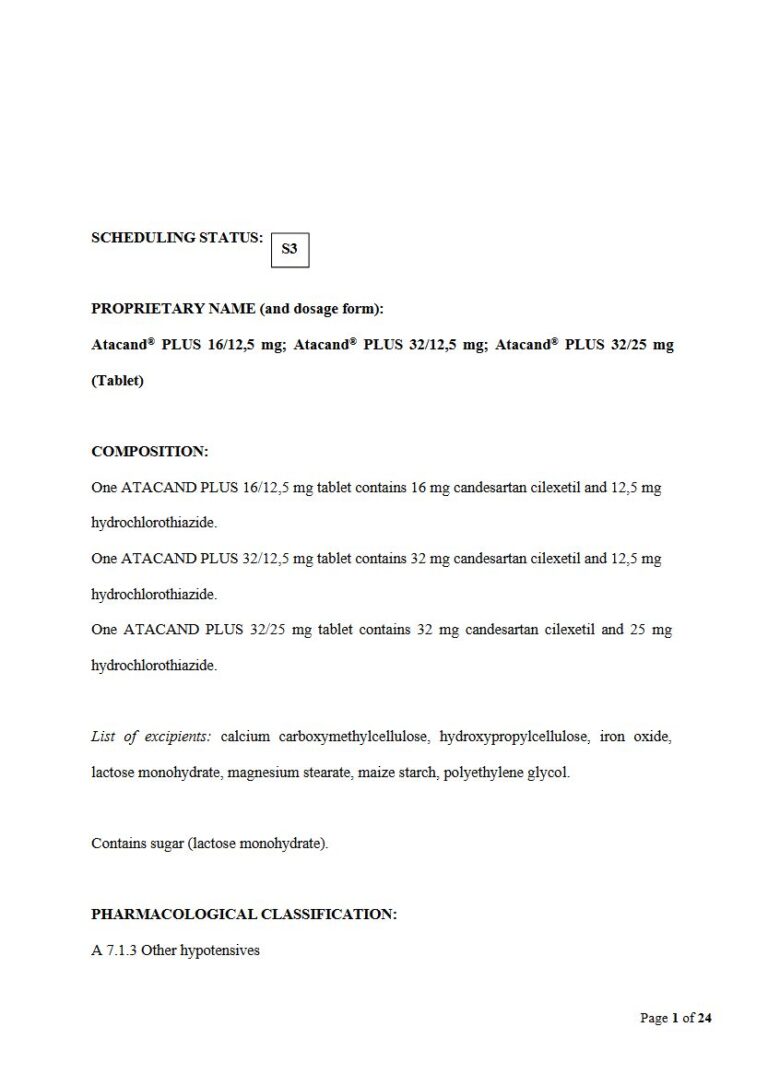
Atacand Plus Tablet
PDF Leaflet Revision Date: 30 September 2011
Clinical Summary
Quick overview from the medicine insert
Indication
Indicated for essential hypertension.
Dosage (summary)
Once daily; may be taken with or without food.
Onset of Action / Duration
Onset: 2 hours, Duration: sustained over long-term treatment.
Special Populations
- Elderly
- Renal impairment
- Hepatic impairment
Pregnancy & Breastfeeding
Contraindicated in pregnancy; breastfeeding should be discontinued if use is essential.
Key Drug Interactions
- Lithium
- Warfarin
- NSAIDs
Contraindications
- Moderate to severe hepatic impairment
- Gout
- Angioedema history
- Moderate to severe renal impairment
Common side effects
- Dizziness
- Headache
- Fatigue
- Back pain
Counselling Points
- Take at the same time each day
- Monitor blood pressure regularly
- Report any signs of allergic reactions
Serious warnings
- Monitor potassium and creatinine in renal impairment
- Risk of hypotension during surgery
Important Disclaimer
The Atacand Plus Tablet professional information leaflet below is the property of Equity Pharmaceuticals and is provided on Medinsert exactly as issued, with no.. alterations or editorial changes. We make every effort to keep content current by updating documents as soon as new versions become available. Medinsert serves as a trusted access point for healthcare professionals, but does not replace official sources or clinical judgement. For more details, please read our full disclaimer. read more>>
 Healthcare Professionals Only
This content is for registered healthcare professionals
Sign in or create a free account to read the full package insert.
Free for HPCSA-registered professionals. Powered by Medinsert.
Clinical Particulars
Section 4 of the official insert — extracted exactly as issued, no alterations
4.1 Therapeutic indications
ATACAND PLUS is indicated for essential hypertension in patients stabilised on the individual components given at the same dosages.
4.2 Posology and method of administration
ATACAND PLUS should be taken once daily and may be taken with or without food. Most of the antihypertensive effect is usually attained within 4 weeks of initiation of treatment.
4.3 Contraindications
- Moderate to severe hepatic impairment and/or cholestasis
- Gout
- Sensitivity to any of the components of ATACAND PLUS
- A history of angioedema related to previous therapy with ACE inhibitors or angiotensin receptor blockers (ARBs): These patients must never again be given these medicines
- Hereditary or idiopathic angioedema
- Hypertrophic obstructive cardiomyopathy (HOCM)
- Moderate to severe renal function impairment (creatinine clearance < 30 ml/min)
- Bilateral renal artery stenosis
- Renal artery stenosis in patients with a single kidney
- Aortic stenosis
- Concomitant therapy with potassium sparing diuretics such as spironolactone, triamterene, amiloride
- Porphyria
- ATACAND PLUS contains a thiazide diuretic in (fixed dose) and therefore should not be given to patients with Addisonu2019s disease. This therapy is also contraindicated in patients with severe renal impairment or anuria, and in patients who show hypersensitivity to other sulphonamide-derived medicines
- Lithium therapy: Concomitant administration with ATACAND PLUS may lead to toxic blood concentrations of lithium (see u201cINTERACTIONSu201d)
- Pregnancy and lactation (see u201cPREGNANCY AND LACTATIONu201d)
4.4 Special warnings and precautions for use
When ATACAND PLUS is used in patients with severe renal impairment, periodic monitoring of serum potassium and creatinine levels should be considered. There is very limited experience in patients with very severe or end-stage renal impairment (creatinine clearance u2264 15 ml/min/1,73 m2 BSA).
Prolongation of INR and bleeding complications with concomitant warfarin therapy may occur. Lithium toxicity may occur when ATACAND PLUS is used in combination with lithium therapy (see u201cINTERACTIONSu201d). Refer to u201cPREGNANCY AND LACTATIONu201d for warnings.
4.5 Interactions with other medicines
No drug interactions of clinical significance have been identified for candesartan cilexetil. Compounds which have formally been investigated in clinical pharmacokinetic studies include hydrochlorothiazide, warfarin, digoxin, oral contraceptives (i.e. ethinylestradiol/levonorgestrel), glibenclamide and nifedipine. Post marketing report suggests a rare but significant interaction with prolongation of INR and bleeding, with concomitant warfarin therapy. The bioavailability of candesartan is not affected by food.
The antihypertensive effect of ATACAND PLUS may be enhanced by other antihypertensives. The potassium-depleting effect of hydrochlorothiazide could be expected to be potentiated by other medicines associated with potassium loss and hypokalaemia (e.g. other kaliuretic diuretics, laxatives, amphotericin, carbenoxolone, penicillin G sodium, salicylic acid derivatives). Diuretic-induced hypokalaemia and hypomagnesaemia predisposes to the potential cardiotoxic effects of digitalis glycosides and anti-arrhythmics. Periodic monitoring of serum potassium is recommended when ATACAND PLUS is administered with such medicines.
Reversible increases in serum lithium concentrations and toxicity have been reported during concomitant administration of lithium with ATACAND PLUS. Careful monitoring of serum lithium levels is recommended during concomitant use. The diuretic, natriuretic and antihypertensive effect of hydrochlorothiazide is blunted by NSAIDs. The absorption of hydrochlorothiazide is reduced by colestipol or cholestyramine. The effect on non-depolarizing skeletal muscle relaxants (e.g. tubocurarine) may be potentiated by hydrochlorothiazide. Thiazide diuretics may increase serum calcium levels due to decreased excretion. If calcium supplements or Vitamin D must be prescribed, serum calcium levels should be monitored and dosage adjusted accordingly. The hyperglycaemic effect of beta-blockers and diazoxide may be enhanced by thiazides. Anticholinergic agents (e.g. atropine, biperiden) may increase the bioavailability of thiazide-type diuretics by decreasing gastrointestinal motility and stomach-emptying rate. Thiazides may increase the risk of adverse effects caused by amantadine. Thiazides may reduce the renal excretion of cytotoxic agents (e.g. cyclophosphamide, methotrexate) and potentiate their myelosuppressive effects. The risk for hypokalaemia may be increased during concomitant use of steroids or adrenocorticotropic hormone (ACTH). Postural hypotension may become aggravated by simultaneous intake of alcohol, barbiturates or anaesthetics. Treatment with a thiazide diuretic may impair glucose tolerance. Dosage adjustment of antidiabetic agents, including insulin, may be required. Hydrochlorothiazide may cause the arterial response to pressor amines (e.g. adrenaline) to decrease but not enough to exclude a pressor effect. Hydrochlorothiazide may increase the risk of acute renal insufficiency especially with high doses of iodinated contrast media. There is no clinically significant interaction between hydrochlorothiazide and food.
4.6 Fertility, pregnancy and lactation
Use in pregnancy: When used in pregnancy during the second and third trimesters, medicines that act directly on the renin-angiotensin system can cause foetal and neonatal injury and death. These medicines pass through the placenta and can be presumed to cause disturbance in foetal blood pressure regulatory mechanisms. Oligohydramnios as well as hypotension, oliguria and anuria in newborns, have been reported after administration in the second and third trimester. Cases of defective skull ossification have been observed. Premature and low birth mass can occur. ATACAND PLUS is contraindicated in pregnancy (see u201cCONTRAINDICATIONSu201d). Hydrochlorothiazide can reduce the plasma volume as well as the uteroplacental blood flow. It may also cause neonatal thrombocytopenia.
Lactation: Candesartan is excreted in the milk of lactating rats. Because of the potential for adverse effects on the nursing infant, breast-feeding should be discontinued if the use of ATACAND PLUS is considered essential (see u201cCONTRAINDICATIONSu201d).
4.7 Effects on ability to drive and use machines
The effect of ATACAND PLUS on the ability to drive and use machines has not been studied. When driving vehicles or operating machines, it should be taken into account that occasionally dizziness or weariness may occur during treatment of hypertension.
4.8 Undesirable effects
The overall incidence of adverse events showed no association with age or gender. Clinical adverse events, regardless of causal relationship, with a cumulative 8-week incidence rate of u2265 1 % during treatment with candesartan cilexetil/hydrochlorothiazide up to 16/12,5 mg in double-blind placebo controlled trials are presented in the following table:
Placebo (n = 526) % Candesartan cilexetil/ hydrochlorothiazide (n = 1 025) % Cardiovascular: Tachycardia 0,8 1,1 Gastrointestinal: Abdominal pain Nausea 0,8 0,6 1,0 1,3 Musculo - skeletal: Back pain 2,4 3,0 Nervous System: Headache Dizziness 5,5 1,2 3,2 2,6 Respiratory: Respiratory infection Bronchitis Pharyngitis Sinusitis 1,4 1,4 1,0 1,6 2,5 1,7 1,0 1,7 Other: Influenza-like symptoms 1,6 2,1 Urinary tract infection 0,4 1,4 Inflicted injury 1,2 1,2 Fatigue 0,8 1,1
Clinical adverse events, regardless of causal relationship, occurring in u2265 1 % of the patients during 8-week randomised treatment with candesartan cilexetil/hydrochlorothiazide 32/12,5 mg and 32/25 mg in double-blind clinical trials are presented in the following table:
Placebo (n = 163) % Candesartan cilexetil/ hydrochlorothiazide (n = 1 873) % Metabolism and nutrition disorders: Dyslipidaemia 0 2,8 Nervous system disorders: Dizziness Headache 0,6 7,4 2,8 2,1 Musculoskeletal and connective tissue disorder: Back pain 2,5 1,9 Infections and infestations: Nasopharyngitis Bronchitis 0 1,2 1,4 1,0 Respiratory, thoracic and mediastinal disorders: Cough 1,2 1,0 General disorders and administration site conditions: Fatigue 2,5 1,0
Candesartan cilexetil: The following adverse reactions have been reported very rarely (u2264 1/10 000) with candesartan cilexetil in post-marketing experience: Very rare: u2264 1/10 000 Blood and lymphatic system disorders: Leukopenia, neutropenia and agranulocytosis Metabolism and nutrition disorders: Hyperkalaemia, hyponatraemia Hepato-biliary disorders: Increased liver enzymes, abnormal hepatic function or hepatitis Skin and subcutaneous tissue disorders: Angioedema, rash, urticaria, pruritis Musculoskeletal, connective tissue and bone disorders Back pain Renal and urinary disorders: Renal impairment, including renal failure in susceptible patients
Hydrochlorothiazide: The following adverse reactions have been reported with hydrochlorothiazide monotherapy, usually in doses of 25 mg or greater. The frequencies used are: Common (u2265 1/100), Uncommon (u2265 1/1 000 and u2264 1/100) and Rare (u2264 1/1 000). Common (u2265 1/100) Metabolism and nutrition disorders: Hyperglycaemia, hyperuricaemia, electrolyte imbalance (including hyponatraemia and hypokalaemia) Nervous system disorders: Light-headedness, vertigo Renal and urinary disorders: Glycosuria General disorders and administration site conditions: Weakness Investigations: Increases in cholesterol and triglycerides Uncommon (u2265 1/1 000 and u2264 1/100) Vascular disorders: Postural hypotension Gastrointestinal disorders: Anorexia, loss of appetite, gastric irritation, diarrhoea, constipation Skin and subcutaneous tissue disorders: Rash, urticaria, photosensitivity reactions Rare (u2264 1/1 000) Blood and lymphatic system disorders: Leukopenia, neutropenia/agranulocytosis, thrombocytopenia, aplastic anaemia, bone marrow depression, haemolytic anaemia Immune system disorders: Anaphylactic reactions Psychiatric disorders: Sleep disturbances, depression, restlessness Nervous system disorders: Paraesthesia Eye disorders: Transient blurred vision Cardiac disorders: Cardiac arrhythmias Vascular disorders: Necrotising angitis (vasculitis, cutaneous vasculitis) Respiratory, thoracic and mediastinal disorders: Respiratory distress (including pneumonitis and pulmonary oedema) Gastrointestinal disorders: Pancreatitis Hepato - biliary disorders: Jaundice (intrahepatic cholestatic jaundice) Skin and subcutaneous tissue disorders: Toxic epidermal necrolysis, cutaneous lupus erythematosus-like reactions, reactivation of cutaneous lupus erythematosus Musculoskeletal and connective tissue disorders: Muscle spasm Renal and urinary disorders: Renal dysfunction and interstitial nephritis General disorders and administration site conditions: Fever Investigations: Increases in urea and serum creatinine
Hypersensitivity reactions to hydrochlorothiazide may occur in patients with or without a history of allergy or bronchial asthma, but are more likely in patients with such a history. Exacerbation or activation of systemic lupus erythematosus has been reported with the use of thiazide diuretics. Laboratory findings: Increases in serum uric acid, serum creatinine, serum urea, serum potassium, blood glucose and serum alanine transaminase (ALT) may occur. Decreases in haemoglobin and increases in serum aspartate transaminase (AST) have been observed in patients receiving ATACAND PLUS.
4.9 Overdose
Symptoms: Based on pharmacological considerations, the main manifestation of an overdose of candesartan cilexetil is likely to be symptomatic hypotension and dizziness. In single case reports of overdose (up to 672 mg candesartan cilexetil) patient recovery was uneventful. The main manifestation of an overdose of hydrochlorothiazide is acute loss of fluid and electrolytes. Symptoms such as dizziness, hypotension, thirst, tachycardia, ventricular arrhythmias, sedation/impairment of consciousness and muscle cramps can also be observed.
Management: No specific information is available on the treatment of overdosage with ATACAND PLUS. The following measures are, however, suggested in case of overdosage. When indicated, induction of vomiting or gastric lavage should be considered. If symptomatic hypotension should occur, symptomatic treatment should be instituted and vital signs monitored. Candesartan is not removed by haemodialysis. It is not known to what extent hydrochlorothiazide is removed by haemodialysis.
