
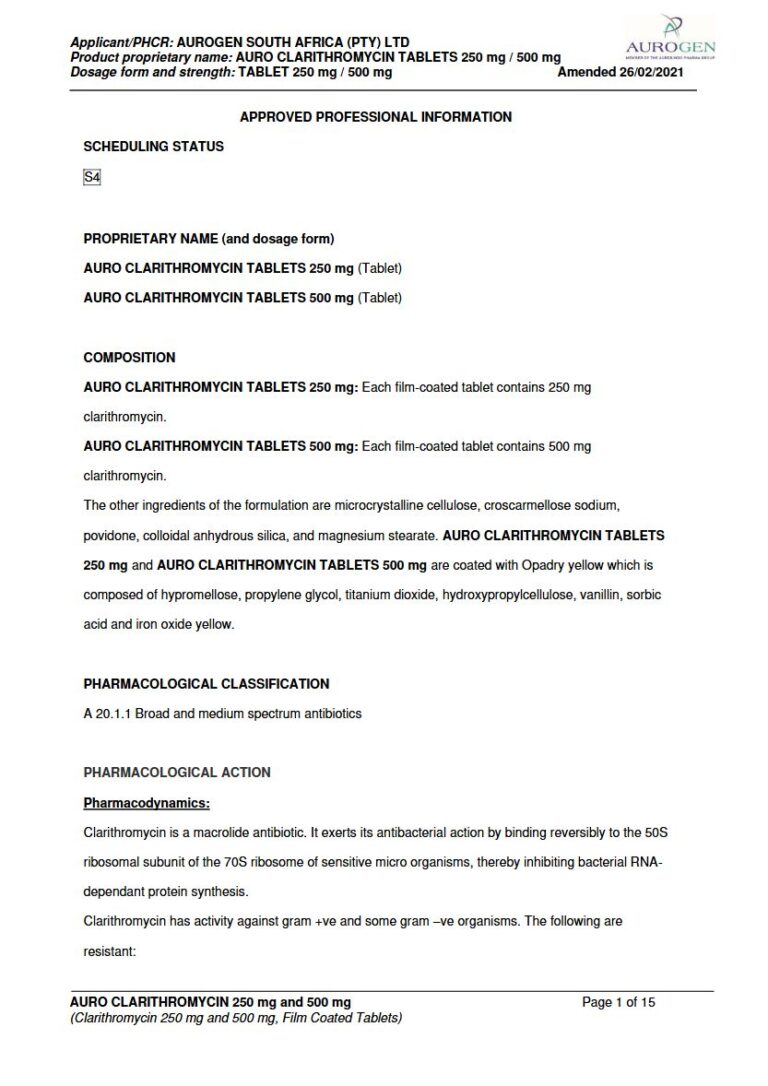
Auro Clarithromycin 250mg & 500mg Tablets
PDF Leaflet Revision Date: 26 February 2021
Clinical Summary
Quick overview from the medicine insert
Indication
Treatment of mild to moderately severe bacterial infections.
Dosage (summary)
Adults: 250 mg twice daily; may increase to 500 mg for severe infections.
Onset of Action / Duration
Onset: 2 hours, Duration: 3-7 hours
Special Populations
- Renal impairment
- Hepatic impairment
Pregnancy & Breastfeeding
Not recommended during pregnancy; excreted in breast milk.
Key Drug Interactions
- Statins
- Warfarin
- Colchicine
- Ergotamine
Contraindications
- Hypersensitivity to clarithromycin
- Porphyria
- Pregnancy
Common side effects
- Nausea
- Diarrhea
- Headache
- QT prolongation
Counselling Points
- Take with or without food
- Monitor for signs of liver dysfunction
- Avoid alcohol
Serious warnings
- Hepatic dysfunction
- Risk of Clostridium difficile-associated diarrhea
Important Disclaimer
The Auro Clarithromycin 250mg & 500mg Tablets professional information leaflet below is the property of Aurogen South Africa and is provided on Medinsert exactly as issued, with no.. alterations or editorial changes. We make every effort to keep content current by updating documents as soon as new versions become available. Medinsert serves as a trusted access point for healthcare professionals, but does not replace official sources or clinical judgement. For more details, please read our full disclaimer. read more>>
 Healthcare Professionals Only
This content is for registered healthcare professionals
Sign in or create a free account to read the full package insert.
Free for HPCSA-registered professionals. Powered by Medinsert.
Clinical Particulars
Section 4 of the official insert — extracted exactly as issued, no alterations
4.1 Therapeutic indications
AURO CLARITHROMYCIN is indicated for the treatment of the following mild to moderately severe bacterial infections caused by susceptible organisms:
- Lower respiratory tract infections such as bronchitis and pneumonia caused by S. pneumonia, M. pneumonia, M. catarrhalis, or H. influenzae.
- Upper respiratory tract infections such as pharyngitis and sinusitis due to S. pyogenes.
- Mild to moderately severe acute otitis media due to S. pneumoniae, M. catarrhalis and H. influenzae.
- Skin and soft tissue infections such as folliculitis, cellulitis or erysipelas due to S. aureus.
- Eradication of Helicobacter pylori when used in combination with a proton pump inhibitor and another antibiotic to decrease recurrence of duodenal ulcer.
4.2 Posology and method of administration
Adults and children older than 12 years: 250 mg twice daily. In more severe infections, the dosage may be increased to 500 mg twice daily.
Renal impairment: Creatinine clearance (<30 ml/min): Reduce dose by half i.e. 250 mg once daily or 250 mg twice daily for severe infections. Limit the duration of treatment to 14 days.
Eradication of H. pylori: Adults: 500 mg twice daily, in combination with an appropriate antibiotic and an acid lowering agent, for 7 to 10 days.
4.3 Contraindications
- Hypersensitivity to clarithromycin or other macrolide antibiotics or to any component of AURO CLARITHROMYCIN.
- Concomitant administration of AURO CLARITHROMYCIN with astemizole, cisapride and pimozide as this may result in QT prolongation and cardiac dysrhythmias including ventricular tachycardia, fibrillation and torsades de pointes (See u201cINTERACTIONSu201d).
- Porphyria.
- Pregnancy (see u201cPREGNANCY AND LACTATIONu201d).
- Concomitant administration of AURO CLARITHROMYCIN with ergotamine or dihydroergotamine as this may result in ergot toxicity characterised by vasospasm and ischaemia of the extremities and central nervous system resulting in permanent tissue damage.
- HMG-CoA reductase inhibitors (statins) such as lovastatin or simvastatin taken with clarithromycin may increase the risk of rhabdomyolysis. Treatment with statins should be discontinued during AURO CLARITHROMYCIN treatment (see u201cWARNINGS AND SPECIAL PRECAUTIONSu201d and u201cINTERACTIONSu201d).
- Colchicine is contraindicated in patients on AURO CLARITHROMYCIN with renal or hepatic impairment who are taking P-glycoprotein inhibitors or a strong CYP34A inhibitor (see u201cINTERACTIONSu201d).
4.4 Special warnings and precautions for use
- AURO CLARITHROMYCIN is metabolised by the liver and excreted in faeces via the bile. Caution should be exercised in patients with impaired hepatic function. Hepatic dysfunction, including increased liver enzymes and hepato-cellular and/or cholestatic hepatitis, with or without jaundice, has been reported with AURO CLARITHROMYCIN. This hepatic dysfunction may be severe and is usually reversible. In some instances hepatic failure with fatal outcome has been reported and generally has been associated with serious underlying and/or concomitant medications. Discontinue AURO CLARITHROMYCIN immediately if signs and symptoms of hepatitis occur, such as anorexia, jaundice, dark urine, pruritus or tender abdomen.
- Renal function impairment (severe) - The elimination of AURO CLARITHROMYCIN is reduced in patients with renal function impairment, especially those with a creatinine clearance of <30 mL/min. The dose of AURO CLARITHROMYCIN should be halved or the dosing interval doubled in patients with a creatinine clearance of <30 mL/min.
- Rhabdomyolysis has been reported with concomitant use of AURO CLARITHROMYCIN and the HMGCoA reductase inhibitors e.g. simvastatin, atorvastatin, rosuvastatin and lovastatin. Concomitant use of clarithromycin with lovastatin or simvastatin is contraindicated (See u201cINTERACTIONSu201d and u201cCONTRAINDICATIONSu201d).
- Long term use of AURO CLARITHROMYCIN may result in colonisation with increased numbers of non-susceptible bacteria and fungi. If super-infections occur, appropriate therapy should be instituted.
- Pseudomembranous colitis has been reported with macrolides such as AURO CLARITHROMYCIN and may range in severity from mild to life threatening. Treatment with antibacterial medicines alters the normal flora of the colon, which may lead to overgrowth of Clostridium difficile. Clostridium difficile associated diarrhoea (CDAD) has been reported with the use of AURO CLARITHROMYCIN and may range in severity from mild to fatal colitis. CDAD must be considered as diagnosis in all patients who present with diarrhoea during or subsequent to the administration of AURO CLARITHROMYCIN. Careful medical history is necessary since CDAD has been reported to occur two months after the administration of an antibacterial agent (see u201cSIDE EFFECTSu201d).
- Should CDAD occur, AURO CLARITHROMYCIN should immediately be discontinued, a medical practitioner be consulted and an appropriate therapy initiated. Antiperistaltic medicines are contra-indicated in this situation.
- Exacerbation of symptoms of myasthenia gravis has been reported in patients receiving AURO CLARITHROMYCIN therapy.
- Caution is advised regarding concomitant administration of clarithromycin and triazolobenzodiazepines such as alprazolam, midazolam and triazolam (see u201cINTERACTIONSu201d).
4.5 Interactions with other medicines
- Concomitant use of AURO CLARITHROMYCIN with the following medicines are contraindicated: colchicine, HMGCoA reductase inhibitors and ergot alkaloids (see u201cCONTRAINDICATIONSu201d).
- Astemizole, cisapride and pimozide has resulted in cardiac dysrhythmias, including QTc-interval prolongation, ventricular dysrhythmia, ventricular tachycardia, ventricular fibrillation and torsade de pointes. Fatalities have occurred. The most likely cause is the inhibition of metabolism of these medicines by AURO CLARITHROMYCIN (see u201cCONTRAINDICATIONSu201d).
- Inducers of cytochrome P450 which may affect the concentration of clarithromycin u2013 Inducers of CYP3A4 (such as rifampicin, phenytoin, carbamazepine, phenobarbital, St Johnu2019s Wort) may increase the metabolism of AURO CLARITHROMYCIN and may result in sub-therapeutic levels of AURO CLARITHROMYCIN, leading to reduced efficacy.
- The following medicines may affect the circulating concentrations of clarithromycin. AURO CLARITHROMYCIN dosage adjustment or consideration of alternative treatments may be required:
- Strong inducers of cytochrome P450 metabolism system such as efavirenz, nevirapine, rifampicin, rifabutin and rifapentine may accelerate the metabolism of AURO CLARITHROMYCIN and thus lower the plasma levels of clarithromycin, while increasing the levels of the active metabolite, 14-OH-clarithromycin. Since the microbiological activities of clarithromycin and 14-OH-clarithromycin are different for different bacteria, the intended therapeutic effect could be impaired during concomitant administration of AURO CLARITHROMYCIN and enzyme inducers.
- AURO CLARITHROMYCIN exposure may be decreased by etravirine: however concentrations of the active metabolite, 14-OH-clarithromycin, were increased. Because 14-OH-clarithromycin has reduced activity against Mycobacterium avium complex (MAC), overall activity against this pathogen may be altered.
- Inhibitors of cytochrome P450 which may affect the concentration of clarithromycin:
- Concomitant administration of fluconazole and AURO CLARITHROMYCIN may lead to increases in the mean steady-state minimum clarithromycin concentration and area under the curve. Steady state concentrations of the active metabolite, 14-OH-clarithromycin are not significantly increased. AURO CLARITHROMYCIN dose adjustment is not necessary.
- Both clarithromycin and atazanavir are substrates and inhibitors of CYP3A and there is evidence of a bidirectional interaction. Co-administration of AURO CLARITHROMYCIN with atazanavir and saquinavir may result in a large increase to the exposure to clarithromycin and increases in the plasma concentrations of atazanavir and saquinavir.
- Co-administration of AURO CLARITHROMYCIN and itraconazole may increase each otheru2019s plasma levels. Patients on both these medicines should be monitored for signs or symptoms of increased or prolonged pharmacological effect.
- Medicines metabolised by the cytochrome P450 enzyme system (CYP3A4) may be affected by AURO CLARITHROMYCIN as an enzyme inhibitor for example: alprazolam, ciclosporin, disopyramide, ergot alkaloids, carbamazepine, methylprednisolone, midazolam, omeprazole, quinidine, sildenafil, simvastatin, tacrolimus, triazolam, vinblastine, phenytoin, and valproate u2013 AURO CLARITHROMYCIN may therefore be associated with increased levels of these medicines. Serum concentrations of these medicines may require monitoring especially medicines with a narrow safety margin such as theophylline and carbamazepine.
- Concurrent use of AURO CLARITHROMYCIN and medicines causing QT prolongation, cardiac dysrhythmias or torsades de pointes should be used with caution. Quinidine or disopyramide serum levels and ECGs should be monitored during therapy with AURO CLARITHROMYCIN.
- Concomitant administration of clarithromycin and oral or IV administration of midazolam increases the midazolam AUC 7 and 2,7 fold respectively. Therefore concomitant administration of AURO CLARITHROMYCIN with oral midazolam should be avoided and with IV midazolam the patient should be closely monitored. The same precautions should apply to other benzodiazepines metabolised by CYP3A4 including alprazolam and triazolam. CNS adverse effects such as somnolence and confusion have occurred.
- Concomitant use of AURO CLARITHROMYCIN and colchicine especially in the elderly, some of which occurred in patients with renal insufficiency may cause colchicine toxicity. Deaths have been reported in some such patients (see u201cCONTRAINDICATIONSu201d).
4.6 Fertility, pregnancy and lactation
Safety and efficacy in pregnancy and lactation have not been established. AURO CLARITHROMYCIN is excreted in the breast milk. AURO CLARITHROMYCIN should not be used during pregnancy as its use has been associated with embryo toxicity in animals.
4.7 Effects on ability to drive and use machines
The potential for dizziness, vertigo, confusion and disorientation should be taken into account before patients on AURO CLARITHROMYCIN drive or use machinery.
4.8 Undesirable effects
Infections and infestations: Less frequent: Oral candidiasis, gastroenteritis, vaginal infection, pseudomembranous colitis, erysipelas, erythrasma.
Blood and the lymphatic system disorders: Less frequent: Leucopenia, thrombocytopenia, agranulocytosis.
Immune system disorders: Less frequent: Allergic reactions, anaphylaxis.
Endocrine disorders: Less frequent: Hypoglycaemia.
Metabolism and nutrition disorders: Less frequent: Anorexia, decreased appetite, hypoglycaemia.
Psychiatric disorders: The following side effects have been reported and frequencies are unknown: Anxiety, insomnia, hallucinations, bad dreams, depersonalisation, psychotic disorder, depression.
Nervous system disorders: Frequent: Headache. The following side effects have been reported and frequencies are unknown: Dizziness, vertigo, disorientation, confusion, convulsions, tremor, parosmia, anosmia, disgeusia and ageusia.
Ear and labyrinth disorders: Less frequent: Hearing loss, vertigo and tinnitus.
Cardiac disorders: Less frequent: QT prolongation, ventricular tachycardia, torsades de pointes and palpitations.
Respiratory, thoracic and mediastinal disorders: Less frequent: Epistaxis.
Gastrointestinal disorders: Frequent: Nausea, vomiting, abdominal pain, abnormal taste, diarrhoea. Less frequent: Glossitis, stomatitis, oral candidiasis, tongue discolouration, tooth discolouration, pseudomembranous colitis (abdominal cramps or pain, tenderness, severe, watery diarrhoea which may also be bloody, fever), dyspepsia, gastrointestinal reflux, gastritis, proctalgia, constipation, dry mouth, eructation and acute pancreatitis.
Hepato-biliary disorders: Less frequent: Increase in liver enzymes, hepatocellular and/or cholestatic hepatitis (with or without jaundice), and hepatic failure.
Skin and subcutaneous tissue disorders: The following side effects have been reported and frequencies are unknown: Hyperhidrosis, pruritus, mild skin eruptions, acne, urticaria, Stevens-Johnson syndrome, toxic epidermal necrolysis, drug rash with eosinophilia and systemic symptoms (DRESS) and Henoch-Schonlein purpura.
Musculoskeletal, connective tissue and bone disorders: Less frequent: Myalgia, rhabdomyolysis and myopathy.
Renal and urinary disorders: The following side effects have been reported and frequencies are unknown: Interstitial nephritis and renal failure.
General disorders and administration site conditions: Less frequent: Asthenia.
Investigations: The following side effects have been reported and frequencies are unknown: Increased INR and prolonged prothrombin time, abnormal globulin ratio.
4.9 Overdose
Symptoms of overdose: Ingestion of large amounts of AURO CLARITHROMYCIN can be expected to produce gastrointestinal symptoms. Adverse reactions accompanying overdosage should be treated by the prompt elimination of unabsorbed medicine and supportive measures. Altered mental status, paranoid behaviour, hypokalaemia and hypoxaemia may occur.
Treatment of overdose: Treatment is symptomatic and supportive. AURO CLARITHROMYCIN is not expected to be appreciably affected by haemodialysis or dialysis.
