
Deslomed Syrup 2.5 mg Syrup
PDF Leaflet Revision Date: 12 September 2025
Clinical Summary
Quick overview from the medicine insert
Indication
Symptomatic relief of seasonal allergies.
Dosage (summary)
Adults: 10 ml (5 mg) once daily; Children 6-11 years: 5 ml (2.5 mg) once daily; Children 2-5 years: 2.5 ml (1.25 mg) once daily.
Onset of Action / Duration
Onset: 30 mins, Duration: 24 hours
Special Populations
- Hepatic impairment
- Renal impairment
Pregnancy & Breastfeeding
Not recommended during pregnancy or lactation.
Key Drug Interactions
- Ketoconazole
- Erythromycin
Contraindications
- Hypersensitivity
- Pregnancy
- Lactation
- Porphyria
Common side effects
- Increased appetite
- Headache
- Dizziness
- Fatigue
- Dry mouth
Counselling Points
- May cause sedation in some individuals
- Avoid alcohol
- Monitor for weight gain
Serious warnings
- Discontinue before skin tests
- Caution in hepatic/renal impairment
Important Disclaimer
The Deslomed Syrup 2.5 mg Syrup professional information leaflet below is the property of Adcock Ingram and is provided on Medinsert exactly as issued, with no.. alterations or editorial changes. We make every effort to keep content current by updating documents as soon as new versions become available. Medinsert serves as a trusted access point for healthcare professionals, but does not replace official sources or clinical judgement. For more details, please read our full disclaimer. read more>>
 Healthcare Professionals Only
This content is for registered healthcare professionals
Sign in or create a free account to read the full package insert.
Free for HPCSA-registered professionals. Powered by Medinsert.
Clinical Particulars
Section 4 of the official insert — extracted exactly as issued, no alterations
4.1 Therapeutic indications
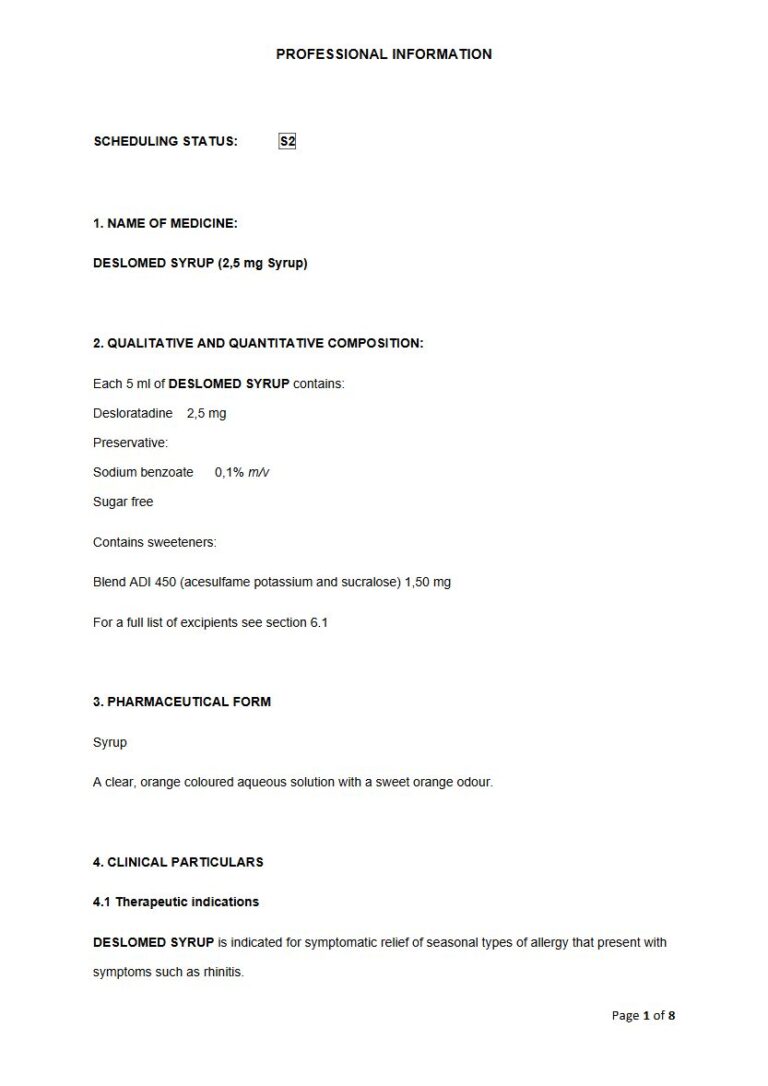
DESLOMED SYRUP is indicated for symptomatic relief of seasonal types of allergy that present with symptoms such as rhinitis.
4.2 Posology and method of administration
Children 2 to 5 years of age: 2,5 ml (1,25 mg) once a day, with or without food.
Children 6 to 11 years of age: 5 ml (2,5 mg) once a day, with or without food.
Adults and adolescents (12 years of age and over): 10 ml (5 mg) once a day, with or without food.
Patients with hepatic or renal impairment should be given 10 ml (5 mg) DESLOMED SYRUP on alternate days initially.
4.3 Contraindications
Hypersensitivity to active substance or to any of the excipients.
Pregnancy and lactation (see section 4.6).
Cross sensitivity to other antihistamines.
Porphyria.
4.4 Special warnings and precautions for use
Patients with the rare hereditary condition of sorbitol or maltitol intolerance should not take DESLOMED SYRUP.
Patients with hepatic or renal impairment should be given 5 mg DESLOMED SYRUP on alternate days initially.
DESLOMED SYRUP lacks significant sedative effects.
Efficacy and safety of DESLOMED SYRUP in children under 2 years of age has not been established.
Safety and efficacy of DESLOMED SYRUP has not been established for treatment periods in excess of 4 weeks.
DESLOMED SYRUP should be discontinued prior to skin tests allergen extracts as it may inhibit the cutaneous histamine response, thus producing false-negative results. DESLOMED SYRUP should be discontinued at least 48 hours before test.
DESLOMED SYRUP should be used with caution when one or more of the following medical conditions exist and/or patient is using other medication metabolised by the cytochrome P450 system: -emphysema, prostatic hypertrophy, narrow angle glaucoma, cardiovascular disorder, epilepsy or during acute attack of asthma.
H1 receptor antihistamines such as DESLOMED SYRUP have been shown to cause weight gain.
DESLOMED SYRUP contains sodium benzoate which may increase jaundice in newborn babies (up to 4 weeks old).
4.5 Interaction with other medicines and other forms of interactions
Concomitant use of DESLOMED SYRUP with alcohol did not potentiate the performance impairing effects of alcohol.
Co-administration of desloratadine with ketoconazole increases the maximum desloratadine concentration (C max) by 45% and the area under the time concentration curve (AUC) by 37%. Co-administration of desloratadine with erythromycin increased the C max of desloratadine by 24% and the AUC by 14%. The increase in C max and AUC of desloratadine when co-administered with either ketoconazole or erythromycin did not cause any clinically relevant adverse events in the population studied.
4.6 Fertility, pregnancy and lactation
DESLOMED SYRUP should not be used during pregnancy (see u2018CONTRAINDICATIONSu2019).
DESLOMED SYRUP is distributed into breast milk therefore is not recommended for use during lactation (see u2018CONTRAINDICATIONSu2019).
4.7 Effects on ability to drive and use machines
DESLOMED SYRUP lacks significant sedative effects. Patients should be warned, however, that a small number of individuals may experience sedation. It is therefore advisable to determine response before driving or performing complicated tasks.
4.8 Undesirable effects
At the recommended dose of 5 mg daily, undesirable effects with DESLOMED SYRUP were reported in 4% of patients in excess of those treated with placebo.
System organ class Frequent Less Frequent Frequency Unknown
Metabolism and nutritional disorder Increased appetite.
Nervous system disorders No excess incidence of somnolence was reported. Headache was reported in 2% of patients receiving DESLOMED SYRUP. Dizziness, fatigue, sedation, nervousness, blurred vision, confusion and nightmares.
Cardiac disorders Tachycardia, palpitations
Respiratory, thoracic and mediastinal disorders Pharyngitis Dyspnoea
Gastrointestinal disorders Dyspepsia, nausea, dry mouth.
Skin and subcutaneous tissue disorders Pruritis, rash, urticaria, alopecia.
Musculoskeletal and connective tissue disorders Myalgia
Reproductive system and breast disorders: Dysmenorrhoea
General disorders and administrative site conditions Fatigue Anaphylaxis, oedema
Investigations Elevations of liver enzymes and bilirubin have been reported.
4.9 Overdose
In the event of overdosage, symptomatic and supportive treatment is recommended. Desloratadine is not eliminated by haemodialysis and it is not known if it is eliminated by peritoneal dialysis.
