
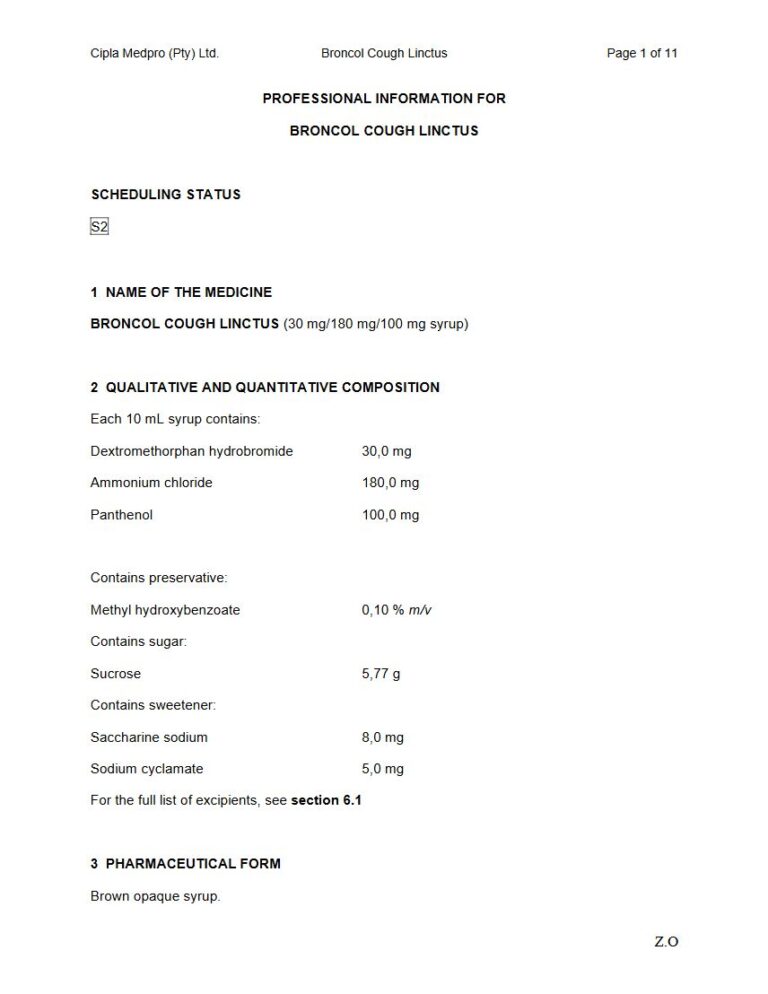
Broncol Cough Linctus Syrup
PDF Leaflet Revision Date: 21 May 2024
Clinical Summary
Quick overview from the medicine insert
Indication
Relief of productive or non-productive bronchial cough.
Dosage (summary)
Adults: 10 mL 2-4 times daily.
Onset of Action / Duration
Onset: 30 mins, Duration: up to 8 hours
Special Populations
- Children under 6 years
- Hepatic impairment
- Renal impairment
Pregnancy & Breastfeeding
Safety in pregnancy and lactation not established.
Key Drug Interactions
- MAOIs
- SSRIs
- CYP2D6 inhibitors
Contraindications
- Hypersensitivity to ingredients
- Acute asthma attack
- Haemophiliacs
- Ileus due to mechanical obstruction
Common side effects
- Dizziness
- Somnolence
- Nausea
- Vomiting
- Allergic reactions
Counselling Points
- Take after meals
- Avoid in acute asthma
- Monitor for allergic reactions
- May impair ability to drive
Serious warnings
- Risk of respiratory failure
- Potential for abuse and dependence
- Caution in diabetes mellitus
Important Disclaimer
The Broncol Cough Linctus Syrup professional information leaflet below is the property of Cipla Medpro and is provided on Medinsert exactly as issued, with no.. alterations or editorial changes. We make every effort to keep content current by updating documents as soon as new versions become available. Medinsert serves as a trusted access point for healthcare professionals, but does not replace official sources or clinical judgement. For more details, please read our full disclaimer. read more>>
 Healthcare Professionals Only
This content is for registered healthcare professionals
Sign in or create a free account to read the full package insert.
Free for HPCSA-registered professionals. Powered by Medinsert.
Clinical Particulars
Section 4 of the official insert — extracted exactly as issued, no alterations
4.1 Therapeutic indications
BRONCOL COUGH LINCTUS is indicated for the relief of productive or non-productive bronchial cough in colds, bronchitis and other respiratory tract disorders.
4.2 Posology and method of administration
Posology
Adults: 10 mL two to four times daily.
Children (6 to 12 years): 5 mL two to four times daily.
Method of administration
BRONCOL COUGH LINCTUS may be taken undiluted or diluted with water, milk, tea, fruit juices, etc., preferably after meals.
4.3 Contraindications
BRONCOL COUGH LINCTUS is contraindicated in:
- Patients with known hypersensitivity to dextromethorphan hydrobromide, ammonium chloride, panthenol or to any of the excipients used in the formulation of BRONCOL COUGH LINCTUS (see section 6.1 ).
- Children under the age of 6 years.
- Ammonium salts, as contained in BRONCOL COUGH LINCTUS, are contraindicated in patients with hepatic or renal impairment.
- Dexpanthenol, as contained in BRONCOL COUGH LINCTUS, is contraindicated in haemophiliacs and in patients with ileus due to mechanical obstruction.
- Dextromethorphan, as contained in BRONCOL COUGH LINCTUS, should not be given during an acute asthma attack and patients at risk of developing respiratory failure.
- Patients taking monoamine oxidase inhibitors (MAOIs), or for 2 weeks after stopping the MAOI medicine.
- Patients taking serotonin reuptake inhibitors.
4.4 Special warnings and precautions for use
- Dextromethorphan, as contained in BRONCOL COUGH LINCTUS, should not be given to patients at risk of developing respiratory failure. Caution is needed in patients with a history of asthma, and it should not be given during an acute attack (see section 4.3 ). Care is also advisable in patients with bronchitis, emphysema, or in other conditions where chronic or persistent cough occurs.
- BRONCOL COUGH LINCTUS contains 5,77 g sucrose per 10 mL. This should be taken into account in patients with diabetes mellitus. Patients with rare hereditary problems of fructose intolerance, glucose-galactose malabsorption or sucrase-isomaltase insufficiency should not take BRONCOL COUGH LINCTUS.
- BRONCOL COUGH LINCTUS contains methyl hydroxybenzoate which may cause allergic reactions (possibly delayed).
- Cases of dextromethorphan abuse and associated dependence have been reported. Caution with BRONCOL COUGH LINCTUS is particularly recommended for adolescents and young adults, as well as in patients with a history of drug abuse or use of psychoactive substances.
- Dextromethorphan, as contained in BRONCOL COUGH LINCTUS, is metabolised by hepatic cytochrome P450 2D6. The activity of this enzyme is genetically determined. About 10 % of the general population are poor metabolisers of CYP2D6. Poor metabolisers and patients with concomitant use of CYP2D6 inhibitors may experience exaggerated and/or prolonged effects of dextromethorphan. Caution with BRONCOL COUGH LINCTUS should therefore be exercised in patients who are slow metabolisers of CYP2D6 or use CYP2D6 inhibitors (see section 4.5 ).
- If a patient is a known slow metaboliser of CYP2D6 or is using any other medicines (such as serotonergic medicines, including selective serotonin reuptake inhibitors (SSRIs u2013 see section 4.3 ), medicines which impair the metabolism of serotonin (including MAOIs u2013 see section 4.3 ) or CYP2D6 inhibitors, a doctor or pharmacist should be consulted prior to taking BRONCOL COUGH LINCTUS. Serotonergic effects, including the development of a potentially life-threatening serotonin syndrome, have been reported for dextromethorphan, with concomitant administration of medicines with serotonergic effects.
- There have been a few reports of allergic reactions possibly associated with dexpanthenol, as in BRONCOL COUGH LINCTUS.
- Smoking tobacco: Since BRONCOL COUGH LINCTUS decreases coughing, it makes it difficult to get rid of the mucus that may collect in the lungs and airways resulting from smoking.
4.5 Interaction with other medicines and other forms of interaction
BRONCOL COUGH LINCTUS is contraindicated in patients taking MAOIs, or for 2 weeks after stopping the MAOI (see section 4.3 ). Severe and sometimes fatal reactions have been reported after the use of dextromethorphan, as contained in BRONCOL COUGH LINCTUS, in patients receiving MAOIs (monoamine oxidase inhibitors). Taking BRONCOL COUGH LINCTUS when taking MAO inhibitors or having taken them within the past 2 to 3 weeks may cause coma, dizziness, excited or unusual behaviour, fever, high blood pressure, nausea, sluggishness, spasms, and tremors.
Dextromethorphan, as contained in BRONCOL COUGH LINCTUS, is primarily metabolised by the cytochrome P450 isoenzyme CYP2D6, the possibility of interactions with inhibitors of this enzyme, including amiodarone, haloperidol, propafenone, quinidine and thioridazine should be kept in mind. Antiarrhythmics such as quinidine can increase serum concentrations of dextromethorphan, as contained in BRONCOL COUGH LINCTUS, markedly which may cause dextromethorphan toxicity in some patients. Serotonin syndrome-like symptoms may occur when antibacterials such as linezolid are taken together with dextromethorphan, as contained in BRONCOL COUGH LINCTUS. BRONCOL COUGH LINCTUS is contraindicated in patients taking selective serotonin reuptake inhibitors (see section 4.3 ). Adverse events such as hallucinations may occur when dextromethorphan, as contained in BRONCOL COUGH LINCTUS, is taken together with antidepressants such as fluoxetine. Serotonin-like symptoms may also occur when dextromethorphan, as contained in BRONCOL COUGH LINCTUS, is taken together with paroxetine.
4.6 Fertility, pregnancy and lactation
The safety of BRONCOL COUGH LINCTUS in fertility, pregnancy and lactation has not been established.
4.7 Effects on ability to drive and use machines
Dextromethorphan hydrobromide, as in BRONCOL COUGH LINCTUS, may cause somnolence and dizziness, which may impair the patientu2019s ability to drive and use machines safely.
4.8 Undesirable effects
Dextromethorphan hydrobromide
Immune system disorders
Less frequent: Angioedema.
Psychiatric disorders
Less frequent: Insomnia.
Nervous system disorders
Less frequent: Dizziness, psychomotor hyperactivity, somnolence.
Gastrointestinal disorders
Less frequent: Gastrointestinal disturbances, abdominal pain, diarrhoea, nausea, vomiting.
Skin and subcutaneous tissue disorders
Less frequent: Pruritus, rash, urticaria.
Ammonium chloride
Gastrointestinal disorders
Frequency unknown: Nausea and vomiting.
Panthenol
Immune system disorders
Less frequent: Allergic reaction.
Reporting of suspected adverse reactions
Reporting suspected adverse reactions after authorisation of the medicine is important. It allows continued monitoring of the benefit/risk balance of the medicine. Health care providers are asked to report any suspected adverse reactions to SAHPRA via the u201cAdverse drug reaction and quality problem reporting formu201d, found online under SAHPRAu2019s publications: https://www.sahpra.org.za/document/adverse-drug-reactions-and-quality-problemreporting-form/ or to Cipla Medpro (Pty) Ltd.by email: [email protected] or telephone: 080 222 6662 (toll free).
4.9 Overdose
Dextromethorphan hydrobromide
Excitation, confusion and respiratory depression may occur after overdosage, including rare fatalities. Naloxone may be effective in reversing toxicity.
Ammonium chloride
Large doses of ammonium chloride may cause profound acidosis and hypokalaemia which should be treated symptomatically.
General
Clinical symptomatology may include one or more of the following: Tiredness, drowsiness, apathy, rigor, miosis and respiratory depression. Treatment is symptomatic and supportive.
