
Bijuva Capsules
PDF Leaflet Revision Date: 06 May 2025
Clinical Summary
Quick overview from the medicine insert
Indication
Hormone replacement therapy for postmenopausal women with intact uterus.
Dosage (summary)
1 capsule daily in the evening with food.
Onset of Action / Duration
Onset: weeks, Duration: varies.
Special Populations
- Elderly
- Renal impairment
- Hepatic impairment
Pregnancy & Breastfeeding
Not indicated during pregnancy or lactation.
Key Drug Interactions
- Anticonvulsants
- Rifampicin
- St John's Wort
- Lamotrigine
- Ciclosporin
Contraindications
- Hypersensitivity
- Breast cancer
- Endometrial cancer
- Undiagnosed bleeding
- Thromboembolic disorders
- Liver disease
Common side effects
- Breast tenderness
- Headache
- Nausea
- Pelvic pain
- Vaginal bleeding
Counselling Points
- Take daily without interruption
- Report any unusual bleeding
- Monitor for thromboembolic symptoms
- Avoid during pregnancy
Serious warnings
- Increased risk of breast and endometrial cancer
- Thromboembolic events
- Ischaemic stroke risk
Important Disclaimer
The Bijuva Capsules professional information leaflet below is the property of Adcock Ingram and is provided on Medinsert exactly as issued, with no.. alterations or editorial changes. We make every effort to keep content current by updating documents as soon as new versions become available. Medinsert serves as a trusted access point for healthcare professionals, but does not replace official sources or clinical judgement. For more details, please read our full disclaimer. read more>>
 Healthcare Professionals Only
This content is for registered healthcare professionals
Sign in or create a free account to read the full package insert.
Free for HPCSA-registered professionals. Powered by Medinsert.
Clinical Particulars
Section 4 of the official insert — extracted exactly as issued, no alterations
4.1 Therapeutic indications
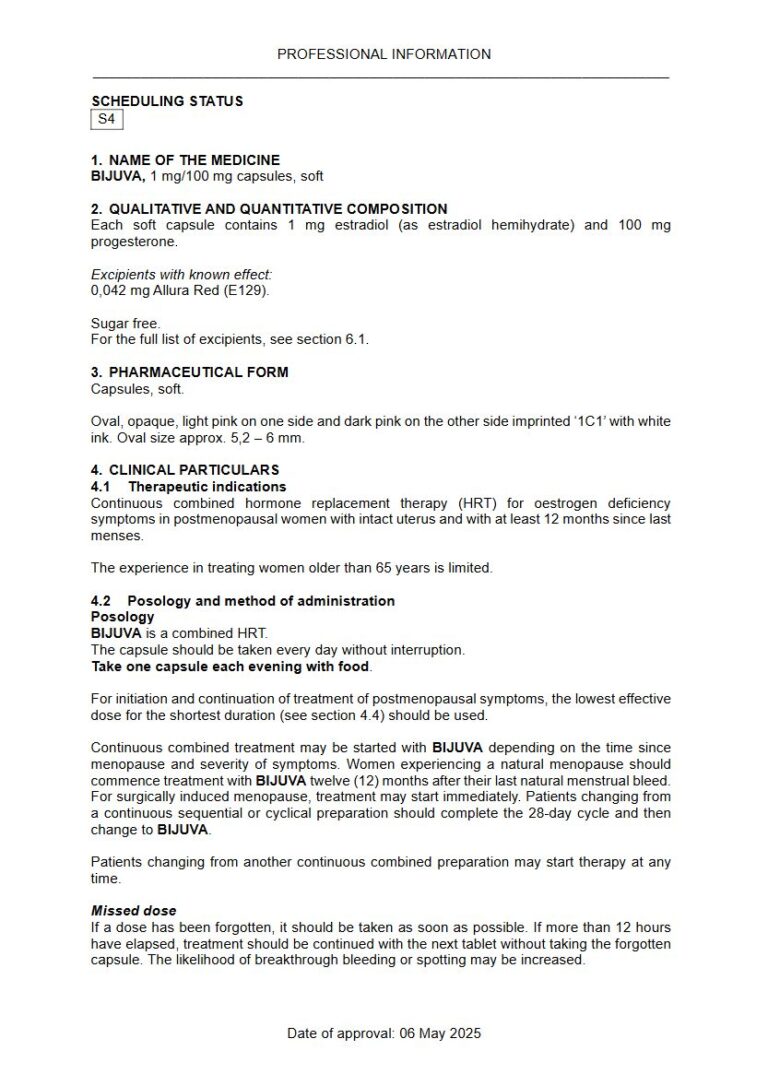
Continuous combined hormone replacement therapy (HRT) for oestrogen deficiency symptoms in postmenopausal women with intact uterus and with at least 12 months since last menses. The experience in treating women older than 65 years is limited.
4.2 Posology and method of administration
Posology BIJUVA is a combined HRT. The capsule should be taken every day without interruption. Take one capsule each evening with food. For initiation and continuation of treatment of postmenopausal symptoms, the lowest effective dose for the shortest duration (see section 4.4) should be used. Continuous combined treatment may be started with BIJUVA depending on the time since menopause and severity of symptoms. Women experiencing a natural menopause should commence treatment with BIJUVA twelve (12) months after their last natural menstrual bleed. For surgically induced menopause, treatment may start immediately. Patients changing from a continuous sequential or cyclical preparation should complete the 28-day cycle and then change to BIJUVA. Patients changing from another continuous combined preparation may start therapy at any time.
Missed dose If a dose has been forgotten, it should be taken as soon as possible. If more than 12 hours have elapsed, treatment should be continued with the next tablet without taking the forgotten capsule. The likelihood of breakthrough bleeding or spotting may be increased.
Paediatric population BIJUVA is not indicated in children.
Method of administration Oral
4.3 Contraindications
- Known hypersensitivity to the active substances or to any of the excipients (see section 6.1).
- Known, past or suspected breast cancer.
- Known or suspected oestrogen-dependent malignant tumours (e.g. endometrial cancer).
- Undiagnosed genital bleeding.
- Untreated endometrial hyperplasia.
- Previous or current venous thromboembolism (deep vein thrombosis, pulmonary embolism).
- Known thrombophilic disorders (e.g. protein C, protein S, or antithrombin deficiency, see section 4.4).
- Active or recent arterial thromboembolic disease (e.g. angina, myocardial infarction).
- Acute liver disease or a history of liver disease as long as liver function tests have failed to return to normal (see section 4.4).
- Porphyria.
4.4 Special warnings and precautions for use
For the treatment of postmenopausal symptoms, HRT should only be initiated for symptoms that adversely affect quality of life. In all cases, a careful appraisal of the risks and benefits should be undertaken at least annually, and HRT should only be continued as long as the benefit outweighs the risk.
Evidence regarding the risks associated with HRT in the treatment of premature menopause is limited. Due to the low level of absolute risk in younger women, however, the balance of benefits and risks for these women may be more favourable than in older women.
Medical examination/follow up Before initiating or reinstituting HRT, a complete personal and family medical history should be taken. Physical (including pelvic and breast) examination should be guided by this and by the contraindications and warnings for use. During treatment, periodic check-ups are recommended of a frequency and nature adapted to the individual woman. Women should be advised what changes in their breasts should be reported to their doctor or nurse (see 'Breast cancer ' below). Investigations, including appropriate imaging tools, e.g. mammography, should be carried out in accordance with currently accepted screening practices, modified to the clinical needs of the individual.
Conditions which need supervision If any of the following conditions are present, have occurred previously, and/or have been aggravated during pregnancy or previous hormone treatment, the patient should be closely supervised. It should be taken into account that these conditions may recur or be aggravated during treatment with BIJUVA, in particular:
- Leiomyoma (uterine fibroids) or endometriosis
- Risk factors for thromboembolic disorders (see below)
- Risk factors for oestrogen dependent tumours, e.g. 1st degree heredity for breast cancer
- Hypertension
- Liver disorders (e.g. liver adenoma)
- Diabetes mellitus with or without vascular involvement
- Cholelithiasis
- Migraine or (severe) headache
- Systemic lupus erythematosus
- A history of endometrial hyperplasia (see below)
- Epilepsy
- Asthma
- Otosclerosis
Reasons for immediate withdrawal of therapy Therapy should be discontinued in cases where a contraindication is discovered and in the following situations:
- Jaundice or deterioration in liver function
- Significant increase in blood pressure
- New onset of migraine-type headache
- Pregnancy
Endometrial hyperplasia and carcinoma In women with an intact uterus the risk of endometrial hyperplasia and carcinoma is increased when oestrogens are administered alone for prolonged periods. The reported increase in endometrial cancer risk among oestrogen-only users varies from 2- to 12-fold greater compared with non-users, depending on the duration of treatment and oestrogen dose (see section 4.8). After stopping treatment risk may remain elevated for at least 10 years. The addition of a progestogen cyclically for at least 12 days per month/28-day cycle or continuous combined oestrogen-progestogen therapy in non-hysterectomised women prevents the excess risk associated with oestrogen-only HRT. Break-through bleeding and spotting may occur during the first months of treatment. If break-through bleeding or spotting appears after some time on therapy, or continues after treatment has been discontinued, the reason should be investigated, which may include endometrial biopsy to exclude endometrial malignancy.
Breast cancer The overall evidence shows an increased risk of breast cancer in women taking combined oestrogen-progestogen or also oestrogen-only HRT, that is dependent on the duration of taking HRT. Combined oestrogen-progestogen therapy The randomised placebo-controlled trial the (Womenu2019s Health Initiative study (WHI), and a meta-analysis of prospective epidemiological studies are consistent in finding an increased risk of breast cancer in women taking combined oestrogen-progestogen for HRT that becomes apparent after about 3 (1 u2013 4) years (see section 4.8). Oestrogen-only therapy The WHI trial found no increase in the risk of breast cancer in hysterectomised women using oestrogen-only HRT. Observational studies have mostly reported a small increase in risk of having breast cancer diagnosed that is lower than that found in users of oestrogen-progestogen combinations (see section 4.8). Results from a large meta-analysis showed that after stopping treatment, the excess risk will decrease with time and the time needed to return to baseline depends on the duration of prior HRT use. When HRT was taken for more than 5 years, the risk may persist for 10 years or more.
HRT, especially oestrogen-progestogen combined treatment, increases the density of mammographic images which may adversely affect the radiological detection of breast cancer.
Ovarian cancer Ovarian cancer is much rarer than breast cancer. Epidemiological evidence from a large meta-analysis suggests a slightly increased risk in women taking oestrogen-only or combined oestrogen-progestogen HRT, which becomes apparent within 5 years of use and diminishes over time after stopping. Some other studies including the WHI trial suggest that use of combined HRTs may be associated with a similar or slightly smaller risk (see Section 4.8).
Venous thromboembolism HRT is associated with a 1,3 u2013 3-fold risk of developing venous thromboembolism (VTE), i.e. deep vein thrombosis or pulmonary embolism. The occurrence of such an event is more likely in the first year of HRT than later. Patients with known thrombophilic states have an increased risk of VTE and HRT may add to this risk. HRT is therefore contraindicated in these patients (see section 4.3). Generally recognised risk factors for VTE include, use of oestrogens, older ages, major surgery, prolonged immobilisation, obesity (BMI > 30 kg/m2), pregnancy/postpartum period, systemic lupus erythematosus (SLE), and cancer. There is no consensus about the possible role of varicose veins in VTE. As in all postoperative patients, prophylactic measures need to be considered to prevent VTE following surgery. If prolonged immobilisation is to follow elective surgery temporarily stopping HRT 4 to 6 weeks earlier is recommended. Treatment should not be restarted until the woman is completely mobilised. In women with no personal history of VTE but with a first degree relative with a history of thrombosis at young age, screening may be offered after careful counselling regarding its limitations (only a proportion of thrombophilic defects are identified by screening). If a thrombophilic defect is identified which segregates with thrombosis in family members or if the defect is severe (e.g. antithrombin, protein S, or protein C deficiencies or a combination of defects) HRT is contraindicated. Women already on chronic anticoagulant treatment require careful consideration of the benefit-risk use of HRT. If VTE develops after initiating therapy, the medicine should be discontinued. Patients should be told to contact their doctors immediately when they are aware of a potential thromboembolic symptom (e.g. painful swelling of a leg, sudden pain in the chest, dyspnoea).
Coronary artery disease (CAD) There is no evidence from randomised controlled trials of protection against myocardial infarction in women with or without existing CAD who received combined oestrogen-progestogen or oestrogen-only HRT. Combined oestrogen-progestogen therapy The relative risk of CAD during use of combined oestrogen-progestogen HRT is slightly increased. As the baseline absolute risk of CAD is strongly dependent on age, the number of extra cases of CAD due to oestrogen-progestogen use is very low in healthy women close to menopause, but will rise with more advanced age. Oestrogen-only Randomised controlled data found no increased risk of CAD in hysterectomised women using oestrogen-only therapy.
Ischaemic stroke Combined oestrogen-progestogen and oestrogen-only therapy are associated with an up to 1,5-fold increase in risk of ischaemic stroke. The relative risk does not change with age or time since menopause. However, as the baseline risk of stroke is strongly age-dependent, the overall risk of stroke in women who use HRT will increase with age (see section 4.8).
Other conditions Oestrogens may cause fluid retention, and therefore patients with cardiac or renal dysfunction should be carefully observed. Women with pre-existing hypertriglyceridemia should be followed closely during oestrogen replacement or hormone replacement therapy, since rare cases of large increases of plasma triglycerides leading to pancreatitis have been reported with oestrogen therapy in this condition. Oestrogens increase thyroid binding globulin (TBG), leading to increased circulating total thyroid hormone, as measured by protein-bound iodine (PBI), T4 levels (by column or by radioimmunoassay) or T3 levels (by radioimmunoassay). T3 resin uptake is decreased, reflecting the elevated TBG. Free T4 and free T3 concentrations are unaltered. Other binding proteins may be elevated in serum, i.e. corticoid binding globulin (CBG), sex-hormone-binding globulin (SHBG) leading to increased circulating corticosteroids and sex steroids, respectively. Free or biological active hormone concentrations are unchanged. Other plasma proteins may be increased (angiotensinogen/renin substrate, alpha-1-antitrypsin, ceruloplasmin). HRT use does not improve cognitive function. There is some evidence of increased risk of possible dementia in women who start using continuous combined or oestrogen-only HRT after the age of 65.
4.5 Interaction with other medicines and other forms of interaction
No drug-drug interaction studies have been conducted with BIJUVA. The drug-drug interactions of estradiol and progesterone have been extensively studied and are well established. Both oestrogens and progesterone are metabolised via cytochrome P450.
Effects of other medicines on BIJUVA The metabolism of oestrogens and progestogens may be increased by concomitant use of substances known to induce drug-metabolising enzymes, specifically cytochrome P450 enzymes, such as anticonvulsants (e.g. phenobarbitone, phenytoin, carbamazepine) and e.g. rifampicin, rifabutin, nevirapine, efavirenz, and griseofulvin. Herbal preparations containing St John's Wort (Hypericum perforatum) may induce the metabolism of oestrogens and progestogens. Ritonavir and nelfinavir, although known as strong inhibitors, by contrast exhibit inducing properties when used concomitantly with steroid hormones. Clinically, an increased metabolism of oestrogens and progestogens may lead to decreased effect and changes in the uterine bleeding profile. Ketoconazole and other inhibitors of CYP450-3A4 may increase bioavailability of progesterone. Such interactions may increase the incidence of adverse effects such as nausea, breast tenderness, headaches associated with progesterone.
Effects of BIJUVA on other medicines Hormone contraceptives containing oestrogens have been shown to significantly decrease plasma concentrations of lamotrigine when co-administered due to induction of lamotrigine glucuronidation. This may reduce seizure control. Although the potential interaction between hormone replacement therapy and lamotrigine has not been studied, it is expected that a similar interaction exists, which may lead to a reduction in seizure control among women taking both medicines together. Progesterone may raise the plasma concentration of ciclosporin.
4.6 Fertility, pregnancy and lactation
Pregnancy BIJUVA is not indicated during pregnancy. If pregnancy occurs during medication with BIJUVA treatment should be withdrawn immediately. The results of most epidemiological studies to date relevant to inadvertent foetal exposure to combinations of oestrogens and progestogens indicate no teratogenic or fetotoxic effect. There are no adequate data from the use of estradiol/progesterone in pregnant women.
Lactation BIJUVA is not indicated during lactation.
Fertility BIJUVA is not indicated in women of childbearing potential.
4.7 Effects on ability to drive and use machines
BIJUVA can cause side effects, such as dizziness, vertigo, visual impairment or fatigue. Patients should be advised that if they experience any of these symptoms they should not to drive or operate machinery.
4.8 Undesirable effects
a. Summary of the safety profile The most commonly reported related adverse drug reactions for BIJUVA in clinical trials were breast tenderness (10,4 %), headache (3,4 %), nausea (2,2 %), pelvic pain (3,1 %), vaginal haemorrhage (3,4 %), and vaginal discharge (3,4 %).
Incidence of Related Treatment Emergent Adverse Events Occurring in u2265 3 % in 1 mg estradiol/100 mg progesterone Treatment Arm and More Commonly than Placebo (Study TXC12 - 05) Adverse Event 1 mg estradiol / 100 mg progesterone (N=415) Placebo (N=151) Breast tenderness 43 (10,4) 1 (0,7) Headache 14 (3,4) 1 (0,7) Nausea 9 (2,2) 1 (0,7) Pelvic pain 13 (3,1) 0 (0) Vaginal Haemorrhage 14 (3,4) 0 (0) Vaginal discharge 14 (3,4) 1 (0,7)
Abbreviations: E2 - 17 u03b2 - estradiol; P u2013 progesterone
b. Tabulated list of adverse reaction Clinical trial data The safety of estradiol and progesterone capsules was assessed in a 1 - year, Phase 3 trial that included 1 835 postmenopausal women (1 684 were treated with estradiol and progesterone capsules once daily and 151 women received placebo. Most women (~ 70 %) in the active treatment groups were treated for u2265 326 days. The table below details the adverse reactions when taking BIJUVA 1 mg/100 mg:
MedDRA System Organ Class Very common u2265 1/10 Common u2265 1/100, < 1/10 Uncommon u2265 1/1 000, < 1/100 Rare u2265 1/10 000, < 1/1 000 Infections and infestations Gastroenteritis, furuncle, vaginal infection, vulvovaginal candidiasis, vulvovaginal mycotic infection, otitis media acute Neoplasms benign, malignant and unspecified (including cysts and polyps) Breast cancer, adnexa uteri cyst Blood and lymphatic system disorders Anaemia Immune system disorders Hypersensitivity Endocrine disorders Hirsutism Metabolism and nutrition disorders Fluid retention, hyperlipidaemia, hyperphagia, hyperuricemia Psychiatric disorders Sleep disorder, abnormal dreams, agitation, anxiety, depression, insomnia, irritability, mood swings, increased libido Nervous system disorders Dizziness, headache Disturbance in attention, memory impairment, migraine with aura, paraesthesia, parasomnia, somnolence Eye disorders Visual impairment Ear and labyrinth disorders Vertigo Vascular disorders Hypertension, superficial thrombophlebitis Gastrointestinal disorders Abdominal distension, abdominal pain, nausea Abdominal discomfort, abdominal tenderness, constipation, diarrhoea, dyspepsia, hyperphagia, dry mouth, oral discomfort, vomiting, dysgeusia, flatulence, acute pancreatitis Skin and subcutaneous tissue disorders Acne, alopecia Dry skin, pruritus, rash, telangiectasia Musculoskeletal and connective tissue disorders Back pain Musculoskeletal pain, pain in extremity, arthralgia, muscle spasms Reproductive system and breast disorders Breast tenderness Breast pain, pelvic pain, uterine pain/spasm, vaginal discharge, vaginal bleeding, haemorrhage Breast disorders (calcification, discharge, discomfort, enlargement swelling, fibrocystic disease, nipple pain, benign breast neoplasm), uterine/cervical disorders (dysplasia, polyp, cyst, uterine haemorrhage, leiomyoma, uterine polyp, bleeding), endometrial hypertrophy, abnormal biopsy, hot flush, metrorrhagia, post-menopausal haemorrhage, vulvovaginal pruritus General disorders and administration site conditions Fatigue Chills Investigations Increased weight Decreased weight, prolonged prothrombin time, increased protein S, abnormal liver function test, abnormal blood pressure, increased blood fibrinogen, increased blood alkaline phosphatase, increased aspartate aminotransferase, increased alanine aminotransferase, prolonged activated partial thromboplastin time
Breast cancer risk u2022 An up to 2-fold increased risk of having breast cancer diagnosed is reported in women taking combined oestrogen-progestogen therapy for more than 5 years. u2022 The increased risk in users of oestrogen-only therapy is lower than that seen in users of oestrogen-progestogen combinations. u2022 The level of risk is dependent on the duration of use (see section 4.4). u2022 Absolute risk estimations based on results of the largest randomised placebo-controlled trial (WHI-study) and the largest meta-analysis of prospective epidemiological studies (MWS) are presented.
Largest meta-analysis of prospective epidemiological studies Estimated additional risk of breast cancer after 5 years' use in women with BMI 27 (kg/m2) Age at start HRT (years) Incidence per 1 000 never-users of HRT over a 5 year period* (50 u2013 54 years)* Risk ratio (RR) Additional cases per 1 000 HRT users 5 years Oestrogen only HRT 50 9 u2013 13,3 1,2 2,7 Combined oestrogen - progestogen 50 u2013 65 9 u2013 13,3 1,6 8 Note: Since the background incidence of breast cancer differs by EU country, the number of additional cases of breast cancer will also change proportionately. 1 Taken from baseline incidence rates in England in 2015 in women with BMI 27 (kg/m2). Estimated additional risk of breast cancer after 10 yearsu2019 use in women with BMI 27 (kg/m2) Age at start HRT (years) Incidence per 1 000 never-users of HRT over a 10 year period (50 u2013 59 years)* Risk Ratio Additional cases per 1 000 HRT users after 10 years Oestrogen only HRT 50 26,6 1,3 7,1 Combined oestrogen - progestogen 50 26,6 1,8 20,8 Note: Since the background incidence of breast cancer differs by EU country, the number of additional cases of breast cancer will also change proportionately. US WHI studies - additional risk of breast cancer after 5 years' use Age range (years) Incidence per 1 000 women in placebo arm over 5 years Risk ratio & 95 % CI Additional cases per 1 000 HRT users over 5 years (95 % CI) CEE oestrogen-only 50 u2013 79 21 0,8 (0,7 u2013 1,0) -4 (-6 u2013 0) * 2 CEE+MPA oestrogen & progestogenu2021
4.9 Overdose
Both estradiol and progestogen are substances with low toxicity. Symptoms such as nausea, vomiting, breast tenderness, dizziness, abdominal pain, drowsiness/fatigue, and withdrawal bleeding could occur in cases of overdosing. It is unlikely that any specific or symptomatic treatment will be necessary. Aforementioned information is applicable for overdosing by children as well.
