
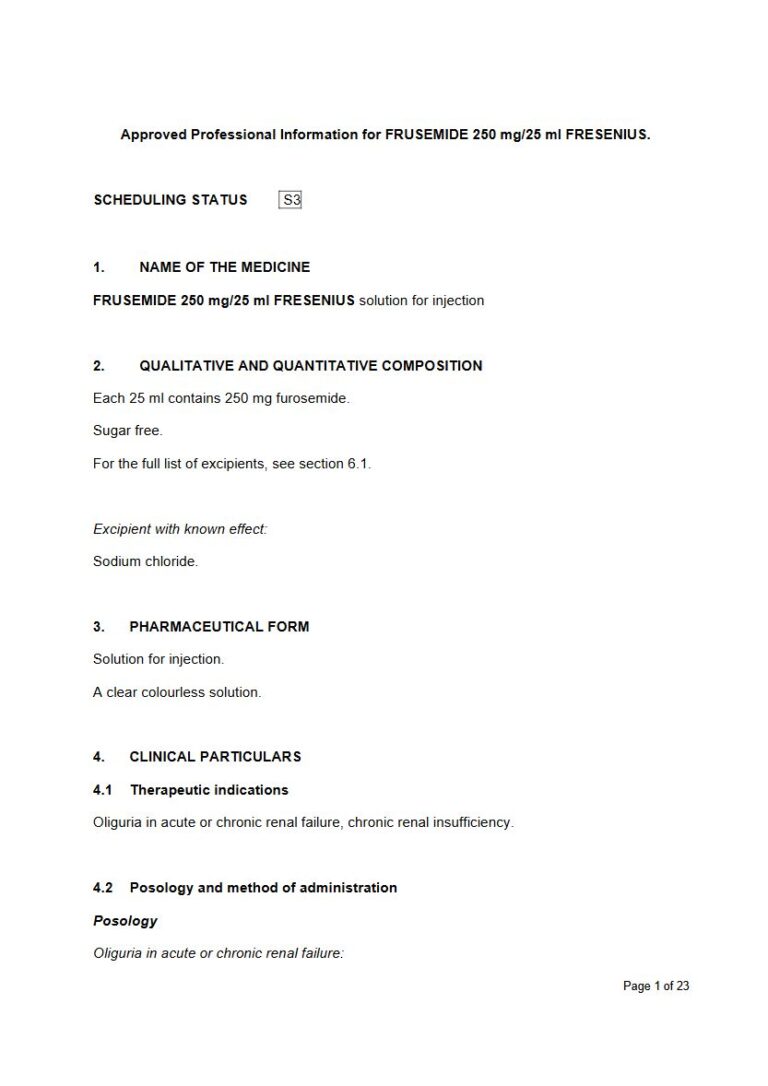
Frusemide 250 Mg/25 Ml Solution
PDF Leaflet Revision Date: 16 July 2024
Clinical Summary
Quick overview from the medicine insert
Indication
Oliguria in acute or chronic renal failure.
Dosage (summary)
Up to 1 g daily, adjusted based on response; slow IV infusion.
Onset of Action / Duration
Onset: 30 mins, Duration: 6-8 hours
Special Populations
- Elderly
- Renal impairment
- Hepatic impairment
Pregnancy & Breastfeeding
Not recommended; crosses placenta and appears in breast milk.
Key Drug Interactions
- Digoxin
- NSAIDs
- Aminoglycosides
- ACE inhibitors
Contraindications
- Hypersensitivity to furosemide
- Hypovolaemia
- Severe hypokalaemia
- Pregnancy and lactation
Common side effects
- Hypokalaemia
- Dizziness
- Dehydration
- Tinnitus
Counselling Points
- Monitor fluid intake
- Regular electrolyte checks
- Avoid alcohol and CNS depressants
Serious warnings
- Risk of hypotension
- Electrolyte imbalances
- Potential for nephrotoxicity
Important Disclaimer
The Frusemide 250 Mg/25 Ml Solution professional information leaflet below is the property of Fresenius Kabi Manufacturing Sa and is provided on Medinsert exactly as issued, with no.. alterations or editorial changes. We make every effort to keep content current by updating documents as soon as new versions become available. Medinsert serves as a trusted access point for healthcare professionals, but does not replace official sources or clinical judgement. For more details, please read our full disclaimer. read more>>
 Healthcare Professionals Only
This content is for registered healthcare professionals
Sign in or create a free account to read the full package insert.
Free for HPCSA-registered professionals. Powered by Medinsert.
Clinical Particulars
Section 4 of the official insert — extracted exactly as issued, no alterations
4.1 Therapeutic indications
Oliguria in acute or chronic renal failure, chronic renal insufficiency.
4.2 Posology and method of administration
Posology
Oliguria in acute or chronic renal failure:
The effective dose (up to 1 g) may be given daily. Dosage is then adjusted according to patientu2019s response. Patients not responding to 1 g FRUSEMIDE 250 mg/25 ml FRESENIUS probably require dialysis.
Method of administration
Slow intravenous infusion. 250 mg FRUSEMIDE 250 mg/25 ml FRESENIUS diluted to 250 ml in a suitable diluent infused over one hour. Suitable diluents include dextrose 5 %; ringersu2019 lactate; sodium chloride 0,9 % or dextrose 10 % or 20 % in water. If urine output is insufficient within an hour, this dose may be followed by 500 mg FRUSEMIDE 250 mg/25 ml FRESENIUS added to an infusion fluid, the volume of which must be governed by the patientu2019s state of hydration and infused over 2 hours. If urine output is still not satisfactory within 1 hour of the end of the second infusion, a third dose of 1 g FRUSEMIDE 250 mg/25 ml FRESENIUS may be infused over 4 hours. In oliguria or anuric patients with significant fluid overload, the injection may be given directly into the vein at an administration rate never to exceed 4 mg/minute.
4.3 Contraindications
- Hypersensitivity to furosemide, amiloride, sulphonamides, sulphonamide derivatives (cross-sensitivity exists between sulphonamides and furosemide) or to any of the excipients listed in section 6.1.
- Hypovolaemia and dehydration (with or without accompanying hypotension) (see section 4.4).
- Severe hypokalaemia, severe hyponatraemia (see section 4.4).
- Comatose or pre-comatose states associated with hepatic cirrhosis (see section 4.4).
- Pregnancy and lactation (see section 4.6).
- FRUSEMIDE 250 mg/25 ml FRESENIUS should not be given in anuria or in renal failure due to nephrotoxic or hepatotoxic medicines nor in renal failure associated with hepatic coma.
- Impaired renal function with a creatinine clearance below 30 ml/min per 1,73 m2 body surface area (see section 4.4).
- FRUSEMIDE 250 mg/25 ml FRESENIUS should not be given to patients with Addisonu2019s disease or pre-existing hypercalcaemia.
- Digoxin intoxication (see section 4.5).
- Porphyria.
4.4 Special warnings and precautions for use
Conditions requiring correction before treatment with FRUSEMIDE 250 mg/25 ml FRESENIUS is started (see section 4.3):
u2022 Hypotension.
u2022 Hypovolaemia.
u2022 Severe electrolyte disturbances u2013 particularly hypokalaemia, hyponatraemia and acid-base disturbances. Fluid and electrolyte imbalance should be monitored during therapy.
FRUSEMIDE 250 mg/25 ml FRESENIUS contains 90,76 mg sodium per ampoule, equivalent to 4% of the WHO recommended daily intake of 2 g sodium for an adult. The maximum daily dose of this product is equivalent to 18 % of the WHO recommended maximum daily intake for sodium. FRUSEMIDE 250 mg/25 ml FRESENIUS is considered high in sodium. This should be particularly taken into account for those on a low salt diet.
FRUSEMIDE 250 mg/25 ml FRESENIUS is not recommended:
u2022 In patients at high risk for radiocontrast nephropathy u2013 FRUSEMIDE 250 mg/25 ml FRESENIUS should not be used for diuresis as part of the preventative measures against radiocontrast-induced nephropathy. Except as a single trial dose in acute anuria in the absence of obstruction, FRUSEMIDE 250 mg/25 ml FRESENIUS should be avoided in anuric patients.
Particular caution and/or dose reduction required:
u2022 Symptomatic hypotension leading to dizziness, fainting or loss of consciousness can occur in patients treated with FRUSEMIDE 250 mg/25 ml FRESENIUS, particularly in the elderly, patients using other medicines which can cause hypotension, and patients with other medical conditions that are risks for hypotension.
u2022 Elderly people (lower initial dose as particularly susceptible to side effects, see section 4.2).
u2022 Difficulty with micturition, including prostatic hypertrophy (increased risk of urinary retention: consider lower dose). Closely monitor patients with partial occlusion of the urinary tract.
u2022 Diabetes mellitus (latent diabetes may become overt; insulin requirements in established diabetes may increase; stop FRUSEMIDE 250 mg/25 ml FRESENIUS before a glucose tolerance test).
u2022 Pregnancy (see section 4.6).
u2022 Patients with hepatorenal syndrome.
u2022 Caution should be exercised in patients with impaired hepatic function or renal impairment (see section 4.3 and below u2013 monitoring required).
u2022 FRUSEMIDE 250 mg/25 ml FRESENIUS may enhance the nephrotoxicity of cephalosporin and aminoglycoside antibiotics (see section 4.5). Hypoproteinaemia e.g. nephritic syndrome (effect of furosemide, as in FRUSEMIDE 250 mg/25 ml FRESENIUS, may be impaired and its ototoxicity potentiated u2013 cautious dose titration required).
u2022 Acute hypercalcaemia (dehydration results from vomiting and diuresis u2013 correct before giving FRUSEMIDE 250 mg/25 ml FRESENIUS). Treatment of hypercalcaemia with a high dose of furosemide results in fluid and electrolyte depletion u2013 meticulous fluid replacement and correction of electrolytes required.
u2022 Patients who are at risk from a pronounced fall in blood pressure.
u2022 FRUSEMIDE 250 mg/25 ml FRESENIUS has been associated with acute attacks of porphyria and is considered unsafe in porphyric patients.
u2022 Caution should be exercised in patients with gout (furosemide, as in FRUSEMIDE 250 mg/25 ml FRESENIUS, may raise uric acid levels/precipitate gout).
u2022 Patients on restricted sodium intake are particularly susceptible to excessive dehydration and hypotension.
u2022 Patients sensitive to sulphonamides may develop allergic dermatological and vasculitic reactions to FRUSEMIDE 250 mg/25 ml FRESENIUS.
u2022 Caution must be exercised in administering FRUSEMIDE 250 mg/25 ml FRESENIUS to infants, particularly for extended periods. Premature infants (possible development of nephrocalcinosis or nephrolithiasis; renal function must be monitored, and renal ultrasonography performed).
Laboratory monitoring requirements:
Serum sodium
Particularly in elderly people or in patients liable to electrolyte deficiency.
Serum potassium
The possibility of hypokalaemia should be taken into account, in particular in patients with cirrhosis of the liver, those receiving concomitant treatment with corticosteroids, those with an unbalanced diet and those who abuse laxatives. Regular monitoring of the potassium, and if necessary, treatment with a potassium supplement, is recommended in all cases, but is essential at higher doses and in patients with impaired renal function. It is especially important in the event of concomitant treatment with digoxin, as potassium deficiency can trigger or exacerbate the symptoms of digitalis intoxication (see section 4.5). A potassium-rich diet is recommended during long-term use.
Frequent checks of the serum potassium are necessary in patients with impaired renal function and creatinine clearance below 60 ml/min per 1,73m2 body surface area, as well as in cases where furosemide is taken in combination with certain other medicines which may lead to an increase in potassium levels (see section 4.5 and refer to section 4.8 for details of electrolyte and metabolic abnormalities).
Renal function
Frequent blood urea nitrogen (BUN) in the first few months of treatment, periodically thereafter. Long-term/high-dose BUN should regularly be measured. Marked diuresis can cause reversible impairment of kidney function in patients with renal dysfunction. Adequate fluid intake is necessary in such patients. Serum creatinine and urea levels tend to rise during treatment.
Glucose
Adverse effect on carbohydrate metabolism u2013 exacerbation of existing carbohydrate intolerance or diabetes mellitus. Regular monitoring of blood glucose levels is desirable.
Other electrolytes
Patients with hepatic failure/alcoholic cirrhosis are particularly at risk of hypomagnesaemia (as well as hypokalaemia). During long-term therapy (especially at high doses) magnesium, calcium, chloride, bicarbonate and uric acid should be regularly measured.
4.5 Interactions with other medicines
General: The dosage of concurrently administered digoxin, diuretics, antihypertensives or other medicines with blood pressure-lowering potential may require adjustment, as a more pronounced fall in blood pressure must be anticipated if given concomitantly with FRUSEMIDE 250 mg/25 ml FRESENIUS. Solutions for injection are alkaline and should not be mixed or diluted with glucose injection or other acidic solutions. FRUSEMIDE 250 mg/25 ml FRESENIUS may enhance the nephrotoxicity of cephalosporin antibiotics and can enhance the ototoxicity of aminoglycoside antibiotics and other ototoxic medicines.
Neuromuscular blockers u2013 the neuromuscular blocking action of competitive neuromuscular blockers, such as atracurium, may be enhanced.
Antihypertensives u2013 enhanced hypotensive effect possible with all types. Concurrent use with angiotensin-converting enzyme (ACE) inhibitors or angiotensin II receptor antagonists can result in marked falls in blood pressure, FRUSEMIDE 250 mg/25 ml FRESENIUS should be stopped, or the dose reduced before starting an ACE inhibitor or angiotensin II receptor antagonists (see section 4.4).
Antipsychotics u2013 furosemide-induced hypokalaemia increases the risk of cardiac toxicity. Avoid concurrent use with pimozide. Increased risk of ventricular dysrhythmias with amisulpride or sertindole. Enhanced hypotensive effect with phenothiazines. When administering risperidone, caution should be exercised and the risks and benefits of the combination or co-treatment with furosemide or with other potent diuretics should be considered prior to the decision to use. See section 4.4 regarding increased mortality in elderly patients with dementia concomitantly receiving risperidone.
Anti-dysrhythmics (including amiodarone, disopyramide, flecanaide and sotalol) u2013 risk of cardiac toxicity (because of furosemide-induced hypokalaemia).
Lidocaine (lignocaine), tocainide or mexiletine u2013 the effects of lidocaine (lignocaine), tocainide or mexiletine may be antagonised by furosemide, as in FRUSEMIDE 250 mg/25 ml FRESENIUS.
Digoxin u2013 hypokalaemia and electrolyte disturbances (including hypomagnesaemia) increase the risk of cardiac toxicity. Medicines that prolong QT interval u2013 increased risk of toxicity with furosemide-induced electrolyte disturbances.
Vasodilators u2013 enhanced hypotensive effect with moxisylyte (thymoxamine) or hydralazine.
Other diuretics u2013 profound diuresis is possible when furosemide, as in Frusemide Fresenius 250 mg/25 ml, is given with metolazone. Increased risk of hypokalaemia with thiazides.
Renin inhibitors u2013 aliskiren reduces plasma concentrations of furosemide, as in FRUSEMIDE 250 mg/25 ml FRESENIUS.
Nitrates u2013 enhanced the hypotensive effect of FRUSEMIDE 250 mg/25 ml FRESENIUS.
Alcohol, barbiturates or opioids u2013 orthostatic hypotension associated with FRUSEMIDE 250 mg/25 ml FRESENIUS may be enhanced by alcohol, barbiturates or opioids.
Nonsteroidal anti-inflammatory drugs (NSAIDs) u2013 the antihypertensive effect may be antagonised by medicines that cause fluid retention, such as nonsteroidal anti-inflammatory drugs (NSAIDs). The nephrotoxicity of NSAIDs may be enhanced. Indomethacin and ketorolac may antagonise the effects of furosemide (avoid, if possible, see section 4.4). NSAIDs may attenuate the action of furosemide, as in FRUSEMIDE 250 mg/25 ml FRESENIUS, and may cause acute renal failure in cases of pre-existing hypovolaemia or dehydration.
Lithium u2013 FRUSEMIDE 250 mg/25 ml FRESENIUS should not be used with lithium.
Allopurinol u2013 the toxicity of allopurinol may be increased.
Tetracycline antibiotics u2013 the toxicity of tetracyclines may be increased.
Chelating medicines u2013 sucralfate may decrease the gastrointestinal absorption of furosemide, as in FRUSEMIDE 250 mg/25 ml FRESENIUS. Sucralfate and FRUSEMIDE 250 mg/25 ml FRESENIUS should be used at least 2 hours apart.
Salicylates u2013 the effects of salicylates may be potentiated by furosemide, as in FRUSEMIDE 250 mg/25 ml FRESENIUS. Salicylic toxicity may be increased by FRUSEMIDE 250 mg/25 ml FRESENIUS.
Antibiotics u2013 increased risk of ototoxicity with aminoglycosides, polymyxins or vancomycin; only use concurrently if these are compelling reasons. Increased risk of nephrotoxicity with aminoglycosides or cefaloridine. Furosemide, as in FRUSEMIDE 250 mg/25 ml FRESENIUS, can decrease vancomycin serum levels after cardiac surgery. Increased risk of hyponatraemia with trimethoprim. Impairment of renal function may develop in patients receiving concurrent treatment with furosemide and high doses of certain cephalosporins.
Antidepressants u2013 enhanced hypotensive effect with monoamine oxidase inhibitors (MAOIs). Increased risk of postural hypotension with tricyclic antidepressants (TCAs). Increased risk of hypokalaemia with reboxetine.
Antidiabetics u2013 FRUSEMIDE 250 mg/25 ml FRESENIUS may alter the requirements for hypoglycaemics in diabetic patients.
Antiepileptics u2013 increased risk of hyponatraemia with carbamazepine. Concurrent administration of phenytoin may reduce the clinical effects of FRUSEMIDE 250 mg/25 ml FRESENIUS.
Antihistamines u2013 hypokalaemia with increased risk of cardiac toxicity.
Antifungals u2013 increased risk of hypokalaemia and nephrotoxicity with amphotericin.
Anxiolytics and hypnotics u2013 enhanced hypotensive effect. Chloral or triclofos may displace thyroid hormone from binding site.
Central nervous system (CNS) stimulants (medicines used for attention deficit hyperactivity disorder (ADHD)) u2013 hypokalaemia increases the risk of ventricular dysrhythmias.
Corticosteroids and corticotrophin u2013 diuretic effect antagonised (sodium retention) and increased risk of hypokalaemia.
Glycyrrhizin u2013 (contained in liquorice) may increase the risk of developing hypokalaemia.
Cytotoxics u2013 increased risk of nephrotoxicity and ototoxicity with platinum compounds/cisplatin. Nephrotoxicity of cisplatin may be enhanced if FRUSEMIDE 250 mg/25 ml FRESENIUS is not given in low doses (e.g. 40 mg in patients with normal renal function) and with positive fluid balance when used to achieve forced diuresis during cisplatin treatment.
Anti-metabolites u2013 effects of FRUSEMIDE 250 mg/25 ml FRESENIUS may be reduced by methotrexate and FRUSEMIDE 250 mg/25 ml FRESENIUS may reduce renal clearance of methotrexate.
Dopaminergics u2013 enhanced hypotensive effect with levodopa.
Immunomodulators u2013 enhanced hypotensive effect with aldesleukin. Increased risk of hyperkalaemia with ciclosporin and tacrolimus. Increased risk of gouty arthritis with ciclosporin.
Muscle relaxants u2013 enhanced hypotensive effect with baclofen or tizanidine. Increased effect of curare-like muscle relaxants.
Oestrogens u2013 diuretic effect antagonised.
Progestogens (drosperidone) u2013 increased risk of hyperkalaemia.
Prostaglandins u2013 enhanced hypotensive effect with alprostadil.
Sympathomimetics u2013 increased risk of hypokalaemia with high doses of beta 2 sympathomimetics, such as sotalol or salbutamol.
Theophylline u2013 enhanced hypotensive effect.
Probenecid u2013 effects of FRUSEMIDE 250 mg/25 ml FRESENIUS may be reduced by probenecid, and furosemide, as in FRUSEMIDE 250 mg/25 ml FRESENIUS, may reduce renal clearance of probenecid.
Anaesthetic medicines u2013 general anaesthetic medicines may enhance the hypotensive effects of furosemide. The effects of curare may be enhanced by FRUSEMIDE 250 mg/25 ml FRESENIUS.
Laxative abuse u2013 increases the risk of potassium loss.
Others u2013 concomitant administration of aminoglutethimide may increase the risk of hyponatraemia. The response of pressor amines e.g. noradrenaline (norepinephrine), has been reported to be diminished.
4.6 Fertility, pregnancy and lactation
The safety of FRUSEMIDE 250 mg/25 ml FRESENIUS in pregnancy and lactation has not been established (see section 4.3). FRUSEMIDE 250 mg/25 ml FRESENIUS should not be used during pregnancy and lactation since it crosses the placenta and also appears in breast milk. FRUSEMIDE 250 mg/25 ml FRESENIUS may compromise placental perfusion by reducing maternal blood volume; it may also inhibit lactation.
4.7 Effects on ability to drive and use machines
Reduced mental alertness, dizziness and blurred vision have been reported, particularly at the start of treatment, with dose changes and in combination with alcohol. Patients should be advised that if affected, they should not drive a vehicle, operate machinery or take part in activities where these effects could put themselves or others at risk.
4.8 Undesirable effects
Blood and lymphatic system disorders:
Less frequent: Bone marrow depression (necessitates withdrawal of treatment, the haemopoietic status should therefore be regularly monitored), aplastic anaemia or haemolytic anaemia, agranulocytosis, thrombocytopenia, leukopenia and eosinophilia.
Electrolyte imbalance: hyponatraemia, hypokalaemia and hypochloraemic alkalosis.
Immune systems disorders:
Less frequent: Allergy, hypersensitivity reactions including interstitial nephritis and fever.
Endocrine disorders:
Frequency unknown: Hyperglycaemia and glycosuria. Hyperuricaemia (with precipitated attacks of gout) and an increased excretion of calcium may occur. Glucose tolerance may decrease with furosemide, as in FRUSEMIDE 250 mg/25 ml FRESENIUS. In patients with diabetes mellitus this may lead to a deterioration of metabolic control; latent diabetes mellitus may become manifest. Insulin requirements of diabetic patients may increase.
Metabolism and nutrition disorders:
Frequency unknown: Electrolyte imbalance: hypovolaemic shock.
Nervous system disorders:
Less frequent: Paraesthesia, hyperosmolar coma. Frequency unknown: Dizziness, headache, fainting and loss of consciousness (caused by symptomatic hypotension). Electrolyte imbalance: headache, lethargy and restlessness.
Eye disorders:
Less frequent: Visual disturbance. Frequency unknown: Blurred vision, yellow vision.
Ear and labyrinth disorders:
Less frequent: Tinnitus and deafness may occur during rapid, high-dose therapy (faster than 4 mg/minute), although usually transitory, it may occur in rare cases, particularly in patients with renal failure or hypoproteinaemia (e.g. in nephritic syndrome). Deafness may be permanent, particularly in patients with impaired renal function or when administered concomitantly with ototoxic medicine.
Cardiac disorders:
Less frequent: Cardiac dysrhythmias. FRUSEMIDE 250 mg/25 ml FRESENIUS may cause a reduction in blood pressure which, if pronounced, may cause signs and symptoms such as impairment of concentration and reactions, light headedness, sensations of pressure in the head, headache, dizziness, drowsiness, weakness, disorders of vision, dry mouth and orthostatic intolerance. The diuretic effect of FRUSEMIDE 250 mg/25 ml FRESENIUS can result in hypovolaemia and dehydration, especially in the elderly. There is an increased risk of thrombosis.
Vascular disorders:
Less frequent: Vasculitis.
Gastrointestinal disorders:
Less frequent: Nausea, vomiting, diarrhoea, constipation, acute pancreatitis. Electrolyte imbalance: dry mouth, thirst and gastrointestinal disturbances.
Hepato-biliary disorders:
Frequency unknown: Jaundice, hepatic dysfunction and cholestatic jaundice. In isolated cases, intrahepatic cholestasis, an increase in liver transaminases or acute pancreatitis may develop. Hepatic encephalopathy in patients with hepatocellular insufficiency may occur (see section 4.3).
Skin and subcutaneous tissue disorders:
Less frequent: Photosensitivity, skin rashes. Skin and mucous membrane reactions may occasionally occur, e.g. itching, urticaria, other rashes or bullous lesions, fever, hypersensitivity to light, exudative erythema multiforme (Lyell's syndrome and Stevens-Johnson syndrome), bullous exanthema, exfoliative dermatitis, purpura, AGEP (acute generalised exanthematous pustulosis) and DRESS (drug rash with eosinophilia and systemic symptoms). Frequency unknown: Bullous pemphigoid.
Musculoskeletal and connective tissue disorders:
Frequency unknown: Electrolyte imbalance: muscle cramps and weakness.
Renal and urinary disorders:
Less frequent: Serum creatinine and urea levels can be temporarily elevated. Interstitial nephritis, acute renal failure. Increased urine production and urinary incontinence can be caused, or symptoms can be exacerbated in patients with urinary tract obstruction. Acute urine retention, possibly accompanied by complications, can occur for example in patients with bladder disorders, prostatic hyperplasia or narrowing of the urethra. Frequency unknown: Renal stone formation has been reported in pre-term infants. Electrolyte imbalance: dehydration and oliguria.
4.9 Overdose
Symptoms
Overdose can cause massive diuresis resulting in dehydration, volume depletion and electrolyte disturbances with consequent hypotension and cardiac toxicity. High doses have the potential to cause transient deafness and may precipitate gout (disturbed uric acid secretion).
Treatment
Benefits of gastric decontamination are uncertain. In patients presenting within 1 hour of ingestion, consider activated charcoal (50 g for adults and 1 g/kg for children). Observe for a minimum of 4 hours u2013 monitor pulse and blood pressure. Treat hypotension and dehydration with appropriate IV fluids. Monitor urinary output and serum electrolytes (including chloride and bicarbonate). Correct electrolyte imbalances. Monitor 12 lead electrocardiogram (ECG) in patients with significant electrolyte disturbances.
