
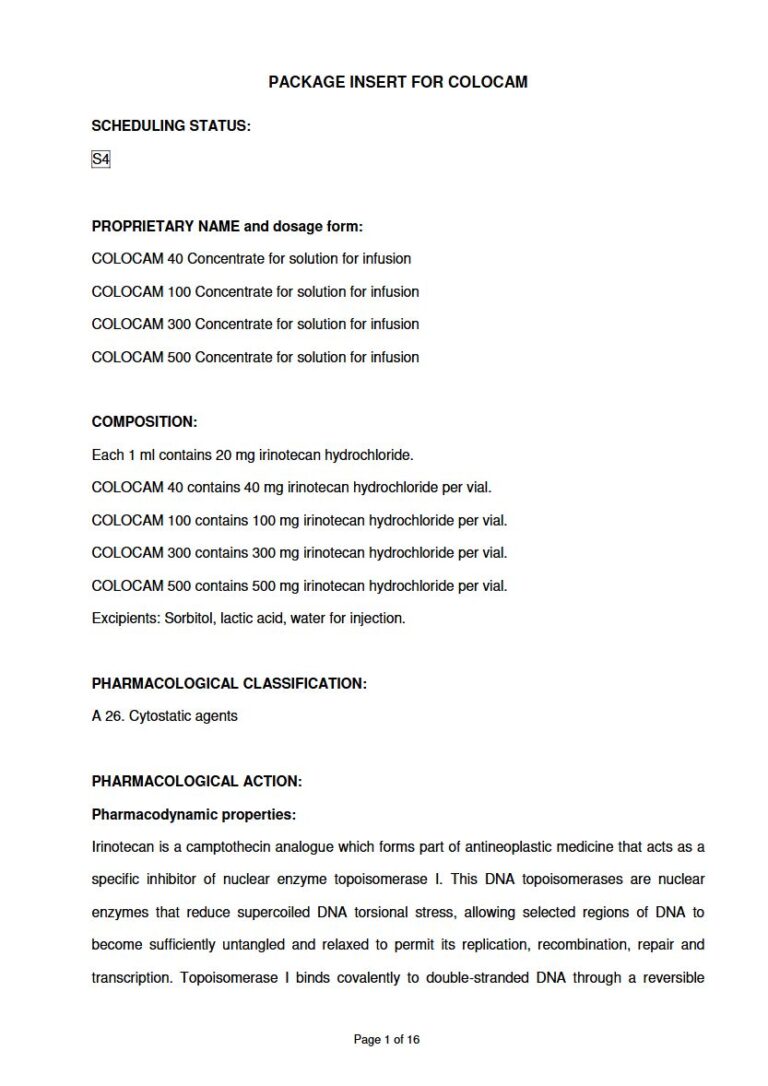
Colocam 40mg. 100mg. 300mg. 500mg: 20mg / ml Infusion
PDF Leaflet Revision Date: 30 September 2016
Clinical Summary
Quick overview from the medicine insert
Indication
Treatment of advanced colorectal cancer.
Dosage (summary)
350 mg/mu00b2 IV every 3 weeks; 80 mg/mu00b2 weekly or 180 mg/mu00b2 every 2 weeks in combination with 5-FU and folinic acid.
Onset of Action / Duration
Onset: 5 days for delayed diarrhea.
Special Populations
- Elderly
- Impaired hepatic function
Pregnancy & Breastfeeding
Contraindicated in pregnancy and lactation.
Key Drug Interactions
- St. John's Wort
- CYP3A4 inducers/inhibitors
- Live vaccines
Contraindications
- Severe hypersensitivity
- Chronic inflammatory bowel disease
- Bilirubin > 1.5 times ULN
- Severe bone marrow failure
- WHO performance status > 2
Common side effects
- Diarrhea
- Nausea
- Vomiting
- Neutropenia
- Fatigue
Counselling Points
- Hydration and anti-diarrheal therapy are crucial
- Avoid pregnancy during and 3 months post-treatment
- Report severe diarrhea immediately
Serious warnings
- Risk of delayed diarrhea
- Monitor for severe neutropenia
- Use in specialized units only
Important Disclaimer
The Colocam 40mg. 100mg. 300mg. 500mg: 20mg / ml Infusion professional information leaflet below is the property of Equity Pharmaceuticals and is provided on Medinsert exactly as issued, with no.. alterations or editorial changes. We make every effort to keep content current by updating documents as soon as new versions become available. Medinsert serves as a trusted access point for healthcare professionals, but does not replace official sources or clinical judgement. For more details, please read our full disclaimer. read more>>
 Healthcare Professionals Only
This content is for registered healthcare professionals
Sign in or create a free account to read the full package insert.
Free for HPCSA-registered professionals. Powered by Medinsert.
Clinical Particulars
Section 4 of the official insert — extracted exactly as issued, no alterations
4.1 Therapeutic indications
COLOCAM is indicated for the treatment of patients with advanced colorectal cancer with a WHO performance status of 2 or lower:
- In combination with 5-fluorouracil and folinic acid in patients without prior chemotherapy for advanced disease.
- As a single agent in patients who have failed an established 5-fluorouracil containing treatment regimen.
4.2 Posology and method of administration
Recommended dosage:
In monotherapy (for a previously treated patient): The recommended dosage of COLOCAM is 350 mg/m2 administered as an intravenous infusion over a 30 minute to 90 minute period every three weeks.
In combination therapy (for a previously untreated patient) Safety and efficacy of COLOCAM in combination with 5-fluorouracil (5FU) and folinic acid (FA) have been assessed with either of the following schedules:
- COLOCAM plus 5FU/FA in weekly schedule: The recommended dose of COLOCAM is 80 mg/m2 administered as a weekly intravenous infusion (IV) over a 30 to 90 minute period, followed by infusion with folinic acid and then by 5-fluorouracil over 6 weeks. This treatment is followed by one week rest. The full dosage regimen is as follows: COLOCAM 80 mg/m2 as a 30 to 90 minute infusion on Day 1 and then weekly for 6 weeks. Folinic acid 500 mg/m2 IV as a 2 hour infusion, followed by 5-fluorouracil 2 000 mg/m2 IV as a 24-hour infusion, on Day 1 and then weekly for 6 weeks. The treatment is to be repeated every 7 weeks.
- COLOCAM plus 5FU/FA every 2 weeks schedule: The recommended dose of COLOCAM is 180 mg/m2 administered once every 2 weeks as an intravenous infusion (IV) over a 30 to 90 minute period, followed by infusion with folinic acid and 5-fluorouracil. The full dosage regimen is as follows: COLOCAM 180 mg/m2 IV as a 30 to 90 minute infusion on Day 1 only. Folinic acid 200 mg/m2 IV as a 2-hour infusion, followed by 5-fluorouracil 400 mg/m2 IV bolus, followed by 5-fluorouracil 600 mg/m2 IV as a 22 hour infusion. The folinic acid and 5-fluorouracil are repeated for two consecutive days. Repeat the cycle every two weeks.
4.3 Contraindications
COLOCAM is contra-indicated in the following:
- Patients with a history of severe hypersensitivity reactions to irinotecan hydrochloride trihydrate or to one of the excipients of COLOCAM.
- Pregnancy and lactation. See u201cPregnancy and Lactationu201d.
- Chronic inflammatory bowel disease, and/or bowel obstruction or ileus.
- Patients should not be treated with COLOCAM until resolution of the ileus.
- Bilirubin > 1,5 times the upper limit of the normal range.
- Severe bone marrow failure.
- WHO performance status > 2.
- Concomitant use with St. Johnu2019s Wort (see u201cINTERACTIONSu201d).
4.4 Special warnings and precautions for use
The safety and efficacy of COLOCAM in children have not been established. COLOCAM should be used in patients with a good performance status of less than 2 (see u201cCONTRAINDICATIONSu201d). The use of COLOCAM should be confined to units specialised in the administration of cytotoxic chemotherapy and it should only be administered to patients under the supervision of a medical practitioner with experience in anticancer chemotherapy. Equipment and medicines necessary for treatment of complications should be readily available (including an intensive care unit).
Premedication with anti-emetic agents are recommended in order to reduce nausea and vomiting associated with COLOCAM treatment. This treatment should be started at least 30 minutes before the infusion. In all instances where the use of COLOCAM is considered for chemotherapy, it is especially important to ensure that the patient understands the need for sufficiently prolonged anti-diarrhoeal treatment and abundant fluid intake. If severe diarrhoea or other toxicity occurs, further treatment should be withheld until recovery occurs. Strict follow-up of the patient by the treating medical practitioner or hospitalisation is recommended in rare cases where it is predictable that the patient would comply poorly with the guidance for the management of side effects of COLOCAM.
Given the nature and frequency of adverse events, the expected benefit must be balanced in case of risk factors, especially WHO Performance status u2265 2 (or Karnofsky Index < 50).
Delayed diarrhoea: There is a high risk of delayed diarrhoea occurring more than 24 hours after the administration of COLOCAM, which can be life-threatening (especially if the patient is concomitantly neutropenic). In monotherapy, the onset of the first liquid stool is approximately 5 days after the infusion of COLOCAM. Patients should immediately inform their medical practitioner and start appropriate therapy.
Patients with an increased risk of diarrhoea:
- Patients who had previous abdominal/pelvic radiotherapy,
- Patients with baseline hyperleukocytosis and
- Patients with performance status u2265 2.
Large volumes of beverages containing electrolytes and an appropriate anti-diarrhoeal therapy must be initiated immediately after the first liquid stool occurs. Anti-diarrhoeal treatment will be prescribed by the medical practitioner. After discharge from the hospital the patients should obtain the prescribed medicine so that they can treat the diarrhoea as soon as it occurs. The treating medical practitioner or the department administering COLOCAM should be notified that diarrhoea is occurring.
The currently recommended anti-diarrhoeal treatment is loperamide 4 mg for the first intake and then 2 mg every 2 hours. This therapy should continue for 12 hours after the last liquid stool and should not be modified. Loperamide should not be administered for more than 48 consecutive hours at these doses (because of the risk of paralytic ileus) nor for less than 12 hours.
A prophylactic broad spectrum antibiotic should be given concomitantly with the anti-diarrhoeal treatment if the diarrhoea is associated with severe neutropenia (neutrophil count < 500 cells/mm3).
In addition to the antibiotic treatment, hospitalisation is recommended for management of the diarrhoea in the following cases:
- Diarrhoea associated with fever.
- Diarrhoea persisting beyond 48 hours following the initiation of high-dose loperamide therapy.
- Severe diarrhoea (requiring intravenous hydration).
Loperamide should not be given prophylactically, even in patients who experienced delayed diarrhoea at previous cycles. A COLOCAM dose reduction is recommended for subsequent cycles in patients who experienced severe diarrhoea.
Haematology: Patients who develop leukopenia should be observed carefully for signs and symptoms of infection. Patients should be aware of the risk of infection and the significance of a fever. In neutropenic patients who develop fever, broad spectrum antibiotic coverage should be initiated empirically, pending bacterial cultures and appropriate diagnostic tests. Febrile neutropenia (temperature u2265 38 u00b0C and neutrophil count u2264 1 000 cells/mm3) should be urgently treated in the hospital with broad spectrum intravenous antibiotics. COLOCAM treatment should be delayed until the neutrophil count is u2265 1 500 cells/mm3. The COLOCAM dose should be reduced in patients who experienced severe asymptomatic neutropenia (< 500 cells/mm3; fever or infections associated with neutropenia). There is an increased risk of infections and haematological toxicity in patients with severe diarrhoea.
Liver impairment: COLOCAM should not be used in patients with a bilirubin >1,5 times the upper limit of the normal (ULN) and the patients with bilirubin > ULN should be followed with caution. Patients with impaired liver function (bilirubin > 1,0 times and u2264 1,5 times the ULN and transaminases 5 times ULN) are at greater risk of developing severe neutropenia or febrile neutropenia and should be closely monitored. Liver function tests should be performed at baseline and before each cycle.
Nausea and vomiting: Nausea and vomiting have been frequently reported. Prophylactic treatment with an anti-emetic is recommended before each treatment with COLOCAM. Patients with vomiting associated with delayed diarrhoea should be hospitalised as soon as possible for treatment. See u201cDelayed diarrhoeau201d section.
Acute cholinergic syndrome: Acute cholinergic syndrome (defined as early diarrhoea and a group of symptoms such as sweating, myosis, lacrimation, abdominal cramping, and salivation), should be treated with atropine sulphate (0,25 mg subcutaneously) unless clinically contra-indicated. Caution is advised in patients with asthma. If acute cholinergic syndrome was reported, the use of prophylactic atropine sulphate is recommended with subsequent doses of COLOCAM.
Immunosuppressant effect: Administration of live or live-attenuated vaccines in patients immunocompromised by chemotherapeutic agents including COLOCAM, may result in serious or fatal infections. Vaccination with a live vaccine should be avoided in patients receiving COLOCAM (see u201cINTERACTIONSu201d). Killed or inactivated vaccines may be administered; however, the response to such vaccines may be diminished.
Respiratory disorders: Interstitial pulmonary disease presenting as pulmonary infiltrates may occur less frequently during COLOCAM therapy. Interstitial pulmonary disease can be fatal. Risk factors possibly associated with the development of interstitial pulmonary disease include the use of pneumotoxic medicines, radiation therapy and colony stimulating factors. Patients with risk factors should be closely monitored for respiratory symptoms before and during COLOCAM therapy.
Excipients: Since COLOCAM contains sorbitol, it is unsuitable in hereditary fructose intolerance.
Effects on ability to drive and use machines: Patients should be warned about the potential for dizziness or visual disturbances, and advised not to drive or operate machinery if these symptoms occur.
Elderly: COLOCAM should be administered with caution in the elderly due to the greater frequency of decreased hepatic, renal or cardiac function.
Others: Contraceptive measures must be taken during and for at least three months after cessation of therapy.
4.5 Interactions with other medicines
St. Johnu2019s Wort decreases SN -38 plasma levels. As a result, St. Johnu2019s Wort should not be taken with COLOCAM (see u201cCONTRAINDICATIONSu201d).
Vaccines: Yellow fever vaccine: There is a risk of fatal generalised reaction to vaccines. Concomitant use with COLOCAM (see u201cWARNINGS and SPECIAL PRECAUTIONSu201d).
Concomitant administration of COLOCAM with a strong inhibitor (e.g. ketoconazole) or inducer (e.g. rifampicin, carbamazepine, phenobarbital, phyenytoin, St. Johnu2019s Wort) of CYP3A4 may alter the metabolism of irinotecan and should be avoided.
Atazanavir sulphate. Co-administration of atazanavir sulphate, a CYP3A4 and UGT1A1 inhibitor, may increase systemic exposure to SN-38, the active metabolite of irinotecan. Medical practitioners should take this into consideration when co-administering these medicines.
Additive bone marrow depression may occur; dosage reductions may be required if COLOCAM and other bone marrow depressants or radiation therapy is administered concomitantly.
Concurrent therapy with COLOCAM and diuretics can lead to an increased severity of dehydration associated with irinotecan-induced diarrhoea or vomiting.
There is an increased risk of infection if COLOCAM and immunosuppressants (ciclosporin, tacrolimus, azathioprine, chlorambucil, corticosteroids etc.) are administered concurrently.
Due to an increased risk of severe diarrhoea, laxatives should not be used during COLOCAM treatment.
Pharmacokinetic parameters of COLOCAM combined with 5-fluorouracil-folinic acid are comparable to those observed in monotherapy.
Interaction between COLOCAM and neuromuscular blocking agents cannot be ruled out. Medicines with anticholinesterase activity may prolong the neuromuscular blocking effects of suxamethonium and the neuromuscular blockade of non-depolarising agents may be antagonised.
4.6 Fertility, pregnancy and lactation
COLOCAM is contra-indicated in pregnancy and lactation. Women of childbearing age receiving COLOCAM should be advised to avoid becoming pregnant and to inform the treating medical practitioner immediately should this occur. Contraceptive measures must be taken during and for at least three months after cessation of therapy.
4.7 Effects on ability to drive and use machines
Patients should be warned about the potential for dizziness or visual disturbances, and advised not to drive or operate machinery if these symptoms occur.
4.8 Undesirable effects
Blood and the lymphatic system disorders
Frequent: Anaemia, leukopenia, neutropenia. Less frequent: Thrombocytopenia. Frequencies not known: Peripheral thrombocytopenia with antiplatelet antibodies has been reported.
Immune system disorders
Less frequent: Hypersensitivity reactions, including anaphylactic, anaphylactoid reactions.
Metabolism and nutrition disorders
Frequent: Decrease or loss in appetite, weight loss.
Nervous system disorders
Frequent: Acute cholinergic syndrome (early diarrhoea, abdominal pain, conjunctivitis, hypotension, vasodilation, sweating, chills, malaise, dizziness, visual disturbances, myosis, lacrimation and increased salivation within 24 hours after the infusion of COLOCAM) (see u201cWARNINGS and SPECIAL PRECAUTIONSu201d). Less frequent: Paraesthesia.
Vascular disorders
Less frequent: Hypertension.
Respiratory, thoracic and mediastinal disorders
Frequent: Dyspnoea. Less frequent: Upper respiratory tract infection, rhinitis, interstitial pneumonia (see u201cWARNINGS and SPECIAL PRECAUTIONSu201d).
Gastrointestinal disorders: Frequent: Diarrhoea (possibly preceded by abdominal cramping and/or sweating), abdominal cramps or pain, constipation, nausea and vomiting, episodes of dehydration commonly associated with diarrhoea (see u201cWARNINGS and SPECIAL PRECAUTIONSu201d). Less frequent: Intestinal obstruction, ileus or gastrointestinal haemorrhage, intestinal perforation, transient increase in amylase and lipase, anorexia, mucositis, abdominal enlargement, bloated feeling or gas, Clostridium difficile induced pseudo-membranous colitis, indigestion.
Skin and subcutaneous tissue disorders
Less frequent: Skin rash, alopecia, mild cutaneous reactions.
Musculoskeletal, connective tissue and bone disorders
Less frequent: Muscular contraction or cramps.
Renal and urinary disorders
Less frequent: Renal insufficiency.
General disorders and administrative site conditions
Frequent: Fever, neutropenic fever, asthenia. Less frequent: Oedema, headache, increased sweating, stomatitis, vasodilation (flushing), infusion site reactions.
Frequency not known: Transient speech disorders.
Investigations
Frequent: Monotherapy: transient and mild to moderate increases in serum levels of either transaminases, alkaline phosphatise, bilirubin and creatinine. Combination therapy: transient increases in serum levels (grades 1 and 2) of either SGPT, SGOT, alkaline phosphatase or bilirubin.
4.9 Overdose
There have been reports of overdosage at doses up to approximately twice the recommended therapeutic dose, which may be fatal. Symptoms: The most significant adverse reactions reported were severe neutropenia and diarrhoea. Treatment: There is no known antidote for COLOCAM. It is recommended that the patients be hospitalised for close monitoring of vital functions and treatment of observed effects. Maximum supportive care should be instituted to prevent dehydration due to diarrhoea and to treat any infectious complications.
