
Isoniazid 300 Adco 300 mg Tablet
PDF Leaflet Revision Date: 10 June 2025
Clinical Summary
Quick overview from the medicine insert
Indication
Prophylaxis and treatment of tuberculosis.
Dosage (summary)
Adults: Prophylaxis 5 mg/kg (max 300 mg), Treatment 5-15 mg/kg (max 900 mg).
Special Populations
- Elderly
- Hepatic impairment
- Renal impairment
Pregnancy & Breastfeeding
Use in pregnancy with caution; not recommended during breastfeeding.
Key Drug Interactions
- CYP450 inhibitors
- Benzodiazepines
- Rifampicin
- Alcohol
Contraindications
- Hypersensitivity to isoniazid
- Alcoholism
- Severe renal failure
- Uncontrolled seizures
Common side effects
- Hepatitis
- Peripheral neuritis
- Optic neuritis
- Gastrointestinal irritation
Counselling Points
- Take on an empty stomach
- Avoid alcohol
- Report signs of liver dysfunction
- Supplement with pyridoxine if at risk of neuropathy
Serious warnings
- Hepatotoxicity risk
- Severe skin reactions
- Monitor for hypersensitivity
Important Disclaimer
The Isoniazid 300 Adco 300 mg Tablet professional information leaflet below is the property of Adcock Ingram and is provided on Medinsert exactly as issued, with no.. alterations or editorial changes. We make every effort to keep content current by updating documents as soon as new versions become available. Medinsert serves as a trusted access point for healthcare professionals, but does not replace official sources or clinical judgement. For more details, please read our full disclaimer. read more>>
 Healthcare Professionals Only
This content is for registered healthcare professionals
Sign in or create a free account to read the full package insert.
Free for HPCSA-registered professionals. Powered by Medinsert.
Clinical Particulars
Section 4 of the official insert — extracted exactly as issued, no alterations
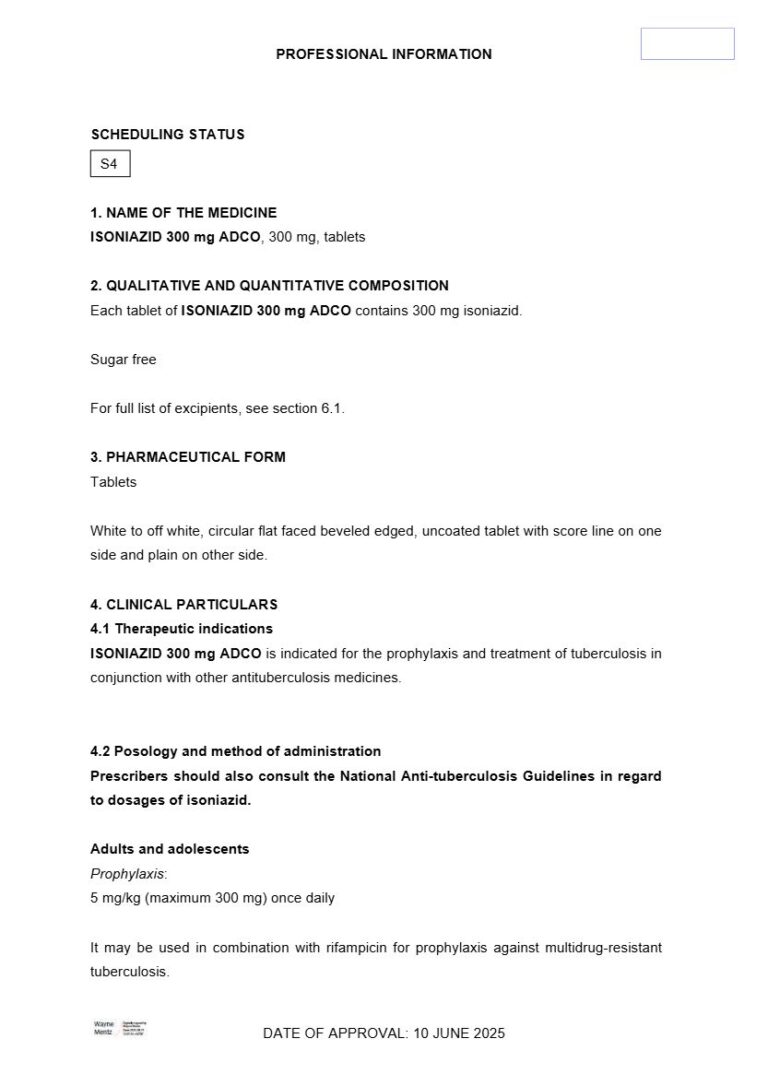
4.1 Therapeutic indications
ISONIAZID 300 mg ADCO is indicated for the prophylaxis and treatment of tuberculosis in conjunction with other antituberculosis medicines.
4.2 Posology and method of administration
Prescribers should also consult the National Anti-tuberculosis Guidelines in regard to dosages of isoniazid.
Adults and adolescents
- Prophylaxis: 5 mg/kg (maximum 300 mg) once daily. It may be used in combination with rifampicin for prophylaxis against multidrug-resistant tuberculosis.
- Treatment (in combination with other antituberculosis medicines): 5 to 15 mg/kg, once daily or in divided doses (maximum 900 mg per day), based on the type of tuberculosis and sensitivity pattern. Higher doses are used for CNS tuberculosis and multidrug-resistant tuberculosis.
Children
- Prophylaxis: 10 mg per kg of body weight, up to 300 mg, once daily.
- Treatment (in combination with other antituberculosis medicines): 10 to 20 mg per kg of body weight, up to 300 mg, once daily. Higher doses are used for CNS tuberculosis and multidrug-resistant tuberculosis.
Special populations
- Slow or fast acetylators: The rate of acetylation is determined genetically. The mean half-life in fast acetylators is approximately 70 minutes, whereas 2 to 5 hours is characteristic of slow acetylators. Patients who are slow acetylators may be more prone to adverse effects and may require lower doses than usual.
- Elderly (65 years of age and older): No dosage reduction is necessary in the elderly, but caution should be exercised due to the possible decrease in renal and hepatic function.
- Hepatic impairment: The half-life of isoniazid may be prolonged in the presence of hepatic insufficiency. ISONIAZID 300 mg ADCO should be used with caution in patients with mild to moderate hepatic impairment (see section 4.4).
- Renal impairment: No dosage reduction of isoniazid is necessary when given to patients with mild renal failure. Patients with severe renal failure (glomerular filtration rate of less than 10 ml/minute) (creatinine clearance < 30 ml/min) and slow acetylator status might require a dose reduction of about 100 mg to maintain trough plasma levels at less than 1 mcg/ml.
Method of administration: For oral administration. ISONIAZID 300 mg ADCO tablets should preferably be taken on an empty stomach, i.e. at least 30 minutes before a meal or 2 hours after a meal. ISONIAZID 300 mg ADCO may be taken with meals if gastrointestinal irritation occurs, but oral absorption may be reduced. Aluminium-containing antacids may delay and decrease absorption and serum concentrations of isoniazid. ISONIAZID 300 mg ADCO should therefore be taken/administered at least 1 hour before taking antacids.
4.3 Contraindications
The contraindications of all other anti-tuberculosis medicines to be used in combination with isoniazid should be consulted and adhered to, in addition to that of isoniazid.
ISONIAZID 300 mg ADCO is contraindicated in:
- Patients hypersensitive to isoniazid, ethionamide, pyrazinamide, niacin, or other chemically-related compounds or to any of the excipients in ISONIAZID 300 mg ADCO (see section 6.1).
- Alcoholism.
- Hepatic impairment and medicine induced liver disease.
- Severe renal failure.
- Patients with uncontrolled seizures.
- Isoniazid in combination with other antituberculosis medicines can lead to optic neuritis. Use of ISONIAZID 300 mg ADCO in pregnancy should take into account the woman and/or her developing foetus where these need to be used (see section 4.6).
4.4 Special warnings and precautions for use
Hepatotoxicity: ISONIAZID 300 mg ADCO may cause severe and sometimes fatal hepatitis. Advanced age, female gender, slow acetylators, malnutrition, HIV infection, pre-existing liver disease, and extra-pulmonary tuberculosis were identified as risk factors for isoniazid-induced hepatotoxicity. All patients should have baseline liver function tests performed and repeated at regular intervals during treatment. If serum ALT rises to more than three times normal, or there is any increase in bilirubin, treatment should be withdrawn.
Stevens-Johnson syndrome (SJS) and Toxic Epidermal Necrolysis (TEN): Cases of severe cutaneous reactions including Stevens-Johnson Syndrome (SJS) and Toxic Epidermal Necrolysis (TEN), some with fatal outcome, have been reported with the use of isoniazid, as in ISONIAZID 300 mg ADCO (see section 4.8). Patients should be advised of these signs and symptoms and closely monitored for skin reactions. The patient should be advised that if signs or symptoms of SJS or TEN (e.g. progressive skin rash often with blisters or mucosal lesions) develop, they should consult their doctor immediately. ISONIAZID 300 mg ADCO should be permanently discontinued if an alternative etiology for these signs and symptoms cannot be established.
Drug Reaction with Eosinophilia and Systemic Symptoms (DRESS): Severe, systemic hypersensitivity reactions, including fatal cases, such as Drug Reaction with Eosinophilia and Systemic Symptoms (DRESS) syndrome have been observed during antituberculosis therapy (see section 4.8). It is important to note that early manifestations of hypersensitivity, such as fever, lymphadenopathy or biological abnormalities (including eosinophilia, liver abnormalities) may be present even though rash is not evident. If such signs or symptoms are present, the patient should be advised to consult their doctor immediately. ISONIAZID 300 mg ADCO should be discontinued if an alternative etiology for the signs and symptoms cannot be established.
ISONIAZID 300 mg ADCO should be given with caution in patients suffering from convulsive disorders and diabetes mellitus, and patients with a history of psychosis. ISONIAZID 300 mg ADCO should be used with caution in patients with mild to moderate hepatic or renal impairment (see section 4.2) or patients taking other potentially hepatotoxic medicines. If symptoms of hepatitis deteriorate in these patients, ISONIAZID 300 mg ADCO should be discontinued immediately.
Pyridoxine: The administration of pyridoxine daily is recommended to prevent or minimise symptoms of peripheral neuritis in high-risk groups such as in patients who are diabetic, alcoholic, malnourished, uraemic, pregnant or infected with HIV. Patients who are at risk of neuropathy or pyridoxine deficiency including those in the abovementioned high-risk groups should receive pyridoxine usually in a dose of 10 to 15 mg daily, with a maximum of 30 mg/day during treatment with ISONIAZID 300 mg ADCO. Periodic eye examinations during treatment are recommended. ISONIAZID 300 mg ADCO in combination with other anti-tuberculosis medicines causes optic neuritis which can lead to optic atrophy and blindness (see section 4.8).
4.5 Interaction with other medicines and other forms of interaction
Inhibition of CYP450: Isoniazid, as in ISONIAZID 300 mg ADCO, can inhibit the hepatic metabolism of a number of medicines, in some cases leading to increased toxicity. These include the antiepileptics carbamazepine, primidone, and phenytoin, the benzodiazepines diazepam and triazolam, and others such as warfarin and theophylline. Concomitant administration of benzodiazepines (diazepam/carbamazepine) and isoniazid, as in ISONIAZID 300 mg ADCO, has been reported to result in benzodiazepine toxicity (sedation, respiratory depression, etc.).
Other interactions: Concurrent administration of ISONIAZID 300 mg ADCO and rifampicin may lead to a higher risk of hepatotoxicity, while increased central nervous system adverse effects have occurred when ISONIAZID 300 mg ADCO is given with potentially neurotoxic medicines such as cycloserine or disulfiram. Hepatotoxic reactions have been reported when paracetamol is given concurrently with ISONIAZID 300 mg ADCO, while chronic alcoholism increases the risk of isoniazid induced hepatitis. When isoniazid, as in ISONIAZID 300 mg ADCO is given to patients receiving paraminosalicyclic acid concurrently, the plasma concentrations of isoniazid may be increased, and adverse effects are more likely to occur. Prednisolone may increase hepatic metabolism and/or excretion of ISONIAZID 300 mg ADCO. Aluminium-containing antacids may delay and decrease absorption and serum concentrations of isoniazid. It is therefore recommended that ISONIAZID 300 mg ADCO be administered at least 1 hour before taking antacids (see section 4.2). Isoniazid, as in ISONIAZID 300 mg ADCO may reduce the therapeutic effects of levodopa. Concomitant administration of ISONIAZID 300 mg ADCO, with itraconazole or ketoconazole may result in significant decreases in either medicineu2019s serum concentrations, and thus therapeutic failure. Concurrent use should be well monitored, and dosage increases made if necessary. Because the clearance of isoniazid, as in ISONIAZID 300 mg ADCO, was found to be doubled when zalcitabine was given in HIV-positive patients, concurrent use of ISONIAZID 300 mg ADCO and zalcitabine should be monitored to ensure isoniazid effectiveness.
Interactions with food: Isoniazid, as in ISONIAZID 300 mg ADCO, is an inhibitor of monoamine oxidase (MAO) and diamine oxidase (DAO), can therefore reduce tyramine and histamine metabolism, causing symptoms such as headache, sweating, palpitations, flushing, conjunctival irritation, tachycardia, tachypnoea and hypotension. Patients should be advised against ingesting foods rich in tyramine and/or histamine during treatment with isoniazid, such as cured meat, some cheeses (e.g. matured cheeses), wine, beer and some fish (e.g. tuna, mackerel, salmon).
4.6 Fertility, pregnancy and lactation
Use of ISONIAZID 300 mg ADCO in pregnancy should take into account the safety of other anti-tuberculosis medicines in pregnancy, and the risk to the pregnant woman and/or her embryo/developing foetus where these medicines are to be used in combination with isoniazid.
Women of childbearing potential: Women of child-bearing potential should be advised to avoid becoming pregnant while on treatment with ISONIAZID 300 mg ADCO.
Pregnancy: Isoniazid, as in ISONIAZID 300 mg ADCO, crosses the placenta. The safe use of isoniazid in pregnancy has not been established, and harm to the embryo/developing foetus cannot be excluded (see section 4.3). Pyridoxine supplementation is recommended (see section 4.4).
Breastfeeding: Women on treatment with ISONIAZID 300 mg ADCO should not breastfeed their infants. The safety of infants receiving breast milk of mothers on treatment with ISONIAZID 300 mg ADCO has not been established.
Fertility: No data on the effect of isoniazid on fertility is available.
4.7 Effects on ability to drive and use machines
ISONIAZID 300 mg ADCO may influence the ability to drive and use machines. Since adverse reactions such as convulsions have been reported in patients receiving isoniazid, as in ISONIAZID 300 mg ADCO, patients should not drive, use machinery or perform any tasks that require concentration, until they are certain that ISONIAZID 300 MG ADCO does not adversely affect their ability to do so (see sections 4.4 and 4.8).
4.8 Undesirable effects
Tabulated list of adverse reactions
System Organ Class Frequency Adverse Reactions
- Blood and the lymphatic system disorders: Less frequent - Blood dyscrasias; Frequency unknown - Agranulocytosis, aplastic anaemia, haemolytic anaemia
- Immune system disorders: Less frequent - Hypersensitivity reactions (fever, skin rashes, joint pain)
- Metabolism and nutrition disorders: Frequency unknown - Hyperglycaemia, metabolic acidosis, hypoglycaemia, nicotinic acid deficiency
- Psychiatric disorders: Frequency unknown - Psychotic reactions/ disorders, elevated moods
- Nervous system disorders: Frequent - Peripheral neuritis; Less frequent - Neurotoxicity; Frequency unknown - Convulsions, peripheral neuropathy, hyperreflexia
- Eye disorders: Frequency unknown - Optic neuritis which can lead to optic atrophy and blindness*
- Ear and labyrinth disorders: Frequency unknown - Deafness, tinnitus, vertigo
- Vascular disorders: Frequency unknown - Vasculitis
- Respiratory, thoracic and mediastinal disorders: Frequency unknown - Interstitial lung disease
- Gastrointestinal disorders: Frequency unknown - Gastrointestinal irritation, nausea, pellagra, constipation, dry mouth acute pancreatitis, vomiting, other gastrointestinal effects
- Hepato-biliary disorders: Frequent - Hepatitis prodromal symptoms (loss of appetite, nausea or vomiting, unusual tiredness or weakness); Less frequent - Hepatitis; Frequency unknown - Acute hepatic failure, liver injury, jaundice
- Skin and subcutaneous tissue disorders: Less frequent - Toxic epidermal necrolysis, eosinophilia systemic symptoms; Frequency unknown - Erythema multiforme, Stevens-Johnson syndrome
- Musculoskeletal and connective tissue disorders: Frequency unknown - Lupus-like syndrome, rheumatoid syndrome, systemic lupus erythematosus
- Renal and urinary disorders: Frequency unknown - Urinary retention, dysuria
- Reproductive system and breast disorders: Frequency unknown - Gynaecomastia
- General disorders and administrative site conditions: Frequency unknown - Pyrexia
- Investigations: Frequency unknown - Increased hepatic enzymes
* When isoniazid is taken in combination with other anti-tuberculosis medicines.
Description of selected adverse reactions
Ear and labyrinth disorders: Deafness, tinnitus, vertigo have been reported in patients with end stage renal impairment/failure. Vertigo may be troublesome with doses of 10 mg per kg body weight.
Eye disorders: Isoniazid causes optic neuritis which in combination with other anti-tuberculosis medicines, can lead to optic atrophy and blindness.
Hepato-biliary disorders: The risk of these undesirable effects increases with age, especially over the age of 35; it may be serious and sometimes fatal with the development of necrosis.
Metabolism and nutrition disorders: Nicotinic acid deficiency may be related to an isoniazid-induced pyridoxine deficiency which affects the conversion of tryptophan to nicotinic acid.
Nervous system disorders: Hyperreflexia may be troublesome with doses of 10 mg per kg body weight.
Psychiatric disorders: Mood elevation and mental disturbances, ranging from minor personality changes to major mental derangement have been reported.
Miscellaneous: Withdrawal symptoms, which may occur on the cessation of the treatment, include headache, insomnia, excessive dreaming, irritability and nervousness.
Reporting of suspected adverse reactions: Reporting suspected adverse reactions after authorisation of the medicine is important. It allows continued monitoring of the benefit/risk balance of the medicine. Health care providers are asked to report any suspected adverse reactions to SAHPRA via the Med Safety APP (Medsafety X SAHPRA) and eReporting platform (who-umc.org) found on SAHPRA website.
4.9 Overdose
Symptoms of isoniazid overdose includes slurred speech, metabolic acidosis, hyperglycaemia, hallucinations, respiratory and CNS depression, convulsions and coma.
Treatment consists of symptomatic and supportive therapy. This includes use of large doses of pyridoxine (1:1) to prevent and/or control convulsions, and sodium bicarbonate for metabolic acidosis.
