
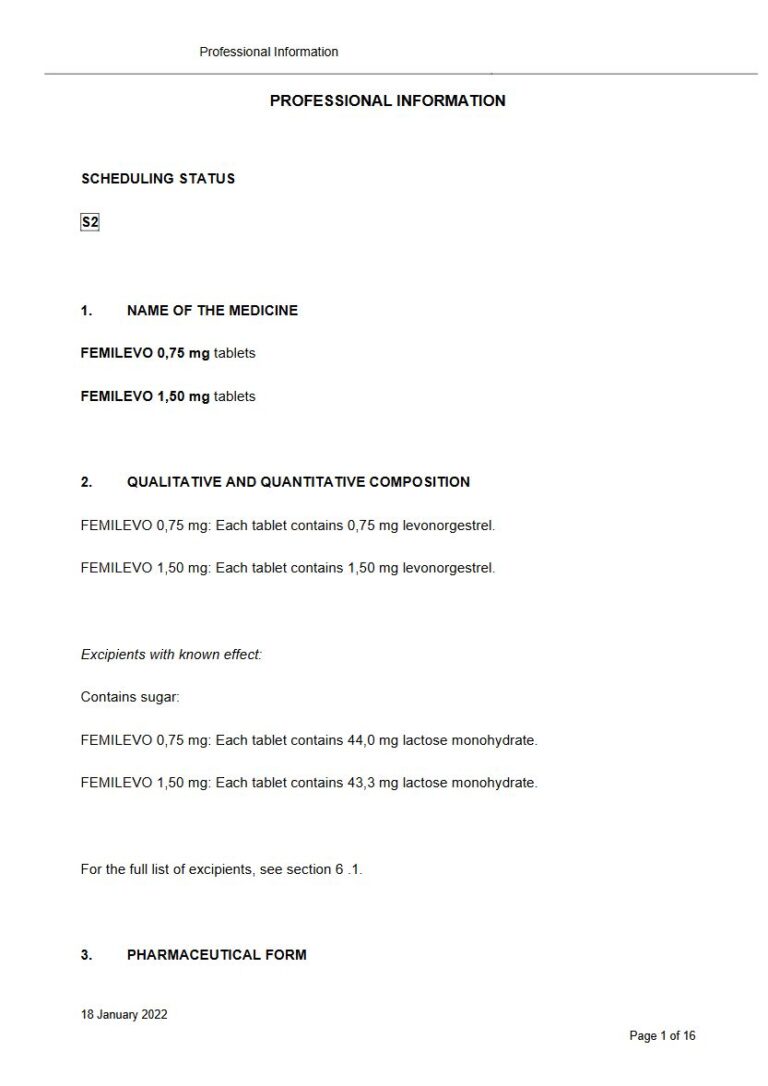
Femilevo 0,75 mg/ 1,50 mg Tablets.
PDF Leaflet Revision Date: 18 January 2022
Clinical Summary
Quick overview from the medicine insert
Indication
Emergency contraception within 72 hours of unprotected intercourse.
Dosage (summary)
FEMILEVO 0.75 mg: 2 tablets; FEMILEVO 1.5 mg: 1 tablet, taken as soon as possible within 72 hours.
Special Populations
- Not recommended in children
- Obese women may have reduced efficacy
Pregnancy & Breastfeeding
Not for use in pregnancy; minimal transfer to breast milk; avoid nursing for 6 hours post-dose.
Key Drug Interactions
- CYP3A4 inducers (e.g., rifampicin, phenytoin)
- Antibiotics may reduce efficacy
Contraindications
- Hypersensitivity to levonorgestrel
- Severe hepatic insufficiency
- Pregnancy
- Undiagnosed vaginal bleeding
Common side effects
- Headache
- Dizziness
- Nausea
- Lower abdominal pain
- Fatigue
Counselling Points
- Use as soon as possible after unprotected intercourse
- Consider regular contraception after use
- Consult if no menstruation occurs within 5 days
Serious warnings
- Not a regular contraceptive method
- Risk of ectopic pregnancy
- Mood changes and depression
Important Disclaimer
The Femilevo 0,75 mg/ 1,50 mg Tablets. professional information leaflet below is the property of Adcock Ingram and is provided on Medinsert exactly as issued, with no.. alterations or editorial changes. We make every effort to keep content current by updating documents as soon as new versions become available. Medinsert serves as a trusted access point for healthcare professionals, but does not replace official sources or clinical judgement. For more details, please read our full disclaimer. read more>>
 Healthcare Professionals Only
This content is for registered healthcare professionals
Sign in or create a free account to read the full package insert.
Free for HPCSA-registered professionals. Powered by Medinsert.
Clinical Particulars
Section 4 of the official insert — extracted exactly as issued, no alterations
4.1 Therapeutic indications
Emergency contraception within 72 hours of unprotected sexual intercourse or failure of a contraceptive method. FEMILEVO is intended for emergencies only and is completely unsuitable for regular contraception. Its reliability is not as high as that of the familiar u201cpillu201d, which is taken for at least 21 days of the menstrual cycle.
4.2 Posology and method of administration
Posology: FEMILEVO 0,75 mg: Take 2 tablets in a single administration as soon as possible, preferably within 12 hours, but not later than 72 hours after unprotected sexual intercourse. FEMILEVO 1,5 mg: Take 1 tablet as soon as possible in a single administration. The tablet should be taken no later than 72 hours after unprotected sexual intercourse.
If the patient vomits within three to four hours of taking FEMILEVO, another dose should be taken immediately. The earlier FEMILEVO is used, the more effective it is. Even extremely high doses of hormone can no longer prevent pregnancy once a fertilised ovum has become implanted in the uterine mucosa. FEMILEVO can be used at any time during the menstrual cycle unless menstrual bleeding is overdue. After using emergency contraception, it is recommended to use a local barrier method (e.g., condom, foam, pessary) until the next menstrual period starts. The use of FEMILEVO does not contraindicate the continuation of regular hormonal contraception. Paediatric Population: FEMILEVO is not recommended in children. Very limited data is available in women under 16 years of age.
Method of administration: For oral administration.
4.3 Contraindications
- Hypersensitivity to levonorgestrel or to any of the excipients listed in section 6.1.
- Severe hepatic insufficiency.
- Pregnancy or suspected pregnancy (see section 4.6).
- Patients with undiagnosed vaginal bleeding, or those with a history of or current high risk of arterial disease.
- Depression, which is not well controlled with treatment.
- A history of depression with the use of oestrogen and/or progesterone/progestogen containing medicines irrespective of the indication, dosage formulation and route of administration.
- The repeated use of FEMILEVO within a monthly cycle is to be avoided, since it constitutes undesirable hormonal stress and may result in severe cycle disturbances.
4.6 Fertility, pregnancy and lactation
Pregnancy: FEMILEVO should not be given to pregnant women. There is no evidence stating that FEMILEVO will not interrupt a pregnancy. In the case of continued pregnancy, limited epidemiological data indicate no adverse effects on the foetus but there are no clinical data on the potential consequences if doses greater than 1,5 mg of levonorgestrel are taken. In case of unprotected coitus more than 72 hours earlier, the patient may be pregnant. In these cases, pregnancy should be investigated.
Lactation: About 0,1% of the maternal FEMILEVO dose can be transferred via breast milk to the nursed infant. Potential exposure of an infant to FEMILEVO can be reduced if the breastfeeding woman takes the tablet immediately after feeding and avoids nursing at least 6 hours following FEMILEVO administration.
Fertility: Levonorgestrel increases the possibility of cycle disturbances which can sometimes lead to earlier or later ovulation date resulting in modified fertility date. Although there are no fertility data in the long term, after treatment with FEMILEVO a rapid return to fertility is expected and therefore, regular contraception should be continued or initiated as soon as possible after FEMILEVO use.
4.7 Effects on ability to drive and use machines
FEMILEVO can cause side effects, such as dizziness and can affect the ability to drive a vehicle and use machines. Caution is advised when driving a vehicle or operating machinery until the effects of FEMILEVO are known.
4.8 Undesirable effects
Frequency System Organ Class Undesirable effects Frequent Nervous System disorders Headache, dizziness Gastrointestinal disorders Nausea, lower abdominal pain, diarrhoea, vomiting Reproductive system and breast disorders Bleeding not related to menstruation*, delay of menstruation more than 7 days**, irregular menstruation or spotting, breast tenderness General disorders and administration site conditions Fatigue, fever Less Frequent Immune system disorders Anaphylaxis, Anaphylactoid reactions Reproductive system and breast disorders Changes in libido Hepato-biliary disorders Alterations in liver function tests, jaundice Frequency unknown Metabolism and Nutrition disorders Changes in appetite or weight, fluid retention, oedema Psychiatric disorders Mental depression Nervous System disorders Drowsiness, insomnia Gastrointestinal disorders Gastrointestinal disturbances Skin and subcutaneous tissue disorders Acne, Melasma or Chloasma, Allergic skin reactions, hair loss or hirsutism Reproductive system and breast disorders Breast changes, premenstrual syndrome-like symptoms * Bleeding patterns may be temporarily disturbed, but most women will have their next menstrual cycle within 7 days of the expected time. ** If the next menstrual cycle is more than 5 days overdue, pregnancy should be excluded.
Post-marketing experience: Psychiatric disorders: Less frequent: severe depression with a higher risk of suicidal thoughts/behaviour and suicide Gastrointestinal disorders: Less frequent: abdominal pain Skin and subcutaneous tissue disorders: Less frequent: rash, urticaria, pruritus Reproductive system and breast disorders: Less frequent: pelvic pain, dysmenorrhoea General disorders and administration site conditions: Less frequent: face oedema.
Reporting of suspected adverse reactions: Reporting suspected adverse reactions after authorisation of FEMILEVO is important. It allows continued monitoring of the benefit/risk balance of FEMILEVO. Health care providers are asked to report any suspected adverse reactions to SAHPRA via the u201c6.04 Adverse Drug Reactions Reporting Formu201d, found online under SAHPRAu2019s publications: https://www.sahpra.org.za/Publications/Index/8.
4.9 Overdose
Serious undesirable effects have not been reported following acute ingestion of large doses of oral contraceptives. Overdose may cause nausea, and withdrawal bleeding may occur. There are no specific antidotes and treatment should be symptomatic.
