
Coltra 500 500 mg Suppositories
PDF Leaflet Revision Date: 22 March 2024
Clinical Summary
Quick overview from the medicine insert
Indication
Treatment and maintenance of remission in ulcerative colitis.
Dosage (summary)
One suppository rectally up to three times daily for adults.
Special Populations
- Renal impairment
- Hepatic impairment
- Elderly
Pregnancy & Breastfeeding
Safety in pregnancy and lactation not established.
Key Drug Interactions
- NSAIDs
- Azathioprine
- Warfarin
Contraindications
- Hypersensitivity to mesalazine
- Severe liver impairment
- GFR < 30 ml/min
- History of salicylate allergy
Common side effects
- Abdominal pain
Counselling Points
- Monitor for signs of hypersensitivity
- Ensure adequate fluid intake
- Report any unexplained bleeding or bruising
Serious warnings
- Severe cutaneous adverse reactions
- Nephrotoxicity
- Blood dyscrasia
Important Disclaimer
The Coltra 500 500 mg Suppositories professional information leaflet below is the property of Equity Pharmaceuticals and is provided on Medinsert exactly as issued, with no.. alterations or editorial changes. We make every effort to keep content current by updating documents as soon as new versions become available. Medinsert serves as a trusted access point for healthcare professionals, but does not replace official sources or clinical judgement. For more details, please read our full disclaimer. read more>>
 Healthcare Professionals Only
This content is for registered healthcare professionals
Sign in or create a free account to read the full package insert.
Free for HPCSA-registered professionals. Powered by Medinsert.
Clinical Particulars
Section 4 of the official insert — extracted exactly as issued, no alterations
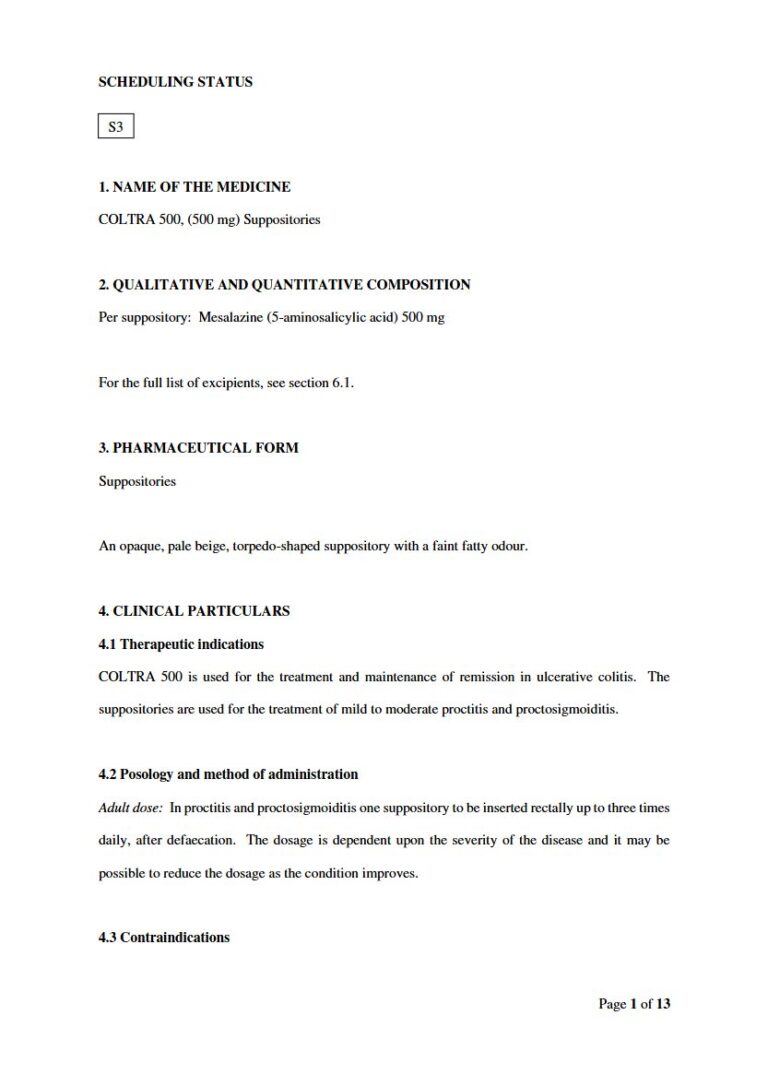
4.1 Therapeutic indications
COLTRA 500 is used for the treatment and maintenance of remission in ulcerative colitis. The suppositories are used for the treatment of mild to moderate proctitis and proctosigmoiditis.
4.2 Posology and method of administration
Adult dose: In proctitis and proctosigmoiditis one suppository to be inserted rectally up to three times daily, after defaecation. The dosage is dependent upon the severity of the disease and it may be possible to reduce the dosage as the condition improves.
4.3 Contraindications
Hypersensitivity to mesalazine or to any other excipients, see section 6.1. History of allergy to salicylates. Severe liver impairment. Patients with impaired renal function (GFR less than 30 ml per minute). Safety in pregnancy and lactation has not been established. Safety and efficacy have not been established in children. Bleeding tendencies. History of mesalazine-induced cardiac hypersensitivity. Salicylate sensitive asthma.
4.4 Special warnings and precautions for use
Blood tests (differential blood count, liver function parameters such as ALT or AST; serum creatinine) and urinary status (dip sticks) should be determined prior to and during treatment, at the discretion of the treating medical practitioner. As a guideline, follow-up tests are recommended 14 days after commencement of treatment and then every 4 weeks for the following 12 weeks. If the findings are normal, follow-up tests should be carried out every three months. If additional signs appear, these tests should be performed immediately.
Renal impairment COLTRA 500 should not be used in patients with renal impairment. Caution should be exercised in patients with raised serum creatinine or proteinuria. The possibility of COLTRA 500-induced nephrotoxicity should be suspected in patients developing impairment of renal function during treatment. Treatment with COLTRA 500 should be stopped immediately if there is evidence of renal impairment and patients should seek immediate medical advice.
Nephrolithiasis Cases of nephrolithiasis have been reported with the use of mesalazine including stones with a 100 % mesalazine content. It is recommended to ensure adequate fluid intake during treatment.
Concurrent use of non-steroidal anti-inflammatory drugs (NSAIDs) or azathioprine may increase the risk of renal reactions (see section 4.5). Mesalazine as contained in COLTRA 500 may produce red-brown urine discoloration after contact with sodium hypochlorite bleach (e.g., in toilets cleaned with sodium hypochlorite contained in certain bleaches).
Severe cutaneous adverse reactions Severe cutaneous adverse reactions (SCARs), including drug reaction with eosinophilia and systemic symptoms (DRESS), Stevens-Johnson syndrome (SJS) and toxic epidermal necrolysis (TEN), have been reported in association with COLTRA 500 treatment. COLTRA 500 should be discontinued, at the first appearance of signs and symptoms of severe skin reactions, such as skin rash, mucosal lesions, or any other sign of hypersensitivity.
Hepatic impairment There have been reports of increased liver enzyme levels in patients taking preparations containing mesalazine. Caution is recommended if COLTRA 500 is administered to patients with liver impairment. Blood tests (liver function parameters such as ALT or AST) should be performed prior to and during treatment, at the discretion of the treating medical practitioner. As a guideline, follow-up tests are recommended 14 days after commencement of treatment, then a further two to three tests at intervals of 4 weeks. If the findings are normal, follow-up tests should be carried out every 3 months. If additional symptoms occur, these tests should be performed immediately.
Blood dyscrasia Very rarely serious blood dyscrasia has been reported. To avoid blood dyscrasia resulting from developing bone marrow depression patients should be monitored with care. Haematological investigations including a complete blood count should be performed prior to initiation and whilst on therapy. Such tests are generally recommended within 14 days of initiation of therapy with 2 to 3 repeat tests each after another 4 weeks. If the results are normal, tests are recommended quarterly. In case additional signs of illness appear, further control tests are necessary. This procedure is to be followed especially, if a patient develops signs and symptoms suggestive of blood dyscrasia during treatment, such as unexplained bleeding, haematoma, purpura, anaemia, persistent fever or sore throat. Treatment with COLTRA 500 should be stopped immediately if there is a suspicion or evidence of blood dyscrasia (signs of unexplained bleeding, bruising, purpura, anaemia, persistent fever or sore throat) and patients should seek immediate medical advice (see section 4.8).
Co-administration of immunosuppressive medicines such as azathioprine or 6-MP can precipitate leukopenia (see section 4.5).
Pulmonary disease Patients with pulmonary disease, in particular asthma, should be very carefully monitored during a course of treatment with COLTRA 500.
Cardiac hypersensitivity reactions Mesalazine-induced cardiac hypersensitivity reactions (myo- and pericarditis) have been reported rarely with COLTRA 500. In case of previous mesalazine-induced cardiac hypersensitivity COLTRA 500 must not be reintroduced. Caution should be used in patients with previous myo- or pericarditis of allergic background regardless of its origin.
Hypersensitivity to sulphasalazine In patients with a history of hypersensitivity to sulphasalazine, therapy should be initiated only under close medical supervision. Treatment must be stopped immediately if acute symptoms of intolerance occur such as abdominal cramps, acute abdominal pain, fever, severe headache and rash.
Gastric and duodenal ulcers In case of existing gastric or duodenal ulcers treatment should begin with caution based on theoretical grounds.
Geriatric patients Use in the elderly should be handled with caution and COLTRA 500 should only be prescribed to patients having a normal or non-severely impaired liver and renal function (see section 4.3).
Paediatric population There is little experience and only limited documentation for an effect in children.
4.5 Interaction with other medicines and other forms of interaction
No interaction studies have been performed. There is weak evidence that COLTRA 500 might decrease the anticoagulant effect of warfarin. COLTRA 500 can increase the myelosuppressive effects of azathioprine, 6-mercaptopurine or thioguanine. As a result, life-threatening infection can occur. Patients should be closely observed for signs of infection and myelosuppression. At initiation of such combination therapy haematological parameters, especially the leukocyte, thrombocyte and lymphocyte cell counts should be monitored regularly (weekly) (see section 4.4). If white blood cells are stable after 1 month, testing every 4 weeks for the following 12 weeks followed by 3 monthly monitoring intervals appears to be justified.
The concurrent use of known nephrotoxic medicines, such as non-steroidal anti-inflammatory drugs (NSAIDs) or azathioprine, may increase the risk of renal reactions (see section 4.4).
4.6 Fertility, pregnancy and lactation
Pregnancy Safety in pregnancy has not been established. Breastfeeding Low concentrations of mesalazine and its N-acetyl metabolite have been detected in human breast milk. Safety in lactation has not been established. Fertility No effects on fertility have been observed.
4.7 Effects on ability to drive and use machines
COLTRA 500 suppositories have no or negligible influence on the ability to drive and use machines.
4.8 Undesirable effects
a) Summary of the safety profile Side effects are presented by system organ class. The only common side effect is abdominal pain (1,2 %). Organ specific allergic reactions affecting the heart, lungs, liver, kidneys, pancreas, skin and subcutaneous tissue have been reported. In patients with a history of hypersensitivity to sulphasalazine, treatment must be stopped immediately if acute symptoms of intolerance occur such as abdominal cramps, acute abdominal pain, fever, severe headache and rash (see section 4.4).
b) Tabulated summary of adverse reactions MedDRA System Organ Class Rare (u2265 1/10 000 to < 1/1 000) Very rare (< 1/10 000) Frequency not known Blood and lymphatic system disorders Altered blood counts (aplastic anaemia, agranulocytosis, pancytopenia, neutropenia, leukopenia, thrombocytopenia), and eosinophilia (as part of an allergic reaction), bone marrow depression. Immune system disorders Hypersensitivity reactions such as allergic exanthema, drug fever, lupus erythematosus syndrome, with pericarditis and pleuro-pericarditis as prominent symptoms as well as rash, pancolitis. Nervous system disorders Headache, dizziness. Peripheral neuropathy. Cardiac disorders Myocarditis, pericarditis. Respiratory, thoracic and mediastinal disorders Allergic and fibrotic lung reactions (including dyspnoea, cough, bronchospasm, alveolitis, pulmonary eosinophilia, lung infiltration, pneumonitis). Pleurisy, interstitial pneumonia. Gastrointestinal disorders Abdominal pain, diarrhoea, flatulence, nausea, vomiting. Acute pancreatitis. Exacerbation of the symptoms of colitis. Hepato-biliary disorders Changes in liver function parameters (increase in transaminases and cholestasis parameters), hepatitis, cholestatic hepatitis. Skin and subcutaneous tissue disorders Photosensitivity* * See section c). Alopecia. Drug Reaction with Eosinophilia and Systemic Symptoms (DRESS), Stevens-Johnson syndrome (SJS), toxic epidermal necrolysis (TEN). Musculo-skeletal, connective tissue and bone disorders Myalgia, arthralgia. Renal and urinary disorders Impairment of renal function including acute and chronic interstitial nephritis and renal insufficiency. Nephrotic syndrome, renal failure which may be reversible on withdrawal, nephrolithiasis** ** see section 4.4 for further information. Reproductive system and breast disorders Oligospermia (reversible). General disorders and administration site conditions Intolerance to mesalazine with C-reactive protein increased and/or exacerbation of symptoms of underlying disease, local reaction.
c) Description of selected adverse reactions An unknown number of the above undesirable effects are probably associated to the underlying IBD rather than COLTRA 500/mesalazine medication. This holds true especially for gastrointestinal undesirable effects. To avoid blood dyscrasia resulting from developing bone marrow depression patients should be monitored with care, see section 4.4. Under co-administration of immunosuppressive medicines such as azathioprine, or 6-MP or thioguanine life-threatening infection can occur, see section 4.5. Photosensitivity More severe reactions are reported in patients with pre-existing skin conditions such as atopic dermatitis and atopic eczema.
d) Paediatric population There is only limited safety experience with the use of COLTRA 500 in the paediatric population. It is expected that the target organs of possible adverse reactions in the paediatric population are the same as for adults (heart, lungs, liver, kidneys, pancreas, skin and subcutaneous tissue).
Reporting of suspected adverse reactions Reporting suspected adverse reactions after authorisation of the medicine is important. It allows continued monitoring of the benefit/risk balance of the medicine. Healthcare professionals are asked to report any suspected adverse reactions to SAHPRA via the u201c6.04 Adverse Drug Reaction Reporting Formu201d, found online under SAHPRAu2019s publications: https://www.sahpra.org.za/Publications/Index/8.
4.9 Overdose
In case of accidental oral ingestion symptoms of overdosage include that of salicylism, e.g.: dizziness, tinnitus, deafness, sweating, nausea and vomiting, headache, mental confusion, hyperventilation, fever, restlessness, ketosis, respiratory alkalosis and metabolic acidosis. Depression of the central nervous system may lead to coma, cardiovascular collapse and respiratory failure. There is no specific treatment for overdosage of COLTRA 500, but early lavage is recommended, if accidentally taken by mouth. Treatment is symptomatic and supportive.
