
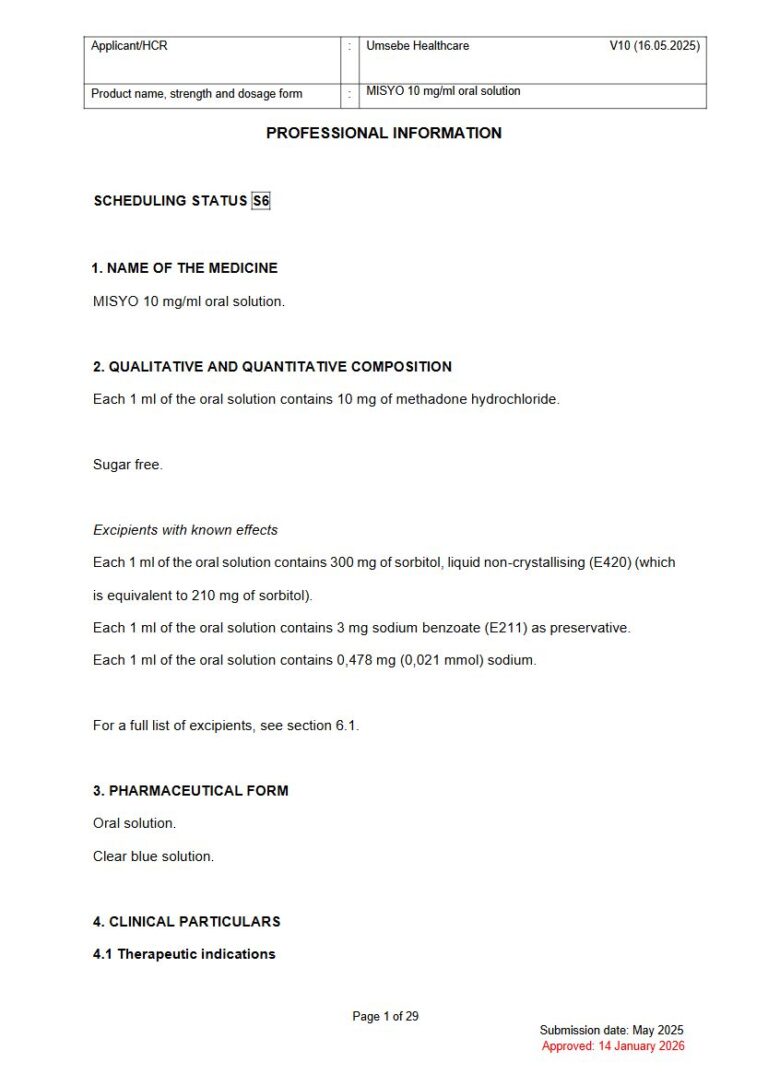
Misyo 10 mg/ml Concentrate for oral solution.
PDF Leaflet Revision Date: 14 January 2026
Clinical Summary
Quick overview from the medicine insert
Indication
Substitution treatment in opiate/opioid dependence in adults.
Dosage (summary)
Initial: 20 mg once daily; adjust based on withdrawal symptoms, usual maintenance: 60-120 mg/day.
Special Populations
- Elderly
- Renal impairment
- Hepatic impairment
- Hypothyroidism
- Prostatic hypertrophy
Pregnancy & Breastfeeding
Not recommended during pregnancy or breastfeeding due to risks of respiratory depression and withdrawal in neonates.
Key Drug Interactions
- CNS depressants
- MAO inhibitors
- CYP3A4 inhibitors/inducers
- Gabapentinoids
Contraindications
- Hypersensitivity to methadone
- Respiratory depression
- Acute asthma attack
- Severe hepatic impairment
- Children
Common side effects
- Nausea
- Vomiting
- Constipation
- Drowsiness
- Respiratory depression
Counselling Points
- Avoid alcohol and CNS depressants
- Monitor for signs of dependence
- Gradual dose reduction required upon discontinuation
Serious warnings
- Risk of dependence and overdose
- QT prolongation
- Respiratory depression in patients with compromised respiratory function
Important Disclaimer
The Misyo 10 mg/ml Concentrate for oral solution. professional information leaflet below is the property of Umsebe Healthcare and is provided on Medinsert exactly as issued, with no.. alterations or editorial changes. We make every effort to keep content current by updating documents as soon as new versions become available. Medinsert serves as a trusted access point for healthcare professionals, but does not replace official sources or clinical judgement. For more details, please read our full disclaimer. read more>>
 Healthcare Professionals Only
This content is for registered healthcare professionals
Sign in or create a free account to read the full package insert.
Free for HPCSA-registered professionals. Powered by Medinsert.
Clinical Particulars
Section 4 of the official insert — extracted exactly as issued, no alterations
4.1 Therapeutic indications
Substitution treatment in opiate/opioid dependence in adults in conjunction with appropriate medical, social and psychological therapy.
4.2 Posology and method of administration
Posology
For oral administration only. MISYO should always be taken orally with or without food. MISYO must not be injected. Dosage should be titrated to individual needs of patients. Substitution treatment with methadone should be prescribed by a doctor with experience of treating opiate/opioid-dependent patients, preferably at centres that are specialised in the treatment of opiate/opioid dependency. The dose is based on the occurrence of withdrawal symptoms and must be adjusted for each patient according to his or her individual situation and the way he or she feels. In general, after adjustment of the dose, the aim is to administer the lowest possible maintenance dose.
Adults
The standard initial dose is 20 mg methadone once daily. The dose may be increased at 10 mg increments over a period of three weeks, usually to 70 or 80 mg. After a recommended stabilisation period of four weeks, the dose is adjusted until the patient feels well, does not feel a need for intoxication and is without clinical signs of psychomotor function effects or abstinence symptoms. The normal dose is 60 to 120 mg of methadone per 24 hours, but some individuals may require higher doses. The dosage must be determined based upon the clinical evaluation, supported by serum level monitoring. The recommended serum level is 600 to 1200 nmol/I (200 to 400 ng/ml). Great importance is attached to the clinical assessment. MISYO is normally administered once daily. If administered more frequently, there will be a risk of accumulation and overdose. Certain patients develop auto-induction, which leads to the medication being metabolised more rapidly in the body. In such cases, the dose must be adjusted upwards once or more to maintain the optimum effect. The highest recommended dose, that rarely should be used, is 150 mg/day. The reason for this limitation is an increased frequency of QT-prolongation, Torsades de Pointes and cases of cardiac arrest within higher dose ranges (see section 4.4). If the patient has been treated with a combined agonist/antagonist (e.g. buprenorphine), the dose should be reduced gradually when the methadone treatment is initiated. If the methadone treatment is interrupted and a switch to sublingual buprenorphine treatment is planned (especially in combination with naloxone), the methadone dose should be reduced to 30 mg/day initially to avoid withdrawal symptoms caused by buprenorphine/naloxone.
Treatment discontinuation
Treatment must be stopped if it is insufficiently effective or if the patient cannot tolerate it. The effect must be evaluated in accordance with national guidelines. Treatment discontinuation must always be done gradually by dose reduction in weekly steps of 5 u2013 10 mg over several weeks to months. The dose may be reduced relatively rapidly to start with, but reduction must be slow in the final phase (from 20 mg daily and downwards). During this period of gradual dose reduction, it is necessary to pay attention to any recurrence of withdrawal symptoms which would require a return to the previous dosage, and to any resumption of addictive behaviours.
Elderly
Caution must be exercised when treating elderly patients, as they may require a reduced dose (see section 4.4).
Patients with renal or hepatic impairment
In patients with renal disorders or mild to moderate hepatic disorders it is advisable to reduce the dose (for more information see section 4.4 and also section 4.3).
Patients with hypothyroidism or prostatic hypertrophy
Patients with hypothyroidism or prostatic hypertrophy must receive a lower initial dose.
Paediatric population
MISYO must not be administered to children (see section 4.4).
Method of administration
The correct dosage should be extracted from the bottle by using a medicine measure, dispenser, measuring cylinder or syringe. MISYO can also be diluted before use if required. Please refer to section 6.6 for further instructions on dilution, if required. MISYO may only be used orally as directed by a healthcare professional.
4.3 Contraindications
- Hypersensitivity to methadone, benzoates, or to any of the excipients of MISYO listed in section 6.1.
- Respiratory depression.
- MISYO is contraindicated in children.
- Use during an acute asthma attack.
- Acute alcoholism.
- Concurrent administration with monoamine oxidase (MAO) inhibitors or within 2 weeks of discontinuation of treatment with them.
- Decreased level of consciousness or head injury.
- Individuals with QT prolongation, including congenital long QT syndrome.
- MISYO should not be administered to patients with severe hepatic impairment, as it may precipitate Porto-systemic Encephalopathy in patients with severe liver damage.
- Absence of dependence on opioid substances.
- Use during labour is not recommended, as the prolonged duration of action increases the risk of neonatal respiratory depression.
- Patients with ulcerative colitis, since MISYO may precipitate toxic dilation or spasm of the colon.
- Patients with biliary and renal tract spasm.
4.4 Special warnings and precautions for use
It is advisable to reduce the dose for older patients, patients with renal disorders or severe chronic hepatic disorders, and patients in poor general condition.
Opioid Use Disorder (abuse and dependence)
Methadone is an opioid analgesic and is highly addictive in its own right. It has a long half-life and can therefore accumulate. A single dose which will relieve symptoms may, if repeated on a daily basis, lead to accumulation and possible death. As with other opioids, tolerance, physical, and/or psychological dependence may develop upon repeated administration of methadone. The risks of dependence are increased in individuals of current or past history of substance misuse disorders e.g., alcohol use disorder, opioid use disorder, drug use disorder. MISYO can produce drowsiness and reduce consciousness although tolerance to these effects can occur after repeated use. Abuse or intentional misuse of MISYO may result in overdose and/or death. The risk of developing Opioid Use Disorder (OUD) is increased in patients with a personal or a family history (parents or siblings) of substance use disorders (including alcohol use disorder), in current tobacco users or in patients with a personal history of other mental health disorders (e.g., major depression, anxiety and personality disorders). Patients will require monitoring for signs of drug-seeking behaviour (e.g., too early requests for refills). This includes the review of concomitant opioids and psycho-active medicines (like benzodiazepines). For patients with signs and symptoms of OUD, consultation with an addiction specialist should be considered.
Withdrawal
Abrupt cessation of treatment can lead to withdrawal symptoms which, although similar to those with morphine, are less intense but more prolonged. Withdrawal of treatment should therefore be gradual.
Respiratory depression
MISYO should be used with caution in patients with asthma, chronic obstructive pulmonary disease or cor pulmonale and in patients with very limited respiratory reserve, a pre-existing impairment of respiratory function, hypoxia or hypercapnia. Even at the usual therapeutic doses for narcotics, these patients can experience a reduction in respiratory activity with a concomitant increase in airway resistance culminating in apnoea. In patients predisposed to such atopic phenomena, pre-existing asthma, skin eruptions and blood count changes (eosinophilia) can be exacerbated. Asthma may be exacerbated due to histamine release. Due to the slow accumulation of methadone in the tissues, respiratory depression may not be fully apparent for a week or two. The symptoms and signs of overdosage and toxicity of methadone are essentially those for morphine, though it is said that methadone has a greater respiratory depressive effect and a lesser sedative effect than an equi-analgesic dose of morphine. Toxic doses are highly variable, regular usage giving tolerance. Pulmonary oedema is a frequent corollary of overdosage whilst the dose-related histamine-releasing property of methadone may account for at least some of the urticaria and pruritus associated with methadone administration. Concomitant treatment with other medicines with CNS depressant activity is not advised due to the potential for CNS and respiratory depression (see also section 4.5).
Sleep-related breathing disorders
Opioids can cause sleep-related breathing disorders including central sleep apnoea (CSA) and sleep-related hypoxemia. Opioid use increases the risk of CSA in a dose-dependent fashion. In patients who present with CSA, consider decreasing the total MISYO dosage.
Head Injury and Increased Intracranial Pressure
The respiratory depressant effects of methadone and its capacity to elevate cerebrospinal-fluid pressure may be markedly exaggerated in the presence of head injury, other intracranial lesions or a pre-existing increased intracranial pressure. Furthermore, opiates/opioids produce side effects that may obscure the clinical course of patients with head injuries. In such patients, MISYO must be used with caution and only if it is deemed essential. MISYO has the potential to increase intracranial pressure especially where it is already raised.
Risk from concomitant use of sedative medicines such as benzodiazepines or related medicines
Concomitant use of MISYO and sedative medicines such as benzodiazepines or related medicines may result in sedation, respiratory depression, coma and death. Because of these risks, concomitant prescribing with these sedative medicines should be reserved for patients for whom alternative treatment options are not possible. If a decision is made to prescribe MISYO concomitantly with sedative medicines, the lowest effective dose should be used, and the duration of treatment should be as short as possible. The patients should be followed closely for signs and symptoms of respiratory depression and sedation. Patients and their caregivers must be informed and made aware of these symptoms (see section 4.5).
Hepatic impairment
Caution is required in case of mild or moderate hepatic impairment, since these patients may be at risk of increased systemic exposure to methadone after multiple dosing. The usual dose of MISYO can be continued in patients with stable chronic liver disease. When there may be impaired liver function following hepatitis B or C infection or prolonged alcohol use, the MISYO dose must be monitored carefully. Particular care must be taken whenever doses of over 50 mg are prescribed.
Renal impairment
Caution should be exercised in the use of MISYO in patients with renal impairment. The dose interval should be lengthened to a minimum of 32 hours if the glomerular filtration rate (GFR) is 10 u2013 50 ml/min and to a minimum of 36 hours if the GFR is lower than 10 ml/min.
Gastrointestinal motility
Methadone may cause troublesome constipation, which is particularly dangerous in patients with severe hepatic impairment, and measures to avoid constipation should be initiated early.
Hypoglycaemia
Hypoglycaemia has been observed in the context of methadone overdose or dose escalation. Regular monitoring of blood sugar is recommended during dose escalation (see section 4.8 and section 4.9).
Adrenal insufficiency
Opiate/opioid analgesics may cause reversible adrenal insufficiency requiring monitoring and glucocorticoid replacement therapy. Symptoms of adrenal insufficiency may include nausea, vomiting, loss of appetite, fatigue, weakness, dizziness, or low blood pressure.
Decreased sex hormones and increased prolactin
Long-term use of opiate/opioid analgesics may be associated with decreased sex hormone levels and increased prolactin. Symptoms include decreased libido, impotence or amenorrhea.
Neonates/children
As there is a risk of greater respiratory depression in neonates and because there are currently insufficient published data on the use in children, MISYO is contraindicated in children (see section 4.3). There are reports of neonates and children exposed to methadone during pregnancy developing visual disorders, including reduced visual acuity, strabismus and nystagmus. The causal relationship to methadone in isolation has not been established as factors such as other medicines taken during pregnancy e.g. benzodiazepines, intake of alcohol, and medicines used to treat neonatal abstinence syndrome e.g. phenobarbital, could play a role in the adverse reactions seen. However, there is sufficient evidence to suggest that an association is possible and therefore consideration of this risk should be taken during prescribing decisions.
Further warnings
Babies born to mothers receiving MISYO may suffer withdrawal symptoms. MISYO should be used with caution in patients with convulsive disorders, hypothyroidism, adrenocortical insufficiency, prostatic hyperplasia, hypotension, shock, inflammatory or obstructive bowel disorders or myasthenia gravis.
MISYO should be used with caution and in reduced dosage in patients who are concomitantly using other narcotic analgesics, general anaesthetics, phenothiazines, other tranquillisers, sedative hypnotics, tricyclic antidepressants, and other CNS depressants (including alcohol) (see 4.5 Interactions with other medicines and other forms of interaction).
Cases of QT interval prolongation and torsades de pointes have been reported during treatment with methadone, particularly at high doses (>100 mg/day). MISYO should be administered with caution to patients at risk for development of prolonged QT interval, e.g. in case of:
- history of cardiac conduction abnormalities.
- advanced or ischaemic heart disease.
- liver disease.
- family history of sudden death.
- electrolyte abnormalities, i.e. hypokalaemia, hypomagnesaemia.
- concomitant treatment with substances that have a potential for QT-prolongation.
- concomitant treatment with substances which may cause electrolyte abnormalities.
- concomitant treatment with cytochrome P450 CYP3A4 inhibitors (see section 4.5).
In patients treated with a combined agonist/antagonist (e.g. buprenorphine), the dose should be reduced gradually when the MISYO treatment is initiated. If the MISYO treatment is interrupted and a switch to sublingual buprenorphine treatment is planned (especially in combination with naloxone), the MISYO dose should be reduced to 30 mg/day initially to avoid withdrawal symptoms caused by buprenorphine/naloxone.
In patients with recognised risk factors for QT-prolongation, or in case of concomitant treatment with substances that have a potential for QT-prolongation, ECG monitoring is recommended prior to MISYO treatment, with a further ECG test at dose stabilisation. ECG monitoring is recommended, in patients without recognised risk factors for QT-prolongation, before dose titration above 100 mg/day and at seven days after titration.
Caution should be exercised in patients who are concurrently taking central nervous system (CNS) depressants.
Excipients
MISYO contains 300 mg of sorbitol, liquid non-crystallising (E420) (which is equivalent to 210 mg of sorbitol), which may have a laxative effect. The additive effect of concomitantly administered products containing sorbitol (or fructose) and dietary intake of sorbitol (or fructose) should be taken into account. The content of sorbitol in medicines for oral use may affect the bioavailability of other medicines for oral use administered concomitantly. Patients with the rare hereditary condition of sorbitol/maltitol/lactitol/fructose intolerance should not take MISYO. MISYO contains 3 mg sodium benzoate (E 211) per 1 ml. Although MISYO is not intended for use in newborns, it is important to know that an increase in bilirubinaemia following bilirubin displacement from albumin due to the presence of benzoate, may increase neonatal jaundice which may develop into kernicterus (nonconjugated bilirubin deposits in the brain tissue). MISYO contains less than 1 mmol sodium (23 mg) per ml, that is to say essentially u2018sodium-freeu2019.
4.5 Interaction with other medicines and other forms of interaction
Pharmacokinetic interactions
P-glycoprotein inhibitors
Methadone is a substrate of p-glycoprotein; all medicines that inhibit P-glycoprotein (e.g. quinidine, verapamil, ciclosporin), may therefore raise the serum concentration of methadone. The pharmacodynamic effect of methadone may also increase because of increased blood brain barrier passage.
CYP3A4-enzyme inducers
Methadone is a substrate of CYP3A4 (see section 5.2). By induction of CYP3A4, clearance of methadone will increase and the plasma levels decrease. Inducers of this enzyme (barbiturates, carbamazepine, phenytoin, nevirapine, rifampicin, efavirenz, amprenavir, spironolactone, dexamethasone, Hypericum perforatum (St John's Wort)), may induce hepatic metabolism. For instance, after three weeksu2019 treatment with 600 mg efavirenz daily, the mean maximal plasma concentration and AUC decreased by 48 % and 57 % respectively, in patients treated with methadone (35 u2013 100 mg daily). The consequences of enzyme induction are more marked if the inducer is administered after treatment with methadone has begun. Abstinence symptoms have been reported following such interactions and hence, it may be necessary to increase the MISYO dose. If treatment with a CYP3A4 inducer is interrupted, the MISYO dose should be reduced.
Co-administration of MISYO with metamizole, which is an inducer of metabolising enzymes including CYP2B6 and CYP3A4 may cause a reduction in plasma concentrations of methadone with potential decrease in clinical efficacy. Therefore, caution is advised when metamizole and MISYO are administered concurrently; clinical response and/or medicine levels should be monitored as appropriate.
CYP3A4-enzyme inhibitors
Methadone is a substrate of CYP3A4 (see section 5.2). By inhibition of CYP3A4 clearance of methadone is lowered. Concomitant administration of CYP3A4 inhibitors (e.g. cannabinoids, clarithromycin, delavirdine, erythromycin, ciprofloxacin, fluconazole, grapefruit juice, cimetidine, itraconazole, ketoconazole, fluoxetine, fluvoxamine, nefazodone and telithromycin) may result in increased plasma concentrations of methadone. A 40 u2013 100 % increase of the quote between the serum levels and the methadone dose has been shown with concomitant fluvoxamine treatment. If these medicines are prescribed to patients on MISYO maintenance treatment, one should be aware of the risk of overdose. Dose adjustment may be necessary.
Cannabidiol
Concomitant administration of cannabidiol may result in increased plasma concentrations of methadone.
Products that affect the acidity of the urine
Methadone is a weak base. Acidifiers of the urine (such as ammonium chloride and ascorbic acid) may increase the renal clearance of methadone. Patients that are treated with MISYO are recommended to avoid products containing ammonium chloride.
Concomitant HIV infection treatment
Some protease inhibitors (amprenavir, nelfinavir, abacavir, lopinavir/ritonavir and ritonavir/saquinavir) seem to decrease the serum levels of methadone. When ritonavir is administered alone, a two-fold AUC of methadone has been observed. The plasma levels of zidovudine (a nucleoside analogue) increase with methadone use after both oral and intravenous administration of zidovudine. This is more noticeable after oral than after intravenous use of zidovudine. These observations are likely caused by inhibition of zidovudine glucuronidation, and therefore decreased clearance of zidovudine. During treatment with MISYO, patients must be carefully monitored for signs of toxicity caused by zidovudine, which may require a reduction in the zidovudine dose. Because of mutual interactions between zidovudine and methadone (zidovudine is a CYP3A4 inducer), typical opiate/opioid abstinence symptoms may develop during concomitant use (headache, myalgia, fatigue and irritability).
Didanosine and stavudine
Methadone delays the absorption and increases the first pass metabolism of stavudine and didanosine, which results in a decreased bioavailability of stavudine and didanosine.
Desipramine
MISYO may double the serum levels of desipramine.
Pharmacodynamic interactions
Opiate/opioid antagonists
Naloxone and naltrexone counteract the effects of methadone and induces abstinence. Similarly, buprenorphine and pentazocine may precipitate withdrawal symptoms.
CNS depressants
Medicines with a sedative effect on the central nervous system may result in increased respiratory depression, hypotension, strong sedation or coma; therefore, it may be necessary to reduce the dose of one or both of the medicines. With MISYO treatment, the slowly eliminated substance methadone, gives rise to a slow tolerance development, and every dose increase may after 1 u2013 2 weeks give rise to symptoms of respiratory depression. The dose adjustments must therefore be made with caution and the dose increased gradually and with careful observation.
Anaesthetics, sedative-hypnotics (including barbiturates, chloral hydrate and chlormethiazole), anxiolytics phenothiazines, antipsychotics and tricyclic antidepressants may increase the general depressant effects of methadone when used concomitantly (see 4.4 Special warnings and precautions for use). Antipsychotics may enhance the sedative effects and hypotensive effects of MISYO.
Sedative medicines such as benzodiazepines or related medicines
The concomitant use of opiates/opioids with sedative medicines such as benzodiazepines or related medicines increases the risk of sedation, respiratory depression, coma and death because of additive CNS depressant effect. The dose and duration of concomitant use should be limited (see section 4.4).
Gabapentinoids
The concomitant use of opioids and gabapentinoids (gabapentin and pregabalin) increases the risk of opioid overdose, respiratory depression, and death.
Peristalsis inhibition
Concomitant use of MISYO and peristalsis inhibiting medicines (loperamide and diphenoxylate) may result in severe obstipation and increase the CNS depressant effects. Opiate/opioid analgesics, in combination with antimuscarinics, may result in severe obstipation or paralytic ileus, especially in long-term use.
QT-prolongation
MISYO should not be combined with medicines that may prolong the QT interval such as antidysrhythmics (sotalol, amiodarone, and flecainide), antipsychotics (thioridazine, haloperidol, sertindole, and phenotiazines), antidepressants (paroxetine, sertraline) or antibiotics (erythromycin, clarithromycin).
Serotonergic medicines
Serotonergic syndrome may occur with concomitant administration of MISYO with pethidine, monoamine oxidase (MAO) inhibitors and serotonin medicines such as Selective Serotonin Re-uptake Inhibitor (SSRI), Serotonin Norepinephrine Re-uptake Inhibitor (SNRI) and tricyclic antidepressants (TCAs). The symptoms of serotonin syndrome may include mental-status changes, autonomic instability, neuromuscular abnormalities, and/or gastrointestinal symptoms.
MAO-inhibitors
Concomitant administration of MAO-inhibitors may result in reinforced CNS-inhibition, serious hypotonia and or apnoea. MISYO should not be combined with MAO-inhibitors and two weeks after such treatment (see section 4.3).
Analgesics
Maintenance patients on a stable dose of MISYO who experience physical trauma, postoperative pain or other causes of acute pain cannot be expected to derive analgesia from their stable dose of methadone regimens. Such patients should be given analgesics, including opiates/opioids that would be indicated in other patients experiencing similar nociceptive stimulation. Due to the opiate/opioid tolerance induced by MISYO, when opiates/opioids are required for management of acute pain in methadone patients, somewhat higher and/or more frequent doses will often be required than would be the case for other, non-tolerant patients.
Diagnostic / Lab Interactions
Gastric emptying studies
MISYO may delay gastric emptying, thereby invalidating test results.
Hepatobiliary imaging using technetium Tc 99m disofenin
Delivery of technetium Tc 99m disofenin to the small bowel may be prevented because MISYO may cause constriction of the sphincter of Oddi and increased biliary tract pressure; these actions result in delayed visualization and thus resemble obstruction of the common bile duct.
Cerebrospinal fluid pressure
Cerebrospinal fluid pressure may be increased; effect is secondary to respiratory depression-induced carbon dioxide retention.
Plasma amylase or lipase levels
Plasma amylase or lipase levels may be increased because MISYO can cause contractions of the sphincter of Oddi and increased biliary tract pressure; the diagnostic utility of determination of these enzymes may be compromised for up to 24 hours after the medication has been given.
Urine tests
MISYO may modify urine tests and give a positive result in doping control.
Pregnancy tests
MISYO may interfere with urine testing for pregnancy.
4.6 Fertility, pregnancy and lactation
Pregnancy
Methadone administered to pregnant women for the management of opiate/opioid addiction has the potential for several adverse effects on the foetus and the neonate. Withdrawal symptoms/respiratory depression may occur in neonates of mothers who were treated with methadone chronically during pregnancy. Studies in animals provided evidence of reproductive toxicity (see section 5.3). However, limited data on the use of methadone in pregnancy in humans show no elevated risk of congenital abnormalities. MISYO should not be administered to pregnant women, because of possible adverse effects on the foetus and neonate including respiratory depression, low birth weight, neonatal withdrawal syndrome and increased rate of stillbirths. However, if maternal MISYO substitution therapy is strongly indicated, careful monitoring is required. It may be necessary to increase the dose of MISYO if withdrawal symptoms develop. Increased clearance and reduced plasma levels have been reported during pregnancy. Considering the well-being of the foetus, it may be advisable to split up the daily dose in order to prevent high peak plasma concentrations and to compensate the accelerated degradation of methadone, thus preventing withdrawal symptoms. Dose reduction or withdrawal during pregnancy must always be carried out under careful monitoring of the mother and only after a stringent risk/benefit assessment. Medicine withdrawal of the neonate must be carried out at an adequate intensive care unit for children, as treatment with MISYO may lead to habituation and addiction of the foetus as well as to withdrawal symptoms in the neonate, which require treatment. Approximately 60 u2013 80 % of the neonates require hospitalised treatment due to the neonatal abstinence syndrome. Dose adjustment (especially dose reduction) may be necessary within 1 u2013 2 weeks postnatal. The use of MISYO just before and during birth is advised against because of the risk of neonatal respiratory depression.
Breastfeeding
Methadone is excreted in breastmilk and MISYO should not be used during lactation.
Fertility
Methadone does not appear to impair human female fertility. Studies in men on methadone maintenance programmes have shown that methadone reduces serum testosterone and markedly depresses the ejaculate volume and sperm motility. The sperm counts of methadone subjects were twice that of controls but this reflected the lack of dilution from seminal secretions.
4.7 Effects on ability to drive and use machines
MISYO has a major influence on the ability to drive and use machines, during and after treatment, as it may cause drowsiness and reduce alertness. The time after which such activities may be safely resumed is extremely patient-dependent and must be decided by the medical practitioner.
4.8 Undesirable effects
The adverse effects of methadone are most commonly nausea and vomiting, that is observed in approximately 20 % of the patients that go through methadone outpatient treatment, where the medicinal control is often unsatisfactory. Long term use of MISYO may lead to morphine-like dependence. The most serious adverse effect of methadone is respiratory depression, which may emerge during the stabilisation phase. Apnoea, shock and cardiac arrest have occurred. Adverse reactions listed below are classified according to frequency and system organ class. These reactions are more frequently observed in non-opiate/opioid-tolerant individuals.
System organ class (MedDRA) Frequency Adverse event
Blood and lymphatic system disorders Not known Reversible thrombocytopenia has been reported in opiate/opioid-dependent patients with chronic hepatitis
Endocrine disorders Less frequent Hypothyroidism
Not known Raised prolactin levels with long-term administration
Metabolism and nutrition disorders Frequent Fluid retention
Not known Anorexia, hypokalaemia, hypomagnesaemia, hypoglycaemia
Psychiatric disorders Frequent Euphoria, hallucinations, sleep disturbances
Less frequent Dysphoria, agitation, insomnia, disorientation
Not known Dependence
Nervous system disorders Frequent Sedation, dizziness, confusion, headache
Less frequent Syncope
Not known Potential to increase intracranial pressure, particularly in circumstances where it is already raised.
Eye disorders Frequent Blurred vision, miosis, dry eyes
Less frequent Visual disturbances
Not known Nystagmus, strabismus, visual acuity reduced
Ear and labyrinth disorders Frequent Vertigo
Not known Hearing loss
Cardiac disorders Less frequent Bradycardia, palpitations, cases of prolonged QT interval and torsade de pointes have been reported, especially with high doses of methadone
Vascular disorders Less frequent Facial flush, hypotension (particularly at high doses), shock
Respiratory, thoracic and mediastinal disorders Less frequent Pulmonary oedema, exacerbation of asthma, dry nose, respiratory depression (particularly at high doses), respiratory arrest
Not known Central sleep apnoea syndrome
Gastrointestinal disorders Frequent Nausea, vomiting, constipation
Less frequent Xerostomia, glossitis, intestinal hypomotility (ileus)
Hepatobiliary disorders Less frequent Bile duct dyskinesia
Skin and subcutaneous tissue disorders Frequent Transient rash, sweating
Less frequent Pruritus, urticaria, other rash and in very uncommon cases bleeding urticaria
Renal and urinary disorders Less frequent Urinary retention, anti-diuretic effect
Reproductive system and breast disorders Frequent Decreased libido
Less frequent Reduced potency, galactorrhoea, dysmenorrhoea and amenorrhoea
General disorders and administration site condition Frequent Fatigue, drowsiness
Less frequent Oedema of the lower extremities (limbs), asthenia, oedema, hypothermia
Investigations Frequent Weight increase
Visual effects have been reported in infants and children exposed to methadone during pregnancy. In long term use of methadone, as for maintenance treatment, the undesirable effects diminish successively and progressively during a period of several weeks however, constipation and perspiration often remain.
Reporting of suspected adverse reactions
Reporting suspected adverse reactions after authorisation of the medicine is important. It allows continued monitoring of the benefit/risk balance of the medicine. Health care providers are requested to report any suspected adverse drug reactions to SAHPRA via the Med Safety APP (Medsafety X SAHPRA) and eReporting platform (who-umc.org) found on the SAHPRA website.
4.9 Overdose
Symptoms
Serious overdose is characterised by respiratory depression, extreme somnolence progressing to stupor or coma, maximally constricted pupils, skeletal muscle flaccidity, cold and clammy skin and sometimes bradycardia and hypotension. Hypoglycaemia has been reported. In severe overdose, particularly by the intravenous route, apnoea, circulatory collapse, cardiac arrest and death may occur. Toxic leukoencephalopathy has been observed with methadone overdose.
Treatment
A patent airway and assisted or controlled ventilation must be assured. Narcotic antagonists may be required, but it should be remembered that methadone is a long-acting depressant (36 to 48 hours), whereas antagonists act for 1 to 3 hours, so that treatment with the latter must be repeated as needed. An antagonist should not be administered, however, in the absence of clinically significant respiratory or cardiovascular depression. The administration of naloxone is advised. Oxygen, intravenous fluids, vasopressors and other supportive measures should be employed as indicated. In a person physically dependent on narcotics, administration of the usual dose of a narcotic antagonist will precipitate an acute withdrawal syndrome; use of the antagonist in such a person should be avoided if possible, but if it must be used to treat serious respiratory depression it should be administered with great care.
