
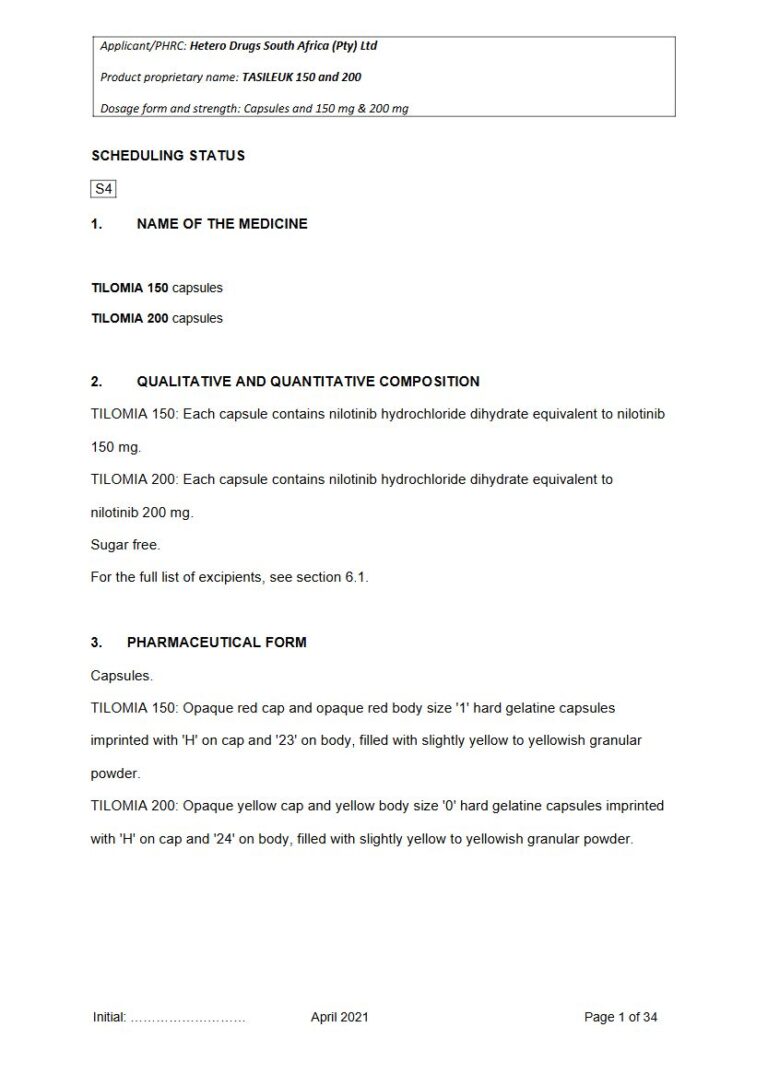
Tilomia 150 mg & 200 mg Capsules
PDF Leaflet Revision Date: 28 April 2021
Clinical Summary
Quick overview from the medicine insert
Indication
Treatment of adult patients with Ph+ CML in chronic or accelerated phase.
Dosage (summary)
300 mg twice daily for newly diagnosed; 400 mg twice daily for resistant/intolerant patients.
Special Populations
- Elderly patients
- Renal impairment
- Hepatic impairment
Pregnancy & Breastfeeding
Not recommended during pregnancy; avoid breastfeeding during treatment.
Key Drug Interactions
- Strong CYP3A4 inhibitors
- CYP3A4 inducers
Contraindications
- Hypersensitivity to nilotinib
Common side effects
- Rash
- Nausea
- Fatigue
- Headache
- Myelosuppression
Counselling Points
- Take on an empty stomach
- Monitor for signs of cardiac issues
- Report any severe side effects immediately
Serious warnings
- QT prolongation
- Myelosuppression
- Hepatitis B reactivation
Important Disclaimer
The Tilomia 150 mg & 200 mg Capsules professional information leaflet below is the property of Hetero Drugs South Africa and is provided on Medinsert exactly as issued, with no.. alterations or editorial changes. We make every effort to keep content current by updating documents as soon as new versions become available. Medinsert serves as a trusted access point for healthcare professionals, but does not replace official sources or clinical judgement. For more details, please read our full disclaimer. read more>>
 Healthcare Professionals Only
This content is for registered healthcare professionals
Sign in or create a free account to read the full package insert.
Free for HPCSA-registered professionals. Powered by Medinsert.
Clinical Particulars
Section 4 of the official insert — extracted exactly as issued, no alterations
4.1 Therapeutic indications
- Treatment of adult patients with newly diagnosed Philadelphia chromosome positive chronic myelogenous leukaemia (Ph+ CML) in chronic phase.
- Treatment of chronic phase and accelerated phase Philadelphia chromosome positive chronic myelogenous leukaemia (Ph+ CML) in adult patients resistant to or intolerant to at least one prior therapy including imatinib.
4.2 Posology and method of administration
Therapy should be initiated by a medical practitioner experienced in the treatment of patients with CML. TILOMIA may be given in combination with haematopoietic growth factors such as erythropoietin or granulocyte- colony stimulating factor (G-CSF) if clinically indicated. TILOMIA may be given with hydroxyurea or anagrelide if clinically indicated.
Posology
Dosing in patients with newly diagnosed Ph+ CML-chronic phase: The recommended dose of TILOMIA is 300 mg twice daily. Treatment should be continued as long as the patient continues to benefit.
Dosing in patients with Ph+ CML-chronic phase and CML-accelerated phase resistant to or intolerant to at least one prior therapy including imatinib: The recommended dose of TILOMIA is 400 mg twice daily. Treatment should be continued as long as the patient continues to benefit.
Dose adjustments or modifications: TILOMIA may need to be temporarily withheld and/or dose reduced for haematological toxicities (neutropenia, thrombocytopenia) that are not related to underlying leukaemia (see Table 1 below).
Table 1: Dose adjustments for neutropenia and thrombocytopenia
- Newly diagnosed CML in chronic phase at 300 mg twice daily.
- Chronic phase or accelerated phase CML at 400 mg twice daily.
(ANC) < 0,5 x 10⁹/L or platelet counts < 50 x 109/L
- Stop [PRODUCT NAME], and monitor blood counts.
- Resume within 2 weeks at prior dose if ANC > 0,5 x 10⁹/L and/or platelets > 50 x 109/L.
- If blood counts remain low a medicine reduction may be required to 400 mg once daily.
If clinically significant moderate or severe non-haematologic toxicity develops, dosing should be interrupted, and may be resumed at 400 mg once daily once the toxicity has resolved. If clinically appropriate, re-escalation of the dose to 300 mg (newly-diagnosed Ph+ CML-CP) or 400 mg (resistant or intolerant Ph+ CML-chronic phase and CML-accelerated phase) twice daily should be attempted.
Asymptomatic serum lipase elevations were observed. Few of these elevations were associated with clinical symptoms such as abdominal pain or a diagnosis of pancreatitis. Elevations in serum lipase did not lead to treatment discontinuation in any patient. Overall, this finding was clinically manageable in the majority of patients without requirement for dose reduction or interruption. For Grade 3 to 4 lipase elevations, doses were reduced to 400 mg once daily (see section 4.8).
In clinical studies, the majority of bilirubin and hepatic transaminase laboratory abnormalities in patients were of low grade toxicity which did not require dose interruption or reduction. Treatment discontinuation due to elevated serum bilirubin occurred in only 1 patient (0,3 %). For Grade 3 to 4 bilirubin or hepatic transaminase elevations, doses were reduced to 400 mg once daily (see section 4.8).
If a dose is missed, the patient should not take an additional dose, but take the usual prescribed next dose.
Special populations
Children and adolescents: Clinical studies have not been conducted in children and adolescents. TILOMIA should not be used in these categories of patients.
Elderly patients: Approximately 12 % and 30 % of subjects in clinical studies (newly diagnosed Ph+ CML-CP and resistant or intolerant Ph+ CML-chronic phase and CML-accelerated phase) were 65 years or over. No major differences were observed for safety and efficacy in patients u2265 65 years of age as compared to adults 18 to 65 years of age.
Patients with renal impairment: Clinical studies have not been performed in patients with impaired renal function. Clinical studies have excluded patients with serum creatinine concentration > 1,5 times the upper limit of the normal range. Since nilotinib and its metabolites are not renally excreted, a decrease in total body clearance is not anticipated in patients with renal impairment.
Patients with hepatic impairment: TILOMIA has not been investigated in patients with hepatic impairment. Clinical studies have excluded patients with ALT and/or AST > 2,5 (or > 5, if related to disease) times the upper limit of the normal range and/or total bilirubin > 1,5 times the upper limit of the normal range. Metabolism of nilotinib is mainly hepatic.
Cardiac disorders: In clinical studies, patients were excluded with clinically significant cardiac syndromes (e.g. complete left bundle branch block, unstable angina, uncontrolled congestive heart failure or recent myocardial infarction).
Method of administration: TILOMIA should be taken twice daily approximately 12 hours apart and should not be taken with food. The capsules should be swallowed whole with water. No food should be consumed for at least 2 hours before the dose is taken and no additional food should be consumed for at least one hour after the dose is taken (see sections 4.4, 4.5 and 5.2). For patients who are unable to swallow capsules, the content of each capsule may be dispersed in one teaspoon of applesauce (pureed apple) and should be taken immediately. Not more than one teaspoon of applesauce and no food other than applesauce must be used (see sections 4.4 and 5.2).
4.3 Contraindications
Known hypersensitivity to nilotinib or to any of the excipients (see section 6.1).
4.4 Special warnings and precautions for use
QT Prolongation: TILOMIA prolongs the QT interval. Correct hypokalaemia or hypomagnesaemia prior to administration and monitor periodically. Avoid medicines known to prolong the QT interval and strong CYP3A4 inhibitors. Use caution in patients with hepatic impairment. Obtain ECGs at baseline, seven days after initiation, and periodically thereafter, as well as following any dose adjustments. Ventricular repolarization abnormalities may have contributed to their occurrence.
Myelosuppression: Treatment with nilotinib is associated with thrombocytopenia, neutropenia and anaemia, (National Cancer Institute Common Toxicity Criteria grade 3 u2013 4). Occurrence is more frequent in patients with imatinib-resistant or intolerant CML, particularly in patients with accelerated-phase CML. Complete blood counts should be performed every two weeks for the first 2 months and then monthly thereafter, or as clinically indicated. Myelosuppression was generally reversible and usually managed by withholding TILOMIA temporarily or dose reduction (see section 4.2).
QT prolongation: Nilotinib, as in TILOMIA, has been shown to prolong cardiac ventricular repolarisation, as measured by the QT interval on the surface ECG in a concentration-dependent manner, in adult and paediatric patients. Significant prolongation of the QT interval may occur when TILOMIA is inappropriately taken with strong CYP3A4 inhibitors and/or medicines with a known potential to prolong the QT interval, and/or food (see section 4.5). The presence of hypokalaemia and hypomagnesaemia may further enhance this effect. Prolongation of the QT interval may expose patients to the risk of fatal outcome. TILOMIA should be used with caution in patients who have or who are at significant risk of developing prolongation of QTc, such as those:
- with congenital long QT prolongation
- with uncontrolled or significant cardiac disease, including: recent myocardial infarction, congestive heart failure, unstable angina or clinically significant bradycardia
- taking anti-dysrhythmic medicines or other substances that lead to QT prolongation.
Close monitoring for an effect on the QTc interval is advisable and a baseline ECG is recommended prior to initiating nilotinib therapy and as clinically indicated. Hypokalaemia or hypomagnesaemia must be corrected prior to TILOMIA administration and should be monitored periodically during therapy.
Sudden death: Uncommon cases (0,1 to 1 %) of sudden deaths have been reported in patients with imatinib-resistant or intolerant CML in chronic phase or accelerated phase with a past medical history of cardiac disease or significant cardiac risk factors. Co-morbidities in addition to the underlying malignancy were also frequently present as were concomitant medicines. Ventricular repolarisation abnormalities may have been contributory factors. No cases of sudden death were reported in the Phase III study in newly diagnosed patients with CML in chronic phase.
Fluid retention and oedema: Severe forms of drug-related fluid retention such as pleural effusion, pulmonary oedema and pericardial effusion were uncommonly (0,1 to 1 %) observed in a Phase III study of newly diagnosed CML patients. Similar events were observed in post-marketing reports. Unexpected, rapid increase in body mass should be carefully investigated. If signs of severe fluid retention appear during treatment with TILOMIA, the aetiology should be evaluated, and patients treated accordingly (see section 4.2 for instructions on managing non-haematological toxicities).
Cardiovascular events: Cardiovascular events were reported in a randomised Phase III study in newly diagnosed CML patients and observed in post-marketing reports. In this clinical study with a median on-therapy time of 60,5 months, Grade 3 u2013 4 cardiovascular events included peripheral arterial occlusive disease (1,4 % and 1,1 % at 300 mg and 400 mg nilotinib twice daily, respectively), ischaemic heart disease (2,2 % and 6,1 % at 300 mg and 400 mg nilotinib twice daily, respectively) and ischaemic cerebrovascular events (1,1 % and 2,2 % at 300 mg and 400 mg nilotinib twice daily, respectively). Patients should be advised to seek immediate medical attention if they experience acute signs or symptoms of cardiovascular events. The cardiovascular status of patients should be evaluated, and cardiovascular risk factors monitored and actively managed during nilotinib therapy according to standard guidelines. Appropriate therapy should be prescribed to manage cardiovascular risk factors (see section 4.2 for instructions on managing non-haematological toxicities).
Hepatitis B reactivation: Reactivation of hepatitis B in patients who are chronic carriers of this virus has occurred after these patients received BCR-ABL tyrosine kinase inhibitors. Some cases resulted in acute hepatic failure or fulminant hepatitis leading to liver transplantation or a fatal outcome. Patients should be tested for HBV infection before initiating treatment with nilotinib. Experts in liver disease and in the treatment of hepatitis B should be consulted before treatment is initiated in patients with positive hepatitis B serology (including those with active disease) and for patients who test positive for HBV infection during treatment. Carriers of HBV who require treatment with nilotinib should be closely monitored for signs and symptoms of active HBV infection throughout therapy and for several months following termination of therapy (see section 4.8).
4.5 Interactions with other medicines
The administration of TILOMIA with medicines that are strong CYP3A4 inhibitors (including, but not limited to, ketoconazole, itraconazole, voriconazole, clarithromycin, telithromycin, ritonavir) should be avoided. Should treatment with any of these medicines be required, it is recommended that TILOMIA therapy be interrupted if possible. If transient interruption of treatment is not possible, close monitoring of the individual for prolongation of the QT interval is indicated (see sections 4.2, 4.5 and 5.2).
Concomitant use of TILOMIA with medicines that are potent inducers of CYP3A4 (e.g. phenytoin, rifampicin, carbamazepine, phenobarbital and St John's wort) is likely to reduce exposure to nilotinib to a clinically relevant extent. Therefore, in patients receiving TILOMIA, co-administration of alternative therapeutic medicines with less potential for CYP3A4 induction should be selected (see section 4.5).
Food effect: The bioavailability of nilotinib, as in TILOMIA, is increased by food. TILOMIA must not be taken in conjunction with food (see sections 4.2 and 4.5) and should be taken 2 hours after a meal. No food should be consumed for at least one hour after the dose is taken. Grapefruit juice and other foods that are known to inhibit CYP3A4 should be avoided. For patients who are unable to swallow hard capsules, the content of each hard capsule may be dispersed in one teaspoon of apple sauce and should be taken immediately. Not more than one teaspoon of apple sauce and no food other than apple sauce must be used (see section 5.2).
4.6 Fertility, pregnancy and lactation
Women of childbearing potential / Contraception: Women of childbearing potential have to use highly effective contraception during treatment with nilotinib and for up to two weeks after ending treatment.
Pregnancy: There are no or limited amount of data from the use of nilotinib in pregnant women. Animal studies have shown reproductive toxicity. TILOMIA should not be used during pregnancy, unless the clinical condition of the woman requires treatment with nilotinib. If it is used during pregnancy, the patient must be informed of the potential risk to the fetus. If a woman who is being treated with TILOMIA is considering pregnancy, treatment discontinuation may be considered based on the eligibility criteria for discontinuing treatment as described in sections 4.2 and 4.4. There is a limited amount of data on pregnancies in patients while attempting treatment-free remission (TFR). If pregnancy is planned during the TFR phase, the patient must be informed of a potential need to re-initiate nilotinib treatment during pregnancy (see sections 4.2 and 4.4).
Breastfeeding: It is unknown whether nilotinib is excreted in human milk. Available toxicological data in animals have shown excretion of nilotinib in milk (see section 5.3). Since a risk to the newborns/infants cannot be excluded, women should not breastfeed during TILOMIA treatment and for 2 weeks after the last dose.
Fertility: Animal studies did not show an effect on fertility in male and female rats (see section 5.3). Sexually active male or female patients taking TILOMIA should use adequate contraception.
4.7 Effects on ability to drive and use machines
TILOMIA has no or negligible influence on the ability to drive a vehicle and use machines. However, it is recommended that patients experiencing dizziness, fatigue, visual impairment or other undesirable effects with a potential impact on the ability to drive a vehicle or use machines safely should refrain from these activities as long as the undesirable effects persist (see section 4.8).
4.8 Undesirable effects
In adult patients with newly diagnosed CML in chronic phase The median duration of exposure was 60,5 months (range 0,1 u2013 70,8 months). The most frequent (u2265 10 %) non-haematological adverse reactions were rash, pruritus, headache, nausea, fatigue, alopecia, myalgia and upper abdominal pain. Most of these adverse reactions were mild to moderate in severity. Constipation, dry skin, asthenia, muscle spasms, diarrhoea, arthralgia, abdominal pain, vomiting and peripheral oedema were observed less frequently (< 10 % and u2265 5 %) were of mild to moderate severity, manageable and generally did not require dose reduction. Treatment-emergent haematological toxicities include myelosuppression: thrombocytopenia (18 %), neutropenia (15 %) and anaemia (8 %). Biochemical adverse drug reactions include increased alanine aminotransferase (24 %), hyperbilirubinaemia (16 %), increased aspartate aminotransferase (12 %), increased lipase (11 %), increased blood bilirubin (10 %), hyperglycaemia (4 %), hypercholesterolaemia (3 %) and hypertriglyceridaemia (< 1 %). Pleural and pericardial effusions, regardless of causality, occurred in 2 % and 500 msec while on the study medicine. QTcF increase from baseline exceeding 60 msec was observed in < 1 % of patients while on the study medicine. No sudden deaths or episodes of torsades de pointes (transient or sustained) were observed. No decrease from baseline in mean left ventricular ejection fraction (LVEF) was observed at any time during treatment. No patient had a LVEF of < 45 % during treatment nor an absolute reduction in LVEF of more than 15 %. Discontinuation due to adverse drug reactions was observed in 10 % of patients.
In adult patients with imatinib-resistant or intolerant CML in chronic phase and accelerated phase The most frequent (u2265 10 %) non-haematological drug-related adverse events were rash, pruritus, nausea, fatigue, headache, vomiting, myalgia, constipation and diarrhoea. Most of these adverse events were mild to moderate in severity. Alopecia, muscle spasms, decreased appetite, arthralgia, abdominal pain, bone pain, peripheral oedema, asthenia, upper abdominal pain, dry skin, erythema and pain in extremity were observed less frequently (< 10 % and u2265 5 %) and have been of mild to moderate severity (Grade 1 or 2). Discontinuation due to adverse drug reactions was observed in 16 % of chronic phase and 10 % of accelerated phase patients. Treatment-emergent haematological toxicities include myelosuppression: thrombocytopenia (31 %), neutropenia (17 %) and anaemia (14 %). Pleural and pericardial effusions as well as complications of fluid retention occurred in < 1 % of patients receiving TILOMIA. Cardiac failure was observed in < 1 % of patients. Gastrointestinal and CNS haemorrhage were reported in 1 % and < 1 % of patients, respectively. QTcF exceeding 500 msec was observed in < 1 % of patients. No episodes of torsades de pointes (transient or sustained) were observed.
4.9 Overdose
Isolated reports on intentional overdose with nilotinib were reported, where an unspecified number of TILOMIA capsules were ingested in combination with alcohol and other medicines. Events included neutropenia, vomiting and drowsiness. No ECG changes or hepatotoxicity were reported. Outcomes were reported as recovered. In the event of overdose, the patient should be observed and appropriate supportive treatment given.
