
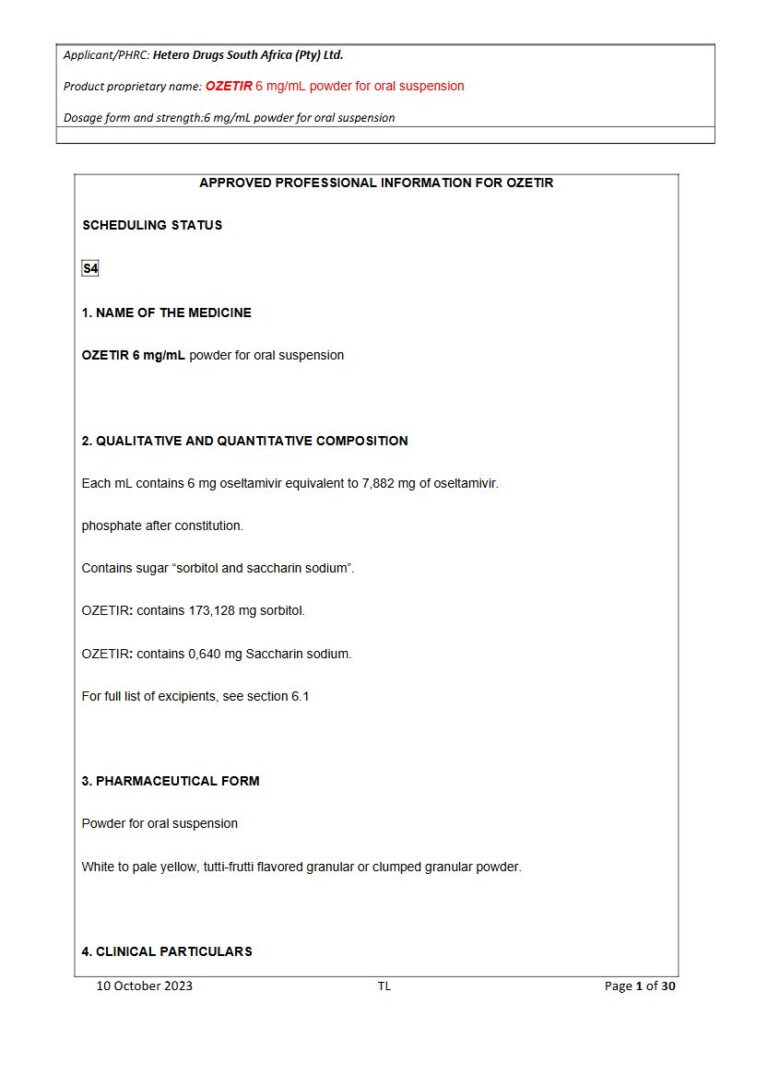
Ozetir 6 mg Powder for oral suspension
PDF Leaflet Revision Date: 10 October 2023
Clinical Summary
Quick overview from the medicine insert
Indication
Treatment and prophylaxis of influenza in adults and children u2265 1 year.
Dosage (summary)
Adults: 75 mg twice daily for 5 days. Children: 5-12.5 mL twice daily based on weight.
Onset of Action / Duration
Onset: 30 mins, Duration: 6-8 hours
Special Populations
- Renal impairment
- Hepatic impairment
- Elderly
- Immunocompromised patients
Pregnancy & Breastfeeding
Safety not established; avoid breastfeeding during treatment.
Key Drug Interactions
- Probenecid
- Amoxicillin
Contraindications
- Hypersensitivity to ingredients
Common side effects
- Nausea
- Vomiting
- Headache
Counselling Points
- Monitor for abnormal behavior
- Take with food to enhance tolerability
- Reconstitute before use
Serious warnings
- Neuropsychiatric events
- Resistance in influenza viruses
Important Disclaimer
The Ozetir 6 mg Powder for oral suspension professional information leaflet below is the property of Hetero Drugs South Africa and is provided on Medinsert exactly as issued, with no.. alterations or editorial changes. We make every effort to keep content current by updating documents as soon as new versions become available. Medinsert serves as a trusted access point for healthcare professionals, but does not replace official sources or clinical judgement. For more details, please read our full disclaimer. read more>>
 Healthcare Professionals Only
This content is for registered healthcare professionals
Sign in or create a free account to read the full package insert.
Free for HPCSA-registered professionals. Powered by Medinsert.
Clinical Particulars
Section 4 of the official insert — extracted exactly as issued, no alterations
4.1 Therapeutic indications
Treatment: OZETIR is indicated for the treatment of influenza in adults and children u2265 1 year of age (see section 4.4 and section 4.2). PANDEMIC USE: OZETIR is indicated for the treatment of infants 6-12 months of age during a pandemic influenza outbreak only, and not for endemic (seasonal) influenza use, (see section 4.4 and section 5.2) PROPHYLAXIS: OZETIR is indicated for the prophylaxis of influenza in adults and children u2265 1 year of age.
4.2 Posology and method of administration
Posology Standard Dosage Treatment of influenza Treatment should begin within the first or second day of onset of symptoms of influenza. Adults and adolescents u2265 13 years of age who are unable to swallow capsules may receive a dose of 75 mg OZETIR powder for oral suspension twice daily, for 5 days. Children: The recommended oral dose of OZETIR powder for oral suspension for children u2265 1 year of age is:
- Body weight Recommended treatment dose for 5 days 6 mg/mL oral suspension
- u2264 15 kg 5.0 mL twice daily
- > 15 kg to 23 kg 7.5 mL twice daily
- > 23 kg to 40 kg 10.0 mL twice daily
- > 40 kg 12.5 mL twice daily
A 10 mL oral dosing syringe is provided for the 6 mg/mL oral suspension for children u2265 1 year of age. It is recommended that OZETIR powder for oral suspension be constituted by a pharmacist prior to dispensing to the patient. The recommended oral dose of OZETIR for children 6 u2013 12 months of age: Based on limited pharmacokinetic data currently available, a dosage of 3 mg/kg twice daily in children 6 - 12 months of age provides plasma exposure to the active metabolite in the majority of patients similar to that shown to be clinically efficacious in older children and adults. Recommended volumes of reconstituted oral suspension to be drawn up into an oral syringe (3 mg/kg body weight) are shown in the table below:
- Body weight (kg) OZETIR (mg) Rounded volume of 6 mg/mL suspension
- 6 18 3 mL
- 7 21 3.5 mL
- 8 24 4 mL
- 9 27 4.5 mL
- u2265 10 30 5 mL
Use the smallest graduated oral syringe that will accurately deliver the appropriate volume. The recommended treatment dose for infants 6 - 12 months is 3 mg/kg twice daily for 5 days, during a pandemic influenza outbreak only, and not for endemic (seasonal) influenza use (see section 5.2) Children u2265 1 year of age The recommended prophylactic oral dose of OZETIR for children u2265 1 year of age is:
- Body weight Recommended treatment dose for 10 days 6 mg/mL oral suspension
- u2265 15 kg 5.0 mL once daily
- > 15 kg to 23 kg 7.5 mL once daily
- > 23 kg to 40 kg 10.0 mL once daily
- > 40 kg 12.5 mL once daily
A 10 mL oral dosing syringe is provided for the 6 mg/mL oral suspension. It is recommended that OZETIR powder for oral suspension be constituted by a pharmacist prior to dispensing to the patient (see section 6.6) Special Dosage Instructions Patients with renal impairment Treatment of influenza: No dose adjustment is necessary for patients with creatinine clearance above 60 mL/min. In patients with creatinine of > 30 u2013 60 mL/min, it is recommended that the treatment dose be reduced to 30 mg of OZETIR twice daily for 5 days. In patients with a creatinine clearance of 10 - 30 mL/min, it is recommended that the dose be reduced to 30 mg of OZETIR once daily for 5 days. In patients undergoing routine haemodialysis an initial dose of 30 mg OZETIR can be administered prior to the start of dialysis if influenza symptoms develop during the 48 hours between dialysis sessions. To maintain plasma concentrations at a therapeutic level, a dose of 30 mg should be administered after every haemodialysis session. For peritoneal dialysis an initial dose of 30 mg of OZETIR administered prior to the start of dialysis followed by further 30 mg doses administered every 5 days is recommended for treatment (see section 5.2 and 4.4). The pharmacokinetics of OZETIR have not been studied in patients with u201cend-stage renal diseaseu201d (i.e. creatinine clearance 30 - 60 mL/min, it is recommended that the dose be reduced to 30 mg of OZETIR once daily. In patients with a creatinine clearance between 10 and 30 mL/min receiving OZETIR, it is recommended that the dose be reduced to 30 mg of OZETIR every other day. In patients undergoing routine haemodialysis an initial dose of 30 mg of OZETIR can be administered prior to the start of dialysis. To maintain plasma concentrations at a therapeutic level, a dose of 30 mg should be administered after every alternate haemodialysis session. For peritoneal dialysis an initial dose of 30 mg of OZETIR administered prior to the start of dialysis followed by further 30 mg doses administered every 7 days is recommended for prophylaxis (see section 5.2 and 4.24). The pharmacokinetics of OZETIR have not been studied in patients with u201cend-stage renal diseaseu201d (i.e., creatinine clearance < 10 mL/min) not undergoing dialysis Hence, dosing recommendation cannot be provided for this group. Patients with hepatic impairment No dose adjustment is required for patients with mild or moderate hepatic dysfunction in the treatment or prophylaxis of influenza (see 5.2). The safety and pharmacokinetics in patients with severe hepatic impairment have not been studied. Immuno-compromised patients Seasonal prophylaxis in immuno-compromised patients 1 year of age and older is recommended for 12 weeks. No dose adjustment is necessary. Elderly No dose adjustment is required for elderly patients in the treatment or prophylaxis of influenza (see section 5.2). Children The safety and efficacy of OZETIR in children under 1 year has not been established (see section 5.2). OZETIR should not be used in children under 1 year of age, other than during a pandemic influenza outbreak. Method of administration For oral use OZETIR may be taken with or without food. (see section 5.2). However, OZETIR taken with food may enhance tolerability in some patients.
4.3 Contraindications
Hypersensitivity to any of the ingredients of OZETIR, including the excipients listed in section 6.1.
4.4 Special warnings and precautions for use
Neuropsychiatric events such as convulsions, abnormal and inappropriate behaviour, disturbances in consciousness, hallucinations and delirium have been reported during oseltamivir administration in patients with influenza. In some cases, the delirium resulted in accidental self-injury and death. These events occurred mostly within the first few days of taking oseltamivir. Patients, and especially paediatric and adolescent patients, taking oseltamivir should be carefully monitored for signs of abnormal behaviour, and the benefits and risks of continuing treatment should be carefully evaluated for each patient (see section 4.8). OZETIR is effective only against illness caused by influenza viruses. There is no evidence for efficacy of OZETIR in any illness caused by medicines other than influenza viruses types A and B (see section 5.1). OZETIR is not a substitute for influenza vaccination. Resistance of influenza viruses to oseltamivir have been reported. The prevalence of virus resistance and virus strains on subtypes differs between countries and seasons. In South Africa where H1N1 viruses predominated among circulating strains, 100 % [225/225] of H1N1 viruses tested in 2008 were resistant to oseltamivir. The resistance of the predominant virus to oseltamivir generally changes from season to season. Updated local surveillance data from the National Institute for Communicable Diseases (NICD) should be consulted for information on seasonal prevalence of medicine resistant viruses. Based on limited pharmacokinetic and safety data, OZETIR may only be used in infants 6 u2013 12 months of age for treatment during a pandemic influenza outbreak. The treating doctor should take into account the pathogenicity of the circulating strain and the underlying condition of the patient to ensure that there is a potential benefit to the child. Severe concomitant condition No information is available regarding the safety and efficacy of oseltamivir in patients with any medical condition sufficiently severe or unstable to be considered at imminent risk of requiring hospitalisation. Immunocompromised patients The efficacy of oseltamivir in either treatment or prophylaxis of influenza in immunocompromised patients has not been firmly established (see section 5.1). Cardiac / respiratory disease Efficacy of oseltamivir in the treatment of subjects with chronic cardiac disease and/or respiratory disease has not been established. No difference in the incidence of complications was observed between the treatment and placebo groups in this population (see section 5.1). Severe renal impairment Dose adjustment is recommended for both treatment and prevention in adolescents (13-17 years of age) and adults with severe renal impairment. There is insufficient clinical data available in infants and children (1 year of age or older) with renal impairment to be able to make any dosing recommendation (see section 4.2 and 5.2). Dose adjustment is recommended for patients with creatinine clearance of 10 - 60 mL/min for the treatment of influenza and the prophylaxis of influenza. No dosing recommendation is available for patients undergoing routine haemodialysis and continuous peritoneal dialysis with end stage renal disease and for patients with creatinine clearance of u2264 10 mL/min (see section 4.2). OZETIR should not be used in children under 1 year of age, other than during a pandemic influenza outbreak. Excipients OZETIR contains sorbitol. Patients with hereditary fructose intolerance (HFI) should not take OZETIR. Sorbitol may cause gastrointestinal discomfort and mild laxative effect. This medicine contains sodium benzoate. Sodium benzoate may increase jaundice in newborn babies (up to 4 weeks old).
4.5 Interaction with other medicines and other forms of interaction
Pharmacokinetic properties of oseltamivir, such as low protein binding and metabolism independent of the CYP450 and glucuronidase systems suggest that clinically significant medicine interactions are unlikely. Oseltamivir is extensively converted to the active compound by esterases, located predominantly in the liver. Interactions involving competition for esterases have not been extensively reported in the literature. In vitro studies demonstrated that neither oseltamivir nor the active metabolite is a good substrate for P450 mixed-function oxidases or for glucuronyl transferases, see section 5.2 There is no mechanistic basis for an interaction with oral contraceptives. Probenecid No dose adjustment is required when co-administering with probenecid in patients with normal renal function. Co-administration of probenecid, a potent inhibitor of the anionic pathway of renal tubular secretion, results in an approximate 2-fold increase in exposure to the active metabolite of oseltamivir. Amoxicillin Oseltamivir has no kinetic interaction with amoxicillin, which is eliminated via the same pathway, suggesting that oseltamivir Interaction with this pathway is weak. Renal elimination Clinically important medicine interactions involving competition for renal tubular secretion are unlikely, due to the known safety margin for most of these medicines, the elimination characteristics of the active metabolite (glomerular filtration and anionic tubular secretion) and the excretion capacity of these pathways. However, care should be taken when prescribing OZETIR in patients when taking co-excreted medicines with a narrow therapeutic margin (e.g. chlorpropamide, methothrexate, phenylbutazone). Additional information No pharmacokinetic interactions between oseltamivir or its major metabolite have been observed when co-administering OZETIR with paracetamol, acetyl-salicylic acid, cimetidine or with antacids (magnesium and aluminium hydroxides and calcium carbonates), rimantadine or warfarin (in patients stable on warfarin and without influenza).
4.6 Fertility, pregnancy and lactation
Pregnancy Safety in pregnancy has not been established. No teratogenic effect was not observed in animal reproductive studies. No studies have been conducted with the use of OZETIR in pregnant women. Breastfeeding Safety in lactation has not been established. In lactating rats, oseltamivir and the active metabolite are excreted in the milk. Limited information is available on infants breastfed by mothers taking oseltamivir and on excretion of oseltamivir in breast milk. Limited data demonstrated that low levels of oseltamivir and the active metabolite were detected in breast milk. Safety in humans has not been demonstrated in children of breastfeeding women using OZETIR. Mothers on treatment with OZETIR should not breastfeed their infants. Fertility No fertility data are available.
4.7 Effects on ability to drive and use machines
It is not known whether OZETIR could affect the ability to drive a car or operate machinery. However, if symptoms such as delirium or fever are experienced while taking OZETIR, patients should be advised not drive or use machines until the symptoms disappear.
4.8 Undesirable effects
a) Summary of the safety profiles In adults/ adolescents, treatment studies the most frequently reported adverse reactions (ARs) were nausea and vomiting and headache. The majority of these ARs were reported on a single occasion on either the first or second treatment day and resolved spontaneously within 1-2 days. In adult/adolescent prophylaxis studies, the most frequently reported adverse reaction were vomiting nausea headache and pain. In children the most frequently reported ADR was vomiting. The following serious adverse reactions have been reported anaphylactic and anaphylactoid reactions, hepatic disorders (fulminant hepatitis, hepatic function disorder and jaundice) angioneutotic oedema, stevens-johnson syndrome and toxic epidermal necrolysis, gastrointestinal bleeding and neuropsychiatric disorders. (Regarding neuropsychiatric disorders, see section 4.4). b. Tabulated summary of adverse reactions Treatment and prevention of influenza in adults and adolescents: In adult/adolescent treatment and prevention studies, ARs that occurred the most frequently at the recommended dose (75 mg twice a day for 5 days for treatment and 75 mg once daily for up to 6 weeks for prophylaxis) are shown in Table 1. The safety profile reported in subjects who received the recommended dose of OZETIR for prophylaxis (75 mg once daily for up to 6 weeks) was qualitatively similar to that seen in the treatment studies, despite a longer duration of dosing in the prophylaxis studies. Table 1 Adverse reactions in studies investigating Tamiflu for treatment and prevention of influenza in adults and adolescents or through post-marketing surveillance Infections and infestations Frequency unknown: Bronchitis, Herpes simplex, Nasopharyngitis, Upper respiratory tract infections, Sinusitis, Influenza Blood and lymphatic system disorders Less frequent: Thrombocytopenia Immune system disorders Less frequent: Hypersensitivity reaction, anaphylactic reactions, anaphylactoid reactions Psychiatric disorders Less frequent: Agitation, abnormal behaviour, anxiety, confusion, delusions, delirium, hallucination, nightmares, self-injury Nervous system disorders Frequent: Headache, Less frequent: Altered level of consciousness, convulsion Frequency unknown Insomnia Eye disorders Less frequent Visual disturbance Cardiac disorders Less frequent: Cardiac dysrhythmia Respiratory, thoracic and mediastinal disorders Frequent: sore throat, Frequency unknown Cough, nasal congestion, rhinorrhea Gastrointestinal disorders Frequent: Nausea, vomiting, Less frequent: Gastrointestinal bleedings, haemorrhagic colitis Frequency unknown abdominal pain (including upper abdominal pain), diarrhoea, dyspepsia Hepato-biliary disorders Less frequent: Elevated liver enzymes, fulminant hepatitis, hepatic failure, hepatitis Skin and subcutaneous tissue disorders Less frequent: Eczema, dermatitis, rash, urticaria, angioneurotic oedema, erythema multiforme, Stevens-Johnson syndrome, toxic epidermal necrolysis Musculoskeletal and connective tissue disorders Frequency unknown: Back pain, arthralgia, myalgia Reproductive system and breast disorders Frequency unknown: dysmenorrhoea General disorders and administration site conditions Frequent: Pain Frequency unknown dizziness (including vertigo), fatigue, pyrexia, pain in limb, influenza-like illness Treatment and prevention of influenza in children: Table 2 Adverse reactions of OZETIR for treatment and prevention of influenza in children Infections and infestations Frequency unknown: Otitis media, pneumonia, sinusitis, bronchitis, Blood and lymphatic system disorders Frequency unknown: Lymphadenopathy Nervous system disorders Frequent: Headache Eye disorders Frequency unknown: Conjunctivitis (including red eyes, eye discharge and eye pain) Ear and labyrinth disorders Frequency unknown: Earache, Tympanic membrane disorder Respiratory, thoracic and mediastinal disorders Frequency unknown: Cough, nasal congestion, rhinorrhea, asthma (including aggravated asthma), epistaxis Gastrointestinal disorders Frequent: Vomiting, dyspepsia Frequency unknown: diarrhoea, abdominal pain (including upper abdominal pain), nausea Skin and subcutaneous tissue disorders Frequency unknown: Dermatitis (including allergic and atopic dermatitis) c. Description of selected adverse reactions Psychiatric disorders and nervous system disorders Influenza can be associated with a variety of neurologic and behavioural symptoms which can include events such as hallucinations, delirium, and abnormal behaviour, in some cases resulting in fatal outcomes. These events may occur in the setting of encephalitis or encephalopathy but can occur without obvious severe disease. In patients with influenza who were receiving OZETIR, there have been post marketing reports of convulsions and delirium (including symptoms such as altered level of consciousness, confusion, abnormal behaviour, delusions, hallucinations, agitation, anxiety, nightmares), in a very few cases resulting in self-injury or fatal outcomes. These events were reported primarily among paediatric and adolescent patients and often had an abrupt onset and rapid resolution. The contribution of oseltamivir to those events is unknown. Such neuropsychiatric events have also been reported in patients with influenza who were not taking oseltamivir. Immune system disorders: allergy, anaphylactic/anaphylactoid reactions and face oedema have been reported. Skin and subcutaneous tissue disorders: Cases of hypersensitivity reactions such as allergic skin reactions including dermatitis, rash, eczema, urticaria, erythema multiforme, Stevens-Johnson Syndrome, and toxic epidermal necrolysis have been reported. Hepato-biliary disorders: Hepato-biliary system disorders, including hepatitis and elevated liver enzymes in patients with influenza-like illness. These cases include fatal fulminant hepatitis/hepatic failure. Gastrointestinal disorders: Gastrointestinal bleedings, in particular, haemorrhagic colitis was reported that subsided when the course of influenza abated or treatment with oseltamivir was interrupted. Other special populations Paediatric population (infants less than one year of age) In two studies to characterise the pharmacokinetics, pharmacodynamics and safety profile of oseltamivir therapy in influenza infected children less than one year of age, the safety profile was similar among age cohorts with vomiting, diarrhoea and diaper rash being the most frequently reported adverse events (see section 5.2). Insufficient data are available for infants who have a post-conceptual age of less than 36 weeks. Safety information available on oseltamivir administered for treatment of influenza in infants less than one year of age from prospective and retrospective observational studies, epidemiological databases research and post marketing reports suggest that the safety profile in infants less than one year of age is similar to the established safety profile of children aged one year and older. Older people and patients with chronic cardiac and/or respiratory disease The population included in the influenza treatment studies is comprised of otherwise healthy adults/adolescents and patients u201cat risku201d (patients at higher risk of developing complications associated with influenza, e.g. older people and patients with chronic cardiac or respiratory disease). In general, the safety profile in the patients u201cat risku201d was qualitatively similar to that in otherwise healthy adults/adolescents. Immunocompromised patients The treatment of influenza in immunocompromised patients were evaluated in two studies receiving standard dose or high dose regimens (double dose or triple dose) of oseltamivir (see section 5.1). The safety profile of oseltamivir observed in these studies was consistent with that observed in previous clinical trials where oseltamivir was administered for treatment of influenza in non-immunocompromised patients across all age groups (otherwise healthy patients or u201cat risku201d patients [i.e., those with respiratory and/or cardiac co-morbidities]). The most frequent adverse reaction reported in immunocompromised children was vomiting (28%). In a 12-week prophylaxis study in immunocompromised patients, including 18 children 1 to 12 years of age and older, the safety profile in patients who received oseltamivir was consistent with that previously observed in oseltamivir prophylaxis clinical studies. Children with pre-existing bronchial asthma In general, the adverse reaction profile in children with pre-existing bronchial asthma was qualitatively similar to that of otherwise healthy children. Reporting of suspected adverse reactions Reporting suspected adverse reactions after authorisation of the medicine is important. It allows continued monitoring of the benefit/risk balance of the medicine. Health care providers are asked to report any suspected adverse to report any suspected adverse reactions to SAHPRA via the u201c6.04 Adverse Drug Reactions Reporting Formu201d, found online under SAHPRAu2019s publications: https://www.sahpra.org.za/publications/Index/8
4.9 Overdose
In overdose symptoms may be the exacerbation or exaggeration of side effects Treatment is supportive and symptomatic No specific antidote is known. Paediatric population Overdose has been reported more frequently for children than adults and adolescents. Caution should be exercised when preparing OZETIR oral suspension and when administering OZETIR to children.
