
Palonosetron 0,25 Teva 0,25 mg Solution for injection;
PDF Leaflet Revision Date: 23 February 2023
Clinical Summary
Quick overview from the medicine insert
Indication
Prevention of acute nausea and vomiting from chemotherapy.
Dosage (summary)
0.25 mg IV bolus 30 mins before chemotherapy.
Onset of Action / Duration
Onset: 30 mins, Duration: Not specified
Special Populations
- Elderly
- Renal impairment
- Hepatic impairment
Pregnancy & Breastfeeding
Not recommended in pregnancy; discontinue breastfeeding during therapy.
Key Drug Interactions
- CYP2D6 inducers/inhibitors
- Serotonergic medications
- Corticosteroids
Contraindications
- Hypersensitivity to palonosetron or excipients
Common side effects
- Headache
- Constipation
Counselling Points
- Monitor for constipation
- Caution when driving or operating machinery
- Report any adverse reactions
Serious warnings
- Risk of serotonin syndrome
- Monitor for myocardial ischemia
- QT prolongation caution
Important Disclaimer
The Palonosetron 0,25 Teva 0,25 mg Solution for injection; professional information leaflet below is the property of Teva Pharmaceuticals and is provided on Medinsert exactly as issued, with no.. alterations or editorial changes. We make every effort to keep content current by updating documents as soon as new versions become available. Medinsert serves as a trusted access point for healthcare professionals, but does not replace official sources or clinical judgement. For more details, please read our full disclaimer. read more>>
 Healthcare Professionals Only
This content is for registered healthcare professionals
Sign in or create a free account to read the full package insert.
Free for HPCSA-registered professionals. Powered by Medinsert.
Clinical Particulars
Section 4 of the official insert — extracted exactly as issued, no alterations
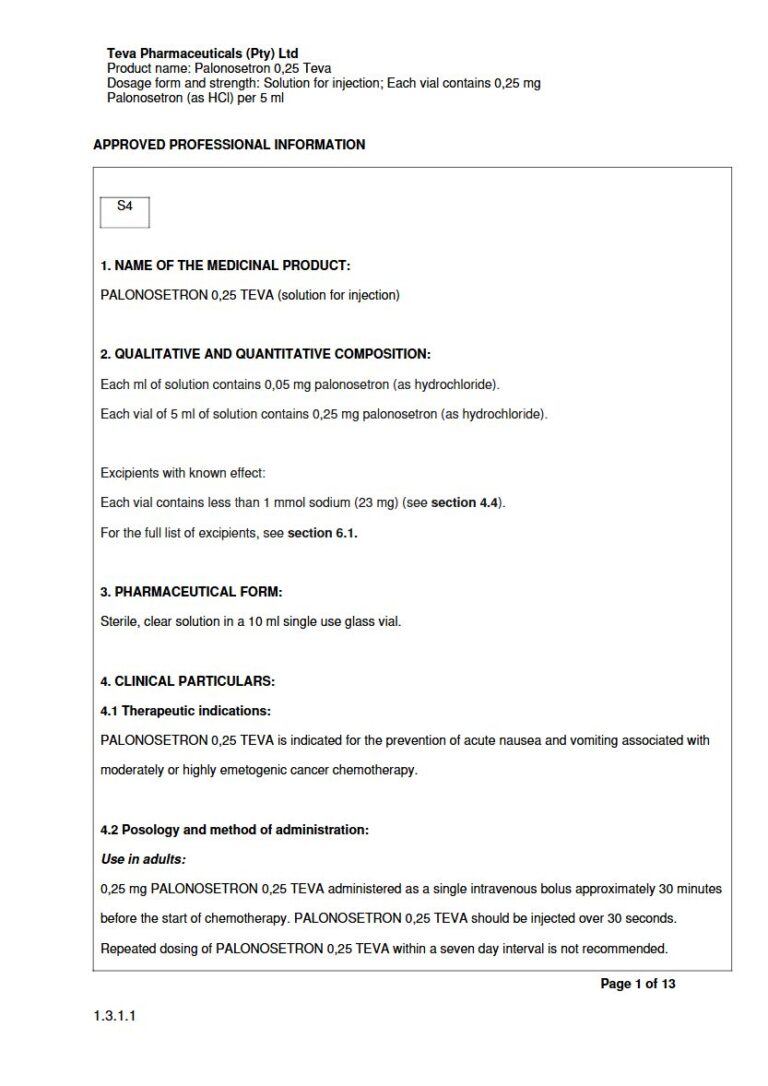
4.1 Therapeutic indications
PALONOSETRON 0,25 TEVA is indicated for the prevention of acute nausea and vomiting associated with moderately or highly emetogenic cancer chemotherapy.
4.2 Posology and method of administration
Use in adults: 0,25 mg PALONOSETRON 0,25 TEVA administered as a single intravenous bolus approximately 30 minutes before the start of chemotherapy. PALONOSETRON 0,25 TEVA should be injected over 30 seconds. Repeated dosing of PALONOSETRON 0,25 TEVA within a seven day interval is not recommended.
The efficacy of PALONOSETRON 0,25 TEVA in the prevention of nausea and vomiting induced by highly emetogenic chemotherapy may be enhanced by the addition of a corticosteroid administered prior to chemotherapy.
Special populations: Use in elderly: No dosage adjustment is necessary in the elderly. Use in patients with renal impairment: No dosage adjustment is necessary for patients with impaired renal function. No data is available for patients with end stage renal disease undergoing haemodialysis. Use in patients with hepatic impairment: No dosage adjustment is necessary for patients with impaired hepatic function. Paediatric population: Use in patients under 18 years of age is not recommended until further data becomes available. Method of administration: For intravenous use.
4.3 Contraindications
Hypersensitivity to the active substance, palonosetron or to any of the excipients of PALONOSETRON 0,25 TEVA listed in section 6.1.
4.4 Special warnings and precautions for use
As PALONOSETRON 0,25 TEVA may increase large bowel transit time, patients with a history of constipation or signs of subacute intestinal obstruction should be monitored following administration. Two cases of constipation with faecal impaction requiring hospitalisation have been reported in association with 0,75 mg palonosetron. At all dose levels tested, PALONOSETRON 0,25 TEVA did not induce clinically relevant prolongation of the QTc interval. A specific thorough QT/QTc study was conducted in healthy volunteers for definitive data demonstrating the effect of PALONOSETRON 0,25 TEVA on QT/QTc. However, as for other 5-HT3 antagonists, caution should be exercised in the use of PALONOSETRON 0,25 TEVA in patients who have or are likely to develop prolongation of the QT interval. These conditions include patients with a personal or family history of QT prolongation, electrolyte abnormalities, congestive heart failure, bradydysrhythmias, and conduction disturbances and in patients taking anti-dysrhythmic medicines or other medicinal products that lead to QT prolongation or electrolyte abnormalities. Hypokalaemia and hypomagnesemia should be corrected prior to 5-HT3-antagonist administration. There have been reports of serotonin syndrome with the use of 5-HT3 antagonists either alone or in combination with other serotonergic medication including selective serotonin reuptake inhibitors (SSRI) and serotonin noradrenaline reuptake inhibitors (SNRis). Appropriate observation of patients for serotonin syndrome like symptoms is advised. PALONOSETRON 0,25 TEVA should not be used to prevent or treat nausea and vomiting in the days following chemotherapy if not associated with another chemotherapy administration. PALONOSETRON 0,25 TEVA contains less than 1 mmol sodium (23 mg) per vial, that is to say essentially u2018sodium-freeu2019. Cases of myocardial ischemia have been reported in patients treated with palonosetron. In some patients, especially in the case of intravenous administration, symptoms appeared immediately after administration of palonosetron. Patients should be alerted to the signs and symptoms of myocardial ischaemia.
4.5 Interaction with other medicinal products and other forms of interaction
PALONOSETRON 0,25 TEVA is mainly metabolised by CYP2D6, with minor contribution by CYP3A4 and CYP1A2 isoenzymes. Based on in vitro studies, PALONOSETRON 0,25 TEVA does not inhibit or induce cytochrome P450 isoenzyme at clinically relevant concentrations. Chemotherapeutic medicines: In preclinical studies, PALONOSETRON 0,25 TEVA did not inhibit the anti-tumour activity of the five chemotherapeutic medicines tested (cisplatin, cyclophosphamide, cytarabine, doxorubicin and mitomycin C). Metoclopramide: In a clinical study, no significant pharmacokinetic interaction was shown between a single intravenous dose of PALONOSETRON 0,25 TEVA and steady state concentration of oral metoclopramide, which is a CYP2D6 inhibitor. CYP2D6 inducers and inhibitors: In a population pharmacokinetic analysis, it has been shown that there was no significant effect on PALONOSETRON 0,25 TEVA clearance when co-administered with CYP2D6 inducers (dexamethasone and rifampicin) and inhibitors (including amiodarone, celecoxib, chlorpromazine, cimetidine, doxorubicin, fluoxetine, haloperidol, paroxetine, quinidine, ranitidine, ritonavir, sertraline or terbinafine). Corticosteroids: PALONOSETRON 0,25 TEVA has been administered safely with corticosteroids. Serotonergic Medication (eg. SSRIs and SNRIs): There have been reports of serotonin syndrome following concomitant use of 5-HT3 antagonists and other serotonergic medication (including SSRIs and SNRIs). Other medicinal products: PALONOSETRON 0,25 TEVA has been administered safely with analgesics, antiemetic/antinauseants, antispasmodics and anticholinergic medicinal products.
4.6 Fertility, pregnancy and lactation
Pregnancy: For PALONOSETRON 0,25 TEVA no clinical data on exposed pregnancies are available. Animal studies do not indicate direct or indirect harmful effects with respect to pregnancy, embryonal/foetal development, parturition or postnatal development. Only limited data from animal studies are available regarding the placental transfer. There is no experience of PALONOSETRON 0,25 TEVA in human pregnancy. Therefore, PALONOSETRON 0,25 TEVA should not be used in pregnant women. Breastfeeding: As there are no data concerning PALONOSETRON 0,25 TEVA excretion in breast milk, breastfeeding should be discontinued during therapy. Fertility: There are no data concerning the effect of PALONOSETRON 0,25 TEVA on fertility.
4.7 Effects on ability to drive and use machines
No studies on the effects on the ability to drive and use machines have been performed. Since PALONOSETRON 0,25 TEVA may induce dizziness, somnolence or fatigue, patients should be cautioned when driving or operating machines.
4.8 Undesirable effects
In studies in adults at a dose of 0,25 mg the most frequently observed adverse reactions, at least possibly related to palonosetron, were headache and constipation. In the studies the following adverse reactions (ARs) were observed as possibly or probably related to palonosetron. Within each frequency grouping, adverse reactions are presented below in order of decreasing seriousness. Immune system disorders: Frequency unknown: Hypersensitivity, anaphylaxis, anaphylactic/anaphylactoid reactions and shock. Metabolism and nutrition disorders: Less frequent: Hyperkalaemia, metabolic disorders, hypocalcaemia, hypokalaemia, anorexia, hyperglycaemia, appetite decreased. Psychiatric disorders: Less frequent: Anxiety, euphoric mood. Nervous system disorders: Frequent: Headache, dizziness. Less frequent: Somnolence, insomnia, paraesthesia, hypersomnia, peripheral sensory neuropathy. Eye disorders: Less frequent: Eye irritation, amblyopia. Ear and labyrinth disorders: Less frequent: Motion sickness, tinnitus. Cardiac disorders: Less frequent: Tachycardia, bradycardia, extrasystoles, sinus tachycardia, sinus dysrhythmia, supraventricular extrasystoles. Frequency unknown: myocardial ischemia (see section 4.4). Vascular disorders: Less frequent: Hypotension, hypertension, vein discolouration, vein distended. Respiratory, thoracic and mediastinal disorders: Less frequent: Hiccups. Gastrointestinal disorders: Frequent: Constipation, diarrhoea. Less frequent: Dyspepsia, abdominal pain, abdominal pain upper, dry mouth, flatulence. Hepatobiliary disorders: Less frequent: Hyperbillirubinaemia. Skin and subcutaneous tissue disorders: Less frequent: Dermatitis allergic, pruritic rash. Musculoskeletal and connective tissue disorders: Less frequent: Arthralgia. Renal and urinary disorders: Less frequent: Urinary retention, glycosuria. General disorders and administration site conditions: Less frequent: Asthenia, pyrexia, fatigue, feeling hot, influenza like illness, injection site reaction (Includes the following: burning, induration, discomfort and pain). Investigations: Less frequent: Elevated transaminases, electrocardiogram QT prolonged. Reporting of suspected adverse reactions: Reporting suspected adverse reactions after authorisation of the medicine is important. It allows continued monitoring of the benefit/risk balance of the medicine. Healthcare providers are asked to report any suspected adverse reactions to SAHPRA via the 6.04 Adverse Drug Reactions Reporting Form, found online under SAHPRAu2019s publications: https://www.sahpra.org.za/Publications/Index/8
4.9 Overdose
No case of overdose has been reported. Doses of up to 6 mg have been used in adult studies. The highest dose group showed a similar incidence of adverse reactions compared to the other dose groups and no dose response effects were observed. In the unlikely event of overdose with PALONOSETRON 0,25 TEVA, this should be managed with supportive care. Dialysis studies have not been performed, however, due to the large volume of distribution, dialysis is unlikely to be an effective treatment for PALONOSETRON 0,25 TEVA overdose.
