
Betadine Surgical Scrub
Clinical Summary
Quick overview from the medicine insert
Indication
Antiseptic for skin disinfection prior to surgery and for the treatment of minor wounds.
Dosage (summary)
Apply to the affected area as needed, ensuring complete coverage. For surgical preparation, apply to the skin and allow to dry before proceeding.
Onset of Action / Duration
Immediate antiseptic effect upon application.
Special Populations
- Elderly
- Patients with thyroid disorders
- Patients with renal impairment
Pregnancy & Breastfeeding
Use with caution during pregnancy and lactation. Consult a healthcare professional before use.
Key Drug Interactions
- May interact with other antiseptics and topical agents.
- Use with caution in patients receiving lithium therapy due to potential thyroid function alteration.
Contraindications
- Hypersensitivity to iodine or any component of the formulation.
- Patients with a history of thyroid dysfunction.
- Not for use in deep puncture wounds or serious burns.
Common side effects
- Skin irritation
- Allergic reactions
- Staining of skin or clothing
Counselling Points
- Instruct patients to avoid contact with eyes and mucous membranes.
- Advise patients to report any signs of allergic reaction or skin irritation.
- Inform patients about potential staining of skin and clothing.
Serious warnings
- Prolonged use may lead to skin sensitization.
- Use with caution in patients with pre-existing thyroid conditions.
- Not for internal use.
Important Disclaimer
The Betadine Surgical Scrub professional information leaflet below is the property of Mundipharma and is provided on Medinsert exactly as issued, with no.. alterations or editorial changes. We make every effort to keep content current by updating documents as soon as new versions become available. Medinsert serves as a trusted access point for healthcare professionals, but does not replace official sources or clinical judgement. For more details, please read our full disclaimer. read more>>
 Healthcare Professionals Only
This content is for registered healthcare professionals
Sign in or create a free account to read the full package insert.
Free for HPCSA-registered professionals. Powered by Medinsert.
Clinical Particulars
Section 4 of the official insert — extracted exactly as issued, no alterations
4.1 Therapeutic indications
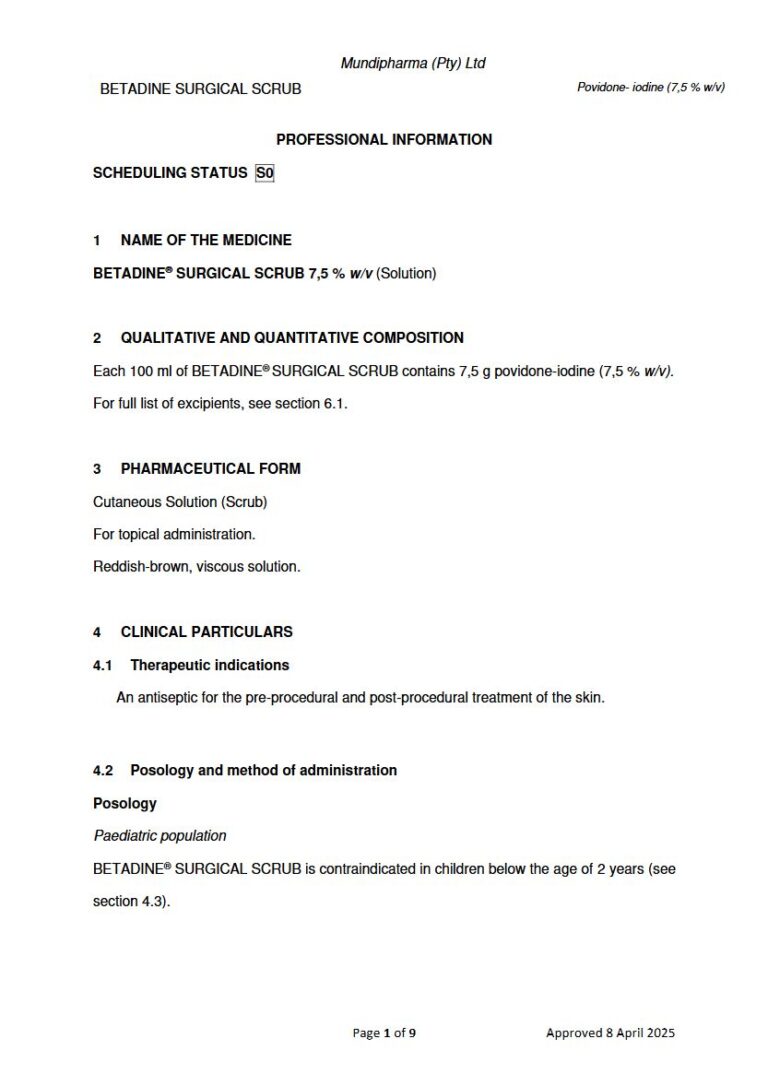
An antiseptic for the pre-procedural and post-procedural treatment of the skin.
4.2 Posology and method of administration
Posology
Paediatric population
BETADINE u00ae SURGICAL SCRUB is contraindicated in children below the age of 2 years (see section 4.3).
Apply for a maximum of 14 consecutive days up to 5 ml up to twice a day for adults and once a day for children aged 2 years or older. Rinse off with water after application.
Method of administration
For topical administration only. NOT FOR ORAL USE. Apply up to 5 ml for surgical handwashing and for pre-operative scrubbing. Rinse off under running water.
4.3 Contraindications
- Hypersensitivity to the active substance or to any of the excipients listed in section 6.1.
- Thyroid dysfunction or goitre (in particular nodular colloid goitre, endemic goitre and Hashimotou2019s thyroiditis).
- During radioiodine scintigraphy or radioiodine treatment of thyroid diseases.
- Products containing mercury, should not be used concomitantly due to formation of a substance which can damage the skin.
- Children below the age of 2 years.
- Patients on concurrent lithium therapy.
4.4 Special warnings and precautions for use
In pre-operative preparation, avoid pooling beneath the patient. Prolonged exposure to wet solution may cause irritation or rarely, severe skin reactions. Chemical burns of skin due to pooling may occur.
In instances of skin irritation, contact dermatitis or hypersensitivity, discontinue use.
Do not heat prior to application.
Povidone iodine use could lead to transient skin discolouration at the application site. It may permanently discolour white gold jewellery and it is recommended that this type of jewellery be removed before using BETADINE u00ae SURGICAL SCRUB.
For external use only.
Paediatric population
BETADINE u00ae SURGICAL SCRUB should not be used in children under 2 years of age and its application in children (2 years or above) must be performed by an adult.
4.5 Interaction with other medicines and other forms of interaction
The PVP-iodine complex is effective at pH values of between 2.0 and 7.0. It has to be expected that the complex will react with protein and other unsaturated organic compounds, leading to impairment of its effectiveness.
The concomitant use of wound-treatment preparations containing enzymatic components leads to a weakening of the effects of both substances.
Products containing silver, hydrogen peroxide, and taurolidine may interact with povidone-iodine.
Povidone iodine products when used concomitantly or immediately after application of octenidine containing antiseptics in the same or adjacent sites may lead to transient dark discolouration in the areas involved.
Due to the oxidative effect of povidone-iodine preparations various diagnostic agents can show false-positive lab results (e.g., tests with toluidine or gum guaiac for the determination of haemoglobin or glucose in the stool or the urine).
Absorption of iodine from povidone-iodine products may lower the iodine uptake of the thyroid. This can lead to interference with various investigations (thyroid scintigraphy, determination of protein-bound iodine (PBI), radioiodine diagnostics) and can interfere with treatment of the thyroid with iodine (radioiodine therapy).
After the end of the treatment, an appropriate interval should be allowed before a new scintigram is carried out.
4.6 Fertility, pregnancy and lactation
Povidone-iodine passes into the placenta and is secreted in breast milk. Thyroid function disorders including congenital hypothyroidism have been reported in the offspring of mothers who have received Iodine. Povidone-iodine use should be avoided.
Fertility
No data is available.
4.7 Effects on ability to drive and use machines
BETADINE u00ae SURGICAL SCRUB has no influence on the ability to drive and use machines.
4.8 Undesirable effects
Immune system disorders
Less frequent: Hypersensitivity, anaphylactic reaction
Endocrine disorders
Less frequent: Hyperthyroidism (sometimes with symptoms such as tachycardia or restlessness) *
Frequency unknown: Hypothyroidism ***
Metabolism and nutrition disorders
Frequency unknown: Electrolyte imbalance **, metabolic acidosis **
Skin and subcutaneous tissue disorders
Less frequent: Contact dermatitis (with symptoms such as erythema, small blisters and pruritus), angioedema
Renal and urinary disorders
Frequency unknown: Acute renal failure**, Blood osmolarity abnormal **
Injury, poisoning and procedural complications
Frequency unknown: Chemical burn of skin ****
* In patients with a history of thyroid disease (see Section 4.4) following a notable uptake of iodine e.g. following long term use of povidone u2013 iodine solution for the treatment of wounds and burns over extensive areas of the skin
** May occur following uptake of large amounts of povidone-iodine (e.g. in the treatment of burns)
*** Hypothyroidism following prolonged or extensive use of povidone iodine
**** May occur due to u201cpoolingu201d beneath the patient in pre-operative preparation
Reporting suspected adverse reactions: Reporting suspected adverse reactions after authorisation of the medicine is important. It allows continued monitoring of the benefit/risk balance of the medicine. Health care providers are asked to report any suspected adverse reactions to SAHPRA via the Med Safety APP (Medsafety X SAHPRA) and eReporting platform (who-umc.org) found on SAHPRA website. Alternatively report to: [email protected]
4.9 Overdose
Systemic toxicity may result in renal impairment (including anuria), metabolic acidosis, acute respiratory distress and congestive heart failure. In the case of deliberate or accidental ingestion of large quantities of povidone-iodine the following may manifest: oesophagitis, gastritis, chemical pulmonary oedema, transient hyperthyroidism, haemolytic anaemia, acute tubular necrosis and several acid-base disturbances. Hyperthyroidism or hypothyroidism may also develop. Treatment is symptomatic and supportive.
