
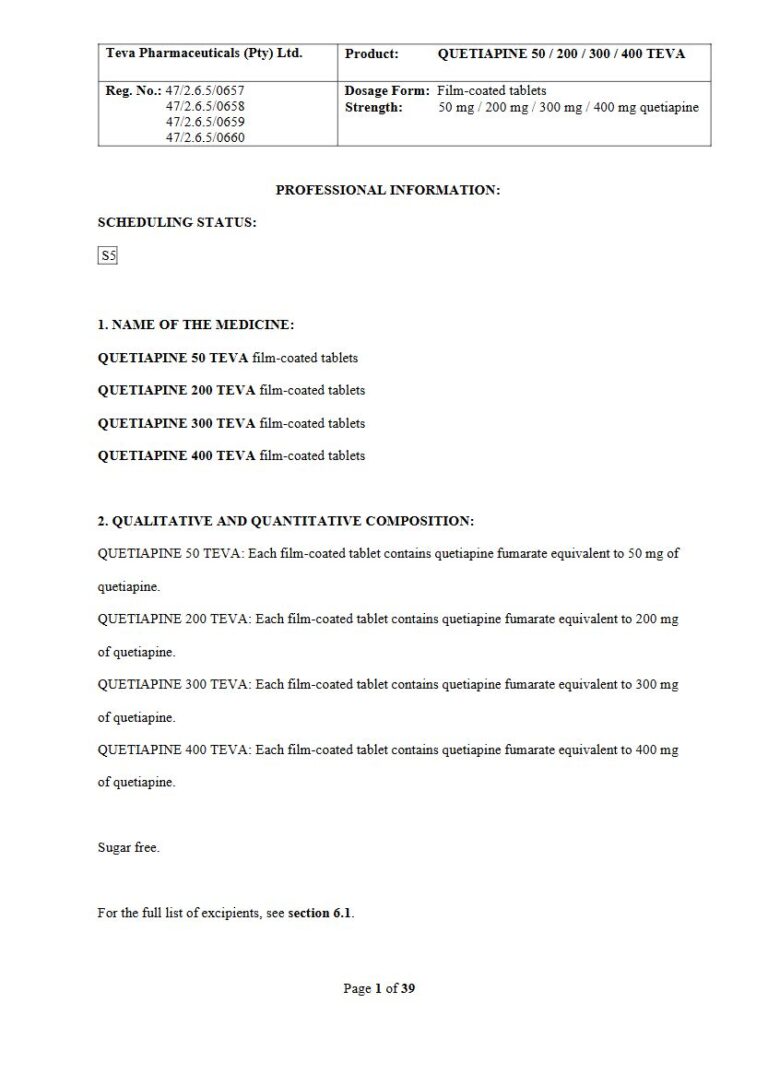
Quetiapine 50 mg/200 mg/300 mg/400 mg Film-Coated Tablets
PDF Leaflet Revision Date: 29 January 2025
Clinical Summary
Quick overview from the medicine insert
Indication
Treatment of schizophrenia, bipolar disorder, and major depressive disorder.
Dosage (summary)
Adults: Start at 300 mg on Day 1, increase to 600 mg on Day 2, up to 800 mg thereafter. Elderly: Start at 50 mg, adjust as needed.
Special Populations
- Elderly
- Hepatic impairment
Pregnancy & Breastfeeding
Contraindicated in pregnancy and lactation; safety not established.
Key Drug Interactions
- CYP3A4 inhibitors
- CYP3A4 inducers
- Serotonergic agents
Contraindications
- Hypersensitivity to quetiapine
- Severe hepatic impairment
- Concomitant use with CYP3A4 inhibitors
Common side effects
- Somnolence
- Dizziness
- Weight gain
- Orthostatic hypotension
Counselling Points
- Monitor for suicidal ideation
- Avoid alcohol
- Report signs of infection or agranulocytosis
Serious warnings
- Increased risk of suicidal thoughts
- Metabolic syndrome
- Tardive dyskinesia
Important Disclaimer
The Quetiapine 50 mg/200 mg/300 mg/400 mg Film-Coated Tablets professional information leaflet below is the property of Teva Pharmaceuticals and is provided on Medinsert exactly as issued, with no.. alterations or editorial changes. We make every effort to keep content current by updating documents as soon as new versions become available. Medinsert serves as a trusted access point for healthcare professionals, but does not replace official sources or clinical judgement. For more details, please read our full disclaimer. read more>>
 Healthcare Professionals Only
This content is for registered healthcare professionals
Sign in or create a free account to read the full package insert.
Free for HPCSA-registered professionals. Powered by Medinsert.
Clinical Particulars
Section 4 of the official insert — extracted exactly as issued, no alterations
4.1 Therapeutic indications:
QUETIAPINE TEVA is indicated for the treatment of:
- Schizophrenia
- Preventing relapse in stable schizophrenic patients who have been maintained on QUETIAPINE TEVA
- Bipolar disorder including:
- Manic episodes associated with bipolar disorder
- Depressive episodes associated with bipolar disorder
- Preventing recurrence in the maintenance treatment of bipolar disorder (manic, mixed or depressive episodes) as monotherapy or in combination with mood stabilisers
- Major depressive disorder
- Preventing relapse in stable major depressive disorder patients who have been maintained on QUETIAPINE TEVA.
4.2 Posology and method of administration:
Posology:
Adults:
For the treatment of schizophrenia:
The daily dose at the start of therapy is 300 mg on Day 1 600 mg on Day 2 and up to 800 mg after Day 2. The dose should be adjusted within the effective dose range of 400 to 800 mg per day, depending on the clinical response and tolerability of the patient. For maintenance therapy in schizophrenia no dosage adjustment is necessary.
For the treatment of manic episodes associated with bipolar disorder:
The daily dose at the start of therapy is 300 mg on Day 1 600 mg on Day 2 and up to 800 mg after Day 2. The dose should be adjusted within the effective dose range of 400 to 800 mg per day, depending on the clinical response and tolerability of the patient.
For the treatment of depressive episodes associated with bipolar disorder:
QUETIAPINE TEVA should be administered once daily in the evening. QUETIAPINE TEVA should be titrated as follows: 50 mg (Day 1), 100 mg (Day 2), 200 mg (Day 3) and 300 mg (Day 4). QUETIAPINE TEVA can be titrated to 400 mg on Day 5 and up to 600 mg by Day 8. Antidepressant efficacy as demonstrated with QUETIAPINE TEVA at 300 mg and 600 mg, however no additional benefit was seen in the 600 mg group during short-term treatment.
For preventing recurrence in maintenance treatment of bipolar disorder:
Patients who have responded to QUETIAPINE TEVA in combination therapy to a mood stabiliser (lithium or valproate) for acute treatment of bipolar disorder should continue on QUETIAPINE TEVA therapy at the same dose. The QUETIAPINE TEVA dose can be re-adjusted depending on clinical response and tolerability of the individual patient within the dose range of 400 to 800 mg per day. Patients who have responded to QUETIAPINE TEVA for acute treatment of bipolar disorder should continue on QUETIAPINE TEVA therapy at the same dosing regimen. QUETIAPINE TEVA dose can be re-adjusted depending on clinical response and tolerability of the individual patient within the dose range of 300 to 800 mg per day.
For the treatment of major depressive disorder:
QUETIAPINE TEVA should be administered once daily in the evening. Initial dosing should begin at 50 mg on Day 1 and 2, increased to 150 mg on Day 3 and 4. Further adjustments can be made upwards or downwards within the recommended dose range of 50 to 300 mg depending upon the clinical response and tolerability of the patient.
For maintenance therapy in major depressive disorder the effective dose during initial treatment should be continued. The dose can be adjusted within the recommended dose range depending upon the clinical response and tolerability of the patient.
Switching from Quetiapine immediate release tablets:
For more convenient dosing, patients who are currently being treated with divided doses of Quetiapine immediate release dosage form (Quetiapine tablets) may be switched to QUETIAPINE TEVA at the equivalent total daily dose taken once daily. Individual dosage adjustments may be necessary.
Elderly:
QUETIAPINE TEVA should be used with caution in the elderly, especially during the initial dosing period. The rate of dose titration of QUETIAPINE TEVA may need to be slower, and the daily therapeutic dose lower than that used in younger patients. The mean plasma clearance of quetiapine was reduced by 30 to 50 % in elderly patients when compared to younger patients. Elderly patients should be started on 50 mg per day. The dose can be increased in increments of 50 mg per day to an effective dose, depending on the clinical response and tolerance of the individual patient.
In elderly patients with major depressive disorder initial dosing should begin at 50 mg on days 1 to 3, the dose can be increased to 100 mg on Day 4, 150 mg on Day 8 and then up to 300 mg depending on clinical response and tolerability.
Children and adolescents:
The safety and efficacy of QUETIAPINE TEVA have not been evaluated in children and adolescents.
Renal and hepatic impairment:
Renal impairment: Dosage adjustment is not necessary in patients with renal impairment.
Hepatic impairment: Quetiapine is extensively metabolised by the liver. Therefore, QUETIAPINE TEVA should be used with caution in patients with known hepatic impairment, especially during the initial dosing period. Patients with hepatic impairment should be started on 50 mg per day. The dose can be increased in increments of 50 mg per day to an effective dose, depending on the clinical response and tolerability of the individual patient.
Method of administration: QUETIAPINE TEVA should be administered once daily, with or without food. The tablets should be swallowed whole and not split, chewed or crushed.
4.3 Contraindications:
- hypersensitivity to quetiapine or to any of the excipients listed in section 6.1
- concomitant administration of cytochrome P450 3A4 inhibitors, such as HIV-protease inhibitors, azole-antifungal medicines, erythromycin, clarithromycin and nefazodone, is contraindicated (see section 4.5)
- pregnancy and lactation (see section 4.6)
- the safety and efficacy in children and adolescents have not been demonstrated
- advanced liver and renal dysfunction, as safety has not been demonstrated.
4.4 Special warnings and precautions for use:
As QUETIAPINE TEVA has several indications, the safety profile should be considered with respect to the individual patientu2019s diagnosis and the dose being administered.
Long-term efficacy and safety in patients with MDD has not been evaluated as add-on therapy, however long-term efficacy and safety has been evaluated in adult patients as monotherapy (see section 5.1).
Suicide/suicidal thoughts or clinical worsening: Depression is associated with an increased risk of suicidal thoughts, self-harm and suicide (suicide-related events). This risk persists until significant remission occurs. As improvement may not occur during the first few weeks or more of treatment, patients should be closely monitored until such improvement occurs. It is general clinical experience that the risk of suicide may increase in the early stages of recovery.
In addition, medical practitioners should consider the potential risk of suicide-related events after abrupt cessation of QUETIAPINE TEVA treatment, due to the known risk factors for the disease being treated.
Other psychiatric conditions for which QUETIAPINE TEVA is prescribed can also be associated with an increased risk of suicide-related events. In addition, these conditions may be co-morbid with major depressive episodes. The same precautions observed when treating patients with major depressive episodes should therefore be observed when treating patients with other psychiatric disorders.
Patients with a history of suicide-related events, or those exhibiting a significant degree of suicidal ideation prior to commencement of treatment are known to be at greater risk of suicidal thoughts or suicide attempts and should receive careful monitoring during treatment.
Close supervision of patients and in particular those at high risk should accompany medicine therapy especially in early treatment and following dose changes. Patients (and caregivers of patients) should be alerted about the need to monitor for any clinical worsening, suicidal behaviour or thoughts and unusual changes in behaviour and to seek medical advice immediately if these symptoms present.
Reports have shown in shorter-term placebo controlled clinical studies of patients with major depressive episodes in bipolar disorder an increased risk of suicide-related events was observed in young adult patients (younger than 25 years of age) who were treated with quetiapine as compared to those treated with placebo (3,0 % vs. 0 %, respectively). In clinical studies of patients with MDD the incidence of suicide-related events observed in young adult patients (younger than 25 years of age) was 2,1 % (3/144) for quetiapine and 1,3 % (1/75) for placebo. Reports from a population-based retrospective study of quetiapine for the treatment of patients with major depressive disorder showed an increased risk of self-harm and suicide in patients aged 25 to 64 years without a history of self-harm during use of quetiapine with other antidepressants.
Metabolic Risk: Given the observed risk for worsening of their metabolic profile, including changes in weight, blood glucose (see hyperglycaemia) and lipids, which was seen in clinical studies, patientu2019s metabolic parameters should be assessed at the time of treatment initiation and changes in these parameters should be regularly controlled for during the course of treatment. Worsening in these parameters should be managed as clinically appropriate (see also section 4.8).
Tardive dyskinesia and Extrapyramidal symptoms: There is a potential for QUETIAPINE TEVA to cause tardive dyskinesia. If signs and symptoms of tardive dyskinesia appear, discontinuation of QUETIAPINE TEVA should be considered.
In placebo-controlled clinical trials of adult patients with schizophrenia and bipolar mania the incidence of extrapyramidal symptoms was no different from that of placebo across the recommended therapeutic dose range. This predicts that QUETIAPINE TEVA has less potential than typical antipsychotic medicines to induce tardive dyskinesia in schizophrenia and bipolar mania patients. In short-term placebo-controlled clinical trials for bipolar depression, the incidence of EPS was higher in quetiapine treated patients than in placebo treated patients (see section 4.8).
Somnolence and dizziness: QUETIAPINE TEVA treatment has been associated with somnolence and related symptoms, such as sedation (see section 4.8). In clinical trials for treatment of patients with bipolar depression and major depressive disorder, onset was usually within the first 3 days of treatment and was predominantly of mild to moderate intensity. Patients experiencing somnolence of severe intensity may require more frequent contact for a minimum of 2 weeks from onset of somnolence, or until symptoms improve and treatment discontinuation may need to be considered.
Orthostatic Hypotension: QUETIAPINE TEVA treatment has been associated with orthostatic hypotension and related dizziness (see section 4.8) which, like somnolence has onset usually during the initial dose-titration period. This could increase the occurrence of accidental injury (fall), especially in the elderly population. Therefore, patients should be advised to exercise caution until they are familiar with the potential effects of the medication.
QUETIAPINE TEVA should be used with caution in patients with known cardiovascular disease, cerebrovascular disease, or other conditions predisposing to hypotension. Dose reduction or more gradual titration should be considered if orthostatic hypotension occurs, especially in patients with underlying cardiovascular disease.
Sleep apnoea syndrome: Sleep apnoea syndrome has been reported in patients using QUETIAPINE TEVA. In patients receiving concomitant central nervous system depressants and who have a history of or are at risk for sleep apnoea, such as those who are overweight/obese or are male, QUETIAPINE TEVA should be used with caution.
Seizures: Caution is recommended when treating patients with a history of seizures (see section 4.8).
Neuroleptic Malignant Syndrome: Neuroleptic malignant syndrome has been associated with antipsychotic treatment, including QUETIAPINE TEVA (see section 4.8). Clinical manifestations include hyperthermia, altered mental status, muscular rigidity, autonomic instability, and increased creatine phosphokinase. In such an event, QUETIAPINE TEVA should be discontinued and appropriate medical treatment given.
Serotonin syndrome: Concomitant administration of QUETIAPINE TEVA and other serotonergic agents, such as MAO inhibitors, selective serotonin re-uptake inhibitors (SSRIs), serotonin norepinephrine re-uptake inhibitors (SNRIs) or tricyclic antidepressants may result in serotonin syndrome, a potentially life-threatening condition (see section 4.5). If concomitant treatment with other serotonergic agents is clinically warranted, careful observation of the patient is advised, particularly during treatment initiation and dose increases. Symptoms of serotonin syndrome may include mental-status changes, autonomic instability, neuromuscular abnormalities, and/or gastrointestinal symptoms.
4.5 Interactions with other medicines:
Given the primary central nervous system effects of quetiapine, QUETIAPINE TEVA should be used with caution in combination with other centrally acting medicines and alcohol.
Quetiapine should be used with caution in combination with serotonergic medicinal products, such as MAO inhibitors, selective serotonin re-uptake inhibitors (SSRIs), serotonin norepinephrine re-uptake inhibitors (SNRIs) or tricyclic antidepressants as the risk of serotonin syndrome, a potentially life-threatening condition, is increased (see section 4.4).
Caution should be exercised treating patients receiving other medications having anti-cholinergic (muscarinic) effects (see section 4.4).
Cytochrome P450 (CYP) 3A4 is the enzyme that is primarily responsible for the cytochrome P450 mediated metabolism of quetiapine. In an interaction study in healthy volunteers, concomitant administration of quetiapine (dosage of 25 mg) with ketoconazole, a CYP3A4 inhibitor, caused a 5- to 8-fold increase in the AUC of quetiapine. On the basis of this, concomitant use of QUETIAPINE TEVA with CYP3A4 inhibitors is contraindicated (see section 4.3). It is also not recommended to consume grapefruit juice while on quetiapine therapy.
Reports from a multiple dose trial in patients to assess the pharmacokinetics of quetiapine given before and during treatment with carbamazepine (a known hepatic enzyme inducer), co-administration of carbamazepine significantly increased the clearance of quetiapine. This increase in clearance reduced systemic quetiapine exposure (as measured by AUC) to an average of 13 % of the exposure during administration of quetiapine alone; although a greater effect was seen in some patients. As a consequence of this interaction, lower plasma concentrations can occur, which could affect the efficacy of QUETIAPINE TEVA therapy. Co-administration of QUETIAPINE TEVA and phenytoin (another microsomal enzyme inducer) caused a greatly increased clearance of quetiapine by approximately 450 %. In patients receiving a hepatic enzyme inducer, initiation of QUETIAPINE TEVA treatment should only occur if the medical practitioner considers that the benefits of QUETIAPINE TEVA outweigh the risks of removing the hepatic enzyme inducer. It is important that any change in the inducer is gradual, and if required, replaced with a non-inducer (e.g. sodium valproate) (see section 4.4).
The pharmacokinetics of quetiapine were not significantly altered by co-administration of the antidepressants imipramine (a known CYP 2D6 inhibitor) or fluoxetine (a known CYP 3A4 and CYP 2D6 inhibitor). The pharmacokinetics of quetiapine were not significantly altered by co-administration of the antipsychotics risperidone or haloperidol. Concomitant use of QUETIAPINE TEVA and thioridazine caused an increased clearance of quetiapine with approximately 70 %. Concomitant administration of clarithromycin and atypical antipsychotics that are predominantly metabolised through the CYP3A4 pathway, for example quetiapine, cariprazine, and aripiprazole may result in an increase in plasma levels of these antipsychotics as a result of inhibition which may present a potential for serious adverse reactions.
The pharmacokinetics of quetiapine were not altered following co-administration with cimetidine. The pharmacokinetics of lithium were not altered when co-administered with QUETIAPINE TEVA. The pharmacokinetics of sodium valproate and quetiapine were not altered to a clinically relevant extent when co-administered. Caution should be exercised when QUETIAPINE TEVA is used concomitantly with medicines known to cause electrolyte imbalance or to increase QT interval (see sections 4.4 and 4.8).
There have been reports of false positive results in enzyme immunoassays for methadone and tricyclic antidepressants in patients who have taken QUETIAPINE TEVA. Confirmation of questionable immunoassay screening results by an appropriate chromatographic technique is recommended.
4.6 Fertility, pregnancy and lactation:
Pregnancy: Animal studies have shown reproductive toxicity (see section 5.3). QUETIAPINE TEVA is contraindicated during pregnancy and lactation, as safety has not been demonstrated (see section 4.3).
Breastfeeding: Women who are breastfeeding should be advised to avoid breastfeeding while taking QUETIAPINE TEVA.
Fertility: The effects of quetiapine as contained in QUETIAPINE TEVA on human fertility have not been assessed. Effects related to elevated prolactin levels were seen in rats, although these are not directly relevant to humans (see section 5.3 preclinical data).
4.7 Effects on ability to drive and use machines:
Given its primary central nervous system effects, QUETIAPINE TEVA may interfere with activities requiring mental alertness. Therefore, patients should be advised not to drive or operate machinery, until individual susceptibility to this is known.
4.8 Undesirable effects:
Blood and lymphatic system disorders:
- Frequent Decreased haemoglobin, leucopenia, decreased neutrophil count, increased eosinophils
- Less frequent Neutropenia, thrombocytopenia, anaemia, decreased platelet count, agranulocytosis
Immune system disorders:
- Less frequent Hypersensitivity (including allergic skin reactions), anaphylactic reaction
Endocrine disorders:
- Frequent Hyperprolactinemia, decreases in total T4, decreases in free T4, decreases in total T3, increases in TSH
- Less frequent Decreases in free T3, hypothyroidism, inappropriate antidiuretic hormone secretion
Metabolism and nutritional disorders:
- Frequent Elevations in serum triglyceride levels, elevations in total cholesterol (predominantly LDL cholesterol), decreases in HDL cholesterol, weight gain, increased appetite, blood glucose increased to hyperglycaemic levels
- Less frequent Hyponatraemia, diabetes mellitus, exacerbation of pre-existing diabetes, metabolic syndrome
Psychiatric disorders:
- Frequent Abnormal dreams and nightmares, suicidal ideation and suicidal behaviour
- Less frequent Somnambulism and related reactions such as sleep talking and sleep related eating disorder
Nervous system disorders:
- Frequent Dizziness, somnolence, headache, extrapyramidal symptoms
- Less frequent Seizure, restless legs syndrome, tardive dyskinesia, syncope
Cardiac disorders:
- Frequent Tachycardia, palpitations
- Less frequent QT prolongation, bradycardia
- Frequency unknown Cardiomyopathy, myocarditis
Eye disorders:
- Frequent Blurred vision
Vascular disorders:
- Frequent Orthostatic hypotension
- Less frequent Venous thrombo-embolism
- Frequency unknown Stroke
Respiratory, thoracic and mediastinal disorder:
- Frequent Dyspnoea
- Less frequent Rhinitis
Gastrointestinal disorders:
- Frequent Dry mouth, constipation, dyspepsia, vomiting
- Less frequent Dysphagia, pancreatitis, intestinal obstruction/ileus
Hepato-biliary disorders:
- Frequent Elevations in serum alanine aminotransferase (ALT), elevations in gamma-GT levels
- Less frequent Elevations in serum aspartate aminotransferase (AST), jaundice, hepatitis
Skin and subcutaneous tissue disorders:
- Less frequent Angioedema, Stevens-Johnson syndrome
- Frequency unknown Toxic Epidermal Necrolysis, erythema multiforme, Acute Generalised Exanthematous Pustulosis (AGEP), Drug Reaction with Eosinophilia and Systemic Symptoms (DRESS), cutaneous vasculitis
Musculoskeletal and connective tissue disorders:
- Less frequent Rhabdomyolysis
Renal and urinary disorders:
- Less frequent Urinary retention
Pregnancy, puerperium and perinatal conditions:
- Frequency unknown Drug withdrawal syndrome neonatal
Reproductive system and breast disorders:
- Less frequent Sexual dysfunction, priapism, galactorrhoea, breast swelling, menstrual disorder
General disorders and administration site conditions:
- Frequent Withdrawal (discontinuation) symptoms, mild asthenia, peripheral oedema, irritability, pyrexia
- Less frequent Neuroleptic malignant syndrome
Investigations:
- Less frequent Elevations in blood creatine phosphokinase
4.9 Overdose:
Symptoms: In general, reported signs and symptoms were those resulting from an exaggeration of the active substanceu2019s known pharmacological effects, i.e., drowsiness and sedation, tachycardia, hypotension and anti-cholinergic effects. Overdose could lead to QT-prolongation, seizures, status epilepticus, rhabdomyolysis, respiratory depression, urinary retention, confusion, delirium and/or agitation, coma and death.
In case of overdose with prolonged-release quetiapine (e.g. QUETIAPINE TEVA there is a delayed peak sedation and peak pulse and prolonged recovery compared with immediate-release quetiapine overdose.
Management of overdose: There is no specific antidote to QUETIAPINE TEVA. In cases of severe signs, the possibility of multiple drug involvement should be considered, and intensive care procedures are recommended, including establishing and maintaining a patent airway, ensuring adequate oxygenation and ventilation, and monitoring and support of the cardiovascular system. Close medical supervision and monitoring should be continued until the patient recovers.
