
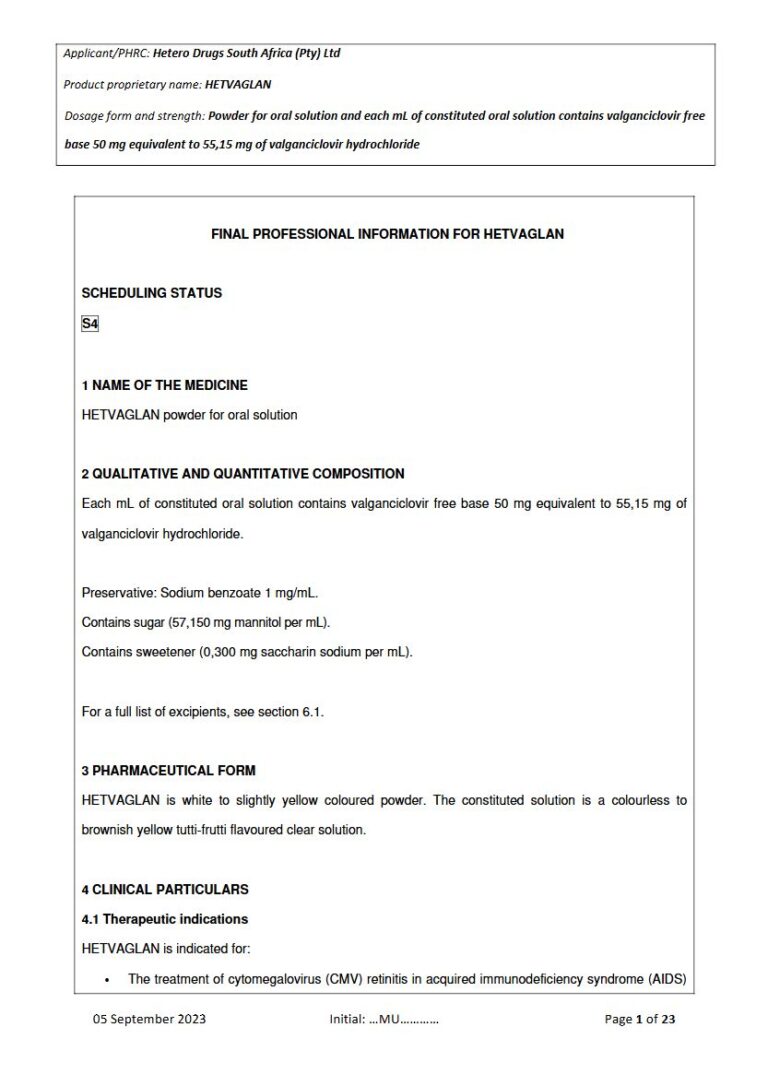
Hetvaglan 50 mg Powder for oral solution
PDF Leaflet Revision Date: 05 September 2023
Clinical Summary
Quick overview from the medicine insert
Indication
Treatment and prevention of CMV disease in at-risk patients.
Dosage (summary)
900 mg twice daily for 21 days for induction; 900 mg once daily for maintenance.
Special Populations
- Renal impairment
- Elderly
- Paediatric population
Pregnancy & Breastfeeding
Contraindicated in pregnancy and breastfeeding; potential teratogenic effects.
Key Drug Interactions
- Imipenem-cilastatin
- Zidovudine
- Didanosine
- Probenecid
Contraindications
- Hypersensitivity to valganciclovir or ganciclovir
- Breastfeeding
Common side effects
- Neutropenia
- Anaemia
- Diarrhoea
Counselling Points
- Take with food.
- Use effective contraception during treatment.
- Monitor for signs of infection or bleeding.
Serious warnings
- Myelosuppression
- Potential teratogenicity
- Carcinogenicity
Important Disclaimer
The Hetvaglan 50 mg Powder for oral solution professional information leaflet below is the property of Hetero Drugs South Africa and is provided on Medinsert exactly as issued, with no.. alterations or editorial changes. We make every effort to keep content current by updating documents as soon as new versions become available. Medinsert serves as a trusted access point for healthcare professionals, but does not replace official sources or clinical judgement. For more details, please read our full disclaimer. read more>>
 Healthcare Professionals Only
This content is for registered healthcare professionals
Sign in or create a free account to read the full package insert.
Free for HPCSA-registered professionals. Powered by Medinsert.
Clinical Particulars
Section 4 of the official insert — extracted exactly as issued, no alterations
4.1 Therapeutic indications
HETVAGLAN is indicated for:
- The treatment of cytomegalovirus (CMV) retinitis in acquired immunodeficiency syndrome (AIDS) patients.
- The prevention of CMV disease in solid organ transplant patients who are at risk i.e., donor seropositive and recipient seronegative.
4.2 Posology and method of administration
Posology
Strict adherence to dosage recommendations is essential to avoid overdose. The bioavailability of ganciclovir from HETVAGLAN is up to 10-fold higher than from ganciclovir capsules, therefore the dosage and administration of HETVAGLAN powder for oral solution should be closely followed. The ganciclovir systemic exposure following administration of 900 mg valganciclovir oral solution is equivalent to a dose of 900 mg valganciclovir tablets (2 x 450 mg tablets).
Standard dosage in adults
Induction treatment of CMV retinitis
For patients with active CMV retinitis, the recommended dose is 900 mg HETVAGLAN twice a day for 21 days. Prolonged induction treatment may increase the risk of bone marrow toxicity.
Maintenance treatment of CMV retinitis
Following induction treatment, or in patients with inactive CMV retinitis, the recommended dose is 900 mg HETVAGLAN once daily. Patients whose retinitis worsens may repeat induction treatment; however, consideration should be given to the possibility of viral medicine resistance.
Prevention of CMV disease in solid organ transplantation
For kidney transplant patients, the recommended dose is 900 mg once daily depending on creatinine clearance, starting within 10 days of transplantation until 200 days post-transplantation. For patients who have received a solid organ transplant other than the kidney, the recommended dose is 900 mg daily, starting within 10 days of transplantation until 100 days post transplantation.
Special populations
Patients with renal impairment
Serum creatinine levels or creatinine clearance should he monitored carefully. Dosage adjustment is required for adult patients based on creatinine clearance, as shown in table 1 below.
Creatinine clearance (mL/min) is calculated from serum creatinine by the following formulae:
CLCR (mL/min) = (140 u2013 age) u00d7 (Wt [kg]) x constant* / SCR [u03bcmol/L]
* Constant = 1,23 for males and 1,04 for females (0,85 x 1,23 = 1,04)
The South African Renal Society recommends simplifying the above formula by omitting the constant of 1,23 for males.
CLCR (mL/min) = (140 u2013 age) u00d7 (Wt [kg]) x 0,85 (if female) / SCR [u03bcmol/L]
CLCR = creatinine clearance
SCR = serum creatinine
Table 1: HETVAGLAN oral solution dose for renally impaired patients
| CrCl (mL/min) | Induction dose of HETVAGLAN oral solution | Maintenance/prevention dose of HETVAGLAN oral solution |
|---|---|---|
| u2265 60 | 900 mg twice daily | 900 mg once daily |
| 40 u2013 59 | 450 mg twice daily | 450 mg once daily |
| 25 u2013 39 | 450 mg once daily | 225 mg once daily |
| 10 u2013 24 | 225 mg once daily | 125 mg once daily |
| < 10 | 200 mg (3 x weekly after dialysis) | 100 mg (3 x weekly after dialysis) |
Patients undergoing haemodialysis
Dosage adjustment is necessary for patients on haemodialysis (CrCl < 10 mL/min) and a dosing recommendation for HETVAGLAN powder for oral solution is given in the above table.
Patients with severe leucopenia, neutropenia, anaemia, thrombocytopenia and pancytopenia
Severe leucopenia, neutropenia, anaemia, thrombocytopenia and pancytopenia, bone marrow depression and aplastic anaemia have been observed in patients treated with HETVAGLAN (and ganciclovir). Therapy should not be initiated if the absolute neutrophil count is less than 500 cells/u03bcL or the platelet count is less than 25 000/u03bcL or the haemoglobin is less than 8 g/dL (see section 4.4)
Elderly
Safety and efficacy have not been established.
Paediatric population
Safety and efficacy have not been established in adequate and well-controlled clinical studies.
Method of administration
HETVAGLAN is administered orally and should be taken with food.
HETVAGLAN, powder for oral solution, preparation of solution:
- Measure 91 mL of purified water in a graduated cylinder.
- Add purified water to the bottle. Shake the closed bottle until the powder is dissolved.
- Remove the child resistant cap and push the bottle adapter into the neck of the bottle.
- Close bottle tightly with child resistant cap.
For further instructions on handling HETVAGLAN see section 6.6.
4.3 Contraindications
- HETVAGLAN is contraindicated in patients with hypersensitivity to valganciclovir, ganciclovir or any of the excipients listed in section 6.1.
- Due to the similarity of the chemical structure of HETVAGLAN and that of aciclovir and valaciclovir, a cross-hypersensitivity reaction between these medicines is possible.
- HETVAGLAN is contraindicated during breast-feeding (see section 4.6).
4.4 Special warnings and precautions for use
Mutagenicity, teratogenicity, carcinogenicity, fertility and contraception
Prior to the initiation of valganciclovir treatment, patients should be advised of the potential risks to the foetus. HETVAGLAN should be considered a potential teratogen and carcinogen with the potential to cause birth defects and cancers. It is likely that valganciclovir causes temporary or permanent inhibition of spermatogenesis (see section 4.6). Valganciclovir has the potential to cause carcinogenicity and reproductive toxicity in the long-term.
Myelosuppression
Severe leucopenia, neutropenia, anaemia, thrombocytopenia, pancytopenia, bone marrow depression and aplastic anaemia have been observed in patients treated with HETVAGLAN (and ganciclovir). Therapy should not be initiated if the absolute neutrophil count is less than 500 cells/u03bcL, or the platelet count is less than 25 000/u03bcL, or the haemoglobin level is less than 8 g/dL.
HETVAGLAN should be used with caution in patients with pre-existing haematological cytopenia or a history of medicine-related haematological cytopenia and in patients receiving radiotherapy. It is recommended that complete blood counts and platelet counts be monitored during therapy. In patients with severe leukopenia, neutropenia, anaemia and/or thrombocytopenia, it is recommended that treatment with haematopoietic growth factors and/or dose interruption be considered (see section 4.2).
The bioavailability of ganciclovir from HETVAGLAN is up to 10-fold higher than from ganciclovir capsules. HETVAGLAN cannot be substituted for ganciclovir capsules on a one-to-one basis.
Renal impairment
In patients with impaired renal function, dosage adjustments based on creatinine clearance are required (see section 4.2). For patients on haemodialysis (CrCl < 10 mL/min) a tablet dose recommendation cannot be given. Thus HETVAGLAN powder for oral solution, should be used in these patients.
Convulsions have been reported in patients taking ganciclovir and imipenem-cilastatin concomitantly.
Use with other medicines
HETVAGLAN should not be used concomitantly with imipenem-cilastatin (see section 4.5). Zidovudine and HETVAGLAN each have the potential to cause neutropenia and anaemia. Some patients may not tolerate concomitant therapy at full dosage (see section 4.5). Didanosine plasma concentrations may increase during concomitant use with HETVAGLAN, therefore patients should be closely monitored for didanosine toxicity (see section 4.5). Concomitant use of other medicines that are known to be myelosuppressive or associated with renal impairment with HETVAGLAN may result in added toxicity (see section 4.5).
Cross-hypersensitivity
Due to the similarity of the chemical structure of ganciclovir and that of aciclovir and penciclovir, a cross-hypersensitivity reaction between these drugs is possible. Caution should therefore be used when prescribing HETVAGLAN to patients with known hypersensitivity to aciclovir or penciclovir, (or to their prodrugs, valaciclovir or famciclovir respectively).
Precautions to be taken before handling
Owing to the teratogenic character, the Valcyte powder and reconstituted solution should be handled with caution. Inhalation should be avoided. If the powder or solution make direct contact with skin, the area should be washed thoroughly with soap and water. If the solution gets into the eye, the eye should be thoroughly washed with water immediately.
Paediatric population
Safety and efficacy in children have not been established in adequate and well controlled clinical studies (see section 4.2).
Excipients with known effects
HETVAGLAN powder for oral solution contains sodium benzoate. Increase in bilirubinaemia following its displacement from albumin may increase neonatal jaundice which may develop into kernicterus (non-conjugated bilirubin deposits in the brain tissue).
4.5 Interaction with other medicines and other forms of interaction
The following medicines, valaciclovir, didanosine, nelfinavir, ciclosporin, omeprazole and mycophenolate mofetil did not affect the permeability of valganciclovir (rat in-situ model). HETVAGLAN is metabolised to ganciclovir. Therefore, medicine interactions associated with ganciclovir will be expected for HETVAGLAN.
Interactions with ganciclovir
Imipenem-cilastatin
Convulsions have been reported in patients taking ganciclovir and imipenem-cilastatin concomitantly. These medicines should not be used concomitantly.
Probenecid
Probenecid given with oral ganciclovir may reduce renal clearance of ganciclovir (20 %) leading to statistically significantly increase exposure (40 %). These changes were consistent with a mechanism of interaction involving competition for renal tubular excretion. Therefore, patients taking probenecid and HETVAGLAN should be closely monitored for ganciclovir toxicity.
Zidovudine
When zidovudine was given in the presence of oral ganciclovir there was a small (17 %), but statistically significant increase in the AUC of zidovudine. There was also trend towards lower ganciclovir concentrations when administered with zidovudine, although this was not statistically significant. However, since both zidovudine and ganciclovir have the potential to cause neutropenia and anaemia, some patients may not tolerate concomitant therapy at full dosage (see section 4.4).
Didanosine
Didanosine plasma concentrations were found to be consistently raised when given with ganciclovir (both intravenous and oral). At ganciclovir oral doses of 3 and 6 g/day, an increase in the AUC of didanosine ranging from 84 to 124 % has been observed. This increase cannot be explained by competition for renal tubular secretion, as there was an increase in the percentage of didanosine dose excreted. This increase could arise from either increased bioavailability or decreased metabolism. There was no clinically significant effect on ganciclovir concentrations. However, given the increase in didanosine plasma concentrations in the presence of ganciclovir, patients should be closely monitored for didanosine toxicity (see section 4.4).
Mycophenolate Mofetil
Based on the results of a single dose administration study of recommended doses of oral mycophenolate mofetil (MMF) and intravenous ganciclovir and the known effects of renal impairment on the pharmacokinetics of MMF and ganciclovir, it is anticipated that co-administration of these medicines (which have the potential to compete for renal tubular secretion) will result in increase in phenolic glucuronide of mycophenolic acid (MPAG) and ganciclovir concentration. No substantial alteration of mycophenolic acid (MPA) pharmacokinetics is anticipated and MMF dose adjustment is not required. In patients with renal impairment in which MMF and ganciclovir are co-administered, the dose recommendation of ganciclovir should be observed and patients monitored carefully.
Zalcitabine
Zalcitabine increased the AUC 0-8h of oral ganciclovir by 13 %. There were no statistically significant changes in any of the other pharmacokinetic parameters assessed. Additionally, there were no clinically relevant changes in zalcitabine pharmacokinetics in the presence of oral ganciclovir although a small increase in the elimination rate constant was observed. Both HETVAGLAN and zalcitabine have the potential to cause peripheral neuropathy and patients should be monitored for such events.
Stavudine
No statistically significant pharmacokinetic interactions were observed when stavudine and oral ganciclovir were given in combination.
Trimethoprim
Trimethoprim statistically significantly decreased the renal clearance of oral ganciclovir by 16,3 % and this was associated with a statistically significant decrease in the terminal elimination rate and the corresponding increase in half-life by 15 %. However, these changes are unlikely to be clinically significant, as AUC 0-8h and C max were unaffected. The only statistically significant change in trimethoprim pharmacokinetic parameters when co-administered with ganciclovir was a 12 % increase in C min. However, this is unlikely to be of clinical significance and no dose adjustment is recommended.
Ciclosporin
There was no evidence that introduction of ganciclovir affects the pharmacokinetics of ciclosporin based on the comparison of ciclosporin trough concentrations. However, there was some evidence of increases in the maximum serum creatinine value observed following initiation of ganciclovir therapy.
Other potential medicine interactions
Toxicity may be enhanced when ganciclovir is co-administered with, or is given immediately before or after, other medicines that inhibit replication of rapidly dividing cell populations such as those occurring in the bone marrow, tested and germinal layers of the skin and gastrointestinal mucosa, or that are associated with renal impairment (such as dapsone, pentamidine, flucytosine, vincristine, vinblastine, adriamycin, amphotericin B, sulfamethoxazole-trimethoprim combinations, nucleoside analogues and hydroxyurea) therefore these medicines should be considered for concomitant use with HETVAGLAN only if the potential benefits outweigh the potential risks (see section 4.4).
Other antiretrovirals
Cytochrome P450 isoenzymes play no role in ganciclovir pharmacokinetics. As a consequence, pharmacokinetic interactions with protease inhibitors and non-nucleoside reverse transcriptase inhibitors are not anticipated.
4.6 Fertility, pregnancy and lactation
Contraception in males and females
As a result of the potential for reproductive toxicity and teratogenicity, women of childbearing potential must be advised to use effective contraception during and for at least 30 days after treatment. Male patients must be advised to practice barrier contraception during and for at least 90 days following treatment with valganciclovir unless it is certain that the female partner is not at risk of pregnancy.
Pregnancy
HETVAGLAN should not be used in pregnancy. The safety of HETVAGLAN for use in pregnant women has not been established. Its active metabolite, ganciclovir, readily diffuses across the human placenta. Based on its pharmacological mechanism of action and reproductive toxicity observed in animal studies with ganciclovir there is a theoretical risk of teratogenicity in humans.
Breastfeeding
It is unknown if ganciclovir is excreted in human breast milk, but the possibility of ganciclovir being excreted in the breastmilk and causing serious adverse reactions in the nursing infant cannot be discounted. Animal data indicate that ganciclovir is excreted in the milk of lactating rats Therefore, breast-feeding must be discontinued during treatment with valganciclovir (see section 4.3).
Fertility
A clinical study with renal transplant patients receiving valganciclovir for CMV prophylaxis for up to 200 days demonstrated an impact of valganciclovir on spermatogenesis, with decreased sperm density and motility measured after treatment completion. This effect appears to be reversible and approximately six months after valganciclovir discontinuation, mean sperm density and motility recovered to levels comparable to those observed in the untreated controls. In animal studies, ganciclovir impaired fertility in male and female mice and has shown to inhibit spermatogenesis and induce testicular atrophy in mice, rats and dogs at doses considered clinically relevant. Based on clinical and nonclinical studies, it is considered likely that ganciclovir (and valganciclovir) may cause temporary or permanent inhibition of human spermatogenesis (see section 4.4).
4.7 Effects on ability to drive and use machines
Convulsions, sedation, dizziness, ataxia and/or confusion have been reported with the use of valganciclovir and/or ganciclovir. If they occur, such effects may affect tasks requiring alertness including the patientu2019s ability to drive and operate machinery.
4.8 Undesirable effects
a) Summary of the safety profile
Valganciclovir is a prodrug of ganciclovir. It is rapidly converted to ganciclovir after oral administration. The side effects known to be associated with ganciclovir usage can therefore be expected to occur with valganciclovir administration. All of the undesirable effects observed in valganciclovir have been previously observed with ganciclovir. The most frequently reported adverse medicine reactions following administration of valganciclovir in adults are neutropenia, anaemia and diarrhoea. Valganciclovir is associated with a higher risk of diarrhoea compared to intravenous ganciclovir. Severe neutropenia (< 500 ANC/u03bcL) has been seen more frequently in CMV retinitis patients undergoing treatment with valganciclovir than in solid organ transport patients receiving valganciclovir.
b) Tabulated summary of adverse reactions
| System organ class | Frequency | Adverse event |
|---|---|---|
| Infections and Infestations | Frequent | Oral candidiasis, sepsis (bacteraemia, viraemia), cellulitis, urinary tract infection, upper respiratory tract infection |
| Blood and lymphatic system disorders | Frequent | Severe neutropenia, anaemia, thrombocytopenia, leucopenia, pancytopenia |
| Less frequent | Bone marrow depression, aplastic anaemia | |
| Immune system disorders | Frequent | Hypersensitivity |
| Less frequent | Anaphylactic reaction | |
| Metabolism and nutrition disorders | Frequent | Decreased appetite, anorexia |
| Psychiatric disorders | Frequent | Depression, anxiety, confusion, abnormal thinking |
| Less frequent | Agitation, psychotic disorder, hallucinations | |
| Nervous system disorders | Frequent | Headache, insomnia, dysgeusia, hypoaesthesia, paraesthesia, peripheral neuropathy, dizziness (excluding vertigo), convulsion |
| Less frequent | Tremor | |
| Eye disorders | Frequent | Macular oedema, retinal detachment, vitreous floaters, eye pain, visual disturbance, conjunctivitis |
| Ear and labyrinth disorders | Frequent | Ear pain |
| Less frequent | Deafness | |
| Cardiac disorders | Less frequent | Dysrhythmias |
| Vascular disorders | Frequent | Hypotension, hypertension |
| Respiratory, thoracic and mediastinal disorders | Frequent | Dyspnoea, cough |
| Gastrointestinal disorders | Frequent | Diarrhoea, nausea, vomiting, abdominal pain, upper abdominal pain, dyspepsia, constipation, flatulence, dysphagia |
| Less frequent | Abdominal distension, mouth ulcerations, pancreatitis | |
| Hepato-biliary disorders | Frequent | Severe abnormal hepatic function, increased blood alkaline phosphatase, increased aspartate aminotransferase |
| Less frequent | Increased alanine aminotransferase | |
| Skin and subcutaneous tissue disorders | Frequent | Dermatitis, pruritus, rash, night sweats |
| Less frequent | Alopecia, urticaria, dry skin | |
| Musculoskeletal and connective tissue disorders | Frequent | Back pain, myalgia, arthralgia, muscle cramps |
| Renal and urinary disorders | Frequent | Decreased creatinine renal clearance, renal impairment |
| Less frequent | Haematuria, renal failure | |
| Reproductive system and breast disorders | Less frequent | Male infertility |
| General disorders and administrative site conditions | Frequent | Fatigue, pyrexia, rigors, pain, malaise, asthenia, chest pain, transplant rejection |
| Investigations | Frequent | Decreased weight, increased blood creatinine |
c) Description of selected adverse reactions
Neutropenia
The risk of neutropenia is not predictable on the basis of the number of neutrophils before treatment. Neutropenia usually occurs during the first or second week of induction therapy. The cell count usually normalises within 2 to 5 days after discontinuation of the medicine or dose reduction (see section 4.4).
Thrombocytopenia
Patients with low baseline platelet counts (< 100 000 /u03bc L) have an increased risk of developing thrombocytopenia. Patients with iatrogenic immunosuppression due to treatment with immunosuppressive medicines are at greater risk of thrombocytopenia than patients with AIDS (see section 4.4). Severe thrombocytopenia may be associated with potentially life-threatening bleeding.
Reporting of suspected adverse reactions
Reporting suspected adverse reactions after authorisation of the medicine is important. It allows continued monitoring of the benefit/risk balance of the medicine. Health care providers are asked to report any suspected adverse reactions via the Adverse drug reaction and quality problem reporting form, found online under SAHPRAu2019s publications: https://www.sahpra.org.za/document/adverse-drug-reactions-and-quality-problem-reporting-form/ or to the Holder of certificate of registration through the mail: [email protected].
4.9 Overdose
It is expected that an overdose of HETVAGLAN, could also possibly result in increased renal toxicity. Haemodialysis and hydration may be of benefit in reducing blood plasma levels in patients who receive an overdose of HETVAGLAN.
Overdose experience with IV ganciclovir:
The majority of patients experienced one or more of the following adverse events:
- Haematological toxicity: pancytopenia, bone marrow depression, medullary aplasia, leucopenia, neutropenia, granulocytopenia.
- Hepatotoxicity: hepatitis, liver function disorder.
- Renal toxicity: worsening of haematuria in a patient with pre-existing renal impairment, acute renal failure, elevated creatinine.
- Gastrointestinal toxicity: abdominal pain, diarrhoea, vomiting.
- Neurotoxicity: generalised tremor, convulsion.
