
Abraxane 100 Injection
Clinical Summary
Quick overview from the medicine insert
Indication
Treatment of breast cancer, non-small cell lung cancer, and pancreatic cancer.
Dosage (summary)
Administered as an intravenous infusion; typical dose is 260 mg/m² every 3 weeks.
Onset of Action / Duration
Onset of action varies; therapeutic effects may be observed within days to weeks after administration.
Special Populations
- Hepatic impairment
- Renal impairment
- Elderly patients
Pregnancy & Breastfeeding
Paclitaxel is contraindicated in pregnancy and breastfeeding due to potential harm to the fetus or infant.
Key Drug Interactions
- CYP2C8 and CYP3A4 inhibitors may increase paclitaxel levels.
- CYP2C8 and CYP3A4 inducers may decrease paclitaxel levels.
- Concurrent use with other myelosuppressive agents may increase the risk of neutropenia.
Contraindications
- Hypersensitivity to paclitaxel or any component of the formulation.
- Severe neutropenia (absolute neutrophil count < 1500 cells/mm³).
- Pregnancy and lactation.
Common side effects
- Neutropenia
- Peripheral neuropathy
- Nausea and vomiting
- Alopecia
- Fatigue
- Hypersensitivity reactions
Counselling Points
- Inform patients about the risk of hair loss and discuss potential coping strategies.
- Advise patients to report any signs of infection, such as fever or chills.
- Encourage patients to maintain hydration and nutrition during treatment.
- Discuss the importance of regular blood tests to monitor blood cell counts.
Serious warnings
- Monitor for signs of hypersensitivity reactions during infusion.
- Caution in patients with pre-existing liver disease.
- Risk of severe myelosuppression; monitor blood counts regularly.
Important Disclaimer
The Abraxane 100 Injection professional information leaflet below is the property of Key Oncologics and is provided on Medinsert exactly as issued, with no.. alterations or editorial changes. We make every effort to keep content current by updating documents as soon as new versions become available. Medinsert serves as a trusted access point for healthcare professionals, but does not replace official sources or clinical judgement. For more details, please read our full disclaimer. read more>>
 Healthcare Professionals Only
This content is for registered healthcare professionals
Sign in or create a free account to read the full package insert.
Free for HPCSA-registered professionals. Powered by Medinsert.
Clinical Particulars
Section 4 of the official insert — extracted exactly as issued, no alterations
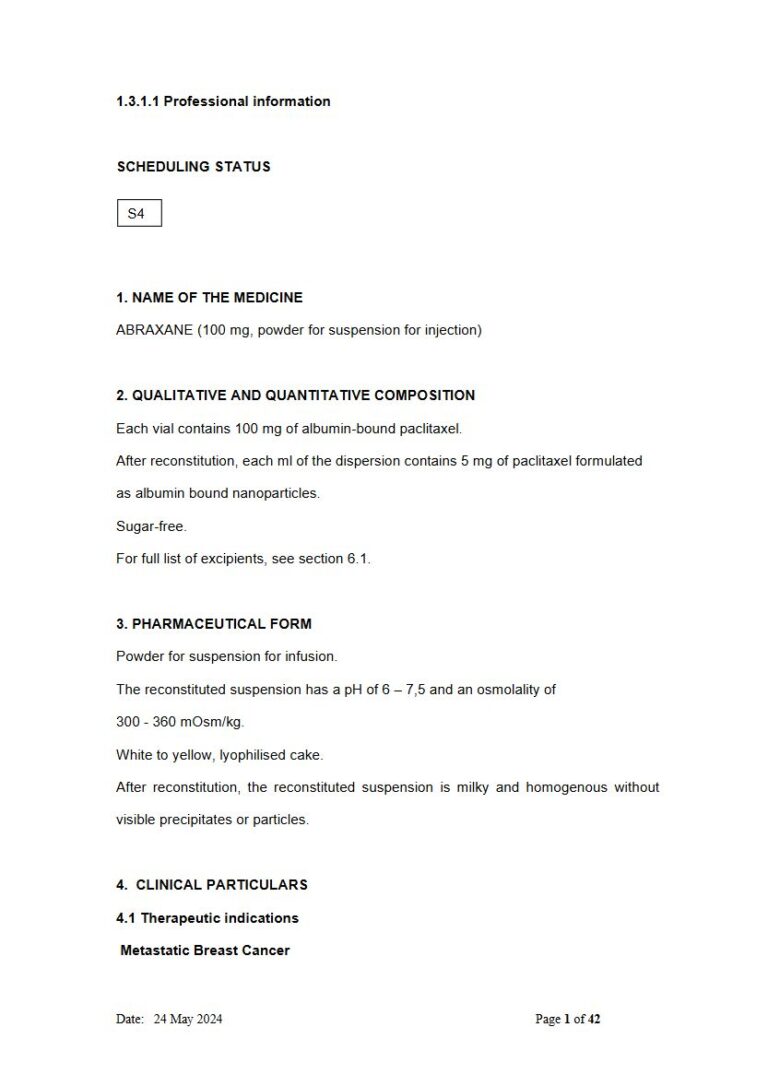
4.1 Therapeutic indications
Metastatic Breast Cancer
ABRAXANE is indicated for the treatment of breast cancer after failure of combination chemotherapy for metastatic disease or relapse within 6 months of adjuvant chemotherapy. Prior therapy should have included an anthracycline unless clinically contraindicated.
Non-Small Cell Lung Cancer
ABRAXANE, in combination with carboplatin, is indicated for the first-line treatment of non-small cell lung cancer in patients who are not candidates for potentially curative surgery and/or radiation therapy.
Adenocarcinoma of the Pancreas
ABRAXANE, in combination with gemcitabine, is indicated for the first-line treatment of patients with locally advanced unresectable or metastatic adenocarcinoma of the pancreas.
4.2 Posology and method of administration
Posology
ABRAXANE should be administered under the supervision of a medical practitioner experienced in the use of cancer chemotherapeutic medicines.
Metastatic Breast Cancer
The recommended dose of ABRAXANE is 260 mg/m2 administered intravenously over 30 minutes every 3 weeks.
Non-Small Cell Lung Cancer
The recommended dose of ABRAXANE is 100 mg/m2 administered as an intravenous infusion over 30 minutes on Days 1, 8, and 15 of each 21-day cycle.
Adenocarcinoma of the Pancreas
The recommended dose of ABRAXANE is 125 mg/m2 administered as an intravenous infusion over 30-40 minutes on Days 1, 8 and 15 of each 28-day cycle.
4.3 Contraindications
- ABRAXANE should not be used in patients who have baseline neutrophil counts of < 1 500 cells/mm3.
- ABRAXANE is contraindicated in patients with hypersensitivity to paclitaxel or to human albumin.
- ABRAXANE is contraindicated during pregnancy and lactation (see Section 4.6).
4.4 Special warnings and precautions for use
DO NOT SUBSTITUTE ABRAXANE FOR OR WITH OTHER PACLITAXEL FORMULATIONS. ABRAXANE is a formulation of paclitaxel which may have substantially different functional properties compared to those of solution formulations of paclitaxel.
Bone marrow suppression (primarily neutropenia) is dose dependent and a dose limiting toxicity. Frequent monitoring of blood counts should be instituted during ABRAXANE treatment.
Peripheral neuropathy occurs frequently with ABRAXANE. The occurrence of grade 1 or 2 peripheral neuropathy does not generally require dose modification.
4.5 Interactions with other medicines and other forms of interaction
The metabolism of paclitaxel is catalysed, in part, by cytochrome P450 isoenzymes CYP2C8 and CYP3A4. Therefore, caution should be exercised when administering ABRAXANE concomitantly with medicines known to inhibit or induce either CYP2C8 or CYP3A4.
4.6 Fertility, pregnancy and lactation
ABRAXANE is contraindicated in pregnancy and lactation. Women of childbearing potential should be advised to avoid becoming pregnant while receiving treatment with ABRAXANE.
4.7 Effects on ability to drive and use machines
Undesirable effects, such as dizziness, fatigue, somnolence, blurred vision, can affect the ability to operate machines or drive.
4.8 Undesirable effects
The most common clinically significant adverse reactions associated with the use of Abraxane have been neutropenia, peripheral neuropathy, arthralgia/myalgia and gastrointestinal disorders.
4.9 Overdose
There is no known antidote for ABRAXANE overdosage. The primary anticipated complications of overdosage would consist of bone marrow suppression, peripheral neuropathy and mucositis.
