
Taxol 30 mg/5 ml/100 mg/300 mg/50 ml Infusion
PDF Leaflet Revision Date: 02 April 2019
Clinical Summary
Quick overview from the medicine insert
Indication
Palliative treatment of advanced ovarian, breast, and lung cancers.
Dosage (summary)
175 mg/mu00b2 IV over 3 hours every 3 weeks; adjust for neutrophil count.
Special Populations
- Hepatic impairment
- Elderly
Pregnancy & Breastfeeding
Contraindicated in pregnancy; avoid breastfeeding during therapy.
Key Drug Interactions
- Ketoconazole may inhibit metabolism
- Increased doxorubicin levels when combined
Contraindications
- Severe hypersensitivity to TAXOL
- Neutrophils < 1500/mmu00b3
Common side effects
- Neutropenia
- Peripheral neuropathy
- Hypersensitivity reactions
- Nausea
- Vomiting
Counselling Points
- Premedicate with corticosteroids and antihistamines
- Monitor for hypersensitivity reactions
- Avoid pregnancy during treatment
Serious warnings
- Severe hypersensitivity reactions possible
- Bone marrow suppression
- Cardiac conduction abnormalities
Important Disclaimer
The Taxol 30 mg/5 ml/100 mg/300 mg/50 ml Infusion professional information leaflet below is the property of Equity Pharmaceuticals and is provided on Medinsert exactly as issued, with no.. alterations or editorial changes. We make every effort to keep content current by updating documents as soon as new versions become available. Medinsert serves as a trusted access point for healthcare professionals, but does not replace official sources or clinical judgement. For more details, please read our full disclaimer. read more>>
 Healthcare Professionals Only
This content is for registered healthcare professionals
Sign in or create a free account to read the full package insert.
Free for HPCSA-registered professionals. Powered by Medinsert.
Clinical Particulars
Section 4 of the official insert — extracted exactly as issued, no alterations
4.1 Therapeutic indications
TAXOL is indicated for:
- The palliative treatment of stage 3 or 4 advanced local carcinoma of the ovary after surgical resection, in combination with cisplatin.
- The palliative management of metastatic carcinoma of the ovary after failure of first line or subsequent chemotherapy.
- The treatment of metastatic carcinoma of the breast after failure of combination chemotherapy or relapse within 6 months of adjuvant chemotherapy. Prior therapy should have included an anthracycline unless clinically contra-indicated.
- First line therapy of advanced or metastatic breast cancer in combination with trastuzumab in patients who over-express HER-2 at a 2+ or 3+ level as determined by immunohistochemistry.
- Palliative treatment of advanced non-small cell lung cancer in patients who are not candidates for potentially curative surgery and/or radiation therapy.
4.2 Posology and method of administration
Dosage
Indication 1: Primary treatment of ovarian carcinoma: A combination regimen consisting of TAXOL 175 mg/m2 administered intravenously over 3 hours, followed by cisplatin, given every 3 weeks. Alternatively, a combination regimen consisting of TAXOL 135 mg/m2 administered over 24 hours, followed by cisplatin, every 3 weeks. TAXOL should be administered before cisplatin.
Indication 2 and 3: Secondary treatment of ovarian carcinoma: TAXOL at a dose of 175 mg/m2 administered intravenously over 3 hours every 3 weeks has been shown to be effective in patients with metastatic carcinoma of the ovary or breast after the failure of first line or subsequent chemotherapy.
Indication 4: Combination, first-line therapy of advanced or metastatic breast cancer: In combination with trastuzumab, the recommended dose of TAXOL is 175 mg/m2 administered intravenously over a period of 3 hours, with a 3 week interval between courses. TAXOL infusion may be started the day following the first dose of trastuzumab or immediately after the subsequent dose of trastuzumab if the preceding dose of trastuzumab was well tolerated.
Indication 5: Palliative treatment of advanced non-small cell lung carcinoma: The recommended dose of TAXOL is 175 mg/m2 administered over a period of 3 hours; followed by a platinum compound, with a 3 week interval between courses. TAXOL should not be re-administered until the neutrophil count is at least 1 500/mm3 and the platelet count is at least 100 000/mm3. Patients who experience severe neutropenia (neutrophil count < 500/mm3) or moderate to severe peripheral neuropathy should receive a dose reduction of 20 % for subsequent courses (see SIDE EFFECTS). The incidence and severity of neurotoxicity and haematologic toxicity increases with dose.
4.3 Contraindications
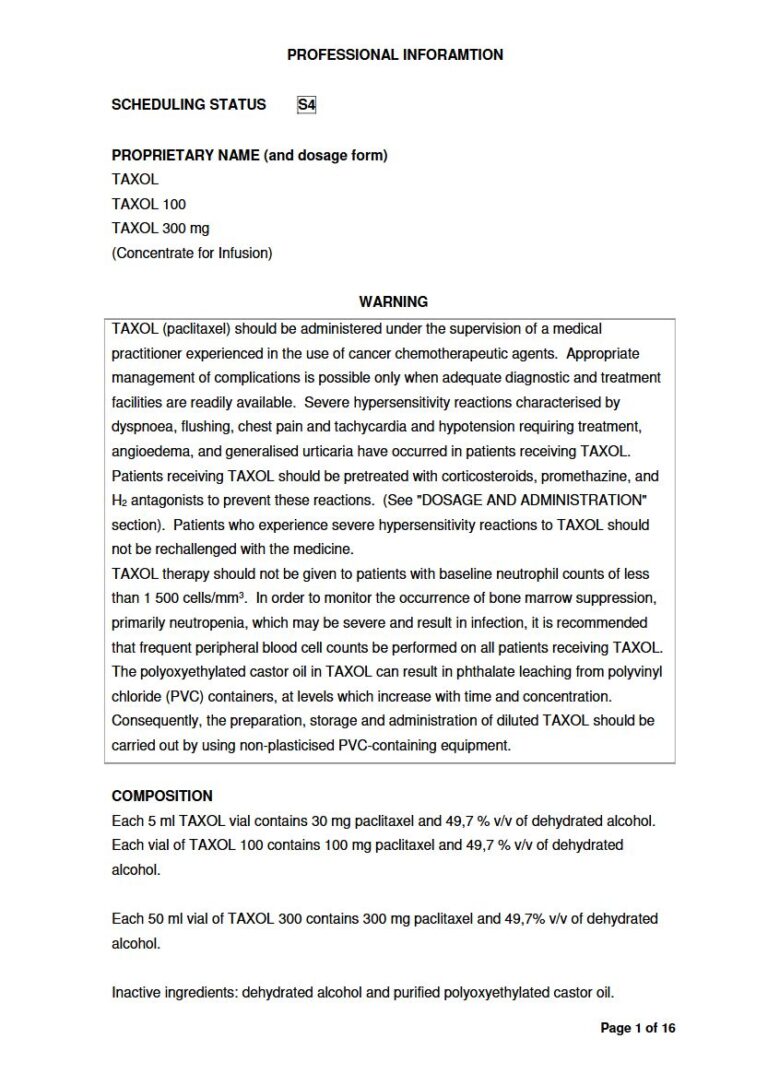
TAXOL is contra-indicated in patients who have a history of severe hypersensitivity reactions to TAXOL or other medicines formulated with polyoxyethylated castor oil. TAXOL should not be used in patients with baseline neutrophils < 1 500/mm3.
4.4 Special warnings and precautions for use
TAXOL should be administered under the supervision of a medical practitioner experienced in the use of cancer chemotherapeutic agents. Since severe hypersensitivity reactions may occur, appropriate supportive equipment should be available. TAXOL should be administered as a diluted infusion. TAXOL should be given before cisplatin when used in combination.
Patients should be pretreated with corticosteroids, antihistamines and H2 antagonists before receiving TAXOL. Anaphylaxis and severe hypersensitivity reactions characterised by dyspnoea, flushing, chest pain and tachycardia and hypotension requiring treatment, angioedema and generalised urticaria have occurred in patients receiving TAXOL. These reactions are probably histamine-mediated. Fatal reactions have occurred in patients despite pre-treatment. In cases of severe hypersensitivity reactions, TAXOL infusion should be immediately discontinued, symptomatic therapy should be initiated and the patient should not be rechallenged with paclitaxel. Minor hypersensitivity reactions such as flushing, skin reactions, not requiring treatment do not require interruption of therapy.
Bone marrow suppression (primary neutropenia) is the principal dose-limiting toxicity. Frequent monitoring of blood counts should be instituted during TAXOL treatment. Patients should not be retreated until neutrophils recover to a level > 1 500/mm3 and platelets recover to a level > 100 000/mm3. In cases of severe neutropenia (< 500 cells/mm3) during a course of TAXOL, a 20 % reduction in dose for subsequent courses of therapy is recommended. The incidence of neurotoxicity and the severity of neutropenia increase with dose within a regimen.
Cardiovascular: Severe cardiac conduction abnormalities have been reported. If patients develop significant conduction abnormalities during TAXOL administration, appropriate therapy should be administered and continuous cardiac monitoring should be performed during subsequent therapy with TAXOL. Severe cardiovascular events were observed more frequently in patients with non-small cell lung carcinoma than breast or ovarian carcinoma. Hypotension, hypertension and bradycardia have been observed during administration of TAXOL, but generally do not require treatment. In severe cases TAXOL infusions may need to be interrupted or discontinued at the discretion of the treating medical practitioner. Frequent vital sign monitoring, particularly during the first hour of TAXOL infusion, is recommended. Continuous cardiac monitoring is not required except for patients with serious conduction abnormalities. When TAXOL is used in combination with trastuzumab for treatment of metastatic breast cancer, monitoring of cardiac function is recommended.
Neurologic: Cross-study comparison of neurotoxicity suggests that when TAXOL is given in combination with cisplatin, the incidence of severe neurotoxicity is more common at a TAXOL dose of 175 mg/m2 given by 3-hour infusion (21 %), than at a dose of 135 mg/m2 given by 24-hour infusion (3 %). TAXOL contains dehydrated alcohol, 396 mg/ml. Consideration should be given to possible central nervous system and other effects of alcohol for all patients. Children may be more sensitive than adults to the effects of alcohol. Although the occurrence of peripheral neuropathy is frequent, the development of moderate to severe symptomatology is unusual and requires a dose reduction of 20 % for all subsequent courses of TAXOL.
Hepatic: Patients with hepatic impairment may be at increased risk of toxicity particularly grade III-IV myelosuppression. Dose adjustment is recommended. Patients should be monitored closely for the development of profound myelosuppression. Hepatic necrosis and hepatic encephalopathy leading to death have been reported. Elevations in alkaline phosphatase and AST (SGOT) have been reported.
Injection site reaction: A specific treatment for extravasation reactions is unknown. Given the possibility of extravasation, it is advisable to closely monitor the infusion site for possible infiltration during medicine administration.
Paediatric Use: The safety and effectiveness of TAXOL in children have not been established. There have been reports of central nervous system toxicity (including death) in a clinical trial in paediatric patients in which TAXOL was infused intravenously over 3 hours at doses ranging from 350 mg/m2 to 420 mg/m2. The toxicity is most likely attributable to the high dose of the ethanol component of the TAXOL vehicle given over a short infusion time. The use of concomitant anti-histamines may intensify this effect. Although a direct effect of the paclitaxel itself cannot be discounted, the high doses used in this study (over twice the recommended adult dose) must be considered in assessing the safety of TAXOL for use in this population.
4.5 Interactions with other medicines
The recommended regimen of TAXOL administration for the primary treatment of ovarian carcinoma is for TAXOL to be given before cisplatin. When TAXOL is given before cisplatin, the safety profile of TAXOL is consistent with that reported for single agent use. When TAXOL was given after cisplatin, patients showed a more profound myelosuppression and an approximately 33 % decrease in paclitaxel clearance.
Medications concomitantly administered with TAXOL (e.g., corticosteroids, antihistamines, and H2 antagonists) did not appear to interact adversely; however, possible interactions of TAXOL with concomitantly administered medications have not been formally investigated.
Based on in vitro data, there is the possibility of an inhibition of TAXOL metabolism in patients treated with ketoconazole. As a result, caution should be exercised when treating patients with TAXOL when they are receiving ketoconazole as concomitant therapy. Plasma levels of doxorubicin and doxorubicinol may be increased when paclitaxel and doxorubicin are used in combination. Sequence effects characterised by more profound neutropenic and stomatitis episodes, have been observed with combination use of TAXOL and doxorubicin when TAXOL was administered BEFORE doxorubicin and using longer than recommended infusion times.
The metabolism of paclitaxel is catalysed by cytochrome P450 isoenzymes CYP2C8 and CYP3A4. In the absence of formal clinical interaction studies, caution should be exercised when administering TAXOL concomitantly with known substrates, inducers or inhibitors of these isoenzymes.
Contact of the undiluted concentrate with plasticised polyvinyl chloride (PVC) equipment or devices used to prepare solutions for infusion is not recommended. In order to minimise patient exposure to the plasticiser DEHP [di-(2-ethylhexyl)phthalate], which may be leached from PVC infusion bags or sets, diluted TAXOL solutions should preferably be stored in bottles (glass, polypropylene) or plastic bags (polypropylene, polyolefin) and administered through polyethylene-lined administration sets. TAXOL should be administered through an in-line filter with a microporous membrane not greater that 0,22 microns. Use of filter devices such as IVEX-2 filters which incorporate short inlet and outlet PVC-coated tubing has not resulted in significant leaching of DEHP.
4.6 Fertility, pregnancy and lactation
TAXOL has been shown to be embryotoxic, fetotoxic and to decrease fertility in animal studies. There is no information on the use of TAXOL in pregnant women. TAXOL may cause foetal harm when administered to pregnant women. TAXOL should not be used during pregnancy. Women of childbearing potential should be advised to avoid becoming pregnant during therapy with TAXOL, and to inform the treating medical practitioner immediately should this occur. It is not known whether TAXOL is excreted in human milk. Breastfeeding should be discontinued for the duration of TAXOL therapy.
4.8 Undesirable effects
The frequency and severity of adverse events are generally similar between patients receiving TAXOL for the treatment of ovarian, breast or lung carcinoma. Unless otherwise noted, the following discussion refers to the overall safety database of 812 patients with solid tumours treated with single-agent TAXOL in clinical studies administered as one of two doses (135 or 175 mg/m2) and one of the two schedules (3 or 24 hours) in the metastatic setting.
Haematologic toxicities: Bone marrow suppression was the major dose-limiting toxicity of TAXOL. Neutropenia, the most important haematologic toxicity, was dose and schedule dependent and was generally rapidly reversible. Severe neutropenia (< 500 cells/mm3) was more frequent with the 24-hour than with the 3-hour infusion; infusion duration had a greater impact on myelosuppression than dose. Neutropenia did not appear to increase with cumulative exposure and did not appear to be more frequent nor more severe for patients previously treated with radiation therapy. Infectious episodes occurred very commonly and were fatal in 1 % of all patients, and included sepsis, pneumonia and peritonitis. Urinary tract infections and upper respiratory tract infections were the most frequently reported infectious complications. The use of supportive therapy, including G-CSF, is recommended for patients who have experienced severe neutropenia.
Twenty percent of the patients experienced a drop in their platelet count below 100 000 cells/mm3 at least once while on treatment; 7 % had a platelet count < 50 000 cells/mm3 at the time of their worst nadir. Bleeding episodes were reported in 4 % of all courses and by 14 % of all patients, but most of the haemorrhagic episodes were localised and the frequency of these events was unrelated to the TAXOL dose and schedule.
Neurologic: In general, the frequency and severity of neurologic manifestations were dose dependent in patients receiving single-agent TAXOL. The frequency of peripheral neuropathy increased with cumulative dose. Paraesthesia commonly occurs in the form of hyperesthesia. Peripheral neuropathy was the cause of TAXOL discontinuation in 1 % of all patients. Sensory symptoms have usually improved or resolved within several months of TAXOL discontinuation. Pre-existing neuropathies resulting from prior therapies are not a contra-indication for TAXOL therapy. Rare reports in the literature of abnormal visual evoked potentials in patients have suggested persistent optic nerve damage.
Hypersensitivity Reactions (HSR): All patients in clinical trials received premedication prior to TAXOL therapy. The frequency and severity of HSR were not affected by the dose or schedule of TAXOL administration. The most frequent symptoms observed during these severe reactions were dyspnoea, flushing, chest pain and tachycardia. Abdominal pain, pain in the extremities, diaphoresis, and hypertension are also noted. Minor hypersensitivity reactions, mainly flushing and rash, did not require therapeutic intervention nor did they prevent continuation of TAXOL therapy.
Injection site reactions: During intravenous administration, injection site reactions were usually mild and consisted of localised oedema, pain, erythema, tenderness, and induration; on occasion, extravasation can result in cellulitis. Skin sloughing and/or peeling has been reported, sometimes related to extravasation. Skin discolouration may also occur. These reactions have been observed more frequently with the 24-hour infusion than with the 3-hour infusion. In some cases the onset of the injection site reaction either occurred during a prolonged infusion or was delayed by a week to 10 days.
Cardiovascular: Hypotension, during the first 3 hours of infusion, occurred in 12 % of all patients and 3 % of all courses administered. Bradycardia, during the first 3 hours of infusion, occurred in 3 % of all patients and 1 % of all courses. ECG alterations in the form of re-polarisation abnormalities like sinus tachycardia, sinus bradycardia, and premature beats have been observed in clinical studies. Severe cardiac conduction abnormalities have been reported in < 1 % of patients during TAXOL therapy. If patients develop significant conduction abnormalities during TAXOL administration, appropriate therapy should be administered and continuous electrocardiographic monitoring should be performed during subsequent therapy with TAXOL.
Gastrointestinal (GI) Toxicity: Mild to moderate nausea/vomiting, diarrhoea and mucositis (also reported as pharyngitis or chelitis) were reported very commonly by all patients. Mucositis was schedule dependent and occurred more frequently with the 24-hour than with the 3-hour infusion. Rare reports of neutropenic enterocolitis (typhlitis), despite the co-administration of G-CSF, were observed in patients treated with TAXOL alone and in combination with other chemotherapeutic agents.
4.9 Overdose
There is no antidote for TAXOL overdosage. The primary anticipated complications of overdosage would consist of bone marrow suppression, peripheral neurotoxicity and mucositis. Overdoses in paediatric patients may be associated with acute ethanol toxicity.
