
Adco Acyclovir 200mg Tablets
PDF Leaflet Revision Date: 08 November 2024
Clinical Summary
Quick overview from the medicine insert
Indication
Treatment and prophylaxis of Herpes simplex and Varicella zoster infections.
Dosage (summary)
200 mg five times daily for Herpes simplex; 800 mg five times daily for Varicella zoster.
Special Populations
- Elderly
- Renal impairment
Pregnancy & Breastfeeding
Safety in pregnancy and lactation not established; passes into breast milk.
Key Drug Interactions
- Probenecid
- Cimetidine
- Theophylline
Contraindications
- Hypersensitivity to acyclovir or excipients
Common side effects
- Headache
- Dizziness
- Nausea
- Vomiting
- Fatigue
Counselling Points
- Maintain hydration
- Monitor for skin reactions
- Avoid driving if dizzy
Serious warnings
- Risk of DRESS
- Renal impairment monitoring required
Important Disclaimer
The Adco Acyclovir 200mg Tablets professional information leaflet below is the property of Adcock Ingram and is provided on Medinsert exactly as issued, with no.. alterations or editorial changes. We make every effort to keep content current by updating documents as soon as new versions become available. Medinsert serves as a trusted access point for healthcare professionals, but does not replace official sources or clinical judgement. For more details, please read our full disclaimer. read more>>
 Healthcare Professionals Only
This content is for registered healthcare professionals
Sign in or create a free account to read the full package insert.
Free for HPCSA-registered professionals. Powered by Medinsert.
Clinical Particulars
Section 4 of the official insert — extracted exactly as issued, no alterations
4.1 Therapeutic indications
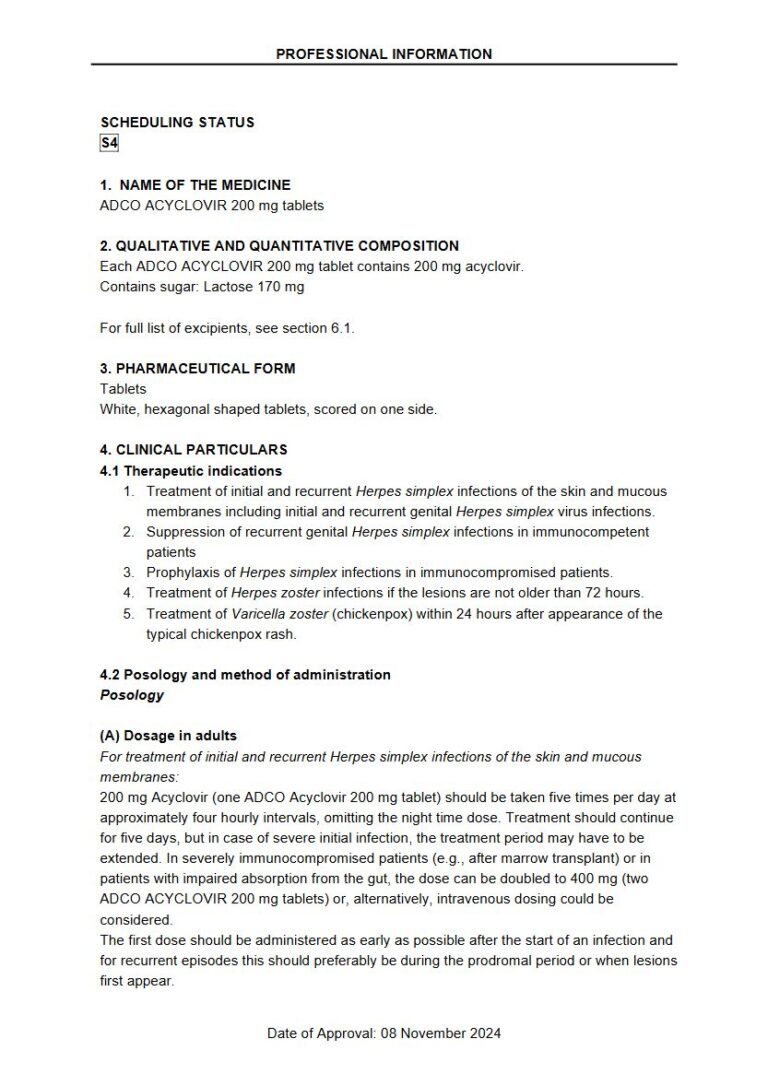
1. Treatment of initial and recurrent Herpes simplex infections of the skin and mucous membranes including initial and recurrent genital Herpes simplex virus infections.
2. Suppression of recurrent genital Herpes simplex infections in immunocompetent patients
3. Prophylaxis of Herpes simplex infections in immunocompromised patients.
4. Treatment of Herpes zoster infections if the lesions are not older than 72 hours.
5. Treatment of Varicella zoster (chickenpox) within 24 hours after appearance of the typical chickenpox rash.
4.2 Posology and method of administration
Posology
(A) Dosage in adults
For treatment of initial and recurrent Herpes simplex infections of the skin and mucous membranes: 200 mg Acyclovir (one ADCO Acyclovir 200 mg tablet) should be taken five times per day at approximately four hourly intervals, omitting the night time dose. Treatment should continue for five days, but in case of severe initial infection, the treatment period may have to be extended. In severely immunocompromised patients (e.g., after marrow transplant) or in patients with impaired absorption from the gut, the dose can be doubled to 400 mg (two ADCO ACYCLOVIR 200 mg tablets) or, alternatively, intravenous dosing could be considered. The first dose should be administered as early as possible after the start of an infection and for recurrent episodes this should preferably be during the prodromal period or when lesions first appear.
For suppression of recurrent genital Herpes simplex infections in immunocompetent adults: A dose of 200 mg acyclovir (one ADCO ACYCLOVIR 200 mg tablet) should be taken four times daily at approximately six-hourly intervals. Many patients may be conveniently managed on a regimen of 400 mg (two ADCO ACYCLOVIR 200 mg tablets) of oral acyclovir taken twice daily at approximately twelve-hourly intervals. Dosage titration down to 200 mg oral acyclovir taken at approximately eight-hourly intervals or even twice daily at approximately twelve-hourly intervals may prove effective. Some patients may experience break-through infections on total doses of 800 mg acyclovir (four ADCO ACYCLOVIR 200 mg tablets). Therapy should be interrupted periodically at intervals of six to twelve months, in order to observe possible changes in the natural history of the disease.
For prophylaxis of Herpes simplex infections in immunocompromised adults: 200 mg Acyclovir should be taken four times daily at approximately six-hourly intervals. In severely immunocompromised patients (e.g., after marrow transplant) or in patients with impaired absorption from the gut, the dose can be doubled to 400 mg (two ADCO ACYCLOVIR 200 mg tablets), or alternatively, intravenous dosing could be considered. The duration of prophylactic administration is determined by the duration of the period at risk.
For treatment of Varicella zoster infections in adolescents (12 to 18 years): A dose of 800 mg oral acyclovir (four ADCO ACYCLOVIR 200 mg tablets) should be taken daily for five days.
For treatment of Varicella zoster and Herpes zoster infections in adults: A dose of 800 mg oral acyclovir (four ADCO ACYCLOVIR 200 mg tablets) should be taken five times daily at approximately four-hourly intervals, omitting the night time dose. Treatment should continue for seven days. In severely immunocompromised patients (e.g., after marrow transplant) or in patients with impaired absorption from the gut, consideration should be given to intravenous dosing. Dosing should begin as early as possible after the start of an infection: treatment yields better results if initiated as soon as possible after rash onset.
Special populations
(B) Dosage in the elderly: In the elderly, total acyclovir body clearance declines, thus adequate hydration should be maintained. Special attention should be given to dosage reduction in elderly patients with impaired renal function.
(C) Dosage in renal impairment: Dosage should be reduced in renal failure. The following is recommended:
Normal dosage regimen Creatinine clearance (ml/min) Adjusted dosage regimen Dose (mg) Dosing interval
200 mg every four hours for Herpes simplex infections 0 to 10 200 every 12 hours
800 mg every four hours for Varicella zoster infections > 25 10 to 25 0 to 10 800 800 800 every 4 hours 5 times daily every 8 hours every 12 hours
Patients on haemodialysis should receive their usual appropriate daily dose after each dialysis.
Paediatric population: Orally administered acyclovir in children less than 2 years of age has not yet been fully studied.
Method of administration: Oral.
4.3 Contraindications
- Hypersensitivity to acyclovir, valacyclovir or any of the excipients listed in section 6.1.
- Safety in pregnancy and lactation has not been established.
4.4 Special warnings and precautions for use
Use in patients with renal impairment and in elderly patients: Acyclovir as contained in ADCO ACYCLOVIR 200 mg, is eliminated by renal clearance, therefore the dose must be adjusted in patients with renal impairment (section 4.2). Elderly patients are likely to have reduced renal function and therefore the need for dose adjustment must be considered in this group of patients. Both elderly patients and patients with renal impairment are at increased risk of developing neurological side effects and should be closely monitored for evidence of these effects. In the reported cases, these reactions may be reversible on discontinuation of treatment (see section 4.8).
Hydration status: Care should be taken to maintain adequate hydration in patients receiving high oral doses of acyclovir as contained in ADCO ACYCLOVIR 200 mg.
Severe cutaneous adverse reactions (SCARs): Drug reaction with eosinophilia and systemic symptoms (DRESS) DRESS, which can be life-threatening or fatal, has been reported in associate with ADCO ACYCLOVIR 200 mg treatment. At the time of prescription patients should be advised of the signs and symptoms and monitored closely for skin reactions. If signs and symptoms suggestive of DRESS appear, ADCO ACYCLOVIR 200 mg should be withdrawn immediately, and an alternative treatment considered (as appropriate). If the patient has developed DRESS with the use of ADCO ACYCLOVIR 200 mg, treatment with ADCO ACYCLOVIR 200 mg must not be restarted in this patient at any time.
Excipients: ADCO ACYCLOVIR 200 mg contains lactose. Patients with rare hereditary problems of galactose intolerance, total lactase deficiency or glucose-galactose malabsorption should not take this medicine. ADCO ACYCLOVIR 200 mg contains less than 1 mmol sodium (23 mg) per tablet, that is to say, it is essentially 'sodium-free'.
4.5 Interaction with other medicines and other forms of interaction
- Acyclovir as contained in ADCO ACYCLOVIR 200 mg, is eliminated primarily unchanged in the urine via active renal tubular secretion. Any medicines administered concurrently that compete with this mechanism may increase the plasma concentrations of ADCO ACYCLOVIR 200 mg. Probenecid and cimetidine increases, the AUC of ADCO ACYCLOVIR 200 mg by this mechanism, and reduces ADCO ACYCLOVIR 200 mg renal clearance.
- Similarly, increases in plasma AUCs of acyclovir contained in ADCO ACYCLOVIR 200 mg and of the inactive metabolite of mycophenolate mofetil, an immunosuppressant medicine used in transplant patients have been shown when the medicines are co-administered.
- Available data indicates that acyclovir as contained in ADCO ACYCLOVIR 200 mg may increase the AUC of totally administered theophylline when administered concomitantly. It is thus recommended to measure plasma concentrations of theophylline during concomitant treatment with ADCO ACYCLOVIR 200 mg.
4.6 Fertility, pregnancy and lactation
Pregnancy: Safety in pregnancy has not been established.
Lactation: Acyclovir does pass into the breast milk. Safety in lactation has not been established.
Fertility: No data available.
4.7 Effects on ability to drive and use machines
ADCO ACYCLOVIR 200 mg can cause dizziness. If affected, patients should not drive or operate machinery.
4.8 Undesirable effects
System Organ Class Frequency Side effects
Blood and the lymphatic system disorders: Less frequent Small decreases in haematological indices (anaemia, leukopenia, thrombocytopenia)
Immune system disorders: Less frequent Anaphylaxis, angioedema.
*Psychiatric and nervous system disorders: Frequent Headache, dizziness. Less frequent Agitation, confusion, tremor, ataxia, dysarthria, hallucinations, psychotic symptoms, convulsions, somnolence, encephalopathy, coma.
Respiratory, thoracic and mediastinal disorders: Less frequent Dyspnoea.
Gastrointestinal disorders: Frequent Nausea, vomiting, diarrhoea, abdominal pains.
Hepato-biliary disorders: Less frequent Reversible rises in bilirubin and liver related enzymes, hepatitis, jaundice.
Skin and subcutaneous tissue disorders: Frequent Pruritus, skin rashes photosensitivity urticaria, accelerated diffuse hair loss.
Renal and urinary disorders: Less frequent Increases in blood urea and creatinine, acute renal failure, renal pain, Renal pain may be associated with renal failure and crystalluria.
General disorders and administration site conditions Frequent Fatigue, fever.
* The above symptoms are usually reversible and are generally reported in patients with renal impairment (see section 4.4).
Post-marketing experience: The following adverse reaction has been identified during post approval use of ADCO ACYCLOVIR 200 mg . Immune: Drug reaction with eosinophilia and systemic symptoms (DRESS) (see Section 4.4).
Reporting of suspected adverse reactions: Reporting suspected adverse reactions after authorisation of the medicine is important. It allows continued monitoring of the benefit/risk balance of the medicine. Healthcare providers are asked to report any suspected adverse reactions to SAHPRA via the u201c 6.04 Adverse Drug Reactions Reporting Form u201d, found online under SAHPRAu2019s publications: https://www.sahpra.org.za/Publications/Index/8 . You may also report to Adcock Ingram Limited using the following e-mail address: [email protected] .
4.9 Overdose
Ingestion of doses of acyclovir in excess of 5 g warrants close observation of the patient. Acyclovir is dialysable. Treatment is symptomatic and supportive.
Symptoms and signs: Accidental, repeated overdoses of oral acyclovir over several days have been associated with gastrointestinal effects (such as nausea and vomiting) and neurological effects (headache and confusion). Overdosage of IV acyclovir has resulted in elevations of serum creatinine, blood urea nitrogen and subsequent renal failure. Neurological effects including confusion, hallucinations, agitation, seizures and coma have been described in association with intravenous overdosage.
Management: Patients should be observed closely for signs of toxicity. Haemodialysis significantly enhances the removal of acyclovir from the blood and may, therefore, be considered a management option in the event of symptomatic overdose.
