
Betnesol-N Eye, Ear & Nose Drops
PDF Leaflet Revision Date: 21 October 2022
Clinical Summary
Quick overview from the medicine insert
Indication
Non-infected inflammatory conditions of the eye, ear, and nasal allergies.
Dosage (summary)
EYE: 1-2 drops every 1-2 hours; EAR: 2-3 drops every 2-3 hours; NOSE: 2-3 drops 2-3 times daily.
Special Populations
- Children
- Elderly
- Renal impairment
- Hepatic impairment
Pregnancy & Breastfeeding
Not recommended in pregnancy and lactation due to potential risks.
Key Drug Interactions
- CYP3A inhibitors may increase systemic side effects
Contraindications
- Hypersensitivity
- Viral infections
- Fungal infections
- Glaucoma
Common side effects
- Ototoxicity
- Visual disturbances
- Skin sensitization
- Nasal irritation
Counselling Points
- Avoid use in soft contact lens wearers
- Monitor for visual disturbances
- Do not exceed recommended duration of use
Serious warnings
- Risk of blindness with 'red eyes'
- Prolonged use may lead to infections
- Increased intraocular pressure
Important Disclaimer
The Betnesol-N Eye, Ear & Nose Drops professional information leaflet below is the property of Adcock Ingram and is provided on Medinsert exactly as issued, with no.. alterations or editorial changes. We make every effort to keep content current by updating documents as soon as new versions become available. Medinsert serves as a trusted access point for healthcare professionals, but does not replace official sources or clinical judgement. For more details, please read our full disclaimer. read more>>
 Healthcare Professionals Only
This content is for registered healthcare professionals
Sign in or create a free account to read the full package insert.
Free for HPCSA-registered professionals. Powered by Medinsert.
Clinical Particulars
Section 4 of the official insert — extracted exactly as issued, no alterations
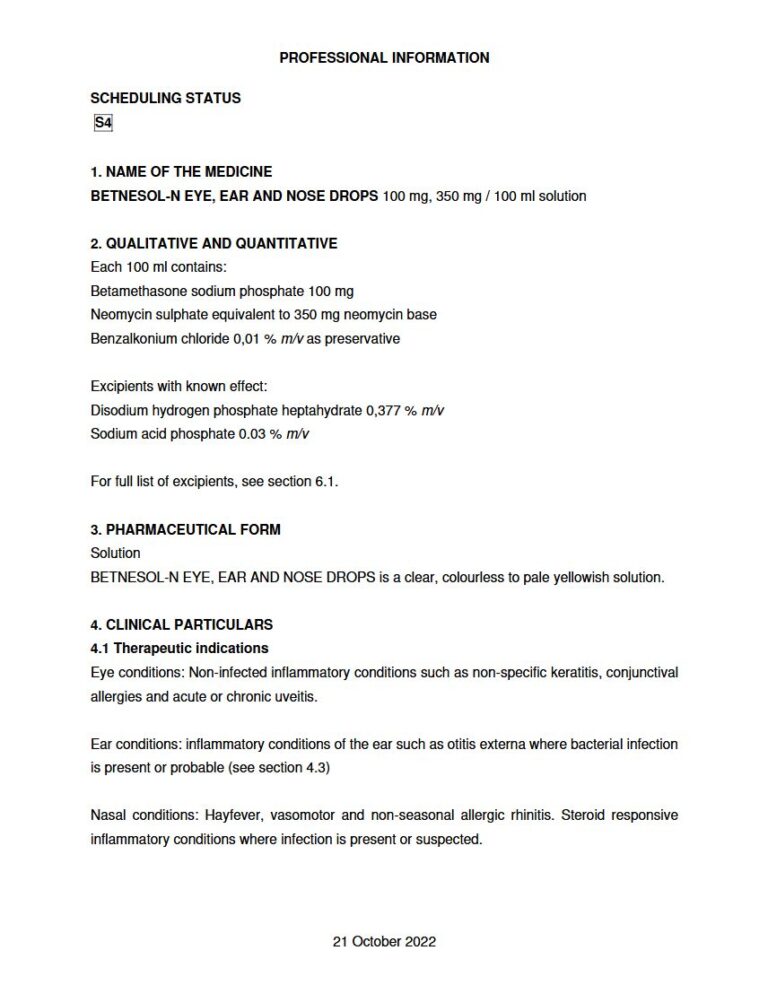
4.1 Therapeutic indications
Eye conditions: Non-infected inflammatory conditions such as non-specific keratitis, conjunctival allergies and acute or chronic uveitis.
Ear conditions: inflammatory conditions of the ear such as otitis externa where bacterial infection is present or probable (see section 4.3)
Nasal conditions: Hayfever, vasomotor and non-seasonal allergic rhinitis. Steroid responsive inflammatory conditions where infection is present or suspected.
4.2 Posology and method of administration
Posology
EYE: One or two drops to be instilled into the eye every one or two hours until control is achieved, then the frequency may be reduced.
EAR: Two to three drops to be instilled into the ear every two or three hours until control is achieved, then the frequency may be reduced.
NOSE: Two or three drops to be instilled into each nostril two or three times daily.
Because of the possibility of inducing corneal abscess, fungal keratopathy or glaucoma, the patient should be referred to an ophthalmologist if the eye has not responded within 48 hours (see section 4.4 and 4.8).
Paediatric population
BETNESOL-N EYE, EAR AND NOSE DROPS is suitable for use in children at the same dose as adults, but the dose should be reduced in infants. BETNESOL-N EYE, EAR AND NOSE DROPS is not recommended for use in neonates (see section 4.3 and 4.4). Due to the growth retardation that has been reported in children receiving nasal corticosteroids such as BETNESOL-N EYE, EAR AND NOSE DROPS, the lowest dose at which effective control of symptoms is maintained should be used. Additionally, consideration should also be given to referring the patient to a paediatric specialist. (see section 4.4 and 4.8).
In infants, long-term continuous topical therapy should be avoided where possible, as adrenal suppression can occur even without occlusion. The least potent corticosteroid which will control the disease should be selected (see section 4.4 and 4.8).
4.3 Contraindications
- Hypersensitivity to the active substances or to any of the excipients listed in section 6.1.
- Viral, fungal, tuberculous and purulent infections.
- Possibility of herpetic keratitis.
- Glaucoma.
- Due to the risk of ototoxicity, preparations containing neomycin should not be used until an intact tympanic membrane has been visualised.
- BETNESOL-N EYE, EAR AND NOSE DROPS contain benzalkonium chloride as a preservative and therefore should not be used to treat patients who wear soft lenses (see section 4.4).
- A possibility of increased absorption exists in very young children, thus Betnesol-N EYE, EAR AND NOSE DROPS is not recommended for use in neonates (see 4.2 and 4.4).
- BETNESOL-N EYE, EAR AND NOSE DROPS is not recommended in pregnancy and lactation (see section 4.6).
4.4 Special warnings and precautions for use
Do not administer to u201cred eyesu201d until a definitive diagnosis is made as inappropriate use could lead to blindness.
Treatment with corticosteroid preparations should not be repeated or prolonged without regular review to exclude raised intraocular pressure, cataract formation or unsuspected infections (see section 4.2 and 4.8).
Treatment with corticosteroid/antibiotic combinations should not be continued for more than 7 days in the absence of any clinical improvement, since prolonged use may lead to occult extension of infection due to the masking effect of the steroid (see 4.2 and 4.8).
Prolonged use may also lead to skin sensitisation.
The unnecessary topical use of neomycin-containing products should be avoided in order to minimise occurrence of neomycin resistant organisms. Acute sensitisation to neomycin has been reported.
Eye preparations containing corticosteroids can cause a serious rise in intra-ocular pressure in a small percentage of the population. A milder rise in ocular tension may be experienced by a larger proportion of subjects if treatment is continued for no longer than a few weeks (see section 4.8).
Because of the possibility of inducing corneal abscess, fungal keratopathy or glaucoma, the patient should be referred to an ophthalmologist if the eye has not responded within 48 hours (see section 4.2 and 4.8).
Visual disturbance may be reported with systemic and topical corticosteroid use. If a patient presents with symptoms such as blurred vision or other visual disturbances, the patient should be considered for referral to an ophthalmologist for evaluation of possible causes which may include cataract, glaucoma or rare diseases such as central serous chorioretinopathy (CSCR) which have been reported after use of systemic and topical corticosteroids (see section 4.2 and 4.8).
In diseases causing thinning of the cornea, perforation has occurred with use of ophthalmic corticosteroids (see section 4.5, and 4.8).
Cataract is reported to have occurred after unduly prolonged treatment of eye conditions with ophthalmic corticosteroids.
Aminoglycoside antibiotics, such as the neomycin in BETNESOL-N EYE, EAR AND NOSE DROPS may cause irreversible, partial or total deafness when given systemically or when applied topically to open wounds or damaged skin. This effect is dose related and is enhanced by renal or hepatic impairment (see section 4.8). Although this effect has not been reported following topical ocular use, the possibility should be considered when high dose topical treatment is given to infants or small children.
There have been observed cases of an increased risk of ototoxicity with aminoglycosides administered to patients with mitochondrial mutations, particularly the m.1555A>G mutation, including cases where the patient's aminoglycoside serum levels were within the recommended range. Some cases were associated with a maternal history of deafness and/or mitochondrial mutation (see section 4.5 and 4.8). While no cases were identified with neomycin, based on a shared mechanism of action there is the potential for a similar effect with neomycin.
These mitochondrial mutations are rare, and the penetrance of this observed effect is unknown.
Nasal administration of corticosteroids is not advised if an untreated nasal infection is present or if the patient has pulmonary tuberculosis or following nasal surgery (until healing has occurred).
Systemic effects of nasal corticosteroids may occur, particularly at high doses prescribed for prolonged periods. These effects are much less likely to occur than with oral corticosteroids and may vary in individual patients and between different corticosteroid preparations (See section 4.8).
4.5 Interaction with other medicines and other forms of interaction
Co-treatment with CYP3A inhibitors, including cobicistat containing products, is expected to increase the risk of systemic side-effects. The combination should be avoided unless the benefit outweighs the increased risk of systemic corticosteroid side-effects, in which case patients should be monitored for systemic corticosteroid side-effects.
BETNESOL-N EYE, EAR AND NOSE DROPS contains benzalkonium chloride as a preservative and therefore, should not be used to treat patients who wear soft contact lenses (see section 4.3 and 4.4).
Special populations
In diseases causing thinning of the cornea, perforation has occurred with use of ophthalmic corticosteroids (see section 4.4 and 4.8).
In those diseases causing thinning of the cornea or sclera, use of BETNESOL-N EYE, EAR AND NOSE DROPS may result in thinning of the globe leading to perforation (see section 4.4).
There have been observed cases of an increased risk of ototoxicity with aminoglycosides administered to patients with mitochondrial mutations, particularly the m.1555A>G mutation, including cases where the patient's aminoglycoside serum levels were within the recommended range. Some cases were associated with a maternal history of deafness and/or mitochondrial mutation (see section 4.4 and 4.8).
4.6 Fertility, pregnancy and lactation
Pregnancy
Corticosteroids included in BETNESOL-N EYE, EAR AND NOSE DROPS have been shown to be teratogenic in animals following dermal application. As these medicines are absorbed percutaneously, teratogenicity following topical application cannot be excluded. Therefore, BETNESOL-N EYE, EAR AND NOSE DROPS should not be used during pregnancy (see section 4.3).
There is little information to demonstrate the possible effect of topically applied neomycin in pregnancy and lactation. However neomycin present in maternal blood can cross the placenta and may give rise to a theoretical risk of foetal ototoxicity. For this reason, BETNESOL-N EYE, EAR AND NOSE DROPS is not recommended in pregnancy and lactation.
Breastfeeding
BETNESOL-N EYE, EAR AND NOSE DROPS should not be used while breastfeeding (see section 4.3).
Fertility
No data is available.
4.7 Effects on ability to drive and use machines
May cause transient blurring of vision on instillation. Patients should be warned not to drive or operate hazardous machinery unless vision is clear.
BETNESOL-N EYE, EAR AND NOSE DROPS has a moderate influence on the ability to drive and use machines.
4.8 Undesirable effects
a) Summary of the safety profile
Treatment with corticosteroid preparations should not be prolonged without regular review to exclude raised intraocular pressure, cataract formation, unsuspected infections, occult extension of infection due to the masking effect of the steroid, skin sensitization, the emergence of resistant organisms and irritation or swelling inside the nose (see section 4.2 and 4.4).
The irreversible, partial or total deafness that is a possible side effect due to the neomycin (an aminoglycoside antibiotic) in BETNESOL-N EYE, EAR AND NOSE DROPS effect is dose related and is enhanced by renal or hepatic impairment (see section 4.4).
Systemic effects of nasal corticosteroids may occur, particularly at high doses prescribed for prolonged periods. These effects are much less likely to occur than with oral corticosteroids and may vary in individual patients and between different corticosteroid preparations (see section 4.4).
b) Tabulated list of adverse reactions
System organ class
Frequent
Less frequent
Frequency unknown (cannot be estimated from the available data)
Infections and Infestations
Unsuspected infections, occult extension of infection due to the masking effect of the steroid (see section 4.4)
Immune system disorders
Acute sensitization to neomycin (see section 4.4).
Endocrine disorders
Cushingu2019s syndrome, Cushingoid features, adrenal suppression, growth retardation in children and adolescents.
Psychiatric disorders
Psychological or behavioural effects including psychomotor hyperactivity, sleep disorders, anxiety, depression or aggression (particularly in children)
Eye disorders
Mild rise in ocular tension (see section 4.8 c).
Serious rise in intra-ocular pressure (see section 4.8 c).
Blindness, raised intraocular pressure, cataracts, corneal abscess, fungal keratopathy, glaucoma, blurred vision, visual disturbances, central serous chorioretinopathy (CSCR), corneal perforation, thinning of the globe leading to perforation adverse effects on corneal permeability, disruption of the corneal epithelium, eye irritation, cloudy patches on the cornea due to calcium build-up, (see section 4.4).
Corneal ulceration, mydriasis, ptosis, epithelial punctate keratitis.
Ear and labyrinth disorders
Ototoxicity (see section 4.4).
Irreversible, partial or total deafness (see section 4.4).
Respiratory, thoracic and
Irritation or swelling inside the nose (see section 4.4), bronchial asthma.
System organ class
Frequent
Less frequent
Frequency unknown (cannot be estimated from the available data)
Mediastinal disorders
Gastrointestinal disorders
Nausea
Skin and subcutaneous tissue disorders
Skin sensitization (see section 4.4), urticaria.
General disorders and administrative site conditions
Nasal dryness and irritation
Sneezing, headache, light-headedness, epistaxis, rebound congestion, perforation of the nasal septum, ulceration of the nasal septum, smell and taste disturbances.
Hypersensitivity that results in irritation, burning, stinging, itching and dermatitis.
c) Description of selected adverse reactions
If a patient presents with symptoms such as blurred vision or other visual disturbances, the patient should be considered for referral to an ophthalmologist for evaluation of possible causes which may include cataract, glaucoma or rare diseases such as central serous chorioretinopathy (CSCR) which have been reported after use of systemic and topical corticosteroids (see section 4.4).
Eye preparations such as BETNESOL-N EYE, EAR AND NOSE DROPS can cause a serious rise in intra-ocular pressure in a small percentage of the population. A milder rise in ocular tension may be experienced by a larger proportion of subjects if treatment is continued for no longer than a few weeks (see section 4.4).
d) Paediatric population
In infants, long-term continuous topical therapy should be avoided where possible due to the adrenal suppression that can occur. If growth is slowed, therapy should be reviewed with the aim of reducing the dose (see section 4.2 and 4.4).
e) Other special population(s)
The benzalkonium chloride included as a preservative in BETNESOL-N EYE, EAR AND NOSE DROPS may also cause eye irritation, especially in patients with dry eyes or disorders of the cornea. Cases of corneal calcification have been reported very rarely in association with the use of phosphate containing eye drops in some patients with significantly damaged corneas (see section 4.4).
Patients with a maternal history of deafness and/or mitochondrial mutation have an increased risk of ototoxicity (see section 4.4 and 4.5).
4.9 Overdose
The quantity of betamethasone sodium phosphate present is such that systemic absorption is unlikely to occur to any significant extent. In these circumstances, overdosage is unlikely, although appropriate care should be taken as noted under Undesirable effects and Special warnings and precautions for use (see sections 4.8 and 4.4).
