
Stop-Allerg Eye 1 ml Solution
PDF Leaflet Revision Date: 27 March 2025
Clinical Summary
Quick overview from the medicine insert
Indication
Allergic conjunctivitis
Dosage (summary)
1-2 drops into each eye 4 times daily for adults and children.
Pregnancy & Breastfeeding
Use with caution in pregnancy; unlikely to affect breastfeeding.
Contraindications
- Hypersensitivity to sodium cromoglycate or excipients
Common side effects
- Hypersensitivity reactions
- Local irritation
- Transient burning or stinging
- Blurring of vision
Counselling Points
- Avoid contact lenses during treatment
- Seek advice before discontinuing use
- May cause transient stinging or blurred vision
Serious warnings
- Monitor for prolonged use
- Caution with benzalkonium chloride in patients with ocular surface disease
Important Disclaimer
The Stop-Allerg Eye 1 ml Solution professional information leaflet below is the property of Adcock Ingram and is provided on Medinsert exactly as issued, with no.. alterations or editorial changes. We make every effort to keep content current by updating documents as soon as new versions become available. Medinsert serves as a trusted access point for healthcare professionals, but does not replace official sources or clinical judgement. For more details, please read our full disclaimer. read more>>
 Healthcare Professionals Only
This content is for registered healthcare professionals
Sign in or create a free account to read the full package insert.
Free for HPCSA-registered professionals. Powered by Medinsert.
Clinical Particulars
Section 4 of the official insert — extracted exactly as issued, no alterations
4.1 THERAPEUTIC INDICATIONS
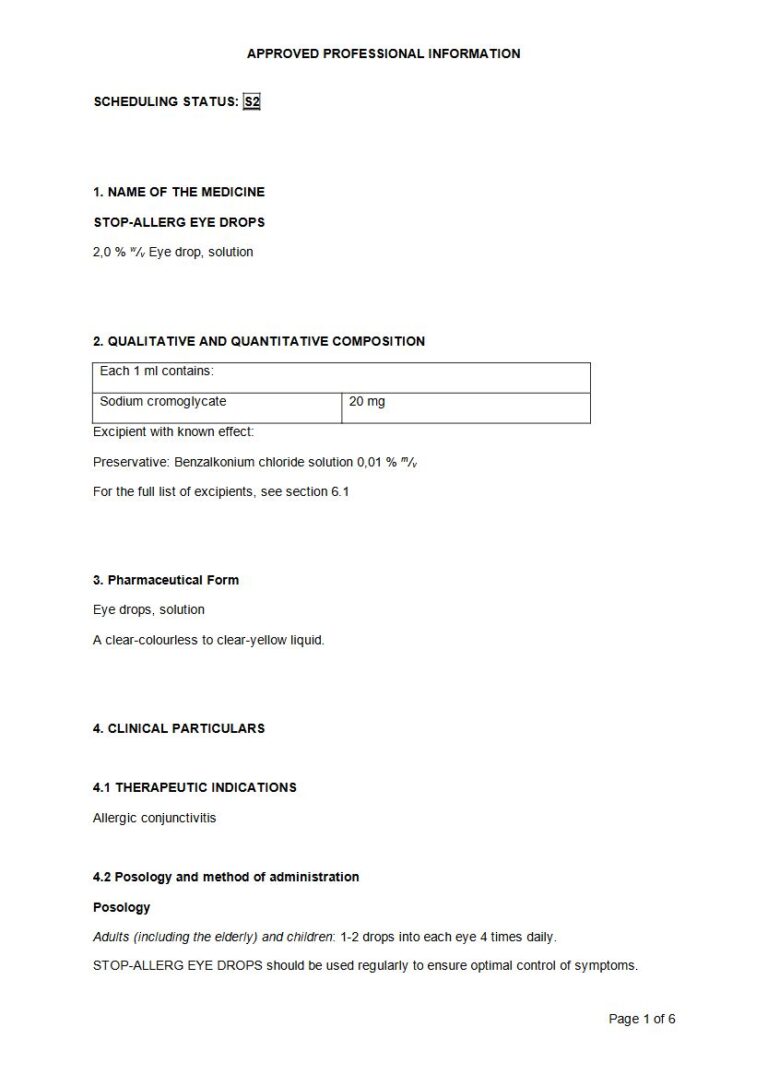
Allergic conjunctivitis
4.2 Posology and method of administration
Posology
Adults (including the elderly) and children: 1-2 drops into each eye 4 times daily. STOP-ALLERG EYE DROPS should be used regularly to ensure optimal control of symptoms.
It is recommended that treatment is continued during the period to the allergen, even when free of symptoms.
Method of administration
For ophthalmic use only
Care should be taken to avoid contamination of the contents during use. Patient should be advised not to wear soft contact lenses during treatment with STOP-ALLERG EYE DROPS.
4.3 CONTRAINDICATIONS
- Known hypersensitivity to sodium cromoglycate or any of the other excipients listed in 6.1.
4.4 SPECIAL WARNINGS AND PRECAUTIONS FOR USE
- Where concomitant steroid and sodium cromoglycate treatment has rendered it possible to reduce the steroid dose, precautions must be taken to prevent a severe attack if/when sodium cromoglycate is withdrawn from the treatment regime.
- Patients should be monitored in case of prolonged use.
- STOP-ALLERG EYE DROPS can be used prophylactically. Patients should seek advice before they discontinue use of STOP-ALLERG EYE DROPS.
- STOP-ALLERG EYE DROPS contains benzalkonium chloride as a preservative.
This medicine contains 0,24 mg benzalkonium chloride 50 % solution in 1 litre which is equivalent to 0,01 % m/v.
As the possibility of adverse effects on the corneal permeability and the danger of disruption of the corneal epithelium with prolong or repeated usage of benzalkonium chloride, preserved ophthalmological preparations cannot be excluded, regular ophthalmological examination is required.
Caution should be exercised in the use of benzalkonium chloride preserved topical medication over an extended period in patients with extensive ocular surface disease.
Benzalkonium chloride may be absorbed by soft contact lenses and may change the colour of the contact lenses. You should remove contact lenses before using this medicine and put them back 15 minutes afterwards.
Benzalkonium chloride may also cause eye irritation, especially if you have dry eyes or disorders of the cornea (the clear layer at the front of the eye). If you feel abnormal eye sensation, stinging or pain in the eye after using this medicine, talk to your doctor.
4.5 Interaction with other medicines and other forms of interaction
None known.
4.6 Fertility, pregnancy and lactation
Fertility: No available data
Pregnancy: STOP-ALLERG EYE DROPS should be used with caution during the first trimester of pregnancy as safety has not been established. Cumulative experience with sodium cromoglycate suggests that it has no adverse effects on foetal development.
Lactation: It is not known whether sodium cromoglycate is excreted in human breast milk but, on the basis of its physiochemical properties, this is considered unlikely. There is no information to suggest the use of sodium cromoglycate and any effects on the baby.
4.7 Effects on ability to drive and use machines
Transient stinging or blurred vision may occur on instillation (see section 4.8). Do not drive or operate machinery until proper vision is restored.
4.8 Undesirable effects
System Organ Class Frequency Undesirable effect
Immune System Disorders Unknown Hypersensitivity reactions (including headache, skin rash, bronchospasm, breathlessness, anaphylaxis).
Eye Disorders Less frequent Local irritation
Unknown Transient burning or stinging and blurring may occur after instillation.
4.9 Overdose
As sodium cromoglycate is absorbed only to a very limited extent from eye drops, no action other than medical observation should be necessary. In the event of accidental ingestion, symptomatic treatment is recommended. If a hypersensitive reaction occurs, withdraw treatment.
