
Bupivacaine Hcl 0,5 % Spinal Fresenius 1 ml Injection.
PDF Leaflet Revision Date: 25 May 2023
Clinical Summary
Quick overview from the medicine insert
Indication
Induction of spinal anaesthesia.
Dosage (summary)
10 to 20 mg (2 to 4 ml) for adults; smaller doses for elderly and debilitated patients.
Onset of Action / Duration
Onset: 15 mins, Duration: up to 8 hours
Special Populations
- Elderly
- Debilitated patients
- Patients with cardiac disease
- Hepatic impairment
Pregnancy & Breastfeeding
Use with caution; may cause fetal bradycardia and is distributed in breast milk.
Key Drug Interactions
- Cimetidine may decrease clearance
- Amiodarone may have additive cardiac effects
Contraindications
- Hypersensitivity to bupivacaine
- Active CNS disease
- Spinal stenosis
- Coagulation disorders
Common side effects
- Hypotension
- Bradycardia
- Nausea
- Dizziness
Counselling Points
- Ensure resuscitation equipment is available
- Monitor for signs of toxicity
- Avoid fast bolus injection
Serious warnings
- Risk of systemic toxicity
- Cardiac arrest may occur
- Increased risk in elderly and late pregnancy
Important Disclaimer
The Bupivacaine Hcl 0,5 % Spinal Fresenius 1 ml Injection. professional information leaflet below is the property of Fresenius Kabi Manufacturing Sa and is provided on Medinsert exactly as issued, with no.. alterations or editorial changes. We make every effort to keep content current by updating documents as soon as new versions become available. Medinsert serves as a trusted access point for healthcare professionals, but does not replace official sources or clinical judgement. For more details, please read our full disclaimer. read more>>
 Healthcare Professionals Only
This content is for registered healthcare professionals
Sign in or create a free account to read the full package insert.
Free for HPCSA-registered professionals. Powered by Medinsert.
Clinical Particulars
Section 4 of the official insert — extracted exactly as issued, no alterations
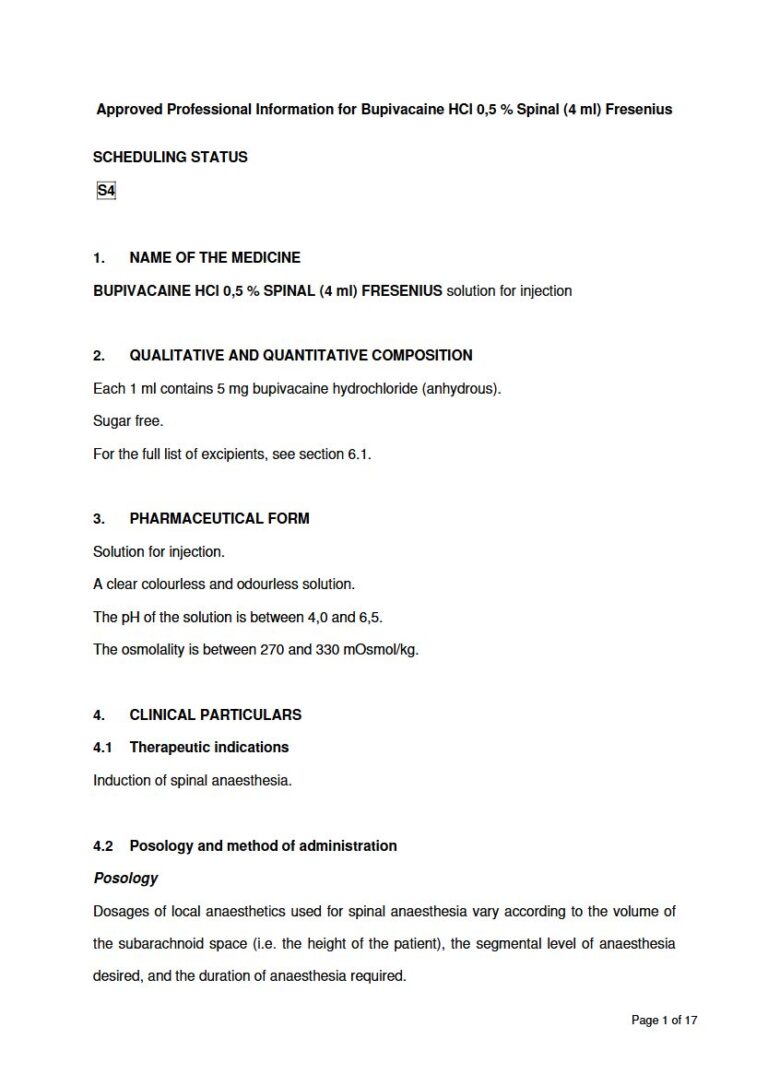
4.1 Therapeutic indications
Induction of spinal anaesthesia.
4.2 Posology and method of administration
Posology
Dosages of local anaesthetics used for spinal anaesthesia vary according to the volume of the subarachnoid space (i.e. the height of the patient), the segmental level of anaesthesia desired, and the duration of anaesthesia required.
BUPIVACAINE HCl 0,5 % SPINAL (4 ml) is given in doses of 10 to 20 mg (2 to 4 ml) for the average adult. The smallest effective dose should be used. Smaller doses are usually needed in the elderly, in children, in debilitated patients, in cardiac disease, and in hepatic disease. Meticulous attention to technique is essential. Special care should be taken to avoid fast bolus injection. The spread of anaesthesia obtained with BUPIVACAINE HCl 0,5 % SPINAL (4 ml) FRESENIUS is dependent upon several factors, the most important being volume of solution injected, and the age and position of the patient. The difference in spread between a 10 mg and 20 mg dose is approximately two segments. The larger dose gives a half to 1 hour longer duration of anaesthesia in the lumbar segments and longer lasting motor blockade. When injected into the sub-arachnoid space via the L3/L4 interspace with the patient in a sitting position, 3 ml of BUPIVACAINE HCl 0,5 % SPINAL (4 ml) FRESENIUS spreads to between the T4 and T5 segments. If the patient is in the supine horizontal position the blockade spreads to between the T5 and T7 segments. Before administration of BUPIVACAINE HCl 0,5 % SPINAL (4 ml) FRESENIUS, make sure that resuscitative equipment, such as equipment to maintain a free airway, oxygenation and circulation, is immediately available.
The effects of spinal administration of a dose of BUPIVACAINE HCl 0,5 % SPINAL (4 ml) FRESENIUS exceeding 20 mg (4 ml) have not yet been studied and such volume can therefore not be recommended.
Method of administration
Intrathecal injection.
4.3 Contraindications
- Hypersensitivity to bupivacaine hydrochloride or to any of the excipients listed in section 6.1.
- Known hypersensitivity to any local anaesthetics of the amide-type.
- BUPIVACAINE HCl 0,5 % SPINAL (4 ml) FRESENIUS is not recommended for use in intravenous regional anaesthesia, or paracervical block in obstetrics.
- Intrathecal anaesthesia, regardless of the local anaesthetic used, has its own contraindications, which include:
- Active disease of the central nervous system such as meningitis, poliomyelitis, intracranial haemorrhage, sub-acute combined degeneration of the cord due to pernicious anaemia and cerebral and spinal tumours.
- Spinal stenosis and active disease (e.g. spondylitis, tuberculosis, tumour) or recent trauma (e.g. fracture) in the vertebral column.
- Septicaemia.
- Pyogenic infection of the skin at or adjacent to the site of lumbar puncture.
- Cardiogenic or hypovolaemic shock.
- Coagulation disorders or ongoing anticoagulation treatment.
4.4 Special warnings and precautions for use
Intrathecal anaesthesia should only be undertaken by doctors with the necessary knowledge and experience. Regional anaesthetic procedures should always be performed in a properly equipped and staffed area. Resuscitation equipment and medication must be available when BUPIVACAINE HCl 0,5 % SPINAL (4 ml) FRESENIUS is used, and the anaesthetist should remain in constant attendance. Intravenous access, e.g. an i.v. infusion, should be in place before starting the intrathecal anaesthesia. The doctor responsible should take the necessary precautions to avoid intravascular injection and be appropriately trained and familiar with the diagnosis and treatment of side effects, systemic toxicity and other complications. If signs of acute systemic toxicity or total spinal block appear, injection of the local anaesthetic should be stopped immediately (see section 4.8).
Like all local anaesthetic medicines, BUPIVACAINE HCl 0,5 % SPINAL (4 ml) FRESENIUS may cause acute toxicity effects on the central nervous and cardiovascular systems, if utilised for local anaesthetic procedures resulting in high blood concentrations of the medicine. This is especially the case after unintentional intravascular administration or injection into highly vascular areas. The inadvertent intravenous injection or filtration of BUPIVACAINE HCl 0,5 % SPINAL (4 ml) FRESENIUS may cause cardiac arrest and convulsions. Ventricular arrhythmia, ventricular fibrillation, sudden cardiovascular collapse and death have been reported in connection with high systemic concentrations of BUPIVACAINE HCl 0,5 % SPINAL (4 ml) FRESENIUS. Should cardiac arrest occur, a successful outcome may require prolonged resuscitative efforts. High systemic concentrations are not expected with doses normally used for intrathecal anaesthesia. Cardiac arrest due to BUPIVACAINE HCl 0,5 % SPINAL (4 ml) FRESENIUS can be resistant to electrical defibrillation and a successful outcome may require prolonged resuscitative efforts.
There is an increased risk of high or total spinal blockade, resulting in cardiovascular and respiratory depression, in the elderly and in patients in the late stages of pregnancy. The dose should therefore be reduced in these patients. BUPIVACAINE HCl 0,5 % SPINAL (4 ml) FRESENIUS should be given cautiously to the elderly, the debilitated, and to patients with epilepsy, impaired cardiac conduction, shock or with liver damage; patients with myasthenia gravis are particularly susceptible to the effects of local anaesthetics. The central nervous system and cardiac toxicity of BUPIVACAINE HCl 0,5 % SPINAL (4 ml) FRESENIUS can be enhanced by hypoxia and acidosis. The use of local anaesthetics during pregnancy in the presence of fetal hypoxia or acidosis may be dangerous (see section 4.6).
Intrathecal anaesthesia can cause hypotension and bradycardia. The risk of such effects can be reduced, e.g. by injecting a vasopressor. If hypotension develops it should be treated promptly with a sympathomimetic intravenously, repeated as necessary. Severe hypotension may result from hypovolaemia due to haemorrhage or dehydration, or aorto-caval occlusion in patients with massive ascites, large abdominal tumours or late pregnancy. Marked hypotension should be avoided in patients with cardiac decompensation.
Patients with hypovolaemia due to any cause can develop sudden and severe hypotension during intrathecal anaesthesia. Intrathecal anaesthesia can cause intercostal paralysis and patients with pleural effusions may suffer respiratory embarrassment. Septicaemia can increase the risk of intraspinal abscess formation in the postoperative period. Neurological injury is a less frequent consequence of intrathecal anaesthesia and may result in paraesthesia, anaesthesia, motor weakness and paralysis. Occasionally these are permanent. Patients in poor general condition due to ageing or other compromising factors such as partial or complete heart conduction block, advanced liver or renal dysfunction require special attention, although regional anaesthesia may be the optimal choice for surgery in these patients. Spinal anaesthetics should be used with caution in patients with impaired cardiovascular function such as severe disturbances of cardiac rhythm, shock, heart block or congestive heart failure. Careful and constant monitoring of cardiovascular and respiratory (adequacy of ventilation) vital signs and the patient's state of consciousness is advised. Convulsions and cardiovascular collapse, that may be dose-related, may result from diminished tolerance and/or rapid absorption from the injection site. Cranial nerve lesions have also occurred after spinal anaesthesia. Reversible loss of hearing in the low frequency range, usually affecting both ears, has been reported following spinal anaesthesia.
Patients treated with antidysrhythmic medicines class III (e.g. amiodarone) should be kept under close surveillance and ECG monitoring considered, since cardiac effects may be additive (see section 4.5). BUPIVACAINE HCl 0,5 % SPINAL (4 ml) FRESENIUS contains sodium BUPIVACAINE HCl 0,5 % SPINAL (4 ml) FRESENIUS contains 3,15 mg sodium per ml, equivalent to 0,16 % of the WHO recommended maximum daily intake of 2 g sodium for an adult. Paediatric population BUPIVACAINE HCl 0,5 % SPINAL (4 ml) FRESENIUS should be given cautiously to children.
4.5 Interaction with other medicines and other forms of interaction
Pre-treatment with Histamin H2-receptor antagonists like cimetidine, can decrease the clearance of BUPIVACAINE HCl 0,5 % SPINAL (4 ml) FRESENIUS or has no significant pharmacokinetic effects. Similarly, pre-treatment with ranitidine can either increase plasma concentrations of bupivacaine or has no significant effect. BUPIVACAINE HCl 0,5 % SPINAL (4 ml) FRESENIUS should be used with caution in patients receiving other local anaesthetics such as lidocaine (lignocaine), or medicines structurally related to amide-type local anaesthetics e.g. certain antidysrhythmics such as mexiletine, since systemic toxic effects are additive. Specific interaction studies with BUPIVACAINE HCl 0,5 % SPINAL (4 ml) FRESENIUS and antidysrhythmic medicines class III (e.g. amiodarone) have not been performed, but caution is advised (see section 4.4).
4.6 Fertility, pregnancy and lactation
Pregnancy
Fetal intoxication can occur following the use of BUPIVACAINE HCl 0,5 % SPINAL (4 ml) FRESENIUS in labour, either as a result of the transplacental diffusion or after accidental injection of the fetus. Using BUPIVACAINE HCl 0,5 % SPINAL (4 ml) FRESENIUS to produce paracervical block during labour, especially continuous block, is not recommended as serious fetal bradycardia may be produced. The use of local anaesthetics during pregnancy in the presence of fetal hypoxia or acidosis may be dangerous.
Breastfeeding
BUPIVACAINE HCl 0,5 % SPINAL (4 ml) FRESENIUS is distributed into breast milk.
4.7 Effects on ability to drive and use machines
BUPIVACAINE HCl 0,5 % SPINAL (4 ml) FRESENIUS has minor influence on the ability to drive and use machines. Besides the direct anaesthetic effect, local anaesthetics may have a very mild effect on mental function and co-ordination even in the absence of overt CNS toxicity and may temporarily impair locomotion and alertness.
4.8 Undesirable effects
a) Summary of the safety profile
Hypersensitivity reactions to BUPIVACAINE HCl 0,5 % SPINAL (4 ml) FRESENIUS occur less frequently. The systemic toxicity mainly involves the central nervous system and the cardiovascular system. Excitation of the central nervous system may be manifested by restlessness, excitement, nervousness, light-headedness, dizziness, blurred vision, nausea and vomiting, vertigo, muscle twitching and tremors, and convulsions. Numbness of the tongue and perioral region may appear as an early sign of systemic toxicity. Excitation might be transient and followed by depression, drowsiness, respiratory failure and coma. There may be simultaneous effects on the cardiovascular system with myocardial depression and peripheral vasodilatation resulting in hypotension and bradycardia; arrhythmia and cardiac arrest may occur. Hypotension often accompanies spinal anaesthesia. The adverse reaction profile for BUPIVACAINE HCl 0,5 % SPINAL (4 ml) FRESENIUS is similar to those for other long acting local anaesthetics used for intrathecal anaesthesia. Adverse reactions caused by the medicine per se are difficult to distinguish from the physiological effects of the nerve block (e.g., decrease in blood pressure, bradycardia, temporary urinary retention), events caused directly (e.g. spinal haematoma) or indirectly (e.g. meningitis, epidural abscess) by needle puncture or events associated to cerebrospinal leakage (e.g. post-dural puncture headache).
b) Tabulated list of adverse reactions
System organ class Frequent Less frequent Frequency unknown (cannot be estimated from the available data) Infections and infestations Septic meningitis Immune system disorders Hypersensitivity reactions Anaphylactic shock Nervous system disorders Post-dural puncture headache Paraesthesia Paresis Dysaesthesia High or total unintentional spinal block Paraplegia Paralysis Neuropathy Arachnoiditis Convulsions Restlessness Excitement Nervousness Light-headedness Dizziness CNS depression Drowsiness Coma Headache Cranial nerve lesions Persistent anaesthesia Meningismus Cranial nerve palsies Trauma or compression of the spinal cord Haematoma of the spinal cord Abscess of the spinal cord Cauda equina syndrome Eye disorders Blurred vision Photophobia Ear and labyrinth disorders Vertigo Tinnitus Reversible hearing loss Cardiac disorders Hypotension Bradycardia Cardiovascular arrest Cardiovascular collapse Myocardial depression Decreased cardiac output Arrhythmia Vascular disorders Peripheral vasodilatation Venodilatation Reduced venous return Respiratory, thoracic and mediastinal disorders Respiratory depression Respiratory failure Gastrointestinal disorders Nausea Vomiting Numbness of the tongue Numbness of the perioral region Loss of sphincter control Faecal incontinence Musculoskeletal and connective tissue disorders Muscle weakness Back pain Muscle twitching Tremors Renal and urinary disorders Urinary retention Urinary incontinence Pregnancy, puerperium and perinatal conditions Fetal intoxication Fetal bradycardia Slowing of labour Increased incidence of forceps delivery Reproductive system and breast disorders Loss of perineal sensation Loss of sexual function General disorders and administrative site conditions Shivering
c) Description of selected adverse reactions
Acute systemic toxicity Bupivacaine HCl 0,5 % Spinal (4 ml) Fresenius, used as recommended, is not likely to cause blood levels high enough to cause systemic toxicity. However, if other local anaesthetics are concomitantly administered, toxic effects are additive and may cause systemic toxic reactions. Systemic toxicity is rarely associated with spinal anaesthesia but might occur after accidental intravascular injection. Systemic adverse reactions are characterised by numbness of the tongue, light-headedness, dizziness and tremors, followed by convulsions and cardiovascular disorders.
Treatment of acute systemic toxicity No treatment is required for milder symptoms of systemic toxicity but if convulsions occur then it is important to ensure adequate oxygenation and to arrest the convulsions if they last more than 15 u2013 30 seconds. Oxygen should be given by face mask and the respiration assisted or controlled if necessary. Convulsions can be arrested by injection of thiopental 100 mg to 150 mg intravenously or with diazepam 5 mg to 10 mg intravenously. Alternatively, succinylcholine 50 mg to 100 mg intravenously may be given but only if the doctor has the ability to perform endotracheal intubation and to manage a totally paralysed patient. High or total spinal blockade causing respiratory paralysis should be treated by ensuring and maintaining a patent airway and giving oxygen by assisted or controlled ventilation. Hypotension should be treated by the use of vasopressors, e.g. ephedrine 10 mg to 15 mg intravenously and repeated until the desired level of arterial pressure is reached. Intravenous fluids, both electrolytes and colloids, given rapidly can also reverse hypotension.
d) Paediatric population
Adverse drug reactions in children are similar to those in adults, however, in children, early signs of local anaesthetic toxicity may be difficult to detect in cases where the block is given during sedation or general anaesthesia.
Reporting of suspected adverse reactions Health care providers are asked to report any suspected adverse drug reactions to the Holder of the Certificate of Registration at the following email address: [email protected] and to the relevant medicineu2019s regulatory authority in the country where the product is marketed. Reporting suspected adverse reactions after authorisation of BUPIVACAINE HCl 0,5 % SPINAL (4 ml) FRESENIUS is important. It allows continued monitoring of the benefit/risk balance of BUPIVACAINE HCl 0,5 % SPINAL (4 ml) FRESENIUS. Health care providers are asked to report any suspected adverse reactions via the Adverse Drug Reaction Reporting Form, found online under SAHPRAu2019s publications: https://www.sahpra.org.za/Publications/Index/8.
4.9 Overdose
Numbness of the tongue and perioral region is an early sign of toxicity. Serious fetal bradycardia may occur. Overdosage should be treated symptomatically and supportive. When systemic reactions to local anaesthetics occur steps should be taken to maintain the circulation and respiration and to control convulsions. A patent airway must be established, and oxygen given, together with assisted ventilation if necessary. The circulation should be maintained with infusions of intravenous fluids. Cardiac arrest due to BUPIVACAINE HCl 0,5 % SPINAL (4 ml) FRESENIUS can be resistant to electrical defibrillation and a successful outcome may require prolonged resuscitative efforts. Resuscitation equipment and medication should always be at hand for emergencies. See also section 4.8 u201cAcute systemic toxicityu201d and u201cTreatment of acute systemic toxicityu201d.
