
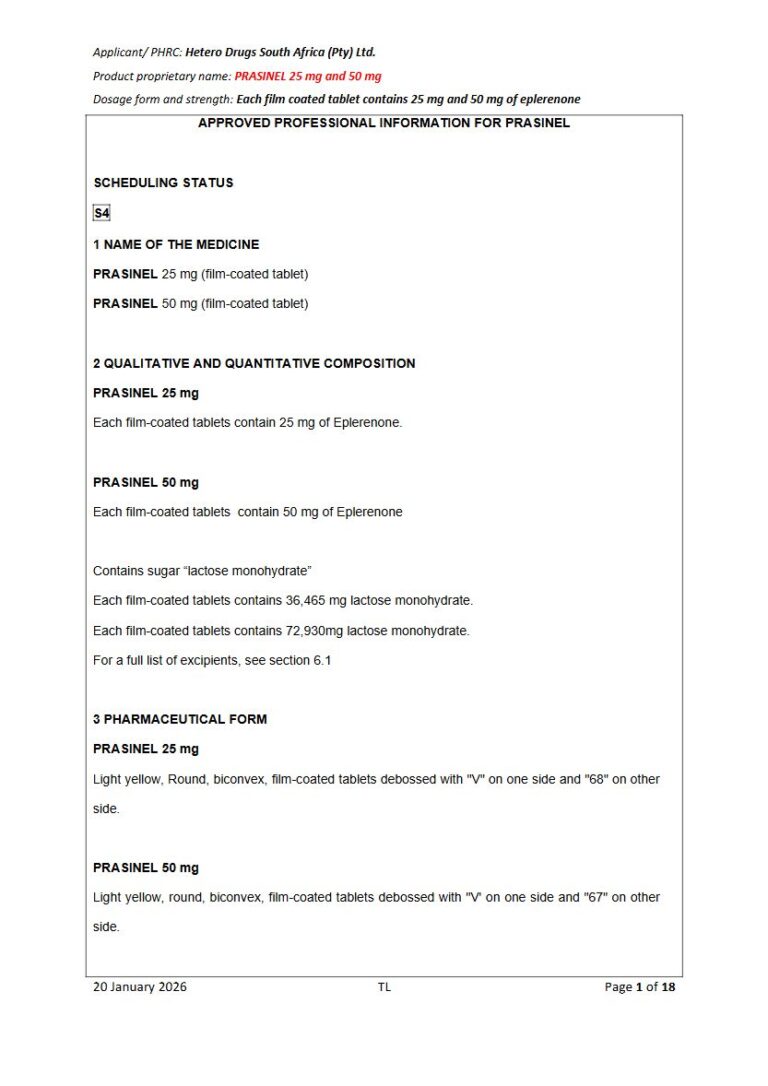
Prasinel 25 Mg/50 Mg Film-Coated Tablets
PDF Leaflet Revision Date: 20 January 2026
Clinical Summary
Quick overview from the medicine insert
Indication
Reduces risk of cardiovascular death in patients with left ventricular dysfunction post-myocardial infarction.
Dosage (summary)
Start at 25 mg once daily, titrate to 50 mg once daily as tolerated.
Special Populations
- Elderly
- Renal impairment
- Hepatic impairment
Pregnancy & Breastfeeding
Caution in pregnancy; not recommended during lactation.
Key Drug Interactions
- Potassium-sparing diuretics
- Strong CYP3A4 inhibitors
- ACE inhibitors
- ARBs
Contraindications
- Hypersensitivity to eplerenone
- Serum potassium > 5.0 mmol/L
- Severe renal insufficiency
- Severe hepatic insufficiency
- Concomitant use with potassium-sparing diuretics
Common side effects
- Hyperkalaemia
- Dizziness
- Insomnia
- Hypotension
- Diarrhoea
Counselling Points
- Monitor potassium levels
- Take with or without food
- Report any signs of hypotension or dizziness
Serious warnings
- Risk of hyperkalaemia
- Monitor renal function
- Avoid in severe hepatic impairment
Important Disclaimer
The Prasinel 25 Mg/50 Mg Film-Coated Tablets professional information leaflet below is the property of Hetero Drugs South Africa and is provided on Medinsert exactly as issued, with no.. alterations or editorial changes. We make every effort to keep content current by updating documents as soon as new versions become available. Medinsert serves as a trusted access point for healthcare professionals, but does not replace official sources or clinical judgement. For more details, please read our full disclaimer. read more>>
 Healthcare Professionals Only
This content is for registered healthcare professionals
Sign in or create a free account to read the full package insert.
Free for HPCSA-registered professionals. Powered by Medinsert.
Clinical Particulars
Section 4 of the official insert — extracted exactly as issued, no alterations
4.1 Therapeutic indications
PRASINEL is indicated to reduce the risk of cardiovascular death in stable patients with left ventricular dysfunction (ejection fraction u2264 40 %) and clinical evidence of heart failure after an acute myocardial infarction.
4.2 Posology and method of administration
Posology
PRASINEL is usually administered in combination with Standard therapies. The recommended dose in of [PRODUCTNAME] is 50 mg once daily. Treatment should be initiated at 25 mg once daily and titrated to the target dose of 50 mg once daily preferably within 4 weeks as tolerated by the patient taking into account the serum potassium level (see Table 1). After initiation, the dose should be adjusted based on the serum potassium level as shown in Table 1.
Table 1. Dose adjustment table in heart failure u2013 post MI
Serum potassium (mmol/L or mEq/L) Action Dose adjustment
< 5,0 Increase 25 mg EOD to 25 mg OD 25 mg OD to 50 mg OD
5,0 u2013 5,4 No dose adjustment
5,5 u2013 5,9 Decrease 50 mg OD to 25 mg OD 25 mg OD to 25 mg EOD 25 mg EOD to withhold
u2265 6,0 Withhold N/A
EOD (every other day), OD (once daily)
Following withholding PRASINEL due to serum potassium u2265 6,0 mmol/L (or > 6,0 mEq/L), PRASINEL can be re-started at a dose of 25 mg every other day when potassium levels have fallen below 5,0 mmol/L (or 5,0 mEq/L).
Special populations
Elderly
No dose adjustment is required in the elderly.
Renal impairment
No initial dose adjustment is required in patients with mild renal impairment (see section 4.4)
Hepatic impairment
No initial dosage adjustment is necessary for patients with mild to moderate hepatic impairment
Paediatric Population
There are insufficient data to recommend the use of PRASINEL in the paediatric population, and therefore, use in this age group is not recommended
Method of Administration
For oral use. [PRODUCTNAME] may be administered with or without food.
4.3 Contraindications
- Hypersensitivity to eplerenone or to any of the excipients listed in section 6.1
- Patients with serum potassium level > 5.0 mmol/L at initiation
- Patients with severe renal insufficiency (eGFR <30 mL per minute per 1.73 m2)
- Patients with severe hepatic insufficiency (Child-Pugh Class C)
- Patients receiving potassium-sparing diuretics or strong inhibitors of CYP 3A4 (e.g., itraconazole, ketoconazole, ritonavir, nelfinavir, clarithromycin, telithromycin and nefazodone) (see section 4.5)
- The combination of an angiotensin converting enzyme (ACE) inhibitor and an angiotensin receptor blocker (ARB) with eplerenone
4.4 Special warnings and precautions for use
Hyperkalaemia
Hyperkalaemia may occur with PLERINTRA. Serum potassium levels should be monitored in all patients at initiation of treatment and with a change in dosage. Thereafter periodic monitoring is recommended in patients at risk for the development of hyperkalaemia. Dose reduction of PRASINEL has been shown to decrease serum potassium level. In one study, the addition of hydrochlorothiazide to PRASINEL therapy has been shown to offset increases in serum potassium. The risk of hyperkalaemia may increase when PRASINEL is used in combination with an angiotensin converting enzyme (ACE) inhibitor and/or an angiotensin receptor blocker (ARB).
Impaired renal function: Potassium levels should be monitored regularly in patients with impaired renal function, including diabetic microalbuminuria. Patients who have serum creatinine levels > 221 u03bcmol/L (> 2,5 mg/dL) or creatinine clearance < 50 ml/min should be treated with caution. While the data from EPHESUS in patients with type 2 diabetes and microalbuminuria is limited, an increased occurrence of hyperkalaemia was observed in this small number of patients. Therefore, these patients should be treated with caution.
Impaired hepatic function: No elevations of serum potassium above 5,5 mmol/L were observed in patients with mild to moderate hepatic impairment. Electrolyte levels should be monitored in patients with mild to moderate hepatic impairment. The use of PRASINEL in patients with severe hepatic impairment (Child-Pugh Class C) has not been evaluated and therefore contraindicated (see section 4.3).
Non-steroidal anti-inflammatory drugs (NSAIDs): The administration of other potassium-sparing medicine with NSAIDs has been shown to result in hyperkalaemia in patients with impaired renal function (see section 4.5).
CYP3A4 inducers: Co-administration of eplerenone with strong CYP3A4 inducers is not recommended (see section 4.5).
Lithium, cyclosporin, tacrolimus: Lithium toxicity has been reported in patients receiving lithium concomitantly with diuretics and ACE inhibitors. Serum lithium levels should be monitored frequently if PRASINEL is administered concomitantly with lithium (see section 4.5).
Elderly: Due to age-related decline in renal function, the risk of hyperkalaemia is increased in elderly patients. Periodic monitoring of serum potassium is recommended.
Lactose: The tablets contain lactose and should not be administered in patients with rare hereditary problems of galactose intolerance, the total lactase deficiency or glucose-galactose malabsorption.
Sodium: This medicine contains less than 1 mmol sodium (23 mg) per tablet, that is to say essentially 'sodium-free'.
4.5 Interaction with other medicines and other forms of interaction
Pharmacodynamic interactions
Potassium-sparing diuretics and potassium supplements
PRASINEL should not be administered to patients receiving other potassium-sparing diuretics (see section 4.3). Potassium-sparing diuretics may also potentiate the effect of anti-hypertensive medicine and other diuretics.
ACE inhibitors, ARBs
The risk of hyperkalaemia may increase when eplerenone is used in combination with an ACE inhibitor and/or an ARB. A close monitoring of serum potassium and renal function is recommended, especially in patients at risk for impaired renal function, e.g., the elderly. The triple combination of an ACE inhibitor and an ARB with eplerenone should not be used (see sections 4.3 and 4.4).
Lithium
Drug interaction studies of PRASINEL have not been conducted with lithium. Lithium toxicity has been reported in patients receiving lithium concomitantly with diuretics and ACE inhibitors (see section 4.4).
Cyclosporin, tacrolimus
Cyclosporin and tacrolimus may lead to impaired renal function and increase the risk of hyperkalaemia. The concomitant use of eplerenone and cyclosporin or tacrolimus should be avoided. If needed, close monitoring of serum potassium and renal function are recommended when cyclosporine and tacrolimus are to be administered during treatment with eplerenone (see section 4.4).
Non-steroidal anti-inflammatory drugs (NSAIDs)
Acute renal failure may occur in at risk patients (elderly, dehydrated subjects, using diuretics, with impaired renal function) due to decreased glomerular filtration (inhibition of vasodilatory prostaglandins due to non-steroidal anti-inflammatory drugs). These effects are generally reversible. Furthermore, there may be a reduction of the antihypertensive effect. Hydrate the patient and monitor renal function at the beginning of treatment and regularly during the combination (see sections 4.2 and 4.4).
Trimethoprim
The concomitant administration of trimethoprim with eplerenone increases the risk of hyperkalaemia. Monitoring of serum potassium and renal function should be made, particularly in patients with renal impairment and in the elderly.
Alpha1-blockers (e.g. prazosin, alfuzosine)
When alpha1-blockers are combined with eplerenone, there is the potential for increased hypotensive effect and/or postural hypotension. Clinical monitoring for postural hypotension is recommended during alpha1-blocker co-administration.
Tricyclic anti-depressants, neuroleptics, amifostine, baclofen
Co-administration of these medicines with eplerenone may potentially increase antihypertensive effects and risk of postural hypotension.
Glucocorticoids, tetracosactide
Co-administration of these medicines with eplerenone may potentially decrease antihypertensive effects (sodium and fluid retention).
Pharmacokinetic interactions
In vitro studies indicate that eplerenone is not an inhibitor of CYP1A2, CYP2C19, CYP2C9, CYP2D6 or CYP3A4 isozymes. Eplerenone is not a substrate or an inhibitor of P-Glycoprotein.
Digoxin
Systemic exposure (AUC) to digoxin increases by 16% (90% CI: 4 u2013 30%) when co-administered with eplerenone. Caution is warranted when digoxin is dosed near the upper limit of therapeutic range.
Warfarin
No clinically significant pharmacokinetic interactions have been observed with warfarin. Caution is warranted when warfarin is dosed near the upper limit of therapeutic range.
CYP3A4 substrates
Results of pharmacokinetic studies with CYP3A4 probe-substrates, i.e. midazolam and cisapride, showed no significant pharmacokinetic interactions when these medicines were co-administered with eplerenone.
CYP3A4 inhibitors
u2022 Strong CYP3A4 inhibitors: Significant pharmacokinetic interactions may occur when eplerenone is co-administered with medicines that inhibit the CYP3A4 enzyme. A strong inhibitor of CYP3A4 (ketoconazole 200 mg BID) led to a 441% increase in AUC of eplerenone (see section 4.3). The concomitant use of eplerenone with strong CYP3A4 inhibitors such as ketoconazole, itraconazole, ritonavir, nelfinavir, clarithromycin, telithromycin and nefazadone, is contraindicated (see section 4.3).
u2022 Mild to moderate CYP3A4 inhibitors: Co-administration with erythromycin, saquinavir, amiodarone, diltiazem, verapamil or fluconazole has led to significant pharmacokinetic interactions with rank order increases in AUC ranging from 98% to 187%. Eplerenone dosing should therefore not exceed 25 mg daily when mild to moderate inhibitors of CYP3A4 are co-administered with eplerenone (see section 4.2).
CYP3A4 inducers
Co-administration of St. Johnu2019s Wort (a strong CYP3A4 inducer) with eplerenone caused a 30 % decrease in eplerenone AUC. A more pronounced decrease in eplerenone AUC may occur with stronger CYP3A4 inducers such as rifampicin. Due to the risk of decreased eplerenone efficacy, the concomitant use of strong CYP3A4 inducers (rifampicin, carbamazepine, phenytoin, phenobarbital, St. Johnu2019s Wort) with eplerenone is not recommended (see section 4.4).
Antacids
Based on the results of a pharmacokinetic clinical study, no significant interaction is expected when antacids are co-administered with eplerenone.
4.6 Fertility, pregnancy and lactation
Pregnancy
There are no adequate data on use of PRASINEL in pregnant women. Animal studies did not indicate direct or indirect adverse effects with respect to pregnancy, embryofoetal development, parturition and postnatal development. Caution should be exercised prescribing eplerenone to pregnant women.
Breastfeeding:
It is unknown if PRASINEL is excreted in human breast milk after oral administration. however, preclinical data show that eplerenone and/or metabolites are present in rat breast milk and that rat pups exposed by this route developed normally. PRASINEL should not be used during lactation.
Fertility
There are no human data available on fertility.
4.7 Effects on ability to drive and use machines
No studies on the effect of PRASINEL on the ability to drive or use machines have been performed. PRASINEL does not cause drowsiness or impairment of cognitive function but when driving vehicles or operating machines, it should be taken into account that dizziness may occur during treatment.
4.8 Undesirable effects
a) Summary of the safety profiles
PRASINEL has been evaluated for safety in 3 307 patients treated for heart failure post-myocardial infarction (see section 5.1), In the PRASINEL post-acute myocardial infarction heart failure efficacy and survival study (EPHESUS), the overall incidence of adverse events reported with eplerenone (78,9 %) was similar to placebo (79,5 %). The discontinuation rate due to adverse events in these studies was 4;4 % for patients receiving eplerenone and for 4,3 % patients receiving placebo. Adverse events reported below are those with suspected relationship to treatment and in excess of placebo, taken from EPHESUS. Adverse events are listed by body system and absolute frequency.
MedDRA system organ class Adverse reaction
Infections and infestations
Less frequent: Pyelonephritis, infection, pharyngitis
Blood and lymphatic system disorders
Less frequent: Eosinophilia
Endocrine disorders
Less frequent: Hypothyroidism
Metabolism and nutrition disorders
Frequent: Hyperkalaemia (see sections 4.3 and 4.4), hypercholesterolaemia
Less frequent: Hyponatraemia, dehydration, hypertriglyceridaemia
Psychiatric disorders
Frequent: Insomnia
Nervous system disorders
Frequent: Dizziness, syncope, headache
Less frequent: Hypoaesthesia
Cardiac disorders
Frequent: Left ventricular failure, atrial fibrillation
Less frequent: Tachycardia
Vascular disorders
Frequent: Hypotension
Less frequent: Arterial thrombosis limb, orthostatic hypotension
Respiratory, thoracic and mediastinal disorders
Frequent: Cough
Gastrointestinal disorders
Frequent: Diarrhoea, nausea, constipation, vomiting
Less frequent: Flatulence
Skin and subcutaneous tissue disorders
Frequent: Rash, pruritus
Less frequent: Hyperhidrosis, angioedema
Musculoskeletal and connective tissue disorders
Frequent: Muscle spasms, back pain
Less frequent: Musculoskeletal pain
Renal and urinary disorders
Frequent: Renal impairment (see sections 4.4 and 4.5)
Hepatobiliary disorders
Less frequent: Cholecystitis
Reproductive system and breast disorders
Less frequent: Gynaecomastia
General disorders and administration site conditions
Frequent: Asthenia
Less frequent: Malaise
Investigations
Frequent: Blood urea increased, blood creatinine increased
Less frequent: Epidermal growth factor receptor decreased, blood glucose increased
In EPHESUS, there were numerically more cases of stroke in the very elderly group (u2265 75 years old). There was however no statistically significant difference between the occurrence of stroke in the eplerenone (30) vs. placebo (22) groups. In EMPHASIS-HF, the number of cases of stroke in the very elderly (u2265 75 years old) was 9 in the eplerenone group and 8 in the placebo group.
4.9 Overdose
No cases of human of overdosage with PRASINEL have been reported. The most likely manifestation of human overdosage would be anticipated to be hypotension hyperkalaemia. PRASINEL cannot be removed by haemodialysis. PRASINEL has been shown to bind extensively to charcoal. If symptomatic hypotension should occur supportive treatment should be initiated. If hyperkalaemia develops, standard treatment should be initiated.
