
Solphyllin 15 ml SYRUP
PDF Leaflet Revision Date: 2 May 1988
Clinical Summary
Quick overview from the medicine insert
Indication
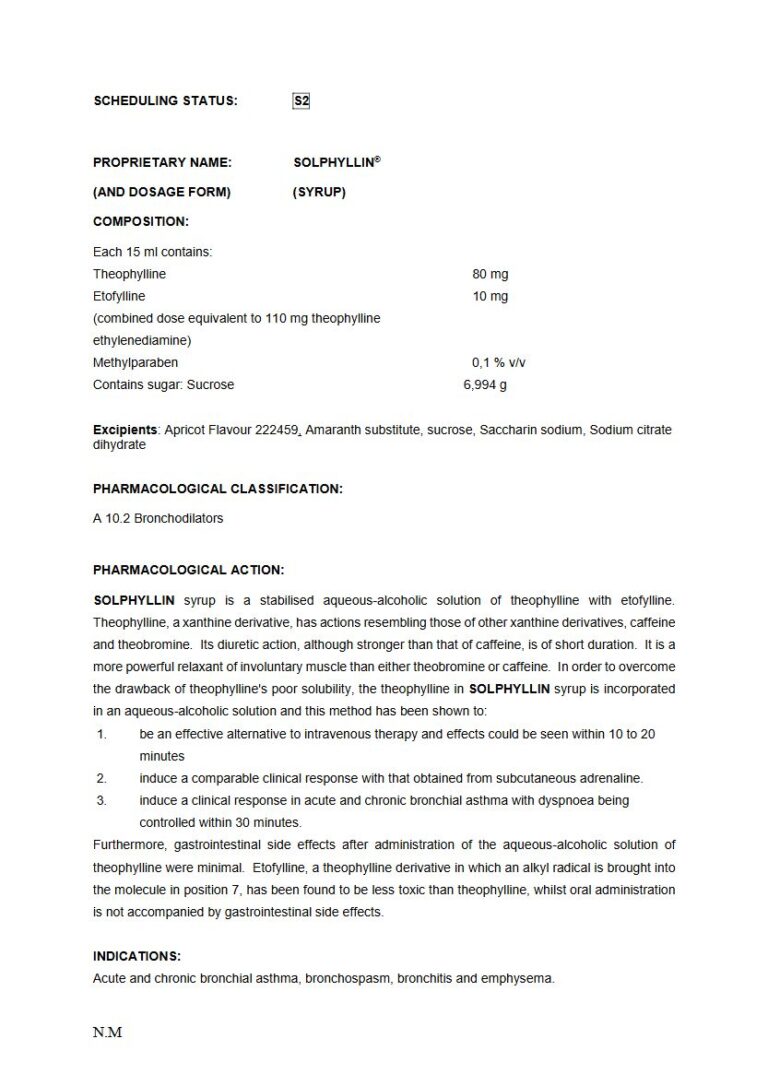
Acute and chronic bronchial asthma, bronchospasm, bronchitis, and emphysema.
Dosage (summary)
Adults: 15-30 ml three times daily; Acute: 60-75 ml at onset. Children: 15 ml three times daily; Acute: 30 ml at onset.
Onset of Action / Duration
Onset: 10-20 mins, Duration: 6-8 hours
Special Populations
- Elderly
- Cardiac disease
- Liver disease
Pregnancy & Breastfeeding
Contraindicated in nursing mothers.
Key Drug Interactions
- Sympathomimetics
- Other xanthines
Contraindications
- Diabetes
- Alcoholism
- Nursing mothers
Common side effects
- Nausea
- Vomiting
- Gastric irritation
- CNS stimulation
- Insomnia
Counselling Points
- Take after meals.
- Monitor for CNS stimulation.
- Store below 25 u00baC.
Serious warnings
- Caution in children; overdosage can be dangerous.
- Caution in elderly and patients with peptic ulceration.
Important Disclaimer
The Solphyllin 15 ml SYRUP professional information leaflet below is the property of Adcock Ingram and is provided on Medinsert exactly as issued, with no.. alterations or editorial changes. We make every effort to keep content current by updating documents as soon as new versions become available. Medinsert serves as a trusted access point for healthcare professionals, but does not replace official sources or clinical judgement. For more details, please read our full disclaimer. read more>>
 Healthcare Professionals Only
This content is for registered healthcare professionals
Sign in or create a free account to read the full package insert.
Free for HPCSA-registered professionals. Powered by Medinsert.
Clinical Particulars
Section 4 of the official insert — extracted exactly as issued, no alterations
4.1 Therapeutic indications
Acute and chronic bronchial asthma, bronchospasm, bronchitis and emphysema.
4.2 Posology and method of administration
Maintenance:
Adults: Three to six medicine measurefuls (15 ml to 30 ml) three times daily after meals.
Children older than 2 years: Three medicine measurefuls (15 ml) three times daily after meals.
Acute attacks:
Adults: Twelve to fifteen medicine measurefuls (60 ml to 75 ml) at onset of attack.
Children older than 2 years: Six medicine measurefuls (30 ml) at onset of attack.
The dose should be reduced if central nervous system stimulation is manifested by irritability, restlessness and insomnia.
4.3 Contraindications
SOLPHYLLIN syrup is contraindicated in diabetes and in alcoholism (rehabilitated alcoholics), and in nursing mothers.
4.4 Special warnings and precautions for use
Children are particularly susceptible to the effects of theophylline and therefore SOLPHYLLIN syrup should not be administered more frequently than every eight hours. Overdosage in children can be dangerous, as absorption is unpredictable. It may be characterised by haematemesis, stimulation of the central nervous system and diuresis. SOLPHYLLIN syrup should be administered with caution to elderly patients and those suffering from cardiac disease and liver disease. Care should be taken in patients with a history of peptic ulceration.
4.5 Interactions with other medicines
The bronchodilator and toxic effects of theophylline may be enhanced by sympathomimetics and by administration with other xanthines. Smokers may require increased dosage as may patients undergoing routine haemodialysis.
4.6 Fertility, pregnancy and lactation
Not provided in the text.
4.7 Effects on ability to drive and use machines
Not provided in the text.
4.8 Undesirable effects
The most common side effects encountered with SOLPHYLLIN syrup are gastric irritation with nausea and vomiting, gastrointestinal bleeding and central nervous system stimulation. Other side effects are visual disorders, insomnia, headache, anxiety, confusion, restlessness, hyperventilation, vertigo and palpitations. Idiosyncrasy may lead to maniacal behaviour, repeated vomiting with extreme thirst, delirium, hyperthermia and convulsions.
4.9 Overdose
See u2018SIDE-EFFECTS AND SPECIAL PRECAUTIONSu2019. Emergency treatment may be started immediately. Treatment is symptomatic and supportive.
